
Transferability & Owner Dependency
What Is a Value Advisor? A Guide to Growing Your Business’s Enterprise Value
What if the very dedication that forged your company’s success has become the invisible ceiling on its ultimate worth? For many owners, the business is a living testament to their personal history, yet it remains tethered to their daily presence, unable to breathe on its own. You likely feel the weight of this dependency and the frustration of receiving fragmented counsel from siloed professionals. Understanding what is a value advisor is the first step in moving beyond mere profitability toward true enterprise excellence. A value advisor serves as a strategic architect, harmonizing the technical precision of your operations with the long-term vision of a legacy that endures.
It's a common burden for the modern steward to find their enterprise's heartbeat is indistinguishable from their own. We understand that your goal is not just to grow, but to preserve the essence of what you've built while ensuring it can stand alone as a masterpiece of engineering. This article will clarify how a value advisor transforms your business from a founder-dependent company into a high-value, transferable asset. We'll provide a clear roadmap to closing the value gap, aligning your personal financial goals with a sophisticated plan for enterprise growth.
Key Takeaways
- Discover what is a value advisor and how they act as a strategic architect to engineer transferability and long-term enterprise growth.
- Learn to apply the Value Acceleration Methodology to align your personal wealth goals with the inner essence of your business.
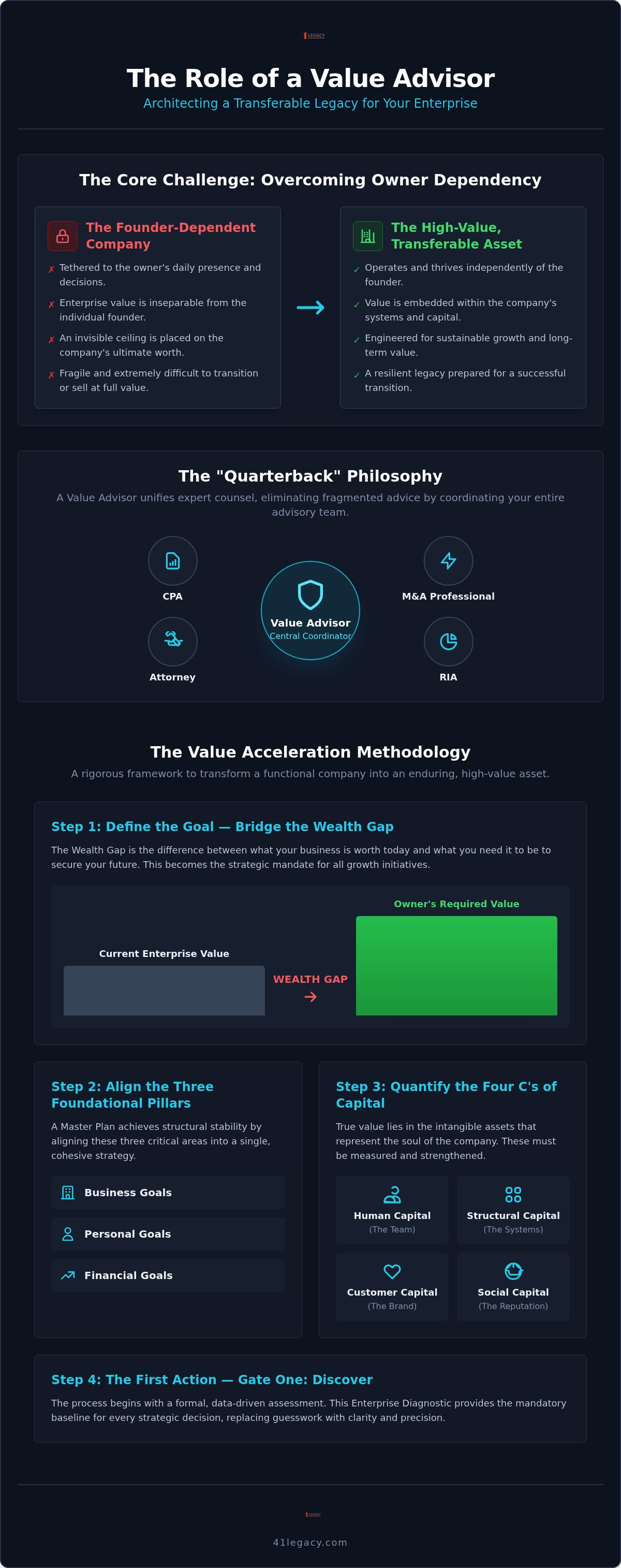
- Understand the "Quarterback" philosophy, where a central advisor coordinates your legal and financial teams to eliminate fragmented advice.
- Identify why reducing owner dependency is the single most critical factor in transforming a founder-led company into a high-value asset.
- Gain clarity on using enterprise diagnostics to bridge the wealth gap and create a structured roadmap for a successful transition.
Defining the Value Advisor: A Guardian of Enterprise Transferability
The transition of a business is rarely a mere financial exchange; it is the passing of a torch. Many owners mistakenly view their companies as extensions of their own identity rather than independent entities of worth. When asking what is a value advisor, one must look beyond the mechanics of a sale. These professionals act as strategic architects who prioritize long-term enterprise health over the immediate gratification of a transaction. While a broker focuses on the finality of a deal, a value advisor serves as a steward of the company’s history, ensuring its future is secured through meticulous risk reduction and growth engineering.
This role demands a profound respect for what has been built. It requires the technical precision of an engineer and the vision of a curator. We see the business not as a series of spreadsheets, but as a living legacy. By establishing exit readiness as a permanent state of excellence, the advisor ensures the company is always prepared for a transition, whether that moment arrives by choice or by circumstance. This constant state of preparedness is the hallmark of a truly high-value asset.
The Core Philosophy of Value Acceleration
Value isn't an accidental byproduct of hard work. It's a deliberate creation. True acceleration occurs when an owner aligns their business, personal, and financial goals into a singular Master Plan. This shift in perspective transforms the company from a demanding daily obligation into a transferable asset. By viewing the enterprise through the lens of Business valuation, we can see that worth is found in the company's ability to thrive without its founder. Exit readiness isn't a destination reached at the end of a career; it's a permanent state of operational excellence that ensures the business is always prepared for its next chapter. It's the difference between a functional machine and a timeless masterpiece.
Why Business Owners Require a Specialized Perspective
Standard advisors often operate in isolation. A CPA focuses on tax mitigation, while an attorney minimizes legal exposure, yet these efforts often lack a unified direction. A value advisor bridges these gaps by identifying the "Value Gap," which is the difference between what your business is worth today and what you need it to be to support your future. This specialized perspective protects the inner essence of the organization. It ensures that as the company scales, its unique spirit and cultural heritage aren't sacrificed for the sake of efficiency. By understanding what is a value advisor, owners gain a partner who sees the enterprise as a whole, ensuring every strategic move strengthens the foundation of their legacy. We believe that a company should be a living entity, capable of growth and evolution beyond the direct influence of its creator.
The Value Acceleration Methodology: Turning Strategy into Asset Value
The Value Acceleration Methodology is the rigorous framework we use to bridge the distance between a functional company and an enduring legacy. It rests upon three foundational pillars: business, personal, and financial alignment. If these elements are out of sync, the enterprise suffers from structural instability. We identify the "Wealth Gap" as the definitive measure of what your business must achieve to secure your future. This isn't a mere calculation; it's a strategic mandate. By understanding what is a value advisor, you realize that our work is to ensure the business provides the necessary capital for your next chapter. We treat the enterprise as a living entity, meticulously engineering every department to maximize its eventual transferability.
Technical precision is required to measure the intangible assets that often represent the true soul of a company. While spreadsheets capture historical data, the methodology focuses on the "Four Cs": human, structural, customer, and social capital. These are the invisible threads that hold an organization together. A value advisor uses these metrics to quantify the quality of your brand, the strength of your team, and the reliability of your systems. This curatorial approach ensures that the business is not just profitable, but valuable to a sophisticated outsider who seeks a turnkey masterpiece.
Gate One: Discover and the Enterprise Diagnostic
The journey begins with Gate One: Discover. A formal assessment provides the mandatory baseline for every strategic decision we make. Without a precise understanding of business valuation methods, an owner is navigating without a map. We identify hidden risks that silently devalue a company in the eyes of a buyer, from concentrated customer bases to fragile internal systems. Enterprise Diagnostics are the proprietary forensic tools we use to uncover these vulnerabilities and establish the foundation of your value growth roadmap. This diagnostic phase is the lens through which we view the company's current reality, allowing us to see past surface-level performance into the core health of the asset.
Gate Two: Prepare and the Value Growth Roadmap
Gate Two is where the vision takes physical form through the Prepare stage. We prioritize value drivers that offer the highest return on effort, focusing on the structural improvements that reduce risk and increase multiples. Implementation is managed through disciplined 90-day sprints to maintain momentum and ensure accountability. This rhythmic progress transforms the company into a transferable and independent asset. Through a structured Value Growth Roadmap, we measure your evolution from a founder-led operation to a self-sustaining enterprise. This process ensures that growth is never accidental but is instead the result of deliberate, high-altitude strategy.
The Coordinated Advisory Team: The "Quarterback" Philosophy
The failure point of most strategic endeavors isn't a lack of expertise, but a lack of coordination. Business owners often find themselves at the center of a fragmented circle of professionals. A CPA focuses on tax mitigation, an attorney manages liability, and a wealth manager oversees personal portfolios. While each is a master of their craft, they often operate in silos, unaware of how their individual advice impacts the collective goal of transferability. When exploring what is a value advisor, one discovers a leader who acts as the "Quarterback" for your professional circle. We orchestrate these specialized voices into a single, harmonious strategy that protects the integrity of your legacy.
At 41 Legacy, we ensure that every professional decision is filtered through the lens of your ultimate exit goal. Without this central coordination, well-intentioned advice can inadvertently create friction. For example, a tax strategy that aggressively lowers short-term profits might simultaneously damage the company's valuation in the eyes of a sophisticated buyer. We provide the technical oversight necessary to align these disjointed efforts. By establishing a rhythmic communication cycle between all advisors, we transform a collection of individual contributors into a unified team dedicated to the long-term health of your enterprise.
Aligning the CPA and Attorney with Your Legacy
True enterprise excellence requires that legal and financial structures be engineered for transferability from the start. We work closely with your attorney to develop structures that support a seamless transition, ensuring that contracts and entities are prepared for the scrutiny of due diligence. Simultaneously, we coordinate with your CPA to ensure tax mitigation doesn't erode the very value you've worked to build. This alignment ensures that wealth management is integrated into the daily operations of the business. It creates a bridge between the company's performance and your personal financial security, treating the business as the primary engine of your future freedom.
Monthly Implementation and Accountability
A strategic roadmap is only as valuable as the discipline used to execute it. Many owners possess a vision but lack the consistent implementation support required to see it through. We act as the guardian of your progress, maintaining the drumbeat of execution through structured advisory support. This isn't about occasional check-ins; it's about a relentless pursuit of the milestones defined in your roadmap. By providing Monthly Implementation Support, we ensure that the complexities of running a business don't stall the essential work of building an asset. This consistent accountability is what separates a theoretical plan from a realized legacy, ensuring that the work of value growth remains a constant priority within the organization.
Eradicating Owner Dependency: The Core Metric of Business Health
Dependency is the single largest discount to business value. A sophisticated buyer isn't just purchasing historical cash flow; they're purchasing the high-probability certainty of its continuation. If the owner remains the sole "Rainmaker," the company is effectively unsellable because the most critical driver of revenue walks out the door with the founder. Understanding what is a value advisor involves recognizing their role in diagnosing this inherent fragility. We view the business as a masterpiece that must be able to hang in any gallery, thriving entirely independent of the hands that first shaped it.
The transition from founder to strategic steward is a profound psychological evolution. It requires a deliberate shift from performing the work to curating a sophisticated environment where the work thrives without intervention. We utilize the "Four Capitals," human, structural, customer, and social, as the technical pillars of this transformation. These elements form the inner essence of the firm, ensuring that value is rooted in the organization's architecture rather than a single individual's charisma. By consulting with an expert who understands what is a value advisor, you can objectively assess which of these capitals requires the most immediate refinement to protect your legacy.
Building Structural Capital through SOPs
Documented processes serve as the institutional memory of the firm, capturing the wisdom of the founder in a form that others can execute with precision. Without these systems, knowledge remains ephemeral and operational risk remains uncomfortably high. Structural Capital is the engine of owner independence, providing the technical precision needed for consistent operational excellence. Transferability engineering requires that every critical function, from client acquisition to service delivery, be captured in a repeatable, audited system. This ensures the company's performance is predictable and its heritage is preserved through every future transition.
Human Capital: Developing the Next Generation of Leadership
A scalable, autonomous organization requires a team capable of high-level execution and strategic thinking. Developing human capital means moving beyond owner-led sales and centralized decision-making toward a culture of empowered leadership. We help you identify and nurture the specific talent that will carry your legacy forward into the next decade. This strategic delegation reduces "Key Man" risk, ensuring the business remains a living, breathing entity long after you've stepped away from the helm. To begin identifying the dependencies within your own firm and engineering a more resilient future, explore our Owner Dependency Reduction strategies today.
41 Legacy: Implementing the Gold Standard of Strategic Advisory
At 41 Legacy, we serve as the dedicated practitioners of rigorous, industry-leading standards for strategic advisory. Our methodology isn't a mere set of business tactics; it's a sophisticated discipline designed to elevate the enterprise to its highest possible form. When owners ask what is a value advisor, they're often seeking a partner who can bridge the gap between technical engineering and the emotional weight of a life's work. We provide that bridge, acting as the curatorial experts who ensure your company’s inner essence is preserved even as its structural independence grows. We don't just prepare a business for a sale; we prepare it to endure as a masterpiece of professional craftsmanship.
The journey we facilitate moves with deliberate precision from Enterprise Diagnostics to Transferability Engineering. This progression ensures that every vulnerability is identified and every strength is fortified. By applying these high-altitude standards, we transform the business into an entity that possesses its own institutional memory and operational heartbeat. We invite you to view your enterprise not as a daily burden, but as a curatorial masterpiece in progress, one that requires the steady hand of a specialist to reach its full potential in the eyes of the market.
Crafting Your Value Growth Roadmap
Moving from an initial assessment to tangible enterprise value requires an uncompromising commitment to detail. We coordinate the technical requirements of growth with the emotional complexities of a transition, ensuring that every strategic move serves the primary objective of closing the Value Gap. This isn't a theoretical exercise. It's a structured process where we identify the specific drivers that will yield the greatest return on your effort. Our role is to maintain the harmony between your personal aspirations and the business’s operational needs, creating a roadmap that leads directly to a successful and meaningful legacy.
Securing Your Legacy Today
The most opportune time to engineer a transition is years before the event actually occurs. Waiting until the moment of exit to address structural weaknesses often results in a significant discount on the value you've spent decades building. We encourage every owner to treat their business as a transferable asset today, ensuring that it remains a source of freedom rather than a constraint. By establishing a foundation of excellence now, you protect the heritage of your work and secure your financial future. We are ready to help you begin this transformation. You can Begin your Enterprise Diagnostic with 41 Legacy to gain the strategic clarity necessary to turn your business into a lasting legacy.
Engineering a Legacy of Enduring Value
Your business is more than a source of income; it's a living testament to your dedication and history. Transforming this work into a transferable asset requires a deliberate shift from daily management to strategic stewardship. By reducing owner dependency and aligning your professional team through a coordinated "quarterback" approach, you ensure the enterprise's heartbeat remains steady long after your transition. This process turns a functional company into a self-sustaining masterpiece.
Understanding what is a value advisor provides the clarity needed to move beyond fragmented advice toward a unified vision of excellence. Led by a Certified Exit Planning Advisor (CEPA), our team utilizes proprietary Enterprise Diagnostics to identify and close the value gap with technical precision. We're dedicated to building owner-independent assets that thrive on their own merit. Discover your business’s true potential with 41 Legacy’s Exit Readiness Assessment.
The future of your enterprise is a legacy waiting to be secured. We're here to help you protect its essence while engineering its growth.
Frequently Asked Questions
What is the primary difference between a business broker and a value advisor?
A business broker is primarily a transactional agent focused on the immediate sale of a company, whereas a value advisor is a strategic architect who engineers the business to increase its intrinsic worth long before a sale. While brokers operate at the end of the journey, a value advisor works to harmonize the enterprise’s internal systems and reduce risk. This preparation ensures that when the time for transition arrives, the business is a masterpiece of transferability.
How long does the Value Acceleration Methodology typically take to implement?
Implementing the Value Acceleration Methodology is a rhythmic process rather than a singular event. While immediate improvements can be seen within the first 90-day implementation sprint, achieving profound enterprise excellence typically requires eighteen to thirty-six months of dedicated advisory. This duration allows for the meticulous refinement of internal systems and the successful reduction of owner dependency, ensuring the legacy is structurally sound and fully transferable.
Can a value advisor help if I want to pass my business to a family member?
A value advisor is essential for internal transitions, including passing a business to a family member, because the goal remains the same: building a healthy, independent asset. By engineering the business to thrive without the founder, you protect the next generation from the burden of an owner-dependent operation. This curatorial approach ensures the family legacy is preserved through a stable, high-value enterprise that can sustain itself and the family for years to come.
What are the "Four Capitals" in the context of business valuation?
The "Four Capitals" represent the intangible pillars of enterprise value: Human, Structural, Customer, and Social capital. Human capital focuses on the talent and leadership within the firm, while Structural capital involves the documented processes and systems that serve as the company's institutional memory. Customer capital measures the strength and diversity of your client relationships, and Social capital encompasses the brand's culture and reputation. Together, these form the inner essence of a high-value, transferable company.
Is an Exit Readiness Assessment necessary if I don’t plan to sell for ten years?
An Exit Readiness Assessment is vital even with a ten-year horizon because it establishes a baseline for operational excellence today. Readiness isn't just about leaving; it's about building a business that is always prepared for the unexpected. By understanding what is a value advisor early in your journey, you can spend the next decade curating an asset that provides maximum freedom and value, rather than rushing to fix structural flaws at the last moment.
How does reducing owner dependency directly increase the multiplier of my business?
Reducing owner dependency directly increases your business multiplier by lowering the perceived risk for a future steward. When a company relies solely on its founder’s presence, it possesses a fragile heartbeat that discourages sophisticated investment. By engineering a management team and systems that function autonomously, you transform the enterprise into a turnkey asset. This increased predictability and reduced risk profile are precisely what drive higher valuation multiples in any market.
What role does the Exit Planning Institute play in ongoing advisor education?
The Exit Planning Institute serves as the primary governing body for the professional standards and ongoing education of Certified Exit Planning Advisors (CEPAs). It provides the research-driven framework and the Value Acceleration Methodology that we use to guide business owners through their transition journeys. By maintaining these rigorous educational standards, the institute ensures that advisors possess the technical precision and strategic depth required to handle the complexities of high-level enterprise growth and legacy preservation.
Does 41 Legacy provide legal or tax advice as part of the process?
41 Legacy does not provide legal document drafting, tax preparation, or investment advice. Instead, we act as the strategic quarterback who coordinates your existing team of specialized professionals, including your attorney and CPA. Our role is to ensure that their technical work aligns perfectly with your overarching Value Growth Roadmap. This collaborative approach ensures that every legal and financial decision serves the singular goal of increasing enterprise transferability and preserving your legacy.
Disclaimer
This article is for educational and informational purposes only and does not provide legal, tax, investment, or business brokerage advice. 41 Legacy does not offer M&A brokerage services, legal document drafting, tax preparation, or investment advisory services. Business owners should consult licensed professionals in those disciplines before making decisions related to business transactions, legal matters, tax strategy, or financial planning. All examples are illustrative and may not apply to your specific situation.