
The Master Craftsman’s Guide to Business Exit Planning and Enterprise Value
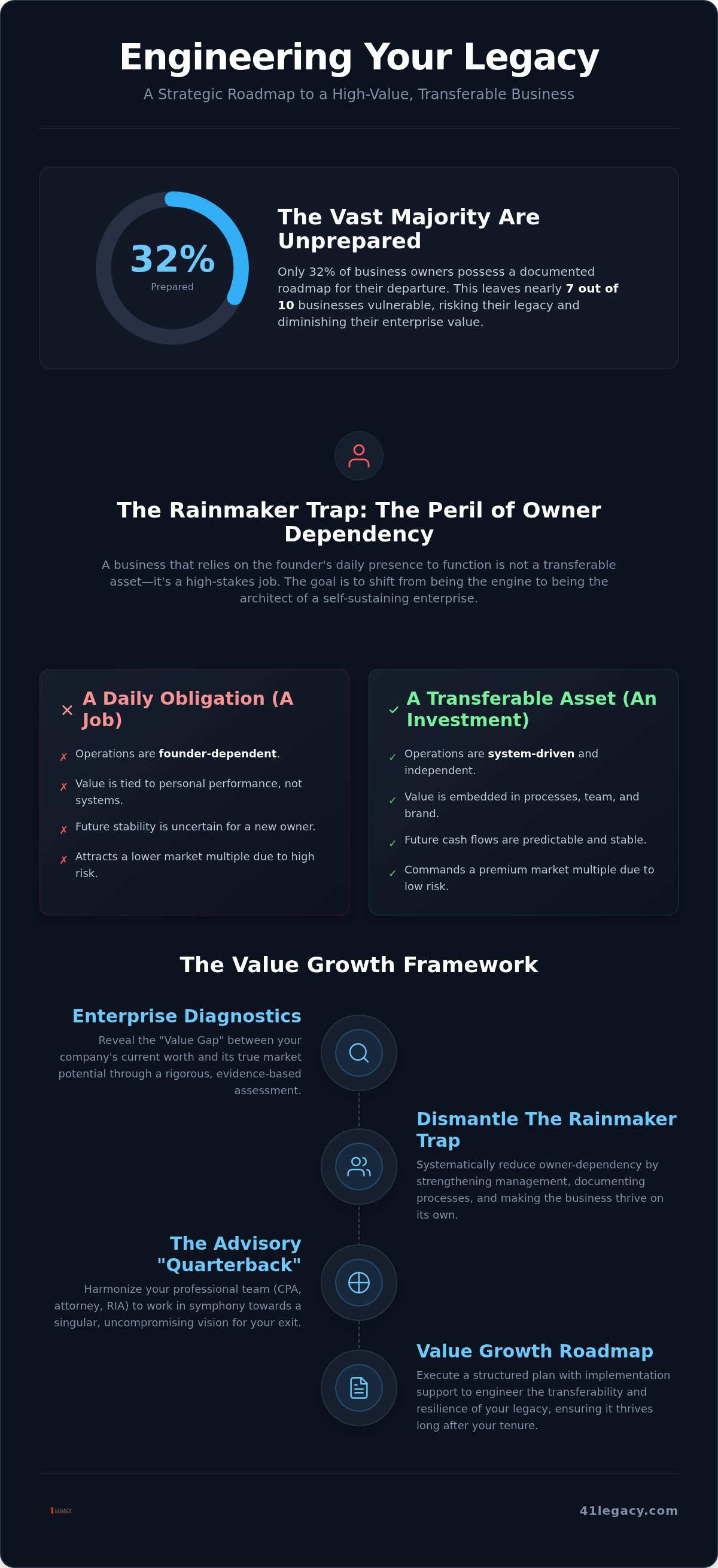
Only 32% of business owners possess a documented roadmap for their departure, leaving the fate of their life’s work to the whims of chance. For the visionary leader, a business is more than a source of income. It's a meticulously crafted legacy that deserves a graceful transition. Yet, many find themselves caught in the Rainmaker Trap, where the enterprise’s heartbeat is tied solely to their own. When exploring business exit planning old saybrook founders often face the frustration of disjointed advice and uncertainty regarding their company’s true market value.
You've spent years honing your craft and building a name that stands for excellence. It's only natural to want that essence preserved. This guide promises to show you how to transform your business from a daily obligation into a high-value, transferable asset. We'll examine the strategic roadmap to closing the Value Gap, the importance of owner-dependency reduction, and how a coordinated team of specialists can secure your legacy through rigorous enterprise diagnostics and structured implementation support. By treating your exit as a final masterpiece of engineering, you can ensure the organization thrives long after your tenure ends.
Key Takeaways
- Discover how business exit planning old saybrook transforms your enterprise from a daily obligation into a high-value, transferable asset.
- Learn how Enterprise Diagnostics reveal the "Value Gap," providing the strategic clarity needed to align your firm’s essence with its true market potential.
- Identify the strategies required to dismantle the "Rainmaker Trap," ensuring your business thrives as a self-sustaining entity independent of your daily oversight.
- Understand the "Quarterback" advisory model, which harmonizes your professional team to work in symphony toward a singular, uncompromising vision.
- Explore how a Value Growth Roadmap and structured implementation support engineer the transferability and resilience of your legacy.
The Stewardship of Success: Why Exit Planning is a Strategic Necessity
Succession is often viewed as a singular moment in time, a transactional event where keys change hands and titles are retired. This narrow perspective ignores the true essence of enterprise. Business Exit Planning isn't merely a departure strategy; it's the ultimate discipline of protecting and expanding the inherent value of your life’s work. When considering business exit planning old saybrook owners must shift their gaze from the act of selling to the art of building a transferable asset. It's a shift from being the engine to being the architect.
A business that requires the founder's daily presence to function is a job, not an investment. The most valuable enterprises are those engineered to operate with surgical precision in the owner’s absence. We view the founder not as a mere operator, but as a steward of a lasting legacy. Your role is to cultivate an entity that possesses its own heartbeat, ensuring that the excellence you've established endures through the progression of time. This curatorial approach ensures that the essence of the company remains intact while the leadership evolves.
The Distinction Between Operation and Transferability
A profitable company is a testament to current performance, but a transferable one is a testament to future stability. Buyers don't just purchase cash flow. They purchase the certainty that those flows will continue without you. Reducing risk is the primary lever of market attractiveness, as complexity and owner-dependency act as friction to a potential successor. Exit planning is a comprehensive value-growth strategy that refines the internal mechanics of the business long before any transition occurs. It's about polishing the gears of the enterprise until they shine with independent efficiency.
The Timeline of Readiness
Timing is the difference between a masterpiece and a rushed sketch. The most advantageous moment to begin this process is years before you intend to step away. Waiting until you're ready to leave often results in "forced exits" driven by burnout or market shifts, which strip you of leverage. When exploring business exit planning old saybrook, remember that readiness grants you ultimate optionality. When your business is prepared for a transition at any moment, you command the terms. It's about maintaining a state of constant excellence that allows for a graceful exit on your own timeline.
Measuring the Essence of Value: The Role of Enterprise Diagnostics
To build a legacy of enduring impact, you must first possess the courage to see the enterprise as it truly is, devoid of sentiment or assumption. Enterprise Diagnostics serve as the foundational bedrock of this journey, providing the strategic clarity required to move from intuition to evidence. For those pursuing business exit planning old saybrook, this phase is akin to a master restorer examining a canvas under ultraviolet light. It reveals the hidden fractures and structural weaknesses that the naked eye might miss. Without this baseline, any attempt to grow value is merely guesswork. We believe that true stewardship begins with an uncompromising assessment of the current state.
At the heart of our diagnostic process lies the identification of the "Value Gap." This is the delta between what your business is currently worth and the financial harvest required to fund your next chapter. Understanding this gap is essential for determining enterprise value with absolute precision. By identifying the specific "red flags" that dampen your market multiple, we can begin the work of refining the asset into its most potent form. This isn't a reactive audit but a proactive engineering of excellence.
Quantifying the Value Gap
Precision is the hallmark of the master craftsman. A "back-of-the-napkin" calculation is a dangerous substitute for a formal assessment, as it often fails to account for the nuances of market attractiveness. We examine the internal and external factors that dictate your final multiple, ensuring your goals are anchored in reality. This quantification allows you to visualize the path forward, turning an abstract desire for "more" into a structured roadmap for growth. It’s about ensuring that when the time comes to transition, the value you receive reflects the excellence you’ve poured into the work.
Identifying Structural Risks
Structural integrity is paramount for any transferable asset. Diagnostics often reveal risks that, if left unaddressed, will significantly devalue the enterprise in a buyer’s eyes. Customer concentration, a lack of recurring revenue, and "key-man risk" are the most common vulnerabilities we encounter. We use these findings to initiate Transferability Engineering, a process designed to strengthen the business’s internal essence. By establishing a clear baseline through our Enterprise Diagnostics, we ensure the business is no longer a fragile entity dependent on a single pillar, but a resilient asset ready for its next steward.
The Rainmaker Trap: Strategies for Reducing Owner Dependency
The brilliance of a founder is often the very thing that limits the value of their creation. When an enterprise’s success is tethered to the charisma, relationships, or technical expertise of a single individual, it's not yet a transferable asset. It's a cage. This is the essence of the "Rainmaker Trap." In the pursuit of business exit planning old saybrook, we recognize that a business dependent on its owner is a liability in the eyes of a sophisticated buyer. They aren't looking to purchase your personal work ethic; they're looking to acquire a self-sustaining system that generates predictable results. Detaching your identity from the daily operations is the most effective way to increase the valuation multiple of your company.
Reducing dependency isn't about working less. It’s about elevating your role from the primary engine to the master architect. A buyer's greatest fear is that the "secret sauce" leaves when you do. By engineering a business that thrives in your absence, you provide the certainty and security that command a premium. This transition requires a meticulous approach to delegating authority and professionalizing the internal culture. It's a process of ensuring that the company's heartbeat remains steady, regardless of who sits in the founder's chair.
Standard Operating Procedures as the Blueprint
Refining the internal mechanics of your legacy requires moving beyond "tribal knowledge." This is where many owners struggle, as they carry the intricacies of the business in their heads rather than on the page. What is an SOP in business? It's the blueprint for a transferable legacy. Standard Operating Procedures act as the instruction manual for your successor, ensuring that every process is documented and repeatable. This documentation turns the ephemeral into the tangible, allowing the business to maintain its high sheen of excellence without your direct intervention.
Empowering the Next Generation of Leadership
A transferable asset requires a team with high "Strategic Capacity." You must identify and cultivate leaders who can handle the weight of decision-making. This isn't a sudden shift but a deliberate progression. We recommend testing the business’s independence through "owner-absent" trials—structured periods where you step away to see where the gears might grind. These trials reveal exactly where the organization still leans on you. 41 Legacy guides you through this transition of authority, helping you build a leadership structure that is resilient, capable, and aligned with the long-term health of the enterprise.
The Advisory Quarterback: Harmonizing Your Professional Collective
A masterpiece is rarely the work of a solitary hand. It requires a collective of specialists, each a master of their specific medium, working in perfect concert. Yet, in the pursuit of business exit planning old saybrook, many owners find their professional advisors operating in isolated silos. Your CPA may be focused on minimizing last year's tax liability, while your attorney is preoccupied with immediate litigation risks and your financial advisor is looking at personal wealth. Without a unifying vision, these efforts often conflict, creating friction where there should be flow. We act as the "Quarterback," ensuring that every professional voice is tuned to the same strategic frequency.
The role of the Certified Exit Planning Advisor is to serve as the architect of this collaboration. By establishing a singular strategic goal, we harmonize the technical precision of your legal and financial team with the long-term vision for your legacy. This coordination ensures that growth decisions today don't create tax or legal complications tomorrow. It’s about building a unified front that protects the essence of the enterprise during every stage of its progression. When business exit planning old saybrook is approached through this collaborative lens, the result is a seamless transition that honors the work of a lifetime.
Aligning the Professional Advisory Team
Alignment begins with shifting the focus from historical reporting to future-state engineering. We work with your CPA to ensure they're planning for an eventual transition rather than just filing an annual return. Similarly, involving legal counsel in the early stages of Transferability Engineering allows for the identification of structural flaws before they become deal breakers. Our Monthly Strategic Advisory rhythm keeps this collective moving forward, ensuring that no detail is polished in isolation. This collaborative approach turns a disjointed group into a high-performance advisory board.
Reducing the Owner’s Administrative Burden
Owners often find themselves serving as the "information bottleneck," manually relaying data between advisors who don't speak the same language. This administrative weight is a distraction from the work of stewardship. By providing a single point of accountability for the exit roadmap, we remove this burden. The result is a unified professional front that offers the owner profound peace of mind. When your advisors are coordinated, you're free to focus on the strategic health of the business, knowing the technical details are being handled with surgical precision. To begin harmonizing your team, consider our Strategic Advisory services today.
The Value Growth Roadmap: Engineering Your Transferable Legacy
Once the diagnostics have revealed the inner essence of your enterprise, the work of transformation begins. The Value Growth Roadmap is the architectural plan that guides this evolution. For those engaged in business exit planning old saybrook, this isn't a static document destined for a shelf. It's a living strategy that translates high-level vision into granular action. We provide Monthly Implementation Support to ensure that the momentum of growth is never lost to the friction of daily operations. This structured rhythm ensures that every adjustment to the business’s mechanics aligns with the ultimate goal of transferability.
Markets are rarely static, and neither is the value of your legacy. As we move through 2026, the M&A landscape has become increasingly selective. While deal values reached $1.2 trillion in the first five months of the year, deal volume has actually decreased by 4%. This "flight to quality" underscores why learning how to increase enterprise value through continuous refinement is vital. We iterate your roadmap as market conditions and internal milestones evolve, ensuring your business remains a premium asset in a competitive environment. It’s about maintaining a state of constant readiness, regardless of when you choose to transition.
The Continuous Cycle of Value Growth
Exit planning is a philosophy of perpetual improvement. We track every milestone against the baseline established in your Enterprise Diagnostics, measuring the reduction of risk and the expansion of strategic capacity. This isn't merely about preparing for a transaction; it's about building an entity that can outlive its creator. A "Legacy" mindset requires an unwavering commitment to excellence, ensuring that the company’s story continues with strength and clarity long after your final chapter as owner. By treating the business as a living entity with its own future, you fulfill your role as its ultimate guardian.
Next Steps: Securing Your Business Future
The path to a transferable legacy begins with a single, decisive step. An initial Exit Readiness Assessment provides the clarity needed to understand where you stand and what is required to reach your goals. Successful value growth requires a commitment to the process and a willingness to see the business through the eyes of a future steward. It's a journey that demands precision, but the reward is the peace of mind that comes from a secured future. We invite you to start the diagnostic process with us today, ensuring that your life’s work is preserved, protected, and prepared for its next great horizon.
Securing the Future of Your Masterpiece
The evolution of your business from a daily obligation into a self-sustaining legacy is the final hallmark of a master steward. We've explored how rigorous Enterprise Diagnostics and the deliberate dismantling of the Rainmaker Trap serve to engineer a truly transferable asset. When navigating the complexities of business exit planning old saybrook, the objective is never just a departure. It's the preservation of an essence that can thrive independently of its creator. By professionalizing your internal systems and reducing owner dependency, you transform your company into a resilient entity ready for its next horizon.
Led by a Certified Exit Planning Advisor (CEPA), our team provides a proprietary Value Growth Roadmap designed to close your Value Gap with surgical precision. We operate with a zero-conflict advisory philosophy, ensuring our guidance is never compromised by brokerage or investment sales. It's time to harmonize your professional collective and secure the impact you've spent a lifetime building. Begin Your Exit Readiness Assessment with 41 Legacy and ensure your masterpiece endures for generations to come. Your dedication deserves a transition as refined as the work itself.
Frequently Asked Questions
What is the difference between a business valuation and an Exit Readiness Assessment?
A traditional valuation provides a numerical figure based on historical performance, but an Exit Readiness Assessment evaluates the structural integrity of the enterprise. It examines the qualitative factors that dictate whether a buyer will actually pay a premium multiple. By identifying the "Value Gap" and market attractiveness, this assessment offers a deeper understanding of your legacy’s health. We use these findings to begin the work of engineering a truly transferable asset that commands respect in any market.
How long does the business exit planning process typically take?
Strategic readiness is a deliberate progression rather than a sprint. While initial Enterprise Diagnostics may take several weeks to complete, the implementation of a Value Growth Roadmap typically spans several years. This timeline allows for the meticulous reduction of owner dependency and the professionalization of internal systems. When considering business exit planning old saybrook, owners should view it as a continuous cycle of improvement that ensures the organization is perpetually prepared for a graceful transition.
Why do I need an exit plan if I am not planning to sell for ten years?
Planning a decade in advance provides you with the ultimate luxury of optionality. By building a transferable asset today, you ensure the business is healthy and resilient regardless of when you choose to depart. This long-term approach allows ample time to close the Value Gap and dismantle the Rainmaker Trap. It ensures that if an unexpected market shift or personal event occurs, your life’s work is already polished and ready for its next steward.
Does 41 Legacy act as a business broker or M&A advisor?
No, we don't engage in the transactional act of brokerage or M&A representation. Our role is strictly that of a strategic advisor and "quarterback" for your existing professional team. We provide the Enterprise Diagnostics and implementation support required to grow enterprise value long before a transaction occurs. This zero-conflict model ensures our guidance remains objective, focused entirely on the long-term health and transferability of your business rather than a commission-driven sale.
How does owner dependency affect the final sale price of my business?
Owner dependency acts as a significant friction point that directly suppresses your valuation multiple. If the enterprise heartbeat relies solely on your presence, a buyer perceives immense risk and will adjust their offer downward accordingly. Reducing this dependency immediately increases the company's attractiveness and the price a successor is willing to pay. A business that thrives in your absence is viewed as a high-performance investment rather than a daily obligation for the new owner.
Can exit planning help if I want to transition the business to a family member?
Transitioning to a family member requires the same level of strategic rigor as an external sale to ensure the legacy’s survival. Exit planning helps identify if the business is strong enough to support the next generation without the founder’s constant intervention. We focus on Transferability Engineering to ensure the successor inherits a resilient, well-documented organization. This process protects family harmony by providing a clear roadmap for the transition of authority and the preservation of the company's essence.
What is the role of a Certified Exit Planning Advisor (CEPA) compared to a traditional consultant?
A Certified Exit Planning Advisor (CEPA) utilizes a specialized, holistic framework that aligns business, personal, and financial goals into a single strategy. Unlike traditional consultants who may focus on a single silo, a CEPA acts as a master architect of the entire transition process. We coordinate the efforts of your CPA and attorney to ensure every decision strengthens the enterprise’s transferability. This comprehensive perspective is essential for owners pursuing business exit planning old saybrook to maximize their legacy's impact.
How much does an initial Enterprise Diagnostic cost?
We utilize project-based diagnostic fees that are tailored to the specific complexity and scale of your enterprise. This phase involves a deep examination of your company’s current state to identify the Value Gap and structural risks. Because every business is a unique masterpiece, we provide a customized proposal after an initial consultation to ensure the scope of the diagnostic matches your strategic needs. This investment establishes the baseline for all future value growth and implementation support.

Article by
Mike Laskowski
Mike Laskowski is a Business Value Growth Strategist who helps business owners uncover the truths that drive their performance, risk, and readiness. Blending forensic interviewing from a 26‑year federal career with Strategic Capacity analysis and CEPA methodology, he works upstream to reduce owner dependency, increase transferability, and strengthen enterprise value. Mike guides founders through clarity, operational evolution, and transition readiness so their companies become transferable, owner‑independent assets that endure beyond the founder.
Disclaimer
This article is for educational and informational purposes only and does not provide legal, tax, investment, or business brokerage advice. 41 Legacy does not offer M&A brokerage services, legal document drafting, tax preparation, or investment advisory services. Business owners should consult licensed professionals in those disciplines before making decisions related to business transactions, legal matters, tax strategy, or financial planning. All examples are illustrative and may not apply to your specific situation.