
Mitigating Customer Concentration Risk: The Sovereign Guide to Enterprise Value Preservation
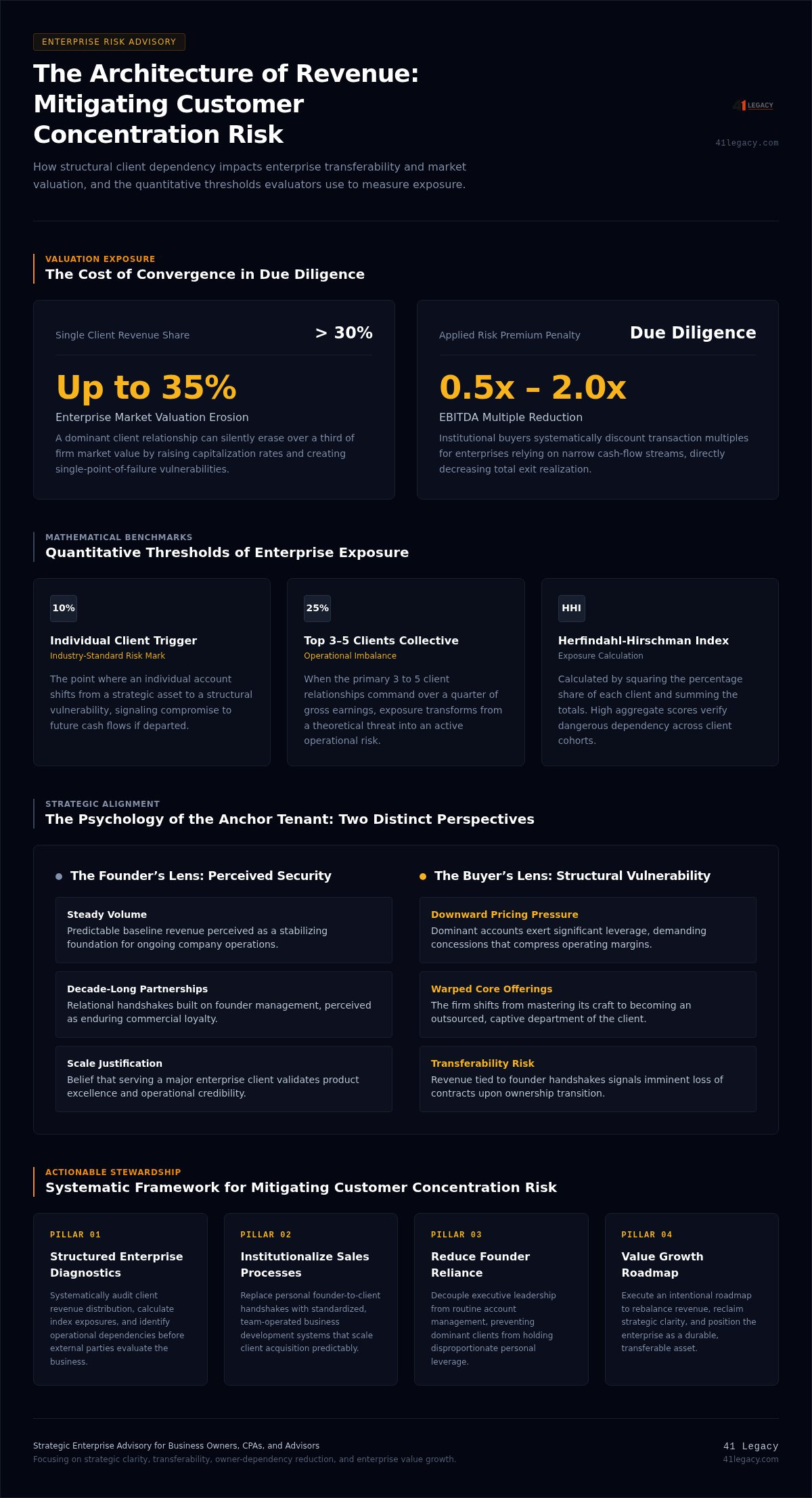
A single customer account exceeding 30% of total revenue can silently erode up to 35% of an enterprise's market valuation. For many business owners, a long-standing, dominant client feels like a crowning achievement and a pillar of stability. In reality, sophisticated buyers and institutional partners view this dependency as a structural flaw that compromises the transferability of the entire operation. Prioritizing a strategy for mitigating customer concentration risk is not merely about protecting monthly cash flow; it's an essential act of stewardship that preserves the long-term value of your organization.
It's natural to feel trapped by the leverage these dominant accounts hold, especially when that concentration subjects your firm to downward pricing pressure or demands constant, founder-led management. You'll discover how to identify, evaluate, and systematically mitigate customer concentration risk to transform your business into a resilient, highly valued, and transferable asset. We'll examine the exact mathematical thresholds that external evaluators use to assess risk, alongside an actionable framework designed to distribute your revenue across a healthier client base without destabilizing your current operations.
Key Takeaways
- Identify the critical 10% threshold where a single client relationship shifts from a strategic asset to a structural vulnerability in your revenue architecture.
- Analyze the direct correlation between high client dependency and the valuation discounts applied by institutional buyers to future cash flows.
- Deconstruct the misconception that anchor accounts provide permanent security, replacing it with a strategy for resilient revenue diversification.
- Execute a systematic framework for mitigating customer concentration risk by institutionalizing sales processes and reducing operational reliance on the founder.
- Leverage structured enterprise diagnostics to transform concentrated revenue into a transferable asset that thrives independently of any single relationship.
The Architecture of Revenue: Defining Customer Concentration Risk
Revenue is the lifeblood of an enterprise, yet its distribution is the true measure of a legacy's permanence. We define concentration risk as a structural imbalance where a single patron or a select guild of clients commands a disproportionate share of total earnings. It's a delicate architecture. When one pillar supports too much weight, the entire edifice becomes fragile. A single client representing more than 10 percent of total revenue constitutes a clear vulnerability, signaling to future stewards that the foundation may be compromised. This isn't merely a sales challenge; it's a fundamental threat to the integrity of the business asset.
Beyond individual accounts, we must observe the collective weight of your top relationships. If your top three to five clients account for more than 25 percent of gross earnings, the risk is no longer theoretical; it's operational. True stewardship requires you to view your business not just as a source of current income, but as a transferable asset. Building such an asset demands a balanced revenue distribution, ensuring the company's essence remains intact regardless of any single relationship's fate. Actively mitigating customer concentration risk is the hallmark of a mature, resilient enterprise that can survive the departure of any one partner.
The Quantitative Thresholds of Enterprise Exposure
Measuring this risk requires surgical precision. We often utilize the Herfindahl-Hirschman Index (HHI), a calculation where you square the revenue percentage of each client and sum the results, to provide a clear view of your exposure. A high HHI score indicates a dangerous lack of diversity. The 10 percent individual client threshold serves as an industry-standard risk trigger, marking the point where a departure becomes catastrophic for cash flow. Vulnerabilities compound when secondary clients begin to mirror the behavior of the anchor account, creating a synchronized failure point that can paralyze the enterprise during market shifts.
The Psychology of the Anchor Tenant Trap
Owners often gravitate toward large, predictable accounts because they offer an intoxicating sense of security. These anchor tenants provide steady volume, yet they quietly demand custom concessions that warp your core offerings. Over time, the business ceases to be a master of its own craft and instead becomes a specialized department of the client's organization. Transitioning away from this trap is an intentional act of corporate preservation. It requires a Value Growth Roadmap to reclaim strategic clarity and ensure the business thrives as an independent entity. This process is essential for mitigating customer concentration risk and securing the transferability of your life's work.
The Cost of Convergence: How Concentration Devalues an Enterprise
An institutional buyer operates with a cold, analytical gaze. Where a founder sees a deep, decade-long partnership with a major client, an acquiring committee sees an immediate threat to future cash flow predictability. This divergence in perspective strikes at the heart of determining enterprise value. When a business relies heavily on a narrow stream of revenue, its capitalization rate rises, which directly reduces the final valuation multiple. A transferable legacy remains entirely out of reach if your corporate revenue is bound to a handful of personal handshakes. True enterprise health requires structural independence.
The Buyer’s Lens: Discount Multipliers and Risk Premiums
During due diligence, sophisticated acquisition teams isolate concentrated revenue streams to calculate the specific risk premium of your business. If a single account represents an oversized portion of your earnings, buyers often apply steep discounts to your EBITDA multiple, sometimes lowering the final valuation by 0.5x to 2.0x EBITDA. A diversified enterprise commands a premium because its cash flow is insulated from a single client's departure. Proactively prioritizing a framework for customer concentration risk mitigation directly closes this valuation gap. It protects your hard-earned equity long before an external transition begins.
The Threat to Transferability and Transition Viability
High concentration thresholds do more than just lower your final valuation; they actively destroy transaction viability. Many institutional investors will walk away from a deal entirely if a single client accounts for more than 30 percent of total revenue. For those who choose to move forward, this vulnerability forces owners into restrictive, multi-year earn-outs rather than clean equity transitions. This structure means a substantial portion of your purchase price remains contingent on that client staying post-sale. True transferability demands that your enterprise can thrive completely independent of any single external entity. Through structured Strategic Advisory support, we help owners engineer that operational independence, transforming a fragile operation into an enduring corporate asset.
The Illusion of Stability: Single-Account Dependency vs. Strategic Diversification
Reliance on a single, high-margin anchor account often masquerades as corporate security. It feels like a triumph of sales, a fortress of predictable cash flow. Yet, this stability is often an illusion. True exit planning for business owners reveals that these anchor accounts act less like foundations and more like gravity. They pull every resource toward their specific needs, leaving the rest of the enterprise thin and exposed. A business that exists solely to serve one master isn't an independent entity; it's a subsidiary without the protection of the parent company.
Diversification is frequently met with the objection that it dilutes operational focus or erodes immediate profitability. This view is short-sighted. Mitigating customer concentration risk isn't about abandoning your finest patrons. It's about the deliberate cultivation of a balanced ecosystem where no single entity holds the power to extinguish your legacy. We view this as a curatorial process. You refine your offerings to appeal to a broader, healthier market without losing the precision that defined your early success. Strategic rebalancing ensures your business remains a sovereign asset rather than a captive supplier.
The Erosion of Pricing Power and Corporate Autonomy
Dominant customers understand their leverage with surgical clarity. They use it to demand margin-squeezing concessions, often insisting on extended payment terms that stress your liquidity. When you reallocate your most talented specialists to satisfy a single client's custom whims, you're quietly warping your company's core. You lose the autonomy to innovate for the broader market. The risk isn't just a slow squeeze; it's the sudden shock of a corporate restructuring or contract termination within the client's own organization, an event you can't predict or control.
Rebalancing the Portfolio Without Compromising Core Strengths
Expanding your market reach doesn't require you to abandon the mastery that built your name. Instead, you should leverage the reputation earned from your anchor account to secure adjacent market segments. Think of your primary client as a proof of concept, a masterpiece that validates your skill to the next tier of patrons. This transition elevates your stature from a dependent vendor to an industry leader. A diversified portfolio ensures that your company's story continues, even if one chapter closes unexpectedly. This strategic rebalancing is a core pillar of mitigating customer concentration risk, ensuring your enterprise remains a transferable asset, polished and ready for its next steward.
Methods for Mitigating Customer Concentration Risk
De-risking the revenue architecture of a firm is an act of meticulous engineering. It requires a shift from passive reliance to active cultivation. A systematic, multi-layered approach to mitigating customer concentration risk ensures the enterprise isn't a fragile collection of accounts, but a durable institution. This transformation begins with the institutionalization of knowledge. By capturing the nuances of client engagement and service delivery, you ensure the business retains its essence regardless of who sits in the founder's chair. We view this as the transition from a personal practice to a transferable corporate asset.
Systematization as an Enterprise Shield
Documentation is the guardian of your legacy. You must capture every facet of client onboarding, account management, and service fulfillment to create a repeatable rhythm. When an institutional buyer reviews your operations, they seek evidence that the business functions without disruption. Understanding what is sop in business provides the blueprint for this transition, turning individual efforts into a disciplined corporate machine. Documented systems transform personal goodwill into institutional enterprise value.
Transitioning from Founder-Led Sales to Scalable Architecture
The business owner acting as the primary relationship holder is a profound operational danger. It creates a single point of failure that buyers will discount heavily during due diligence. To resolve this, you'll need to build, train, and empower an independent sales and account management team. This isn't merely about delegation; it's about building a scalable architecture where your team handles the high-value details of client execution. Separating the founder identity from daily client delivery instantly reduces owner dependency metrics and increases the market attractiveness of the asset.
Strategic Productization of Bespoke Services
Standardization is the ally of scale. Analyze the custom solutions you've delivered to large clients and refine them into repeatable, standardized products. This strategic productization offers significant pricing advantages and protects your margins from the whims of a dominant client. By creating structured offerings, you lower the barrier to entry for smaller accounts, which accelerates organic diversification. This shift allows you to serve a wider market with the same precision you once reserved for a few, effectively mitigating customer concentration risk through structural innovation. To begin this transformation, you may request a Strategic Capacity Evaluation to identify the hidden potential within your current operations.
Securing the Legacy: How Exit Readiness Transforms Concentration into Enterprise Value
The final stage of corporate stewardship isn't a single event; it's the culmination of a disciplined, artistic process. We view the act of mitigating customer concentration risk as a vital component of a holistic framework for enterprise value optimization. It's the process of refining the rough edges of a founder-dependent operation until it becomes a masterpiece of transferability. A structured roadmap provides the necessary accountability to execute these long-term diversification strategies, ensuring that the vision for the company's future remains uncompromised. Navigating these structural transformations requires a steady hand and a deep respect for the enterprise's history, guiding owners toward a future where their legacy is truly secure.
The Role of Comprehensive Enterprise Diagnostics
An objective assessment is the first essential step in revealing the true depth of client concentration and owner dependency. You can't fortify what you haven't accurately measured. We utilize rigorous Enterprise Diagnostics to uncover hidden vulnerabilities across your operational landscape. By separating these diagnostics from transactional execution, we ensure unbiased strategic clarity that a standard audit might miss. Identifying the specific Value Gap between your current state and your potential market worth inspires owners to actively fortify their corporate architecture, focusing on how to increase enterprise value through precision engineering.
Engineering a Transferable Asset for Long-Term Preservation
Ongoing, monthly advisory support ensures the leadership team stays aligned with critical diversification milestones. It's easy to drift back into the comfort of a dominant client, but a structured process keeps the focus on the enduring asset. We act as a strategic advisor, quarterbacking the process to harmonize efforts with your existing CPAs and corporate attorneys. This collaborative approach ensures that every structural change is technically sound and strategically purposeful. Building a transferable asset is the ultimate act of preservation, ensuring your company thrives for generations to come. We invite you to take the definitive first step toward protecting your life's work by exploring the bespoke frameworks at 41 Legacy. Through active mitigating customer concentration risk, you transform a fragile operation into an enduring corporate masterpiece.
Cultivating an Enduring Corporate Legacy
A business defined by its independence is the ultimate expression of professional stewardship. You've seen how a single dominant client, while appearing as a pillar of strength, often functions as a hidden weight that suppresses your company's market transferability. By systematically mitigating customer concentration risk, you move beyond the fragility of founder-led accounts toward a resilient, productized architecture that thrives on its own merits. This transformation isn't just about protection; it's about engineering an asset that commands a premium in any market.
True enterprise value is built through precision and strategic clarity. At 41 Legacy, we provide bespoke enterprise diagnostics led by a Certified Exit Planning Advisor to uncover the structural vulnerabilities that threaten your equity. Our tailored value growth roadmaps are designed to foster sustainable owner independence while we coordinate seamlessly with your trusted legal and financial advisory teams. You don't have to navigate these complexities alone.
Begin your journey toward structural resilience with an Exit Readiness Assessment at 41 Legacy. Your life's work deserves a foundation that endures.
Frequently Asked Questions
What exactly is considered a dangerous level of customer concentration risk?
Industry standards define a 10 percent individual client threshold as a clear materiality risk. Once a single relationship exceeds 20 percent to 30 percent of total revenue, it's classified as high risk. At the 30 percent inflection point, many lenders and institutional buyers view the vulnerability as critical. This concentration often triggers significant valuation discounts, as the enterprise becomes overly dependent on a single source of cash flow.
Can a business still be sold if it suffers from severe customer concentration?
Yes, but the transaction structure and final price will reflect the heightened risk. Buyers often introduce protective deal mechanisms such as earn-outs or holdbacks, which can tie up 30 percent to 50 percent of the purchase price. These contingent payments shift the risk back to the owner, making the transition dependent on the retention of that oversized account. Proactively mitigating customer concentration risk before an exit ensures a cleaner equity transition.
How long does it typically take to mitigate customer concentration risk effectively?
Meaningful revenue rebalancing generally requires 18 to 36 months of focused implementation. This timeline allows for the systematic expansion of customer segments and the maturation of new accounts without destabilizing current operations. It's a deliberate process of transferability engineering. This requires consistent monthly effort to dilute the top customer's share of revenue while simultaneously growing the overall enterprise value and ensuring the asset remains independent of its founder.
Does customer concentration risk affect my ability to secure corporate financing or lines of credit?
Lenders are historically conservative regarding revenue imbalances. Many SBA lenders cap financing for businesses where one customer accounts for more than 30 percent of revenue. They view this as a single point of failure that could jeopardize loan repayment. Reducing concentration is often a prerequisite for securing favorable terms or larger credit facilities needed for strategic expansion, acquisitions, or successful internal transitions.
Should I intentionally turn away business from my largest client to fix my concentration metrics?
No, the goal is to grow the denominator, not shrink the numerator. You shouldn't sacrifice profitable revenue to improve a ratio. Instead, focus on strategic diversification by leveraging the reputation of your anchor account to capture new market segments. This approach preserves your current cash flow while building a more resilient, balanced revenue architecture. It satisfies the requirements of institutional buyers and lenders without compromising immediate profitability.
How do standard operating procedures help in reducing customer concentration?
Documented systems eliminate the founder-led account management trap. When client fulfillment is tied to a repeatable process rather than a personal relationship, the business becomes easier to scale across a wider client base. These procedures reassure buyers that the enterprise can transition smoothly post-exit. Structured systems transform personal goodwill into institutional value, which is a core pillar of mitigating customer concentration risk and enhancing transferability.
What is the role of a Certified Exit Planning Advisor in resolving revenue concentration?
A Certified Exit Planning Advisor acts as a strategic quarterback for the entire diversification process. They lead the initial Enterprise Diagnostics to uncover hidden vulnerabilities and design a Value Growth Roadmap. By coordinating with your existing CPAs and attorneys, the advisor ensures that every operational shift aligns with the ultimate goal of maximizing transferability. This structured support provides the accountability required to protect your legacy and secure your company's future value.

Article by
Mike Laskowski
Mike Laskowski is a Business Value Growth Strategist who helps business owners uncover the truths that drive their performance, risk, and readiness. Blending forensic interviewing from a 26‑year federal career with Strategic Capacity analysis and CEPA methodology, he works upstream to reduce owner dependency, increase transferability, and strengthen enterprise value. Mike guides founders through clarity, operational evolution, and transition readiness so their companies become transferable, owner‑independent assets that endure beyond the founder.
Disclaimer
This article is for educational and informational purposes only and does not provide legal, tax, investment, or business brokerage advice. 41 Legacy does not offer M&A brokerage services, legal document drafting, tax preparation, or investment advisory services. Business owners should consult licensed professionals in those disciplines before making decisions related to business transactions, legal matters, tax strategy, or financial planning. All examples are illustrative and may not apply to your specific situation.

