
KPIs for Enterprise Value: A Guide for Business Owners
What if rising revenue is masking a business that still depends too heavily on its owner or a handful of customers? For owners setting KPIs to track enterprise value, the answer isn’t a bigger dashboard. It’s a focused set of measures that reveals whether the business is becoming stronger, less exposed to risk, and more transferable.
Financial dashboards can show what happened without clarifying what matters next. When every metric looks urgent, priorities and accountability can blur. A useful KPI system connects operating performance to the owner’s goals, so revenue and profit are considered alongside customer concentration, recurring revenue, leadership depth, and owner dependency.
This guide explains how to choose a focused group of enterprise-value indicators, assign clear owners, and set a review cadence that turns results into action. It also shows how to interpret diverging measures: growth may be positive, for example, while rising customer concentration signals a risk to address. Through enterprise diagnostics and a sequenced Value Growth Roadmap, 41 Legacy helps owners connect measurement to practical priorities for strengthening transferability and building an enterprise that can thrive beyond its founder.
Key Takeaways
- KPIs help owners monitor progress and inform decisions, but they don’t establish a formal company valuation.
- Build a balanced scorecard across financial performance, revenue durability, customer risk, operations, and leadership to see where enterprise strength or exposure may lie.
- When setting KPIs to track enterprise value, choose measures tied to strategic priorities, supported by reliable data, and paired with a clear owner and response.
- Set a baseline and consistent reporting periods before deciding what improvement should look like.
- Use diagnostic findings to shape a sequenced Value Growth Roadmap, turning KPI signals into accountable priorities.
What Does Setting KPIs to Track Enterprise Value Actually Measure?
Enterprise value, operating performance, and KPIs are related, but they aren’t the same. Enterprise value reflects the broader worth of a business; operating performance describes how it is functioning; KPIs help owners monitor conditions that may support or weaken its long-term strength. Setting KPIs to track enterprise value means choosing measures that connect daily operations to strategic goals, risk, and transferability.
A KPI is a measurable indicator tied to a stated objective, a person accountable for it, and a defined review period. It gives an owner a consistent signal to discuss and act on. A KPI doesn’t independently establish a company’s formal valuation or prove a particular value outcome. It informs decisions; valuation requires a broader assessment of the business and its circumstances.
How do enterprise-value KPIs differ from ordinary business metrics?
Ordinary metrics often describe activity: sales calls made, orders processed, or hours billed. Those figures can help manage work, but they don’t automatically show whether the business is becoming more resilient or transferable. A performance indicator becomes useful as a KPI when it is tied to an objective and helps guide a decision.
For example, counting customer orders is a metric. If the goal is to build more predictable revenue, tracking the share of revenue from repeat customers each quarter may be more decision-useful. The measure can prompt questions about retention or customer mix, but it doesn’t prove that enterprise value has increased.
Revenue and profit still matter. On their own, however, they can leave important questions unanswered: Is revenue concentrated among a few customers? Can the business deliver consistently without the founder resolving every issue? Are key processes documented and understood by the team? The answers add context to financial results and help identify where management attention may be needed.
Why should owners include transferability in the scorecard?
A business may perform well while depending heavily on its founder for customer relationships, approvals, or operational decisions. That concentration can make continuity less certain if the owner steps back. Measures such as the share of key processes documented or the number of critical responsibilities assigned to capable leaders can help reveal where independence is developing and where it remains fragile.
Transferability is built through capable leadership, clear processes, and knowledge shared beyond one person. Tracking these conditions alongside financial performance helps owners see whether the enterprise can sustain its work without constant founder involvement. For a deeper explanation of how value is assessed, consult the existing guide to determining enterprise value.
Which KPI Categories Reveal Enterprise Value Strength and Risk?
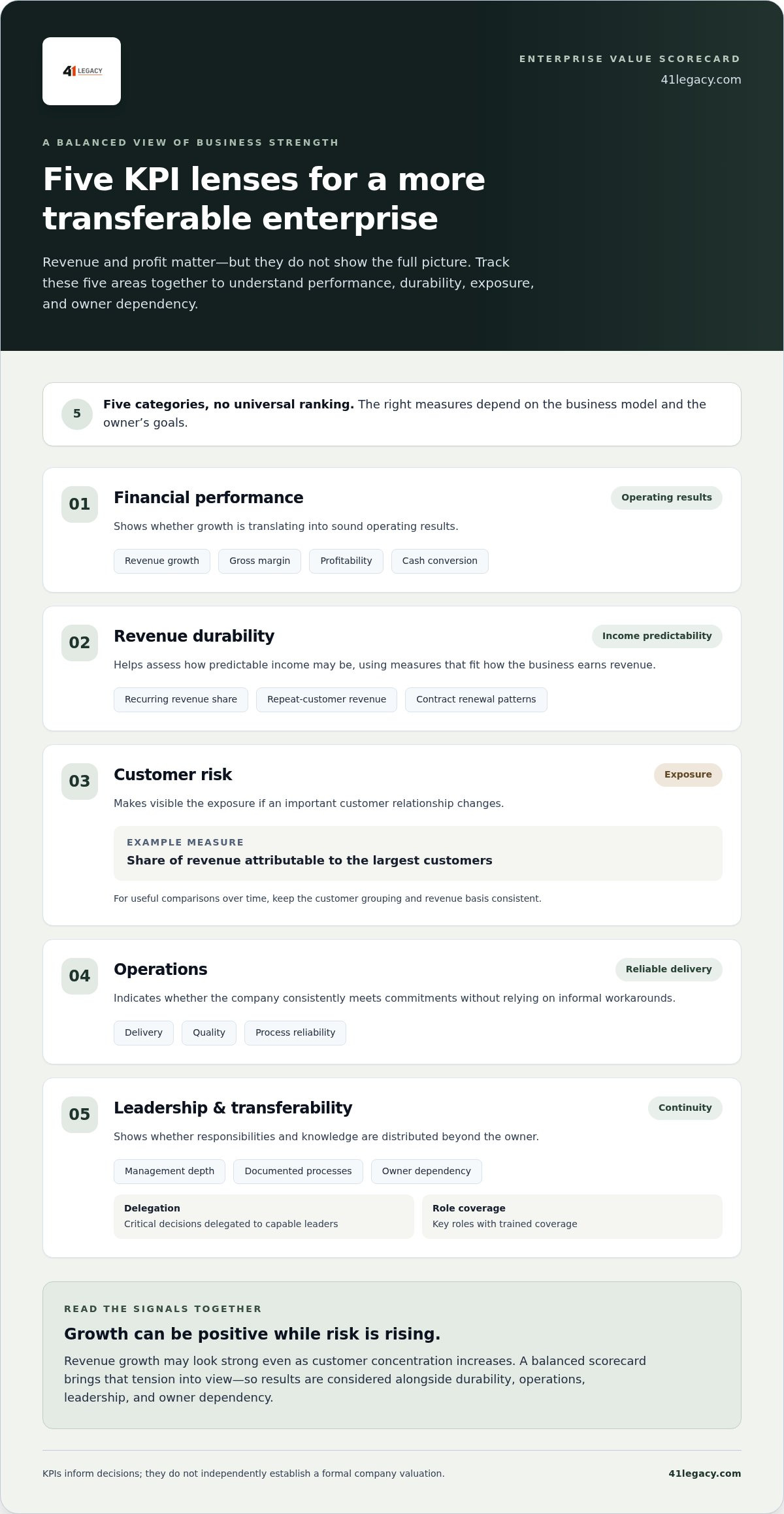
A useful scorecard looks beyond growth to the quality and durability of that growth. The right measures depend on the business model and the owner’s goals, but five categories offer a practical starting point: financial performance, revenue durability, customer risk, operations, and leadership. Together, they help show where the business is performing well and where continuity or resilience may be exposed.
CFO.com’s coverage of an EY survey makes the case that enterprise value metrics need to be reevaluated beyond traditional financial measures. For owners setting KPIs to track enterprise value, a balanced view can make risks visible that revenue and profit alone may not reveal.
- Financial performance: Revenue growth, gross margin, profitability, and cash conversion can show whether growth is translating into sound operating results. They don’t explain every cause or establish value on their own.
- Revenue durability: Recurring revenue share, repeat-customer revenue, or contract renewal patterns can help assess how predictable income may be. Choose measures that fit how the business earns revenue.
- Customer risk: Customer concentration, such as the share of revenue attributable to the largest customers, helps reveal exposure if a key relationship changes. Track it using the same customer grouping and revenue basis over time.
- Operations: Measures tied to delivery, quality, or process reliability can indicate whether the company consistently meets commitments without relying on informal workarounds.
- Leadership and transferability: Management depth, documented processes, and owner dependency can show whether responsibilities are distributed. For example, track critical decisions delegated to capable leaders or key roles with trained coverage.
Which financial KPIs can help show performance quality?
Revenue growth shows whether sales are expanding, while gross margin indicates how much revenue remains after direct costs. Cash conversion helps owners examine how effectively operating activity becomes available cash, and profitability shows whether the business is generating earnings after expenses. Each measure has limits: strong growth can coexist with weak margins, and profitability alone says little about customer concentration or founder reliance.
There are no universal targets that fit every company. Compare results with the business’s own history and strategy, and define each measure precisely, including its data source and reporting period. For example, be consistent about which revenue period you use when calculating customer concentration. That consistency is essential for meaningful comparisons.
How can owners measure durability and transferability?
Pair financial results with indicators of continuity: recurring revenue share, customer concentration, documented critical processes, and leadership coverage. For additional strategic context, see our guide to increasing enterprise value. If selecting and connecting these measures to owner priorities is difficult, enterprise value guidance for business owners can help bring the scorecard into focus.
How Do You Choose KPIs That Track Enterprise Value Rather Than Vanity?
A larger dashboard doesn’t automatically create greater enterprise value. Every measure takes attention to define, review, and act on, so the goal is not to track everything. It’s to select indicators that clarify progress toward the owner’s priorities and reveal where a decision is needed.
Use five tests before adding a KPI:
- Strategic relevance: Does it connect to a stated priority, such as more durable revenue or less dependence on the founder?
- Clear definition: Can the team explain exactly what’s included and how the measure is calculated?
- Reliable data: Is there a credible, repeatable source for the information?
- Accountable owner: Is one person responsible for reviewing the result and raising concerns?
- Actionable response: Could a change in the measure lead to a specific decision or follow-up?
If a metric has no clear purpose, dependable source, or owner, leave it off the initial scorecard. Begin with a focused set tied to current priorities, then refine it as the business learns which measures are useful and where data quality needs work. For instance, if customer concentration matters but customer records are inconsistent, address the definition and data source before relying on the KPI to guide decisions.
How do leading and lagging indicators complement each other?
Leading indicators signal activity or conditions that may shape future results. Lagging indicators record outcomes that have already occurred. Pair them when there’s a plausible connection, then examine the relationship using the company’s own data over time. A pattern between two measures is a reason to investigate, not proof that one caused the other.
Leading indicator: A measure of an operational driver or early signal. Useful for spotting a potential issue while there may still be time to respond.
Lagging indicator: A measure of a recorded result, such as completed revenue or realized profitability. Useful for assessing what happened and whether earlier actions appear to be working.
For example, a company might track the timeliness of customer follow-ups alongside customer renewals. The first shows whether the planned activity is happening; the second records an outcome. Review both consistently, and test whether changes move together before treating the activity as a reliable driver.
How can you distinguish useful KPIs from vanity metrics?
Ask one direct question: What decision would change if this number moved? If the answer is unclear, the measure may describe activity without helping manage a strategic priority. A high count can look impressive while saying little about revenue quality, resilience, or transferability.
Use consistent definitions, sources, owners, and review periods so comparisons are meaningful. Setting KPIs to track enterprise value is an iterative discipline: start with measures the business can trust, learn from the results, and adjust the scorecard as priorities evolve. For broader enterprise value strategy support, connect KPI findings to sequenced priorities and follow-through.
How Do You Implement and Review an Enterprise-Value KPI Scorecard?
A scorecard only matters if it changes how the business is managed. Setting KPIs to track enterprise value means building a repeatable process that moves from priority to evidence, then from evidence to action.
- Choose a priority: Identify a business condition tied to the owner’s goals, such as improving revenue durability or reducing reliance on the founder.
- Define the measure: State what will be counted, how it will be calculated, and what the result is intended to reveal.
- Assign accountability: Name the person responsible for the measure and for explaining material changes.
- Record the source and period: Identify where the data comes from and establish a consistent reporting period.
- Review and act: Set a review date, examine the result against a baseline, and document any next step.
Establish the baseline before setting an improvement expectation. A reliable history gives the owner context for normal variation and helps distinguish a meaningful shift from a change in reporting or timing.
What should each KPI definition include?
Document the measure, calculation method, data source, reporting period, and accountable owner. Also record exclusions, such as which transactions or customer groups are omitted, and note any later changes to the definition. Without that discipline, apparent improvement may reflect a changed calculation rather than a changed business condition. Set a target only when it follows from the company’s strategy, a dependable baseline, and its operating context.
For each review, record the result, variance from the baseline or target, likely causes, next action, person responsible, and follow-up date. This creates a clear line between what the scorecard signals and what management decides to do.
A useful KPI review is a decision-and-action process, not a reporting ritual.
How often should owners review enterprise-value KPIs?
Match the review rhythm to how often reliable data becomes available and how quickly management can respond. Operational measures may call for closer check-ins, while broader reviews can examine strategic value drivers, risk, and transferability. Treat exceptions as prompts to investigate, not automatic crises. Ask whether the change is real, what may explain it, and whether action is warranted.
Keep measurement connected to execution. 41 Legacy’s strategic advisory support connects KPI findings with accountable priorities for transferability and enterprise value.
How Can 41 Legacy Connect KPI Tracking to a Value Growth Roadmap?
A KPI scorecard shows what the business is measuring. A diagnostic helps clarify why those measures matter to the owner’s goals. 41 Legacy uses enterprise diagnostics to examine current conditions, strengths, risks, and transferability questions, then identify gaps between the business as it stands and the enterprise the owner intends to build.
For example, a scorecard may show steady revenue alongside high customer concentration or key decisions that still depend on the founder. Those signals point to different priorities than revenue growth alone. The diagnostic helps interpret the findings in context and determine which conditions deserve attention first. For background on preparing for a future transition, explore this exit planning guidance.
How can diagnostics turn KPI findings into priorities?
Diagnostic findings can anchor a Value Growth Roadmap: a sequenced plan that connects selected KPIs to specific priorities, accountable people, and follow-up. If reporting shows that customer relationships are concentrated with the owner, for instance, a priority may be to develop relationship coverage across the leadership team. A related KPI could track progress in assigning and documenting that coverage.
The sequence matters. Trying to change every measure at once can divide attention and make ownership unclear. A focused roadmap identifies the most relevant actions, clarifies who is responsible, and uses KPI reviews to assess whether execution is moving in the intended direction. The scorecard then becomes part of a practical management process, not a collection of numbers detached from the owner’s objectives.
What does ongoing implementation support add?
Priorities need consistent attention after they’re identified. Through ongoing strategic advisory and monthly implementation support, 41 Legacy helps keep roadmap actions, accountability, and measurement connected. Strategic reviews can surface delays, changing conditions, or results that call for a revised action. The aim is to maintain focus while adapting the plan thoughtfully, not to treat every change in a KPI as a crisis.
41 Legacy also acts as a strategic quarterback, coordinating the owner’s existing CPAs, attorneys, and other professional advisors around shared enterprise priorities. Each advisor brings a distinct role; coordination helps keep their work aligned with the owner’s goals for transferability and reduced owner dependency, without replacing their professional advice.
For owners ready to connect measurement with execution, 41 Legacy’s strategic advisory support brings together a diagnostic, a focused Value Growth Roadmap, and structured follow-through to help turn setting KPIs to track enterprise value into a disciplined effort to strengthen the business as a transferable asset.
Turn KPI Insight Into Lasting Enterprise Strength
A useful KPI system does more than report results. It connects financial performance with revenue durability, risk, and transferability, then gives leaders a clear basis for action. The strongest scorecards stay focused: each measure has a reliable definition, an accountable owner, and a review process that leads to decisions.
Setting KPIs to track enterprise value is an ongoing discipline, not a one-time dashboard exercise. Start with the business’s priorities, establish a dependable baseline, and use findings to guide practical steps that reduce owner dependency and strengthen the enterprise over time.
41 Legacy, led by Chris Giammarco, a Certified Exit Planning Advisor, combines enterprise diagnostics, a Value Growth Roadmap, and monthly implementation support to connect measurement with accountable execution. Explore 41 Legacy’s enterprise-value advisory approach to connect your KPIs with a focused path forward.
Your business is an asset you’re stewarding for the future. With clear priorities and consistent follow-through, you can build one that is better prepared to thrive beyond its founder.
Frequently Asked Questions
What KPIs should I track to measure enterprise value?
Setting KPIs to track enterprise value starts with measures that reflect your company’s strategy, risks, and available data. A useful scorecard may cover financial performance, revenue durability, customer concentration, operating consistency, management depth, and owner dependency. Define each measure consistently, identify a reliable data source, and assign someone to review it. No single KPI establishes enterprise value or guarantees a particular valuation, so interpret indicators together and use them to guide decisions.
How many KPIs should a business track?
There’s no universally correct number of KPIs. Begin with a focused set covering the business’s most important value drivers and risks, rather than adding every available metric to a dashboard. Each measure should have a clear definition, reliable source, accountable owner, and purpose for review. Ask what decision a KPI informs. If leaders can’t explain what they would do differently based on its result, reconsider whether it belongs on the core scorecard.
What is the difference between a KPI and a value driver?
A value driver is a business condition that may influence performance, resilience, or transferability. A KPI is a defined measure used to monitor a relevant condition over time. For example, customer concentration may be a value-driver concern, while the largest customer’s share of revenue can help track that exposure. The measure provides a signal, not a complete assessment. Its meaning depends on context, and it doesn’t establish a valuation by itself.
Are revenue and EBITDA enough to track enterprise value?
Revenue and EBITDA, or earnings before interest, taxes, depreciation, and amortization, provide important financial information, but they don’t show every factor affecting resilience or transferability. Owners may also assess revenue durability, customer concentration, operating consistency, management depth, and reliance on the founder. Choose measures that fit the business model, then interpret financial and nonfinancial indicators together. A strong result in one area can coexist with material exposure elsewhere.
How often should a company review its enterprise-value KPIs?
Set review timing according to how often reliable data is available and how quickly management can respond. Operational indicators may warrant more frequent check-ins, while broader strategic measures can be reviewed periodically. Keep definitions and reporting periods consistent so changes are comparable. For meaningful variances, record what changed, possible explanations, the next action, who owns it, and when it will be revisited. A variance prompts investigation, not necessarily a crisis.
Can tracking KPIs increase enterprise value?
Tracking KPIs alone doesn’t increase enterprise value. It makes performance, risks, and progress more visible, giving owners a basis for informed decisions and follow-through. Any benefit depends on choosing relevant measures, using dependable data, and acting on what the results reveal. Connect the scorecard to strategic priorities such as improving transferability or reducing owner dependency. Treat KPIs as tools for execution, not as a promise or direct measure of a valuation outcome.

Article by
Mike Laskowski
Mike Laskowski is a Business Value Growth Strategist who helps business owners uncover the truths that drive their performance, risk, and readiness. Blending forensic interviewing from a 26‑year federal career with Strategic Capacity analysis and CEPA methodology, he works upstream to reduce owner dependency, increase transferability, and strengthen enterprise value. Mike guides founders through clarity, operational evolution, and transition readiness so their companies become transferable, owner‑independent assets that endure beyond the founder.
Disclaimer
This article is for educational and informational purposes only and does not provide legal, tax, investment, or business brokerage advice. 41 Legacy does not offer M&A brokerage services, legal document drafting, tax preparation, or investment advisory services. Business owners should consult licensed professionals in those disciplines before making decisions related to business transactions, legal matters, tax strategy, or financial planning. All examples are illustrative and may not apply to your specific situation.

