
Transferability & Owner Dependency
What Is a Recapitalization Exit Strategy? A Guide for Strategic Business Owners
What if the most sophisticated way to preserve your legacy isn't to walk away, but to recalibrate the very foundation of your ownership? For the strategic owner, understanding what is a recapitalization exit strategy represents the transition from being a prisoner of one's success to becoming a true steward of an enduring asset. It's a method of achieving equilibrium; it allows you to extract significant personal liquidity while retaining the ability to guide the company toward its ultimate potential.
It's natural to feel a sense of weight when your entire net worth is locked within a single, illiquid entity. You've built something of substance, yet the risks of concentration remain uncomfortably high. This guide will show you how a recapitalization transforms your business into a transferable asset while securing the immediate capital you've earned. We'll explore how to leverage the current market, where U.S. private equity dry powder stands at approximately $880 billion, to diversify your wealth and find the precise partner needed to scale your vision. We'll examine the technical mechanics of de-risking your life's work and creating a clear, disciplined path toward a future transition through structured advisory and transferability engineering.
Key Takeaways
- Define the strategic transition from operator to steward by understanding what is a recapitalization exit strategy and its role in securing immediate liquidity.
- Master the art of de-risking your personal wealth by diversifying capital without surrendering the potential for significant future enterprise value growth.
- Analyze the "second bite of the apple" concept, where retaining a minority stake in a scaled organization can yield greater returns than a full initial sale.
- Utilize an Exit Readiness Assessment to identify critical value gaps and transform your business into a transferable asset that thrives independently of your presence.
- Recognize the importance of a coordinated advisory team to ensure that technical financial restructuring remains aligned with your enduring legacy goals.
Defining Recapitalization: The Strategic Bridge for Business Owners
To the dedicated founder, a business is far more than a collection of accounts and equipment; it's a living testament to years of disciplined effort and vision. Yet, there comes a season when the risks of keeping one's entire legacy tied to a single, illiquid entity become too significant to ignore. This is where we begin to explore what is a recapitalization exit strategy. At its core, Recapitalization is the intentional restructuring of a company's debt and equity ratio to unlock value while maintaining a meaningful ownership stake.
This process facilitates a profound shift in identity. You move from the daily exhaustion of the owner-operator to the elevated position of a strategic partner or steward. It's about engineering a transferable asset, one that possesses the structural integrity to thrive long after your direct involvement ceases. We view this not as an end, but as a sophisticated refinement of your life's work. Building a transferable asset requires a meticulous focus on reducing owner-dependency. When a founder is the sole repository of institutional knowledge, the business remains a job rather than a true asset. A recapitalization forces a rigorous diagnostic of these dependencies, demanding that we build systems and leadership teams capable of carrying the legacy forward.
The Essence of the 'Recap' Strategy
Often referred to as a partial exit or re-equitization, this strategy invites sophisticated capital partners, such as private equity firms or family offices, into the company's story. These partners don't just provide liquidity; they bring the specialized resources and strategic capacity necessary to scale the enterprise beyond its current horizon. Recapitalization is a strategic alignment of capital to support the next phase of enterprise growth. By choosing this path, you secure your personal financial future today while retaining an interest in the company's future triumphs. It allows for the preservation of the brand's heritage while injecting the modern capital required for expansion.
Recapitalization vs. Traditional Business Sale
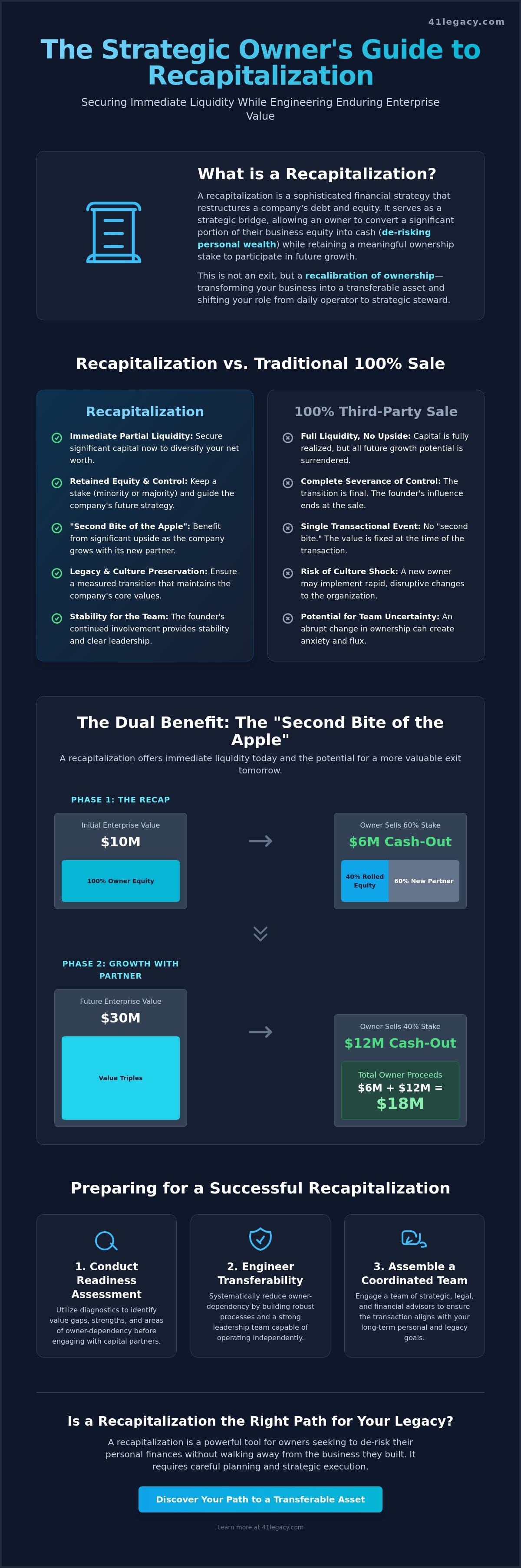
A traditional 100% third-party sale often feels like a severance. It's a rapid, sometimes jarring transition that can leave employees and culture in a state of flux. In contrast, choosing what is a recapitalization exit strategy over a total divestiture offers a more measured pace. While a full sale removes you from the helm entirely, a recap allows you to transition your role gradually. You remain a guardian of the company's culture and values, ensuring that the essence of the organization isn't lost in the transition.
The impact on the organization is typically one of stability. Employees see a founder who's still invested, both literally and figuratively, in the company's success. This approach prioritizes the long-term health of the enterprise over a simple transactional exit. It ensures that the craftsmanship and precision you've instilled remain the guiding principles as the financial structure evolves to meet new global demands. The timeline becomes a collaborative bridge between the founder’s era and the company’s future.
How a Recapitalization Strategy Functions: Minority vs. Majority Stakes
Understanding what is a recapitalization exit strategy requires looking beneath the surface of the balance sheet to the very architecture of the company’s capital. It's a precise reorganization of the capital stack, the layers of debt and equity that fund the enterprise. By recalibrating these layers, an owner can extract significant value while ensuring the business has the fuel required for its next chapter. This is not a simple transaction; it's an act of financial engineering designed to harmonize personal liquidity with corporate longevity.
The mechanics often involve two distinct paths. A Dividend Recapitalization allows the company to assume new debt to fund a one-time distribution to shareholders. This path is attractive because it provides liquidity without requiring the founder to surrender equity. Conversely, an Equity Recapitalization introduces a fresh partner who buys a portion of the company’s shares. Both methods rely heavily on the company’s EBITDA and debt-to-equity ratios. With the Prime Rate at 6.75% and the 30-day average SOFR at 3.59% as of June 2026, the cost of debt remains a critical factor. Sophisticated owners must weigh these benchmarks carefully to ensure the new debt load doesn't stifle the company’s creative or operational capacity.
Minority Recapitalization: Retaining the Helm
A minority recapitalization involves selling 20% to 49% of the company’s equity. This is the preferred route for owners who possess a long time horizon, perhaps five to ten years, and aren't ready to relinquish their role as the primary steward. It provides the "dry powder" needed for expansion while allowing the founder to remain in control. However, bringing in a minority partner is a delicate endeavor. Without a clear Value Growth Roadmap, the introduction of an outside voice can lead to strategic friction. The goal is to find a partner whose vision for excellence mirrors your own.
Majority Recapitalization: Partnering for Scale
In a majority recapitalization, the owner typically sells 51% to 80% of the entity to a private equity firm or family office. This represents a profound de-risking event, moving the majority of the owner's wealth into a personal, liquid bucket. The trade-off is the loss of ultimate control. In the current 2026 market, private equity groups are increasingly selective. They prioritize Owner Dependency Reduction, seeking businesses where the essence of the brand is codified into systems rather than residing solely in the founder’s mind. They aren't just looking for cash flow; they're looking for a transferable asset that can thrive under their stewardship and eventually lead to a second, even larger exit.
The Dual Benefit: Immediate Liquidity and the Second Bite of the Apple
The decision to pursue a recapitalization often stems from a desire for equilibrium. For the founder who has weathered decades of market volatility, the prospect of moving wealth from the business bucket into a diversified personal bucket offers a profound sense of security. This de-risking event is the primary catalyst for many considering what is a recapitalization exit strategy. It allows you to secure your family's future while remaining at the helm of the organization you spent a lifetime building. By extracting a significant portion of your equity today, you transform an illiquid asset into a foundation for personal freedom.
The true elegance of this strategy lies in the concept of the second bite of the apple. By retaining a 20% to 30% stake in the newly restructured entity, you align yourself with a partner whose sole objective is to scale the enterprise. These institutional partners bring a strategic capacity, such as access to global talent, advanced technologies, and acquisition capital, that few founders can access independently. During the typical holding period, which median data shows was approximately 5.4 years in 2024, the goal is to professionalize the business and reduce owner-dependency. When the final exit occurs, that retained minority stake can often exceed the value of the original majority sale because the company is exiting at a higher EBITDA and a potentially expanded valuation multiple.
Why Business Owners Choose Recapitalization in 2026
In 2026, the landscape for these transactions remains robust. U.S. based private equity funds are currently holding approximately $880 billion in dry powder, according to data from late 2025. This surplus of capital creates a competitive environment for high quality, stable assets. For families navigating internal transitions or management teams looking to buy into the legacy, a recapitalization provides the necessary structure to facilitate these handoffs without compromising the company’s competitive edge. It ensures the business has the resources to thrive in an increasingly consolidated market where scale is often a prerequisite for survival.
Calculating the Real Potential of the 'Second Bite'
Success in the second exit isn't guaranteed by the partnership alone; it requires a disciplined focus on closing the Value Gap. This gap represents the difference between your current enterprise value and the amount required to fund your ultimate lifestyle and legacy goals. Strategic partners drive EBITDA growth through operational efficiencies and bolt-on acquisitions, but the owner must ensure the business is truly transferable. A business that remains dependent on the founder’s personal relationships or intuition won't command the premium multiple seen in institutional grade assets. Preparing for that final liquidity event starts on the day the first recapitalization is signed.
Preparing for a Recap: Closing the Value Gap and Ensuring Transferability
The architecture of a successful recapitalization is built long before the first letter of intent is drafted. For the owner seeking to understand what is a recapitalization exit strategy, the journey must begin with an objective Exit Readiness Assessment. This diagnostic process illuminates the "Value Gap," which is the distance between the current enterprise value and the capital required to fund your ultimate legacy and lifestyle. Bridging this gap requires more than just increasing revenue; it demands the creation of a transferable asset that functions with surgical precision independently of its founder.
Owner dependency is the most significant deterrent to institutional capital. If the business relies on your personal relationships or unique intuition to generate cash flow, it is not yet an asset; it is a high-paying job. Enterprise Diagnostics serve to identify these "red flags" before an investor does. By uncovering hidden risks in your organizational structure, you can address them on your own terms rather than defending them during a high-pressure negotiation. This proactive approach ensures that the essence of the business is codified into its systems and culture. It transforms the company from a personal endeavor into a durable institution.
The Value Growth Roadmap
A structured Value Growth Roadmap prioritizes the specific improvements that drive the highest valuation multiples. This involves Transferability Engineering, the process of documenting and optimizing every critical workflow to ensure a seamless transition. Additionally, we must conduct a Strategic Capacity Evaluation. This evaluates the company’s ability to absorb the aggressive growth an investor will expect post-recap. If the foundation is brittle, the weight of new capital will only expose the cracks. Building capacity today ensures you can handle the scale of tomorrow.
Reducing Risks That Devalue Your Enterprise
Institutional investors seek predictability above all else. This requires cleaning up financial statements and moving toward rigorous pro-forma forecasting that mirrors reality. Operational continuity is secured through the documentation of Standard Operating Procedures (SOPs), ensuring that craftsmanship remains consistent across the organization. We must also address customer concentration. If a single client represents more than 15 percent of revenue, the perceived risk can significantly erode your enterprise value. By diversifying your client base and addressing key-man risks within your leadership team, you prepare the business for the scrutiny of a sophisticated partner.
To ensure your business is prepared for this level of scrutiny, consider beginning with a comprehensive Strategic Capacity Evaluation to identify your most impactful growth levers.
Navigating the Transition: The Role of a Coordinated Advisory Team
The execution of a sophisticated capital restructuring is never a solitary endeavor; it's an exercise in meticulous orchestration. For the visionary owner, determining what is a recapitalization exit strategy is merely the first step in a broader narrative of stewardship. This process is a team sport that demands the synchronized efforts of CPAs, attorneys, and exit planners. Without a central Quarterback to harmonize these distinct voices, the complexity of the transaction can lead to fragmented advice and strategic drift. A coordinated team helps you define exactly what is a recapitalization exit strategy for your specific enterprise, ensuring the capital stack supports your personal freedom and the company's future. At 41 Legacy, we provide the Strategic Advisory necessary to ensure that every technical refinement aligns with the owner’s long-term vision for their Third Act.
Aligning Professional Advisors
CPAs focus on the nuances of tax mitigation, navigating the 2026 long-term capital gains landscape where rates of 15% or 20% apply to most high-income earners, alongside the 3.8% Net Investment Income Tax. Simultaneously, the attorney must meticulously craft the operating agreement to protect the owner’s interests in the retained minority stake, ensuring rights are preserved for the second bite. When these professionals operate in silos, the resulting deal fatigue can jeopardize the entire transition. A coordinated approach ensures that the financial engineering remains subservient to the overarching goal of building a lasting impact. It prevents conflicting advice from stalling the momentum needed to reach the closing table.
Stewardship and the Long-Term Vision
Maintaining focus on enterprise value requires looking beyond the immediate liquidity event to the eventual full transition. The most successful recapitalizations occur when the founder finds a partner whose values mirror the company’s heritage. Cultural fit is the invisible thread that holds the partnership together during the three to seven year professionalization phase. It ensures that the craftsmanship and dedication that built the brand remain its guiding principles as it scales toward a final exit. By treating the business as a living entity with a story to tell, you ensure its essence remains intact throughout the evolution. This level of stewardship transforms a simple transaction into a legacy-defining achievement.
Start your journey toward a transferable asset with an Exit Readiness Assessment.
Refining Your Legacy for the Next Chapter
The transition from a founder-led company to a transferable asset is the ultimate mark of institutional maturity. By mastering what is a recapitalization exit strategy, you ensure that your life's work is no longer a source of personal risk; instead, it becomes a foundation for enduring impact. This path allows you to secure immediate liquidity today while positioning yourself for a more significant secondary exit tomorrow. It is a disciplined approach to stewardship that honors the history of the brand while inviting the capital necessary for future excellence.
Achieving this level of strategic clarity requires a partner who understands the intricacies of transferability and enterprise value. Our national strategic advisory, led by a Certified Exit Planning Advisor (CEPA), specializes in owner dependency reduction and the engineering of durable assets. We invite you to secure your legacy with a professional Exit Readiness Assessment. By addressing the Value Gap now, you prepare your business to thrive independently and command the respect of the world's most sophisticated partners. Your journey toward a refined and resilient future begins with a single, precise step.
Frequently Asked Questions
Is a recapitalization better than selling my business entirely?
Whether a recapitalization is superior to a full sale depends entirely on your personal timeline and the vision you hold for your legacy. A recapitalization serves as a strategic bridge for owners who aren't ready to retire but wish to diversify their personal wealth. It allows you to extract significant liquidity while maintaining a meaningful stake in the company’s future triumphs.
What is the 'second bite of the apple' in a recapitalization?
The "second bite" refers to the secondary liquidity event that occurs when you eventually sell your retained minority stake. Because a strategic partner helps professionalize the organization and drive EBITDA growth, your remaining 20% to 30% interest can often be worth as much as, or more than, the original majority stake you sold. It's a method of capturing the value created by institutional-grade scaling.
How much control do I lose in a majority recapitalization?
In a majority recapitalization, you typically relinquish ultimate board control and final decision-making authority to the lead investor. While you may remain in an influential role as CEO or Chairman, you'll operate within a governance structure that requires alignment with the partner’s strategic objectives. This shift requires a profound transition from owner-operator to a collaborative partner focused on enterprise growth.
Does a recapitalization involve taking on more debt?
Yes, many structures utilize senior or subordinated debt to fund the distribution to existing shareholders. This leverage must be managed with surgical precision to ensure the company’s debt-to-equity ratio remains healthy. The goal is to use debt as a tool for liquidity without compromising the organization's ability to invest in craftsmanship or operational excellence.
What is the difference between a dividend recap and an equity recap?
A dividend recapitalization uses debt to fund a one-time distribution to current owners without altering the ownership percentages. An equity recapitalization involves a new partner purchasing a portion of the company’s shares. This latter path brings both fresh capital and the strategic capacity required to transform the business into a truly transferable asset.
How long does a recapitalization process usually take?
The journey from the initial diagnostic to the final closing typically spans six to nine months. This unhurried rhythm allows for the rigorous preparation of the enterprise, including the reduction of owner dependency and the documentation of critical systems. It ensures that the partner selected is a perfect cultural fit for the company’s enduring legacy.
Can I use a recapitalization to fund a family business transition?
Understanding what is a recapitalization exit strategy is vital for family transitions, as it allows the senior generation to extract their earned equity while the next generation retains a stake. It provides the liquidity needed for the founders to de-risk their lives without forcing a 100% third-party sale. This structure preserves the family heritage while professionalizing the business for future leadership.
What are the tax implications of a recapitalization exit strategy?
Executing what is a recapitalization exit strategy typically triggers capital gains taxes on the portion of equity you sell. While 2026 long-term capital gains rates are 15% or 20% for high earners, the specific structure of the deal can significantly impact your net proceeds. You should coordinate with a CPA to ensure the transaction is structured to support your long-term financial health.
Disclaimer
This article is for educational and informational purposes only and does not provide legal, tax, investment, or business brokerage advice. 41 Legacy does not offer M&A brokerage services, legal document drafting, tax preparation, or investment advisory services. Business owners should consult licensed professionals in those disciplines before making decisions related to business transactions, legal matters, tax strategy, or financial planning. All examples are illustrative and may not apply to your specific situation.