
Quarterly Strategic Review: Guide for Business Owners
Your quarterly review should change what happens next, not simply record what happened last. A well-designed quarterly strategic review process gives business owners a disciplined way to examine performance, test assumptions, resolve strategic questions, and set priorities that carry forward beyond the meeting.
If reviews drift into status updates or action items lose momentum between quarters, the issue may not be a lack of effort. Leaders need consistent evidence, clear decisions, and named owners to turn strategy into progress. That discipline also supports transferability: a business is stronger when priorities are understood and advanced by the team, rather than held in the owner’s head.
This guide shows you how to prepare decision-ready inputs, structure a focused review, and leave with a short list of accountable priorities and follow-up checkpoints. You’ll see how to connect current performance with owner-dependency reduction and long-term enterprise strength, making each quarterly discussion part of a deliberate strategic advisory rhythm.
Key Takeaways
- Set the quarterly review apart from routine operating meetings by centering it on strategic questions and decisions.
- Prepare a concise evidence pack that compares results with plan and prior periods, while separating recurring patterns from one-off events.
- Use a clear sequence to move from business evidence to interpretation, decisions, and assigned next steps.
- Make the quarterly strategic review process actionable by giving each priority an owner, a defined outcome, and a follow-up checkpoint.
- Use recurring reviews to identify dependencies that could limit performance beyond the founder and weaken long-term transferability.
What a Quarterly Strategic Review Process Is, and What It Should Decide
A quarterly strategic review is a recurring leadership forum for examining business evidence, testing the assumptions behind the plan, and deciding what should change, continue, or receive greater attention. A quarterly strategic review process links evidence about business performance to deliberate choices about the company’s direction and priorities.
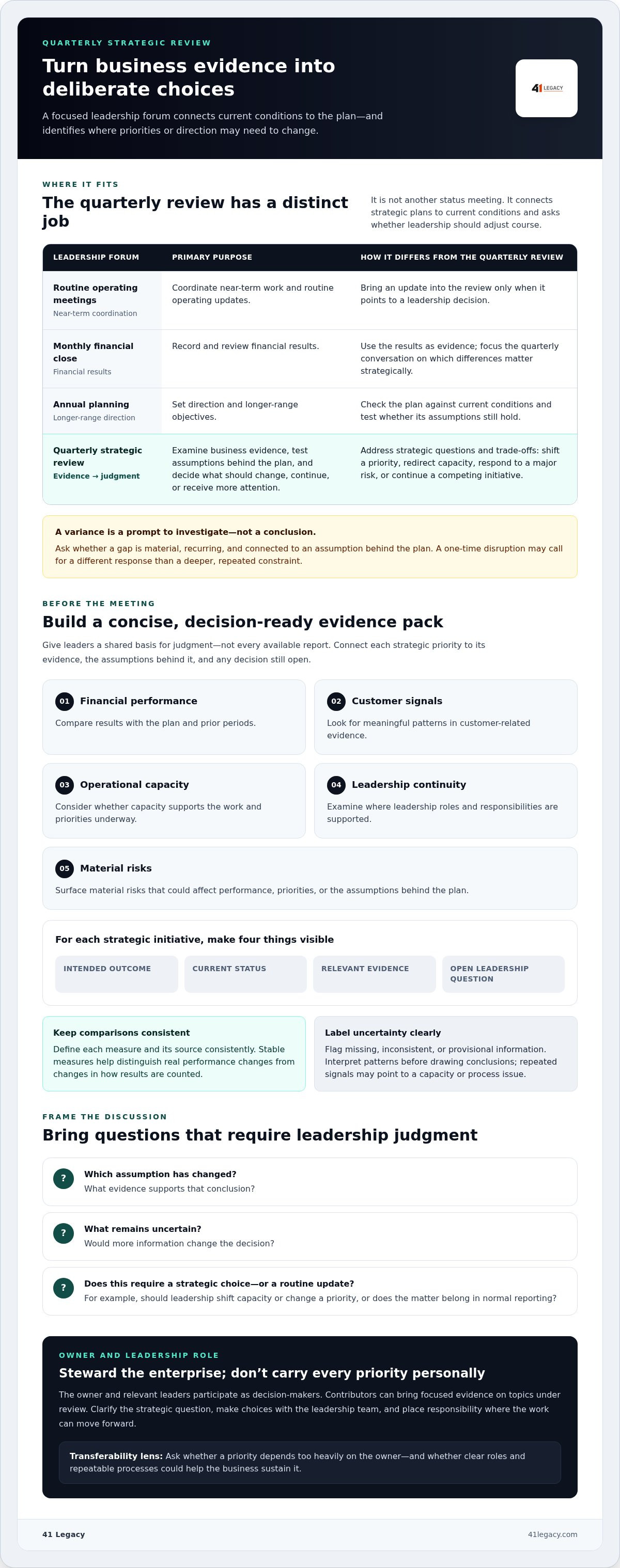
It draws on the broader discipline of strategic management, but it serves a distinct purpose in the leadership calendar. Routine operating meetings coordinate near-term work. A monthly financial close records and reviews financial results. Annual planning sets direction and longer-range objectives. The quarterly review connects those plans to current conditions and asks whether leadership should adjust course.
The goal isn’t to explain every variance. It’s to determine which differences matter strategically. A missed target may reflect a one-time disruption, or it may signal a deeper constraint that calls for a change in priorities, capacity, or leadership attention. Start by asking whether the gap is material, recurring, and connected to an assumption behind the plan.
Which decisions belong in a quarterly strategic review?
Bring forward questions that require leadership judgment or a trade-off. These may include whether to shift a strategic priority, redirect capacity, respond to a major risk, or continue an initiative competing with other important work. For example, if a new growth effort depends on the same people needed to improve an existing operation, leaders may need to decide which work receives capacity first and what will be delayed.
Routine updates belong in normal reporting unless they point to a decision. Use owner dependency and transferability as useful lenses, not automatic conclusions: ask whether a priority relies too heavily on the owner and whether the business can sustain it through clear roles and repeatable processes.
Who should participate, and what is the owner’s role?
The owner and relevant leaders should participate as decision-makers. Invite other contributors to provide focused evidence on the topics under review, rather than turning the meeting into a broad reporting session. Professional advisors may contribute within their expertise and existing client relationships, helping the owner consider relevant perspectives without replacing leadership’s responsibility for business decisions.
The owner’s role is to steward the enterprise, not to supply every answer or carry every priority personally. Clarify the strategic question, make choices with the leadership team, and place responsibility where the work can move forward. Over time, this discipline can reveal where performance depends on the owner’s direct involvement and where stronger leadership capacity or processes could support a more transferable business.
How to Prepare for a Quarterly Strategic Review with Decision-Ready Evidence
A productive quarterly strategic review begins before leaders enter the room. Prepare a concise pre-read that connects each strategic priority to the evidence, the assumptions behind it, and any decision that remains open. The purpose isn’t to assemble every available report. It’s to give leaders a shared, reliable basis for judgment.
Build a focused quarterly review pack
Include a balanced view of the business: financial performance, customer signals, operational capacity, leadership continuity, and material risks. For each strategic initiative, show its intended outcome, current status, relevant evidence, and the question leadership needs to resolve. A compact table can make gaps and trade-offs easier to see.
Use a small set of indicators tied to the priorities under review. Define each measure and its source consistently, then compare current results with the plan and prior periods. Consistent measures make quarter-to-quarter comparisons more useful because leaders can distinguish real changes in performance from changes in how results are counted.
Interpret the pattern before drawing a conclusion. A temporary customer delay may explain a single-period shortfall; repeated delays across periods could point to a capacity or process issue. Flag missing, inconsistent, or provisional information rather than presenting uncertain figures as settled facts. For value-related questions, evidence about customer concentration, leadership continuity, or reliance on the owner can inform the wider discussion of enterprise value.
Frame the questions before the meeting
For each priority, write down what leaders need to determine:
- Which assumption has changed, and what evidence supports that conclusion?
- What remains uncertain, and would more information change the decision?
- Does this require leadership judgment, such as shifting capacity or changing a priority, or is it a routine update for normal reporting?
These questions keep the pre-read focused on choices rather than description. They also help contributors prepare evidence relevant to the decision, not simply a longer account of activity. For additional guidance on structuring the discussion, Dale Carnegie explains how to run a quarterly review meeting with a clear narrative.
A disciplined quarterly strategic review process makes evidence usable: leaders can see what the business planned, what the results suggest, and where judgment is required. Owners seeking to connect recurring reviews with a broader plan for enterprise strength can explore 41 Legacy’s strategic advisory approach.
Quarterly Strategic Review: From Variance to Choices
A focused quarterly strategic review moves from business signals to decisions, then records who will carry each decision forward. Begin with strategic intent and material changes since the last review. Don’t walk the room through every slide. Keep the discussion anchored to what leadership needs to understand or choose.
Use this sequence to guide the meeting:
- Orient. Restate the priorities under review and note significant changes in the business or its conditions since the previous meeting.
- Examine. Identify meaningful variances between expected and actual results. Select the signals that could affect a strategic priority.
- Interpret. Test possible causes, determine whether the variance is temporary or recurring, and consider how it affects other priorities.
- Decide. Agree on what to change, continue, stop, defer, or investigate. Make trade-offs explicit.
- Assign. Record the decision, accountable owner, unresolved questions, and follow-up date in a shared decision log.
Move from performance signals to strategic meaning
A variance is a signal, not an explanation. If customer response times worsen, for example, the underlying cause could be temporary demand or a lasting capacity constraint. Ask whether the issue affects customer value, execution capacity, risk, or reliance on the owner. Compare results across periods and check for related signals before treating a single deviation as a strategic problem.
Use SWOT analysis only when it helps clarify a specific choice. A list of strengths, weaknesses, opportunities, and threats can organize discussion, but it doesn’t replace the decision. The quarterly strategic review process should leave leaders clearer about what the evidence means and what action follows.
Make trade-offs explicit and record the decision
Before choosing a course, state the options, the evidence supporting each, the assumptions that remain, and the likely consequences. Then name what the team will stop, defer, continue, or investigate so new commitments don’t quietly dilute existing priorities.
A decision log is the shared record of what leaders chose, who owns the next step, and how follow-through will be reviewed. Capture unresolved questions as well as settled choices, and assign each an owner or a date for reconsideration. This gives the next review a clear starting point and makes accountability visible between meetings.
Turn Quarterly Review Decisions into Accountable Priorities
A review isn’t useful just because it happens regularly. It’s useful when leaders make clear decisions and those decisions shape the work that follows. The quarterly strategic review process should produce a manageable set of priorities, not a long list of intentions competing for the same people, time, and attention.
Translate each choice into an observable commitment. Record the intended result, the accountable lead, the first action, and the evidence that will indicate progress. Use a KPI only when it measures a meaningful outcome or an early signal that the outcome is on track. For example, if a decision is intended to reduce reliance on the owner for routine approvals, define which responsibility will shift, who will take it on, and what evidence will show the team can manage it.
Translate strategic choices into observable commitments
A useful priority makes responsibility clear without implying that one person must do all the work. Name the lead who will coordinate progress, then identify dependencies, such as capacity from another team or a decision needed from a professional advisor in their role. Capture those dependencies beside the commitment so they don’t become hidden reasons for delay.
Repeatable execution also supports transferability. Documenting how important work is carried out can help a business rely less on unwritten knowledge held by the owner. See this guide to SOPs and transferability for more on building processes that others can follow.
Keep the process focused between review meetings
Use a short monthly check-in to surface obstacles, confirm progress, and resolve routine dependencies. Keep it distinct from the quarterly discussion: monthly follow-up monitors agreed commitments, while the quarterly meeting considers broader strategic choices. Don’t reopen a decision simply because another meeting is scheduled. Revisit it when material evidence changes or an important assumption no longer holds.
If capacity shifts or the basis for a priority changes, adjust the commitment deliberately. Record what changed and why, including any work the team will pause or defer. That preserves the reasoning behind the choice and gives leaders a reliable point of reference at the next review.
When commitments stall, look beyond whether the owner is doing enough. The issue may be unclear responsibility, missing capacity, or a process that depends on one person’s knowledge. Explore 41 Legacy’s strategic advisory support to connect quarterly priorities with a broader approach to execution, owner-dependency reduction, and transferability.
Connect Quarterly Strategic Reviews to Transferability and Long-Term Value
A quarterly review can reveal more than whether the business is meeting its current plan. Repeated discussions may expose concentrated customer relationships, decisions only the owner can make, undocumented operating knowledge, or leadership capacity that hasn’t kept pace with the company’s needs. Treat these as signals to examine, not automatic conclusions about the business.
Use them to ask a longer-term question: can the company sustain its performance if the founder steps back from day-to-day decisions? The answer may depend on whether capable leaders can act with clear authority, essential processes are understood, and the business has enough capacity to deliver consistently. The exit planning guide offers further perspective for owners considering an internal or external transition.
Use recurring reviews to identify transferability gaps
Look for recurring dependencies in the evidence and decisions reviewed each quarter. Who holds key customer relationships? Which approvals routinely wait for the owner? What important work relies on knowledge that hasn’t been documented? Track whether leadership coverage, repeatable processes, and operating capacity are becoming more resilient over time.
Then frame each gap as a strategic priority to assess, sequence, and revisit. A business may first need to clarify decision authority, then document a critical process, before shifting responsibility. Quarterly reviews provide a way to see whether those changes are taking hold. They also create a record of the issues leaders identified and the actions they chose to address them.
These insights can inform longer-term enterprise decisions, but they don’t promise a particular valuation outcome. They help owners understand the conditions supporting performance and where concentration or execution risk may warrant attention.
When structured strategic support can help
When priorities span several parts of the business, structured support can help clarify the starting point and organize the work. Enterprise diagnostics can help an owner understand current conditions and the gap between those conditions and their goals. A Value Growth Roadmap can then sequence priorities for implementation, rather than treating every identified issue as equally urgent.
41 Legacy’s Strategic Advisory and Monthly Implementation Support provide a coordinated way to work through those priorities alongside an owner’s existing professional advisors. The quarterly strategic review process can serve as one cadence within that broader effort, keeping decisions connected to transferability, reduced owner dependency, and long-term enterprise strength.
Explore strategic support for your business to consider how a structured approach can help connect current priorities with your longer-term goals.
Make Each Quarter Strengthen the Business
A disciplined quarterly strategic review process gives leaders a reliable way to move from evidence to choices, then carry those choices into focused action. Prepare information that helps answer strategic questions, make trade-offs explicit, and assign each priority a clear owner and follow-up checkpoint. The aim isn’t simply to meet on a schedule. It’s to build a business that can sustain performance with less dependence on the founder.
Over time, recurring reviews can reveal where leadership, processes, or key relationships need strengthening. Those insights can guide longer-term decisions about transferability and enterprise value without promising a particular outcome.
41 Legacy’s approach includes enterprise diagnostics, Value Growth Roadmaps, and Monthly Implementation Support, coordinated with an owner’s existing professional advisors. Founder Chris Giammarco is a Certified Exit Planning Advisor (CEPA). Explore strategic support for your business to consider how structured advisory can help turn priorities into lasting progress.
Each thoughtful decision builds on the last. With a clear rhythm and shared accountability, your business can become more resilient and better prepared for what comes next.
Frequently Asked Questions
What is a quarterly strategic review process?
A quarterly strategic review process is a recurring leadership discussion that uses business evidence to test assumptions and make choices about priorities. It asks what to continue, change, stop, or investigate in light of results and business conditions. Unlike routine operating meetings or monthly financial closes, it focuses on strategic direction, material risks, capacity, and leadership trade-offs. The output should be decisions with clear ownership and follow-through.
How do you conduct a quarterly strategic review?
Conduct the review by preparing relevant evidence, then guiding leaders through a structured discussion. Start with strategic intent and material changes since the previous review. Examine important variances, consider whether they reflect a pattern or temporary event, and discuss their effect on priorities. Agree on what to change, continue, or investigate. Record each decision, its owner, unresolved questions, and the next checkpoint so follow-through is clear.
How long should a quarterly strategic review take?
There’s no single duration that suits every company. Set aside enough uninterrupted time to examine the strategic questions and make decisions, with the scope guided by the number and complexity of issues requiring leadership judgment. A concise pre-read helps avoid using meeting time for routine reporting. If key evidence is missing, identify what’s needed and who will provide it rather than extending discussion without a clear basis for action.
Who should attend a quarterly strategic review?
The owner and leaders responsible for the priorities under review should attend as decision-makers. Invite other contributors to present focused evidence on relevant topics, such as customer patterns, operational capacity, or leadership coverage. The owner’s existing professional advisors may contribute within their expertise and client relationships. Keep participation purposeful: each attendee should help interpret evidence, make a decision, or clarify what is needed to carry it out.
What should be included in a quarterly strategic review agenda?
Include a brief review of strategic priorities and material changes, followed by selected performance evidence, important trends, assumptions, risks, and initiatives needing a decision. Reserve discussion for interpreting what the evidence means and weighing options, not reading every report aloud. Close by recording decisions, accountable leads, unresolved questions, and follow-up checkpoints. Include owner-dependency or transferability questions when relevant to the priorities being considered.
How is a quarterly strategic review different from a monthly business review?
A quarterly strategic review examines whether the company’s direction, priorities, and assumptions still fit the evidence. A monthly business review typically focuses on nearer-term performance, operating progress, and obstacles to current commitments. The two can work together: monthly check-ins monitor agreed work, while quarterly discussions consider broader choices. A financial close, by contrast, is a process for completing and reviewing financial records, not a substitute for strategic decision-making.
How can quarterly strategic reviews reduce owner dependency?
Quarterly reviews can reduce owner dependency by making reliance on the owner visible and turning it into a deliberate priority where appropriate. Leaders can identify decisions, key relationships, or operating knowledge concentrated with the founder, then assign actions to build capability, clarify responsibility, or document repeatable work. Track whether those changes are taking hold over time. The aim is to help the business sustain performance beyond the owner’s personal effort.

Article by
Mike Laskowski
Mike Laskowski is a Business Value Growth Strategist who helps business owners uncover the truths that drive their performance, risk, and readiness. Blending forensic interviewing from a 26‑year federal career with Strategic Capacity analysis and CEPA methodology, he works upstream to reduce owner dependency, increase transferability, and strengthen enterprise value. Mike guides founders through clarity, operational evolution, and transition readiness so their companies become transferable, owner‑independent assets that endure beyond the founder.
Disclaimer
This article is for educational and informational purposes only and does not provide legal, tax, investment, or business brokerage advice. 41 Legacy does not offer M&A brokerage services, legal document drafting, tax preparation, or investment advisory services. Business owners should consult licensed professionals in those disciplines before making decisions related to business transactions, legal matters, tax strategy, or financial planning. All examples are illustrative and may not apply to your specific situation.

