
Benchmarking Your Business: A Guide for Owners
What if the competitor with the strongest numbers is the wrong business to measure yourself against? Benchmarking your business against competitors can clarify where performance differs, but only when the comparison is relevant. Competitor data may be incomplete, and industry averages can hide important differences in scale, business model, and strategy.
It’s reasonable to want a clear signal from the numbers. Yet a gap in revenue, margin, or customer retention doesn’t explain its own cause, and a peer’s result isn’t automatically the right target for your company. Use benchmarks as context for better decisions, not as instructions to imitate another business.
This guide will help you select appropriate peers and meaningful measures, distinguish useful performance signals from misleading differences, and turn what you learn into clear priorities. We’ll look at how to interpret gaps, investigate what may be driving them, and evaluate possible actions through both their profit and cash impact and their enterprise-value impact. The goal is a considered view of where to focus and how to strengthen a business that can thrive beyond its owner.
Key Takeaways
- Start benchmarking your business against competitors with a specific decision in mind, then choose peers whose business model, scale, customer mix, and operating structure make the comparison useful.
- Record what each measure shows, how reliable and comparable the data is, and what questions remain before drawing conclusions.
- Separate a visible performance gap from its possible causes. Prioritize actions based on strategic relevance, evidence quality, owner influence, and implementation demands.
- Assess potential decisions through both profit and cash impact and enterprise-value impact, so benchmarks inform priorities without dictating strategy.
- 41 Legacy’s fixed, six-week financial clarity intensive includes one working session per week and weekly deliverables. The scope of each engagement is defined in the client’s written agreement.
Why Benchmarking Your Business Against Competitors Needs a Clear Question
Benchmarking your business against competitors is most useful when it starts with a decision the owner needs to make. Without that purpose, a collection of ratios and industry averages can create activity without clarity. One peer may appear stronger on a particular measure, but the difference alone doesn’t show whether it matters to your strategy or what action could improve your business.
In business, competitor benchmarking is the comparison of selected business measures with relevant external peers to understand performance in context. A benchmark is a reference point, not a prescribed destination. It can help you ask sharper questions, but it can’t tell you to copy another company’s choices.
Benchmarking can cover different forms of comparison, including financial results, performance measures, and operating processes. The overview of benchmarking in business provides wider context on these approaches. For an owner, the useful method depends on the question at hand, not on how many metrics can be assembled.
What business benchmarking can, and cannot, tell an owner
A comparison can show that your gross margin, cash-conversion pattern, or revenue per employee differs from the results reported by a peer group. That difference is a signal to investigate, not an explanation. It doesn’t establish whether the cause is pricing, customer mix, staffing, capacity, or a difference in how the data was measured. Test those possibilities against your own operations and financial information.
Benchmarking also doesn’t determine what a specific company is worth. A peer’s financial measure is not a company-specific valuation, and a favorable comparison does not prove that your business is ready for a transition. External data adds perspective, but it cannot replace a sound understanding of your own cash flow, profitability, operating structure, and owner dependency.
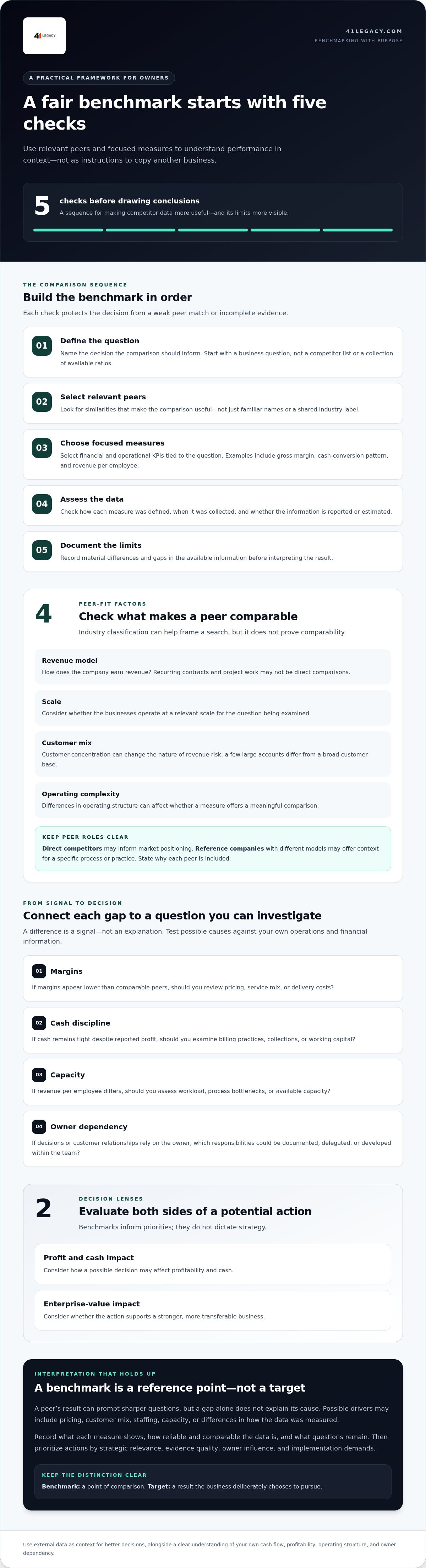
A useful distinction is simple: a benchmark describes a point of comparison; a target is a result you deliberately choose to pursue. The first can inform the second, but it doesn’t set it for you.
Start with the decision, not the competitor list
Write down the decision before searching for peer data. Then choose a measure that can inform that decision and an action within the owner’s influence. For example:
- Margins: If margins appear lower than those of comparable peers, should you review pricing, service mix, or delivery costs?
- Cash discipline: If cash remains tight despite reported profit, should you examine billing practices, collections, or working capital?
- Capacity: If revenue per employee differs, should you assess workload, process bottlenecks, or the use of available capacity?
- Owner dependency: If key decisions or customer relationships rely on the owner, which responsibilities could be documented, delegated, or developed within the team?
Each question connects a comparison to a decision the owner can influence. By contrast, gathering metrics simply because they’re available can consume attention while leaving the underlying business question unanswered. Define the decision first, then let it determine which evidence deserves a place in the comparison.
Choose Comparable Competitors and Measures for a Fair Benchmark
A fair comparison depends on two choices: which businesses belong in the peer group and which measures answer the owner’s question. In benchmarking your business against competitors, a shared industry label is only a starting point. Companies in the same category can earn revenue in different ways, serve different customers, and operate with very different levels of complexity.
Use a deliberate sequence before drawing conclusions:
- Define the question. Identify the decision the comparison should inform.
- Select peers. Look for businesses with relevant similarities, not just familiar names.
- Choose measures. Pick a focused set of financial and operational KPIs tied to the question.
- Assess the data. Check how each measure was defined, when it was collected, and whether it is reported or estimated.
- Document limits. Record material differences and gaps in the available information.
How to select a useful peer group
Start with how a company earns revenue. A firm with recurring contracts may not be a strong direct comparison for one that relies on project work, even if both share an industry label. Then consider scale, customer concentration, and operating complexity. A company serving a few large accounts, for example, may face a different revenue risk from one with a broad customer base.
NAICS categories can help frame an industry search, but classification is not proof of comparability. Treat direct competitors and useful reference companies as distinct groups. Direct competitors may illuminate market positioning; a company with a different model may offer a helpful reference for a specific process or practice. State why each peer is included so the comparison remains interpretable.
Which KPIs should you compare?
Choose measures that connect to the decision, rather than building an exhaustive scorecard. Depending on the question, financial measures might include gross margin, operating margin, working capital, or revenue concentration. Pair them with operational indicators that help explain how results are produced, such as capacity use, delivery time, or customer retention, when those measures fit the business.
Define every KPI before comparing companies or periods. Specify what goes into the calculation, the time span covered, and the unit of measurement. For instance, “operating margin” can mislead if one company includes certain costs in operating expenses and another treats them differently. Apply the same definition to your own results and peer data wherever possible.
Keep a brief comparison record: the decision question, peer rationale, KPI definitions, data source, and known limitations. This discipline helps separate a meaningful signal from a mismatch in models or measurement. A clear understanding of your own financial position is essential to that work; structured financial clarity can help owners frame business questions and assess the information behind them.
Interpret Competitor Benchmarks Without Mistaking Difference for Underperformance
A benchmark is a point of comparison, not a verdict. A benchmark identifies a difference, not its cause. A result below a peer reference may warrant investigation, but it doesn’t establish that the business is underperforming. Interpretation depends on how the measure was calculated, what period it covers, and whether the companies are genuinely comparable.
Use a simple comparison record to keep observations separate from explanations. For example, if your gross margin appears lower than a peer reference, record the difference and what still needs to be understood before deciding what it means.
| Observed measure | Peer context | Comparability | Open question |
|---|---|---|---|
| Gross margin is lower than the reference | Peer data reports a higher margin | Customer mix and service mix may differ | Are pricing, delivery costs, or the work performed driving the gap? |
How to read a gap against peer performance
Describe the finding neutrally first: “Our reported gross margin is below the peer reference for this period.” Avoid jumping to “our pricing is too low” or “our team is less efficient.” Those are possible explanations, not findings.
Before forming a view, check whether the peer measure uses the same definition and reporting period. Timing matters: a comparison of a full year with a partial year, or of different seasonal periods, may distort the apparent gap. Accounting definitions can also shift what appears in a margin or working-capital measure. Customer mix and scale matter too. A business with a few large customers or a different cost structure may produce a different result for sound reasons.
Then test possible explanations against your company’s own trends and operating context. If margin has changed, compare it with changes in the work delivered, customer mix, pricing, and costs over the same period. The comparison can focus the investigation; internal evidence helps determine which explanations deserve attention.
When competitor data is private or incomplete
Private-company information is often limited. Use only details you can reasonably substantiate, and keep a record of where each figure came from and when it was collected. Mark information as verified data, estimate, assumption, or qualitative observation. A clearly labeled estimate is more useful than a precise-looking figure with no reliable basis.
For instance, a published account may confirm a company’s reported revenue, while a judgment about its customer concentration may be an assumption. Keep those statements distinct. Don’t combine them into one conclusion as if both had equal support.
Public-company information can offer context, but a large organization may have a different scale, structure, customer base, and cost allocation from an owner-operated company. Treat the figures as reference material, not a direct standard. In benchmarking your business against competitors, confidence in the interpretation comes from making the limits visible, then asking what the evidence supports and what remains unknown.
Turn Benchmark Findings Into Priorities Your Business Can Act On
A comparison earns its place when it changes a decision. Not every gap deserves action, and not every apparent strength should become a new target. Before committing time or resources, assess each finding by its strategic relevance, the quality of its evidence, your ability to influence it, and the effort required to respond. A difference supported by reliable data and tied to a central business priority may deserve attention; a weak estimate with little connection to strategy may not.
Look beneath the symptom before choosing a response. If customer work depends heavily on the owner, the visible issue might be delays in responding or limited capacity. The underlying cause may be that key relationships, approvals, or knowledge have not been shared across the team. Addressing the symptom alone may not reduce that dependence.
Build an action plan from comparison findings
Turn each selected finding into a practical action record. Name the person responsible, define the next step, choose an internal indicator to track, and note what evidence supports the action. For example, if an owner handles most major customer decisions, a next step could be documenting the decision process and developing another team member’s role. An internal indicator might track how often those decisions can be completed without the owner.
Record assumptions alongside the plan. If a peer comparison relies on estimated information, state that plainly and revisit the assumption when stronger evidence becomes available. This keeps uncertain inputs from hardening into facts.
Keep the list manageable. Prioritize work that connects to strategic aims, is supported by credible evidence, and falls within the company’s influence. Set an internal measure and a review cadence appropriate to the activity, then assess whether the action is producing the intended change. A peer’s result can inform your thinking, but your internal measure should reflect the outcome your business needs.
Keep enterprise value and transferability in view
Evaluate each proposed action through two lenses: its profit and cash impact, and its enterprise-value impact. A change that improves a short-term measure may still create strain elsewhere. Consider whether it strengthens the company’s ability to operate consistently, retain important knowledge, and serve customers without relying on the owner to resolve every decision.
That perspective makes transferability practical. Documented processes and clear responsibilities can help preserve how work is done as people and roles change. If a benchmark highlights a capability gap, ask whether the response will build a repeatable system or simply add another responsibility to the owner’s workload.
Benchmarking your business against competitors should lead to deliberate priorities, not an imitation plan. 41 Legacy evaluates financial decisions through both profit and cash impact and enterprise-value impact. The scope of each engagement is defined in the client’s written agreement. The firm’s financial clarity and enterprise-value services connect financial context with strategic decisions.
How 41 Legacy Connects Financial Clarity With Competitor Benchmarking
Competitor benchmarks can give an owner useful context, but they don’t explain a company’s financial position or determine what it’s worth. Their role is narrower and more practical: help frame questions about performance, then compare those questions with the company’s own financial information and strategic priorities. A peer result can inform a decision, but it isn’t a promise of a particular outcome or a company-specific valuation.
41 Legacy’s fixed, six-week financial clarity intensive provides a structured way to examine the business’s financial picture. It includes one working session per week and weekly deliverables. Weeks 1 and 6 are identical for every client; weeks 2 through 5 are customized after week 1. The week 3 deliverable is a 13-week cash-flow forecast, and the intensive also provides a custom KPI tracking sheet. The scope of each engagement is defined in the client’s written agreement.
Use KPI context alongside a clear financial picture
The custom KPI tracking sheet gives owners a defined set of internal measures to review alongside relevant external benchmarks. This helps keep peer information in its proper role: context for a decision, not a substitute for understanding the company’s own results, cash needs, and operating conditions.
For owner-operated companies with $1 M to $30 M annual revenue, the financial picture is central to decisions about the company’s future. 80 to 90 % of an owner’s net worth sits inside the business. Three weeks late is how old the average owner’s financial picture is when the decision has to be made. Those realities make timely, decision-useful financial information important when evaluating a benchmark or considering a change.
Ongoing CFO Seat work includes budgeting, forecasting, KPI review, decision support, working-capital discipline, and enterprise-value tracking. The CFO Seat continues after the intensive and focuses on forward-looking decisions. Its recommendations use a dual-lens evaluation of profit and cash impact and enterprise-value impact. These practices can help owners assess whether an apparent gap is relevant to their business and identify what additional information may be needed. External comparison and company-specific financial analysis answer related but distinct questions.
Bring recommendations back to two decision lenses
Every recommendation considers both profit and cash impact and enterprise-value impact. This dual-lens evaluation helps owners consider not only the immediate financial effect of a decision, but also how it may influence the strength and transferability of the enterprise over time.
Working-capital discipline and enterprise-value tracking are part of ongoing strategic finance. Together, they keep attention on the resources required to operate and on the capabilities that support a business beyond its owner. A benchmark may raise a question about cash, margins, or performance; the company’s own financial picture and strategic aims must guide the response.
For owners who want to bring greater structure to those questions, the first step is a 30-minute conversation: “No pitch. No pressure.” Learn more about financial clarity and enterprise-value services. This information is general in nature and is not advice for any specific situation.
Make the Next Comparison Count
The value of benchmarking your business against competitors lies in the quality of the decisions it helps you make, not in how closely your numbers resemble another company’s. Use the comparison to sharpen one strategic question, identify what evidence would help answer it, and decide when you’ll revisit the issue. That practice keeps external data in service of your business rather than letting it set your direction.
Each careful decision can strengthen the company as an asset: clearer priorities, less reliance on the owner, and a more deliberate path toward transferability. Progress comes from understanding what matters to your enterprise and acting on it with sound financial context.
To bring greater structure to the questions behind your numbers, schedule a 30-minute conversation with 41 Legacy. No pitch. No pressure.
Frequently Asked Questions
How often should a business benchmark itself against competitors?
Review benchmarks on a cadence that matches how quickly the decision or market can change. A monthly scan can flag new signals, while a quarterly review can support a closer look at assumptions and priorities. For a stable measure, less frequent review may be sufficient. The aim of benchmarking your business against competitors isn’t to refresh a dashboard for its own sake, but to revisit comparisons when they can inform a real decision.
Can a small business benchmark itself against larger competitors?
Yes, if the comparison is framed carefully. A larger company may provide useful context for a specific process, customer measure, or operating practice, even when its overall financial results aren’t comparable. Avoid treating absolute revenue or spending levels as direct standards. Ratios, trends, or clearly defined operating measures may offer a more useful lens, provided differences in scale, structure, and customer mix are made explicit.
What happens if reliable competitor financial data is not available?
You can still make progress by strengthening internal comparisons. Track your own results over time, compare locations or business units where appropriate, and use public information only when its source and limitations are clear. For example, job postings may suggest what roles a competitor is prioritizing, but they don’t establish its costs or performance. Label estimates as estimates, and don’t present an inference as verified financial data.
Is an industry average the same as a competitor benchmark?
No. An industry average combines results from a broader group, which may include businesses with different sizes, models, and customer bases. A competitor benchmark focuses on selected peers or a defined peer group. An average can help orient an inquiry, but it may conceal how widely results vary. Before using it, check what businesses and measures are included, and whether that population resembles your own company.
How many competitors should a business include in a benchmark?
There’s no fixed number that works for every comparison. Use enough relevant observations to avoid letting one unusual company dominate your interpretation, while keeping the peer group narrow enough to remain meaningful. If only a few suitable peers are available, describe the comparison as limited rather than implying it represents the whole market. Explain why each company belongs in the group and note any missing or inconsistent data.
Can benchmarking help identify owner dependency?
It can prompt useful questions, although competitor metrics alone won’t reveal how much the business relies on its owner. Examine internal evidence such as who approves routine decisions, holds key customer relationships, or carries knowledge that isn’t documented elsewhere. If these responsibilities repeatedly return to the owner, track them over time and identify which could be shared or systematized. That creates a clearer starting point for reducing reliance on one person.
Does benchmarking tell me what my business is worth?
No. A benchmark shows how selected measures compare with other businesses; it doesn’t establish the value of your specific company. Even similar businesses can differ in risk, financial performance, customer relationships, and reliance on the owner. Use comparison data to guide questions about business health and readiness, not as a valuation result. A company-specific value assessment requires its own analysis and shouldn’t be inferred from an industry average.

Article by
Mike Laskowski
Mike Laskowski is a Business Value Growth Strategist who helps business owners uncover the truths that drive their performance, risk, and readiness. Blending forensic interviewing from a 26‑year federal career with Strategic Capacity analysis and CEPA methodology, he works upstream to reduce owner dependency, increase transferability, and strengthen enterprise value. Mike guides founders through clarity, operational evolution, and transition readiness so their companies become transferable, owner‑independent assets that endure beyond the founder.
Disclaimer
This article is for educational and informational purposes only and does not provide legal, tax, investment, or business brokerage advice. 41 Legacy does not offer M&A brokerage services, legal document drafting, tax preparation, or investment advisory services. Business owners should consult licensed professionals in those disciplines before making decisions related to business transactions, legal matters, tax strategy, or financial planning. All examples are illustrative and may not apply to your specific situation.

