
Transferability & Owner Dependency
How to Delegate Effectively as a Business Owner: Building a Transferable Legacy
If your business cannot survive a 30-day absence without a decline in quality, you've built a cage rather than a legacy. You've spent years perfecting every detail, so it's natural to feel that no one else can match your meticulous standards. This owner-dependency is a silent thief of value. According to the 2023 State of Owner Readiness Report, 80% of a company’s enterprise value is often locked within intangible assets like team autonomy and systems. Learning how to delegate effectively as a business owner is the only way to unlock that value. It's the process of evolving from a primary problem-solver into a master curator of a self-sustaining asset.
This article explores how to transform delegation into a sophisticated strategy for building a transferable legacy. We'll examine the specific steps to document your craftsmanship and empower a team to uphold your vision, ensuring your business thrives and retains its soul long after you've stepped away from the bench. You'll discover how to transition from the center of every decision to the architect of a business that functions as a high-performance, independent engine.
Key Takeaways
- Understand why personal indispensability acts as a ceiling on valuation and how to dismantle the "Rainmaker Trap" to enhance your enterprise value.
- Master how to delegate effectively as a business owner by transitioning from the micromanagement of tasks to the strategic oversight of outcome ownership.
- Utilize a meticulous 5-step framework to audit your current operations and align specialized artisans with the specific outcomes required for a self-sustaining asset.
- Address the emotional transition of stepping back, moving beyond the identity of a primary problem-solver to become the architect of a transferable legacy.
- Learn to implement the "Quarterback" model, coordinating a professional advisory team to ensure your business remains protected and performance-ready without your daily intervention.
The Rainmaker Trap: Why Indispensability is the Enemy of Enterprise Value
The Rainmaker Trap is a sophisticated paradox where the founder's personal brilliance becomes the enterprise's greatest liability. In the early stages of growth, your talent is the engine. However, as the company matures, that same talent can cap the total valuation. Enterprise diagnostics frequently identify owner dependency as the primary risk factor during a transition. When a business relies on the singular vision or technical skill of its leader, it lacks the structural integrity required for a high-value exit. True enterprise value exists only when the business can perform with the same precision in your absence.
The psychological barrier to scaling often rests in the conflict between the Hero Complex and the Master Craftsman mindset. The Hero seeks to save the day through personal intervention. The Master Craftsman, however, understands that excellence must be systemic. Learning how to delegate effectively as a business owner requires a shift in identity. You must move from being the primary actor to the architect of the system. According to data from the Value Builder System, companies with low owner dependency trade for a 71% premium over those where the founder remains the central hub of operations.
The Hidden Cost of Being the Best
Being your company's most gifted salesperson or technician creates a profound Value Gap. A buyer is not purchasing your talent; they are purchasing a predictable future stream of cash flow. If that flow stops the moment you leave the building, the asset is considered high-risk. Investors and successors look for institutionalized excellence rather than individual heroics. A transferable asset is a resilient ecosystem where documented processes and a capable team ensure performance consistency regardless of leadership changes in the 2026 market.
Preserving the Soul While Releasing the Reins
Delegation is often misunderstood as a loss of control. In reality, it is the ultimate act of stewardship. By applying the principles of delegation, you protect the company's heritage by ensuring its standards are not tied to your physical presence. This transition allows you to move from "doing" the work to "curating" the excellence of your team. You become the guardian of the brand's soul rather than its only laborer.
At 41 Legacy, we view the transition from operator to owner as a necessary evolution of the craft. It is about building a legacy that survives the individual. We help owners implement structured advisory support to reduce dependency and enhance transferability. This process ensures the business remains a living entity, capable of thriving for generations. Success is defined by a business that mirrors the harmony of a perfectly restored engine: every part working in concert, driven by a design that outlasts its creator.
The Philosophy of Effective Delegation: From Tasks to Outcomes
Delegation is an art form. It requires the precision of a master restorer. True mastery involves moving beyond task delegation, which often descends into micromanagement, toward outcome ownership. When you delegate a task, you remain the architect of the process. When you delegate an outcome, you empower your team to own the result. This shift is vital for any steward looking to build a business that functions as a high-performance machine rather than a personal workshop. Understanding how to delegate effectively as a business owner begins with this mental evolution.
Standard Operating Procedures (SOPs) serve as the blueprint of your legacy. They're the technical drawings that ensure every component of your operation meets an uncompromising standard. By documenting these processes, you establish a culture where excellence is repeatable. Identifying high-value activities is the first step. These are the strategic levers that only the owner should touch, such as long-term vision and high-level relationship management. Implementing delegation strategies to reduce stress allows you to focus on these pillars while the team handles the mechanical execution. It ensures your physical presence isn't the only thing holding the structure together.
The Hierarchy of Delegation
Progress follows a specific sequence. Level 1 involves administrative tasks. Level 2 covers technical execution. Level 3 reaches the pinnacle: decision-making. Most owners remain tethered to Level 1 because they fear a loss of control. They spend 70 percent of their time on 15 percent of the value. Moving to Level 3 requires a strategic advisory approach. It's about identifying what to let go of first so you can ascend to the role of a visionary curator. This transition is essential for anyone learning how to delegate effectively as a business owner while maintaining a standard of absolute quality.
Creating a Meticulous Culture of Accountability
The transition from "I'll do it myself" to "I will build a system that does it" marks the birth of a transferable asset. Accountability isn't about oversight; it's about alignment with documented standards. This structure is a core component of the 41 Legacy Value Growth Roadmap. We focus on building systems that preserve your standards of excellence. You must communicate your expectations with surgical precision. When the team understands the "why" behind the "how," they become guardians of your vision. This meticulous approach reduces owner-dependency and increases the enterprise value of your legacy for the next generation.
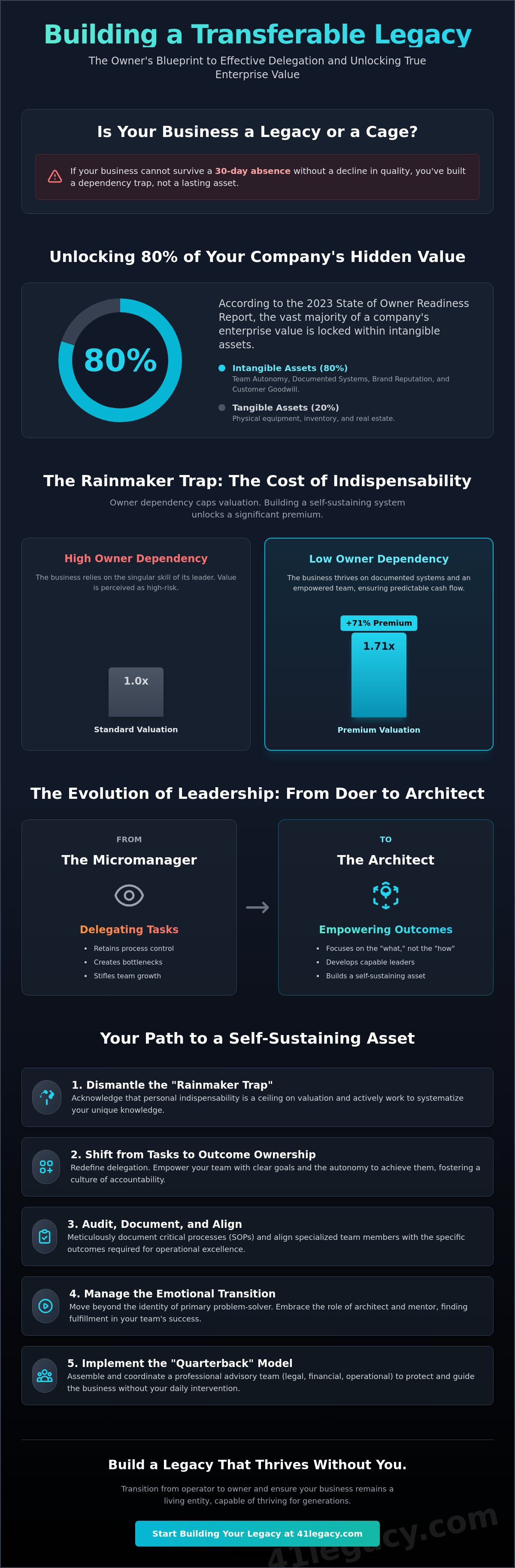
A 5-Step Framework for Effective Delegation in 2026
Delegation is not a mere transfer of tasks; it is a meticulous hand-off of stewardship. To understand how to delegate effectively as a business owner, you must view your company as a living entity that requires diverse hands to maintain its precision. A 2023 survey by the Exit Planning Institute revealed that 40% of business owners have no transition plan. This framework bridges that gap by transforming individual effort into institutional excellence.
- Step 1: The Enterprise Diagnostic. Conduct a rigorous audit of your weekly 50 hour schedule to identify where your presence creates a bottleneck rather than value.
- Step 2: Identifying the Right Artisans. Match specific outcomes to team members whose natural strengths align with the soul of the work.
- Step 3: Defining the Bespoke Outcome. Focus on the "what" and "why" with absolute clarity, leaving the "how" to the discretion of your trusted leads.
- Step 4: Providing the Tools and Authority. Adopt a "Quarterback" approach where you provide the protection and resources necessary for your team to execute the play without interference.
- Step 5: Meticulous Feedback Loops. Establish rhythmic reviews that prioritize the preservation of the brand's standards and long-term legacy.
By following these effective delegation tips for managers, you ensure that the quality of output remains uncompromising even when you are not in the room. This shift from operator to orchestrator is the hallmark of a sophisticated enterprise.
Auditing the Owner’s Footprint
The first step toward freedom is recognizing where you are over-functioning. When an owner involves themselves in every $100 decision, they diminish the enterprise value of the firm. You must curate a "Stop Doing" list to strip away low-value activities that cloud your strategic vision. This process is essential for building a business that operates with the rhythm of a fine-tuned engine. The Owner’s Footprint is the metric that determines how much of the enterprise’s value is tethered to the founder’s presence rather than its systems.
Empowering Your Team as Guardians of the Brand
True delegation requires the transfer of authority, not just the assignment of labor. You are building a transferable management layer that a future buyer will recognize as a stable, appreciating asset. By establishing clear guardrails, you allow your key leaders to innovate within a defined philosophical framework. This protects the core legacy while fostering a culture of ownership. When your team acts as guardians of the brand, they ensure the company's evolution remains consistent with its original heritage and uncompromising standards.
Overcoming the Emotional Weight of Letting Go
Relinquishing control of a business you've built from the ground up is rarely a simple logistical exercise. It's an emotional transition that mirrors the stages of grief. For many, the business is not merely a collection of assets; it's a physical manifestation of their standards, their sacrifices, and their unique vision for excellence. Moving away from daily operations feels like losing a part of one's self. To build a truly transferable legacy, you must reframe your role from The Engine of the enterprise to its Architect.
The Identity Crisis of the Successful Owner
The internal struggle often stems from a shift in daily purpose. When you stop being the primary problem-solver, you might wonder what your value is to the organization. Learning how to delegate effectively as a business owner requires moving from the question "What do I do today?" to "What is my legacy worth?" This is where the guidance of a Certified Exit Planning Advisor (CEPA) becomes invaluable. A CEPA doesn't just look at the balance sheet; they evaluate your emotional readiness for the next chapter.
The Exit Planning Institute's 2023 National State of Owner Readiness Report found that 75% of business owners experience profound regret within 12 months of exiting their business. This regret rarely stems from the financial outcome. It comes from a lack of a "Life After Business" plan. Without a clear vision for your next act, the vacuum created by delegation feels threatening rather than liberating. You aren't just stepping away; you're stepping toward a new form of stewardship.
Trusting the Process and the People
True delegation is an exercise in meticulous trust. It requires managing the inherent fear of failure by recognizing that allowing mistakes is a strategic investment in your team's development. If a system is so fragile that it cannot withstand a minor human error, it's not a professional organization; it's a precarious extension of your own willpower. Understanding how to delegate effectively as a business owner means building an anti-fragile structure that grows stronger through decentralized decision-making.
- The Meticulous Hire: Seek individuals who don't just possess technical skills, but who share your reverence for the work and the brand’s soul.
- The Architect's Perspective: Focus on designing the frameworks and protocols that ensure quality remains uncompromising in your absence.
- Resilience through Redundancy: A business that depends on a single point of failure, even if that point is you, lacks enterprise value.
When you empower others to guard the heritage of the business, you create a resilient asset. This transformation ensures the organization thrives independently of your presence, preserving the excellence you've established for generations to come. It's the ultimate act of craftsmanship to build something that doesn't need you to survive.
Building a Self-Sustaining Asset: The 41 Legacy Approach
True mastery in business isn't found in the daily grind; it's found in the creation of an entity that breathes on its own. The 41 Legacy 'Quarterback' model represents the pinnacle of this evolution. To understand how to delegate effectively as a business owner, you must transition from the person turning the wrench to the visionary curating the collection. This approach doesn't just lighten your load. It protects the intrinsic value you've spent decades building by ensuring every component of your enterprise operates with mechanical precision.
Our Monthly Implementation Support serves as the rhythmic heartbeat of this transition. It acts as a structured accountability mechanism, ensuring the owner remains focused on strategic growth rather than tactical fires. This is where the business begins to function as a bespoke asset, polished and ready for its next chapter. It's a shift from a founder-centric model to a legacy-centric one, where the strength of the system outweighs the presence of any single individual.
Delegation Beyond the Internal Team
Your internal staff manages the day-to-day, but your legacy requires a professional defense. A Quarterback aligns your CPA, Attorney, and Advisor under a singular Value Growth Roadmap. This coordination ensures that legal structures, tax strategies, and financial goals move in perfect harmony. It offers the peace of mind that comes from knowing every professional decision is being monitored through a lens of long-term preservation. When these professionals work in silos, the owner often becomes the bottleneck; when they are coordinated, the owner becomes the steward of a high-performing machine.
The Ultimate Conversion: From Operator to Investor
The final stage of the Value Growth Roadmap is the creation of a Transferable Asset. When a business is no longer dependent on its founder, its market value increases. Research from the Exit Planning Institute suggests that businesses with low owner-dependency can see valuations significantly higher than those tied to a founder's daily involvement. Learning how to delegate effectively as a business owner is the catalyst for this value jump.
You're no longer just an operator; you're an investor in a self-sustaining enterprise. This transformation ensures that when the time comes for a transition, the asset is ready for its next steward. The business is no longer a job you own, but a masterpiece you've curated for the future.
Discover your current exit readiness with our Enterprise Diagnostic.
Architecting a Business That Transcends the Founder
A business is more than a mere source of income; it's a testament to your vision and a vessel for your legacy. To ensure this vision survives your daily presence, you must transition from a central operator to a strategic steward. True enterprise value isn't found in your personal output. It's found in the systems and talent you cultivate. By applying a structured framework, you dismantle the Rainmaker Trap and transform your company into a self-sustaining asset.
Mastering how to delegate effectively as a business owner is the primary mechanism for this evolution. It allows you to step back without the machinery of the enterprise losing its momentum or its soul. This process requires the same precision as restoring a vintage masterpiece. Led by Chris Giammarco, a Certified Exit Planning Advisor (CEPA), we provide the meticulous coordination of your entire advisory team. We design Bespoke Value Growth Roadmaps tailored to your individual business legacy, ensuring your enterprise functions with the harmony of a well-tuned engine.
Secure your legacy and grow your enterprise value with 41 Legacy.
Your commitment to excellence has brought you this far. Now, let's ensure your business is prepared for its next chapter of greatness.
Frequently Asked Questions
How do I know which tasks I should delegate first?
Identify and delegate repeatable, low-risk administrative functions first to protect your creative energy. Focus on technical processes that already follow a documented manual. A 2023 study by the Harvard Business Review found that owners who delegate these administrative tasks see a 33% increase in their productive capacity. This shift allows you to move from being a technician to acting as the strategic steward of your brand's evolution.
What if my team makes a mistake that damages the company's reputation?
Mitigate risk by establishing uncompromising standards and rigorous quality control checkpoints before any delegation occurs. A mistake is often a diagnostic signal that a process lacks clarity or a structural safeguard. By building a culture of meticulous craftsmanship, you ensure that every output meets your brand's high-end engineering standards. This rigorous framework protects the soul of the business even when you're not the one performing the work.
Can I really delegate customer relationships if I built the business on my name?
You can delegate high-level relationships by transitioning the client's trust from your persona to your proprietary process. This is how to delegate effectively as a business owner while maintaining the brand's premium status. Introduce senior leads as the master craftsmen of their specific departments during initial consultations. This shift ensures the client values the collective expertise of the institution rather than just the presence of the individual founder.
How do I delegate without losing control of the quality of work?
Maintain quality through the implementation of a bespoke standard operating manual that acts as the guardian of your technical excellence. Use specific performance indicators to monitor output without micromanaging the daily flow. According to the 2024 State of Small Business Report, companies with documented processes are 2.5 times more likely to maintain consistent quality during growth phases. Control lives in the system, not in your constant physical presence.
How much time should I expect to spend training someone to take over a task?
Expect an initial investment of 10 to 20 hours for complex, high-stakes technical roles. This period involves a specific methodology where the apprentice watches, performs, and finally leads the process to ensure they absorb the nuances of your craftsmanship. While this requires a temporary reduction in your personal output, it's a necessary step in building a transferable asset. Short-term training prevents the long-term risk of owner-dependency.
What is the difference between delegating to an employee and delegating to an advisor?
Delegating to an employee involves transferring the execution of internal processes, while delegating to an advisor involves sourcing strategic foresight. Employees maintain the machinery of the business; advisors provide the roadmap for its evolution. Advisors, such as CPAs or specialized consultants, help you navigate the complexities of enterprise value and risk reduction. Both roles are essential for a steward who aims to build a lasting, independent legacy.
Is it possible to delegate too much and lose touch with my business?
You won't lose touch if you shift your role from an active technician to a curator of the company's vision. Effective delegation allows you to oversee the gallery from a distance, ensuring every piece aligns with the overarching aesthetic. Data from a 2022 Management Institute report suggests that owners who spend 20% of their time on high-level oversight maintain higher quality than those who remain involved in every minor detail.
How does delegation impact the final sale price of my company?
Comprehensive delegation significantly increases enterprise value by proving the business is a transferable asset that thrives independently. Buyers pay a premium for turnkey operations where the owner is not the primary engine of revenue. According to the 2023 Value Builder Project, businesses with low owner-dependency receive offers that are 71% higher than those where the founder is essential. Learning how to delegate effectively as a business owner is the most direct path to a successful transition.
Disclaimer
This article is for educational and informational purposes only and does not provide legal, tax, investment, or business brokerage advice. 41 Legacy does not offer M&A brokerage services, legal document drafting, tax preparation, or investment advisory services. Business owners should consult licensed professionals in those disciplines before making decisions related to business transactions, legal matters, tax strategy, or financial planning. All examples are illustrative and may not apply to your specific situation.