
How to Reduce Owner Dependency: Building a Transferable Legacy
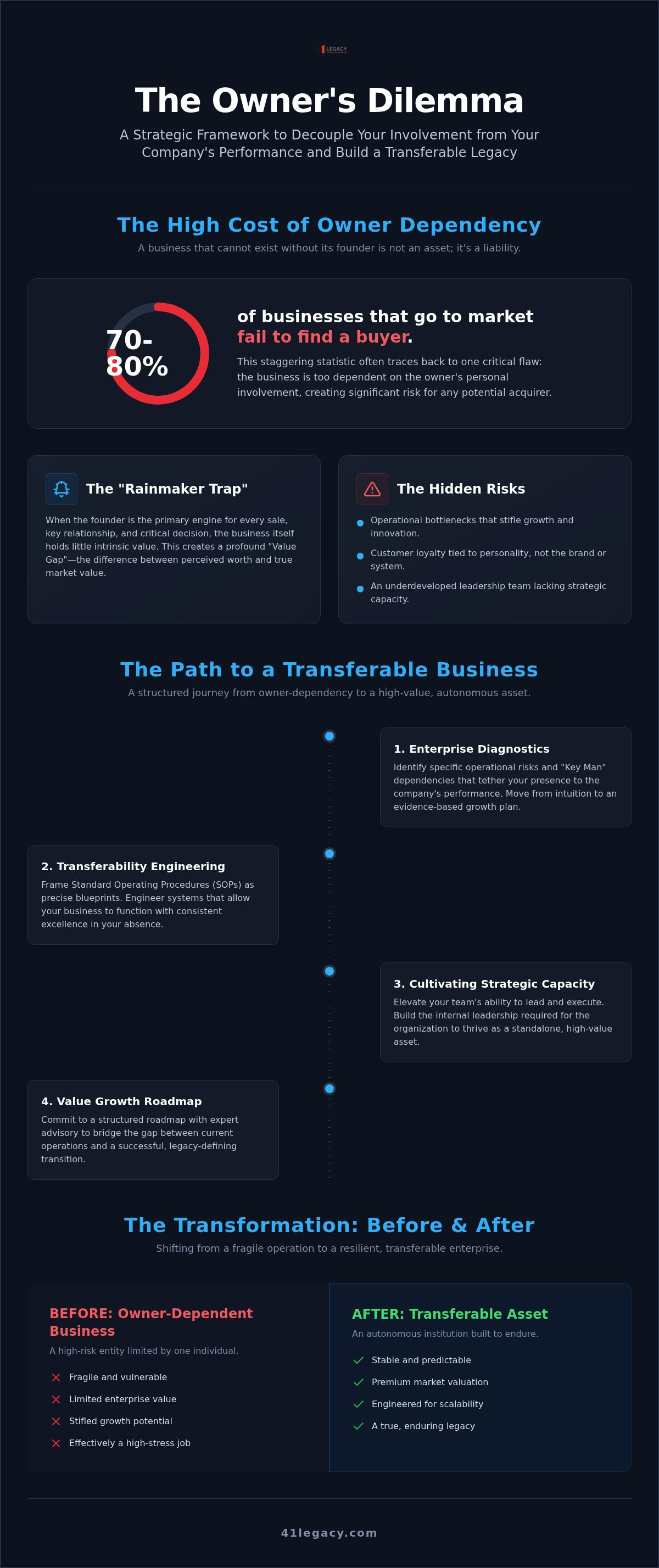
Did you know that between 70% and 80% of businesses that go to market fail to find a buyer? This staggering reality often traces back to a single, invisible flaw: the company cannot exist without its creator. You likely recognize the weight of this burden. It is the quiet exhaustion of being the sole engine of your company's success and the unsettling realization that your life's work may lack the inherent value required for a successful transition. Learning how to reduce owner dependency is not merely an operational task; it is the ultimate act of stewardship in preserving the essence of what you have built.
We believe your business is a legacy that deserves to endure. This article provides the strategic framework to decouple your personal involvement from your company's performance, transforming your enterprise into a high-value, transferable asset. We will examine the intricacies of Transferability Engineering, utilizing Enterprise Diagnostics and a structured Value Growth Roadmap to ensure your company possesses its own independent strength. By following this path, you can transition from being a prisoner of your own success to becoming the architect of a lasting, autonomous institution.
Key Takeaways
- Identify the "Rainmaker Trap" and how a founder's singular influence creates a Value Gap that diminishes the marketability of their life's work.
- Discover how to reduce owner dependency through Enterprise Diagnostics, identifying the specific operational risks that tether your presence to the company's performance.
- Implement Transferability Engineering by framing SOPs as precise blueprints that allow your business to function with the same excellence in your absence.
- Elevate your team's strategic capacity to ensure the organization possesses the internal leadership required to thrive as a standalone, high-value asset.
- Commit to a structured Value Growth Roadmap supported by monthly advisory to bridge the distance between current operations and a successful, legacy-defining transition.
The Silent Erosion: How Owner Dependency Devalues Your Life’s Work
A business that cannot breathe without its founder is not an asset; it is a beautifully crafted cage. Many owners unknowingly find themselves caught in the "Rainmaker Trap," a state where their personal involvement acts as the primary engine for every sale and operational detail. This dynamic creates a profound "Value Gap." It's the silent distance between what your company is worth today and the premium it could command as a truly independent entity. Learning how to reduce owner dependency is the essential first step in moving from a job you own to an asset that works for you. Without this shift, your enterprise remains fragile. It appears to outsiders as a high-risk investment rather than a stable, enduring legacy.
A business is more than a sequence of transactions. It is a living entity, a testament to your vision. Yet, broad industry research suggests that only 20% to 30% of businesses that go to market actually find a buyer. Often, the failure isn't due to poor revenue. It happens because the business is too dependent on the owner. When you are the business, there is nothing for a successor to acquire. You've built a reputation, but you haven't yet engineered a transferable asset that can thrive in your absence.
The Hidden Risks of the Indispensable Founder
When every decision flows through a single point, excellence is limited by that individual's capacity. These operational bottlenecks stifle growth and leave the organization vulnerable to the unexpected. If customer loyalty is tied to your personality rather than your brand's essence, that goodwill vanishes the moment you step away. This owner-centric model often prevents the development of a middle-management layer. Without that layer, the company lacks the strategic capacity to sustain its rhythm. It's a structure that demands your constant presence, turning your greatest achievement into an exhausting obligation.
Transferability as the Ultimate Metric of Success
True success is measured by how well your work survives your departure. A formal succession planning process ensures your vision isn't lost when the baton is passed. While a P&L statement shows historical performance, determining enterprise value requires looking at the company's inherent market attractiveness. Buyers seek a machine that produces results reliably and predictably. By ensuring documented SOPs increase your business value, you provide the architectural blueprints for continued excellence. This deliberate work of increasing enterprise value transforms your business into a transferable legacy that honors your years of dedication. It is the difference between a fleeting success and a permanent impact.
Enterprise Diagnostics: Uncovering the Risks in Your Daily Involvement
Precision requires absolute clarity. Before you can reshape your organization, you must understand its current state through a rigorous Enterprise Diagnostic. This process isn't merely a checklist. It is a sophisticated examination that identifies where your personal influence creates friction instead of momentum. By evaluating your team's strategic capacity, you determine if they have the internal bandwidth to execute your vision without your constant oversight. This move from gut feel to evidence-based growth is essential for anyone seeking how to reduce owner dependency. It reveals the "Key Man" risks that make your structure fragile and replaces intuition with surgical precision.
A true diagnostic looks at the business as a standalone entity. According to the SBA definition of succession planning, maintaining consistency of service and knowledge transfer is vital for future readiness. The diagnostic identifies the gaps where knowledge is trapped within the owner, preventing that vital transfer from occurring and leaving the company's future to chance.
The Value Growth Roadmap: A Blueprint for Independence
Once the diagnostic is complete, we establish a baseline for your current enterprise value. This baseline isn't just about revenue; it's about the quality of your systems and the strength of your culture. The Value Growth Roadmap serves as your architectural guide, mapping the specific journey from high dependency to autonomous operations. We focus on three critical pillars:
- Baseline Assessment: Establishing the current market attractiveness of the business.
- Dependency Mapping: Identifying specific tasks that require your direct oversight.
- Value Driver Prioritization: Focusing on the specific changes that create the greatest transferable value.
This structured approach ensures that every action taken strengthens the foundation of the asset, moving it closer to a state of independent excellence. It provides the strategic clarity needed to stop reacting to daily fires and start building for the long term.
Identifying Your 'Zone of Genius' vs. Tactical Tasks
True stewardship requires a shift in focus. An honest audit of your time often reveals that while you believe you're adding value, you're actually acting as a bottleneck for tactical tasks. Identifying your "Zone of Genius" allows you to delegate the mundane, freeing you to lead with strategic clarity. Letting go of tactical control is often a psychological hurdle, yet it's the only way to prepare the company for its next phase. It requires a steward's mindset, focusing on the long-term health of the institution rather than the short-term satisfaction of control. If you're ready to begin this transition, an Enterprise Diagnostic can provide the objective perspective needed to move forward with confidence.
Transferability Engineering: The Strategic Role of SOPs
Standard Operating Procedures (SOPs) are often dismissed as mere administrative paperwork. In reality, they are the architectural blueprints of a high-value enterprise. Without them, a business relies on "tribal knowledge," an invisible and volatile collection of habits held within the minds of a few. By codifying these processes, you ensure that excellence is a repeatable result rather than a happy accident. This level of precision is the hallmark of a master artisan. It's also the most effective method for reducing owner dependency to maximize value. When you understand how to reduce owner dependency, you realize that your systems are the bridge between your personal effort and a transferable legacy.
Systematizing the Critical Path
Precision requires focus. You don't need to document every minor task to see immediate results. Instead, identify the critical path: the top 20% of processes that drive 80% of your company's outcomes. We call this Transferability Engineering. When documented SOPs increase your business value, it's because they reduce training time and eliminate the risk of human error. This documentation shouldn't be a one-time project. It must become a core part of your culture. Treat these systems as living entities that evolve as the business grows. This ensures that the organization’s brilliance stays within the company, even as people move on. A well-documented process is a gift to your future successor, providing them with the confidence to maintain your standards of excellence.
Reducing Customer Reliance on the Founder
Many founders believe their "magic touch" is what keeps clients loyal. While your vision is vital, dependency on your personal charisma is a significant risk. You must systematize the sales and service processes so they aren't tied to a single personality. This shift is essential to how to reduce owner dependency within your sales infrastructure. Transitioning key accounts to a structured team approach protects the company's revenue and institutionalizes trust. Use technology and CRM systems to capture every nuance of customer knowledge. This ensures that every client interaction reflects the brand's standards, not just the owner's individual effort. By removing yourself as the primary point of contact, you allow the brand to stand on its own merits, making the business far more attractive to future stewards.
Cultivating Strategic Capacity: Building the Team That Leads
Strategic capacity is the measure of your company's ability to thrive when you aren't in the room. It represents the deliberate transition from a founder-led culture to a leader-led organization. This evolution is the cornerstone of increasing enterprise value. When you build a team capable of navigating complexity without your direct intervention, you transform the business from a personal project into a durable institution. Understanding how to reduce owner dependency requires you to shed the mantle of "Chief Problem Solver." You must embrace the role of a strategic visionary, providing the direction while your team manages the momentum. This shift doesn't just reduce stress; it creates the professional environment necessary to attract and retain high-level talent who seek a clear path for growth.
Empowering a Leadership Team
Many businesses operate on a "hub-and-spoke" model. The owner is the hub, and every decision, no matter how small, travels down a spoke for approval. This structure is inherently limited by the owner's personal bandwidth. To build a transferable legacy, you must move toward a decentralized leadership structure. This involves training managers to think like owners through radical transparency and clear accountability. Our Monthly Implementation Support acts as the connective tissue in this process. It ensures the roadmap is followed and that the leadership team remains aligned with the long-term vision of transferability. By empowering others to lead, you ensure the business possesses its own independent pulse and rhythm.
The Role of the Coordinated Advisory Team
Your legacy is too important to be managed in silos. Often, a business owner's CPA, attorney, and financial advisor work independently, leading to disjointed strategies that can inadvertently increase risk. We serve in a "Quarterback" role, orchestrating these professional advisors to ensure every decision is viewed through the lens of exit readiness and long-term health. This alignment is critical to how to reduce owner dependency because it creates a unified front of expertise. Every legal document and tax strategy should support the goal of building a transferable asset that can thrive independently of its founder. By coordinating these efforts, we protect the essence of what you have built and ensure a seamless transition when the time is right. If you're ready to evaluate your organization's readiness, we invite you to begin with a Strategic Capacity Evaluation to see where your team stands today.
The 41 Legacy Path: Executing Your Transition with Precision
Building a business that thrives without your daily presence is the ultimate expression of craftsmanship. Our approach follows a rigorous three-step sequence: Enterprise Diagnostic, Value Growth Roadmap, and structured Implementation. This process is not a temporary adjustment. It is a fundamental realignment of your company's DNA. Learning how to reduce owner dependency requires more than a plan; it demands a commitment to execution. By treating your business as a masterpiece, you ensure it possesses the structural integrity to endure for generations. This path transforms your role from a necessary component to a deliberate steward of a lasting legacy.
The Power of Monthly Implementation Support
The greatest threat to a successful transition is the "whirlwind" of daily operations. Without structured accountability, even the most elegant roadmap will gather dust while you react to immediate crises. Monthly Strategic Advisory provides the steady rhythm needed to maintain momentum. We track specific metrics that signal reduced dependency, such as decision-making speed within your leadership team and the successful delegation of tactical tasks. A Certified Exit Planning Advisor serves as the primary architect in this journey. They coordinate the technical intricacies of the transition while keeping your long-term vision in focus. This ensures that every operational adjustment serves the higher purpose of building a transferable asset.
Securing Your Legacy
Reducing dependency is the ultimate gift to your family and your employees. It provides them with a stable, resilient organization that isn't vulnerable to a single point of failure. When you master how to reduce owner dependency, you gain more than financial value. You gain the peace of mind that comes from owning a truly transferable asset. A business that is always "ready" for an exit is a healthy business, regardless of whether you intend to step away tomorrow or ten years from now. It allows you to lead from a position of strength and choice rather than necessity. We invite you to begin this transformative journey by taking your first step with an Exit Readiness Assessment. Treat your life's work with the reverence it deserves. Ensure its essence remains intact long after your tenure concludes.
The Architecture of a Lasting Institution
Building a company that thrives independently is the highest form of professional stewardship. By moving beyond the Rainmaker Trap and embracing Transferability Engineering, you transform your life's work into a durable asset. This journey requires a precise understanding of how to reduce owner dependency through Enterprise Diagnostics and a structured Value Growth Roadmap. Success isn't just about current revenue. It's about the organization's inherent ability to maintain excellence without your direct intervention.
Led by a Certified Exit Planning Advisor (CEPA), we serve as the strategic quarterback for your professional advisors. We specialize in building transferable enterprise value by aligning your leadership, systems, and long-term vision. This coordinated approach ensures your legacy remains intact and your company is always prepared for a successful transition. You've dedicated years to crafting this masterpiece. Now, ensure it possesses the strength to endure. Begin your journey toward a transferable legacy with an Exit Readiness Assessment from 41 Legacy. Your business is more than a job. It's a testament to your vision that deserves to flourish for generations to come.
Frequently Asked Questions
What is owner dependency in a business?
Owner dependency is a structural risk where a company's performance is inextricably linked to the founder's personal effort. It often manifests as the "Rainmaker Trap," where you're the primary driver of sales and operational decisions. This creates a ceiling on growth and a floor on valuation. Understanding how to reduce owner dependency is about shifting from a person-centric model to a process-centric organization that functions with excellence in your absence.
How much does owner dependency affect business valuation?
High owner dependency can lead to a valuation discount of 25% to 35% compared to similar businesses with strong management. According to 2026 industry data, companies heavily reliant on a founder often sell for one to two turns lower on EBITDA multiples. This "Value Gap" represents the wealth lost because the business is viewed as a high-risk investment. Buyers pay a premium for stability and predictability, not for a job they must manage.
What are the first steps to reduce my company's reliance on me?
The first step is an Enterprise Diagnostic to objectively identify where your daily involvement creates bottlenecks. You must move from "gut feel" to evidence-based insights to see which processes are trapped in your head as "tribal knowledge." By conducting a Strategic Capacity Evaluation, you can determine if your team has the bandwidth to lead. This clarity allows you to begin Transferability Engineering, focusing on the specific systems that drive the most value.
How long does it take to significantly reduce owner dependency?
Reducing dependency is a deliberate process that typically requires twelve to twenty-four months of focused implementation. It isn't a one-time project but a structural evolution guided by a Value Growth Roadmap. This timeline allows for the documentation of SOPs and the testing of your leadership team's autonomy. Consistent Monthly Implementation Support ensures the roadmap remains a priority, allowing the business to slowly decouple from your personal influence while maintaining its operational rhythm.
Can a business be sold if the owner is still heavily involved?
While a business can technically sell with a heavily involved owner, the success rate is significantly lower. Data from the Exit Planning Institute shows that only 20% to 30% of businesses that go to market actually sell. Buyers often view owner-dependent companies as fragile assets. If a sale does occur, it frequently involves a long earn-out period or a lower purchase price to account for the risk of the founder's eventual departure.
What is the difference between an owner and a steward?
An owner often views the business as a personal possession or a high-paying job. A steward, however, treats the enterprise as a masterpiece that must be preserved for future generations. Stewards focus on building a transferable asset that possesses its own independent essence and value. This shift in mindset is critical to how to reduce owner dependency. It moves the focus from short-term control to the long-term health and autonomy of the institution.
How do SOPs directly impact my company's exit readiness?
Standard Operating Procedures (SOPs) serve as the architectural blueprints that prove a business can function without its creator. They directly impact exit readiness by reducing training time and eliminating human error, which are key metrics for any successor. When processes are codified, they become intellectual property that belongs to the company rather than the individual. This documentation provides a buyer with the confidence that your standards of excellence will endure after the transition.
Why do I need a coordinated advisory team to reduce dependency?
Reducing dependency involves complex legal, tax, and financial considerations that require a coordinated effort. Without a "Quarterback" to align your CPA, attorney, and financial advisor, you risk receiving disjointed advice that could inadvertently increase your personal liability. A coordinated advisory team ensures every strategic decision supports your goal of building a transferable legacy. This alignment protects the essence of the business while maximizing the enterprise value for all stakeholders involved.

Article by
Mike Laskowski
Mike Laskowski is a Business Value Growth Strategist who helps business owners uncover the truths that drive their performance, risk, and readiness. Blending forensic interviewing from a 26‑year federal career with Strategic Capacity analysis and CEPA methodology, he works upstream to reduce owner dependency, increase transferability, and strengthen enterprise value. Mike guides founders through clarity, operational evolution, and transition readiness so their companies become transferable, owner‑independent assets that endure beyond the founder.
Disclaimer
This article is for educational and informational purposes only and does not provide legal, tax, investment, or business brokerage advice. 41 Legacy does not offer M&A brokerage services, legal document drafting, tax preparation, or investment advisory services. Business owners should consult licensed professionals in those disciplines before making decisions related to business transactions, legal matters, tax strategy, or financial planning. All examples are illustrative and may not apply to your specific situation.