
How to Reduce Owner Dependency: Building a Transferable Legacy
If your enterprise cannot survive without your daily presence, you haven't built a valuable company; you've simply engineered a demanding job. Many dedicated founders find themselves trapped inside the very organizations they created, quietly fearing that taking a two-week vacation could cause operations to unravel. When every critical decision runs through your desk, prospective buyers see unacceptable operational risk rather than enduring worth. Understanding how to reduce owner dependency is not merely an exit tactic. It is the definitive act of craftsmanship that preserves your enterprise value and honors what you've spent years building.
You already know that long-term stability shouldn't depend on your sheer force of will, yet stepping away without sacrificing quality feels impossible. This guide provides the strategic framework to decouple your personal involvement from your company's performance, transforming your business into a resilient, transferable asset. Ahead, you'll examine the core principles of transferability engineering, diagnostic methods to uncover hidden operational risks, and the structured milestones required to transition from an indispensable operator into a true steward of your legacy.
Key Takeaways
- Identify the operational liabilities of the Rainmaker Trap and recognize how an unaddressed Value Gap restricts your company's true worth.
- Utilize Enterprise Diagnostics to evaluate strategic capacity and pinpoint where your day-to-day oversight creates operational friction.
- Learn how to reduce owner dependency through Transferability Engineering, transforming institutional knowledge into clear blueprints that preserve quality.
- Cultivate an autonomous leadership tier capable of driving enterprise momentum and making critical decisions without your daily involvement.
- Implement a structured Value Growth Roadmap backed by consistent advisory support to secure a seamless, lasting transition.
The Silent Erosion: How Owner Dependency Devalues Your Life’s Work
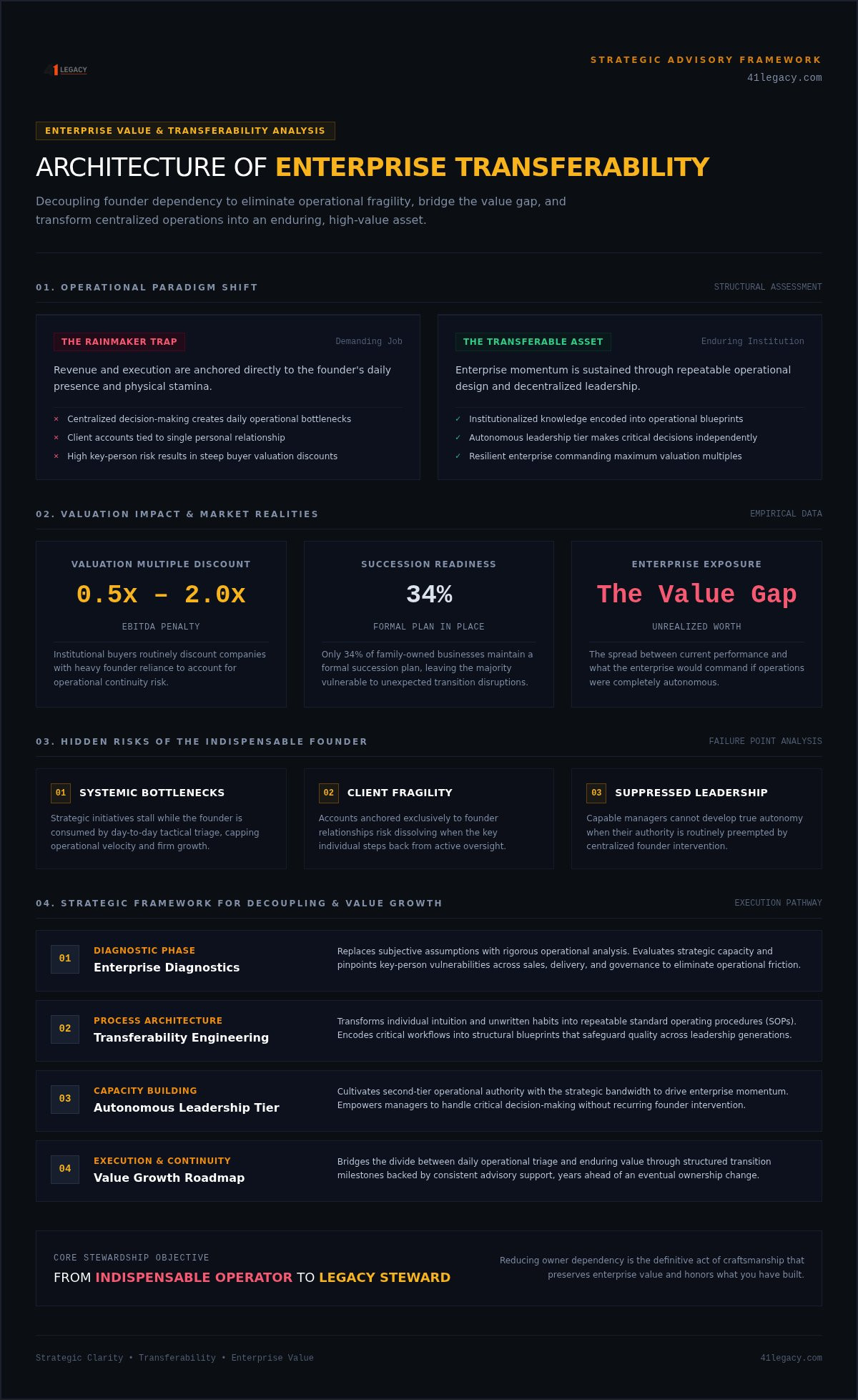
Every business begins with the founder's personal drive, but sustained growth requires stepping out of the center. When an enterprise relies on you to close every deal and resolve every operational issue, you haven't built a self-sustaining asset; you've stepped into the Rainmaker Trap. In this state, revenue is tied to your direct presence rather than systemic capability. This reliance creates a substantial Value Gap, which is the spread between what your company generates today and what it could command as an autonomous enterprise. Learning how to reduce owner dependency allows you to shift from merely holding a job you own to stewarding an asset that works for you.
Prospective investors and successors do not evaluate historical profits in isolation. They evaluate durability. An organization reliant on a single individual's daily involvement introduces structural fragility. If removing the founder destabilizes operational continuity or customer trust, the company represents a high-risk gamble rather than a transferable asset. True business stewardship requires engineering resilience so the enterprise retains its value across leadership generations.
The Hidden Risks of the Indispensable Founder
Centralized decision-making inevitably constricts operational velocity. When team members must seek founder approval for routine challenges, three critical vulnerabilities emerge:
- Systemic Bottlenecks: Strategic initiatives stall while the founder manages day-to-day triage.
- Client Fragility: Accounts anchored to a personal relationship often dissolve when that relationship steps back.
- Suppressed Leadership: Capable managers cannot develop autonomy when their authority is routinely preempted.
Without clear pathways for internal authority to mature, an enterprise remains permanently capped by its architect's physical capacity.
Transferability as the Ultimate Metric of Success
A healthy balance sheet does not guarantee market durability. When assessing the true worth of an enterprise, determining enterprise value requires looking beyond historical net income to assess transferability. Institutional buyers routinely discount businesses with heavy founder reliance, sometimes reducing valuation multiples by 0.5x to 2.0x EBITDA to account for continuity risk.
Structured succession planning protects against this discount by replacing individual intuition with repeatable organizational systems. When you understand how to reduce owner dependency through disciplined operational design, your business stops being a vulnerable reflection of your stamina. It becomes an enduring institution engineered to thrive well past your tenure.
Enterprise Diagnostics: Uncovering the Risks in Your Daily Involvement
Founders often rely on intuition to evaluate organizational health, yet gut feelings rarely uncover structural risk. An Enterprise Diagnostic replaces subjective assumptions with rigorous operational analysis. It measures your company's Strategic Capacity, determining whether your leadership team possesses the bandwidth and authority to execute core objectives without your daily intervention. Pinpointing key-person vulnerabilities across sales, delivery, and governance reveals where tactical reliance throttles growth, clarifying how to reduce owner dependency before enterprise value deteriorates.
The Value Growth Roadmap: A Blueprint for Independence
Systematic transformation requires an empirical baseline. A formal assessment exposes your current operational vulnerabilities and identifies specific value drivers that directly improve transferability. While industry research indicates only 34% of family-owned businesses maintain a formal succession plan, proactive founders develop a strategy to transition ownership years ahead of an eventual leadership change. Translating diagnostic findings into a phased Value Growth Roadmap bridges the divide between chaotic daily oversight and structured operational autonomy.
Identifying Your 'Zone of Genius' vs. Tactical Tasks
A rigorous audit of your working hours often reveals an uncomfortable reality: founders regularly spend vital hours acting as operational bottlenecks. Lasting enterprise stewardship requires distinguishing between high-leverage strategic foresight and routine coordination. Letting go of tactical control often triggers psychological friction, especially when personal identity is closely tied to solving daily crises. When you shift your role from hands-on operator to architectural guardian, you clear the runway for your team to build true execution capability. Beginning with an objective Enterprise Diagnostic allows you to identify where operational reliance exists and map an intentional path toward genuine enterprise freedom.
Transferability Engineering: The Strategic Role of SOPs
Standard operating procedures are often dismissed as administrative overhead or mere checklists designed to reduce daily stress. In reality, they serve as the architectural blueprints of an enduring institution. High-performing organizations never rely on tribal memory or unwritten habits passed down informally between staff. Instead, they capture founder intuition into codified systems of operational excellence. Mastering how to reduce owner dependency requires translating implicit expertise into verifiable processes that qualified professionals can execute. Through disciplined Transferability Engineering, documented SOPs increase your business value by shortening onboarding cycles, eliminating costly execution errors, and proving that company performance is structural rather than accidental.
Systematizing the Critical Path
Attempting to document every minor workflow at once creates organizational fatigue. Strategic systematization concentrates on the vital 20% of processes that generate 80% of your operational throughput and client satisfaction. Treat these procedures as living entities that operational teams actively refine, rather than static manuals archived on a digital drive. When core workflows reflect real-world precision, quality control becomes an institutional reflex rather than a founder's personal burden.
Reducing Customer Reliance on the Founder
A persistent vulnerability in growing firms is the commercial relationship. If accounts believe they are buying your personal involvement rather than your organization's collective capability, the business remains fragile. Addressing how to reduce owner dependency across your revenue model requires decoupling business development from founder charisma:
- Structured Methodologies: Codify discovery calls, pricing structures, and onboarding stages into documented frameworks that sales teams can replicate.
- Team-Led Account Management: Introduce delivery specialists early in client conversations so account loyalty attaches directly to the firm.
- Institutionalized Data: Centralize client history and communication preferences in a CRM to ensure institutional knowledge remains an enterprise asset.
When client retention is anchored in process rigor, the enterprise commands far greater confidence from future successors and strategic partners.
Cultivating Strategic Capacity: Building the Team That Leads
A company's value is ultimately bounded by its Strategic Capacity, which represents the organization's intrinsic ability to grow without constant direction from its founder. Many businesses reach a natural plateau because the founder remains the chief problem solver, resolving daily frictions while broader expansion stalls. Unlocking true transferability requires elevating your role to strategic visionary and cultivating talent capable of driving operational momentum. In the journey of increasing enterprise value, investing in leadership equity is just as vital as refining operational systems. High-caliber professionals don't commit to static environments; they commit to enterprises with defined paths for autonomy and growth.
Empowering a Leadership Team
Most early-stage enterprises operate on a hub-and-spoke architecture, where every decision routes back to the founder at the center. Dismantling this structure requires establishing decentralized management. To execute this shift effectively, leaders need three core pillars:
- Decisional Boundaries: Define clear operational thresholds where managers have full authority to commit resources without prior executive sign-off.
- Financial Transparency: Share performance metrics openly so team leaders understand the fiscal impact of their daily choices.
- Structured Accountability: Replace ad-hoc oversight with disciplined review cadences, such as ongoing Monthly Implementation Support, to maintain execution momentum.
When leadership teams learn to think like owners, operational reliance dissolves naturally.
The Role of the Coordinated Advisory Team
Mastering how to reduce owner dependency requires external alignment as well as internal talent. Your CPA, corporate attorney, and financial specialists often operate in silos, solving technical problems without an overarching strategic framework. A seasoned advisor acts as a quarterback, harmonizing these disciplines so that tax planning, governance, and operational design all support transition readiness.
Evaluating every strategic decision through the lens of transferability protects the legacy you've built and ensures your business commands maximum value in any future transition. To measure your organization's leadership runway and chart an actionable path forward, schedule a Strategic Capacity Evaluation with our advisory team today.
The 41 Legacy Path: Executing Your Transition with Precision
A rigorous strategic vision is only as effective as the discipline applied to its execution. Many organizational initiatives stall not from an absence of ambition, but from the lack of a structured mechanism to carry high-level goals into daily operations. The 41 Legacy methodology treats transferability as a discipline of operational engineering, guiding business owners through three distinct, interdependent phases: Enterprise Diagnostics, the Value Growth Roadmap, and Monthly Strategic Advisory. This structured progression systematically decouples company performance from individual presence, creating an organization that remains perpetually transition-ready.
Operating an exit-ready business isn't exclusively about orchestrating a departure. It is about constructing an enterprise that possesses its own momentum. Even if you intend to remain at the helm for decades, building a self-sustaining asset provides absolute operational freedom, protects your balance sheet against sudden disruption, and maximizes options for internal or external succession.
The Power of Monthly Implementation Support
Strategic plans frequently fail when the immediate demands of daily operations consume executive attention. Overcoming this friction requires external structure and dedicated accountability. Through structured Monthly Implementation Support, leadership teams partner with a Certified Exit Planning Advisor to maintain focus on core value drivers.
This disciplined advisory cadence monitors objective indicators of organizational autonomy, tracking milestones such as decentralized project delivery, diversified client management, and expanded management authority. Learning how to reduce owner dependency requires steady, iterative progress; ongoing advisory reviews ensure that operational brushfires never derail your long-term value creation.
Securing Your Legacy
Removing yourself from daily operational bottlenecks is the greatest gift you can provide to your employees, your leadership team, and your family. An enterprise that cannot function without its creator offers fragile security. By treating your company as an enduring asset rather than a personal burden, you build a resilient organization that protects livelihoods and preserves institutional integrity across generations.
Discovering how to reduce owner dependency transforms your enterprise into a true legacy that stands on its own merits. Take the definitive first step toward architectural clarity and operational resilience by initiating your Exit Readiness Assessment today.
Building an Enterprise That Endures Beyond You
Building an organization that operates independently of your daily oversight isn't merely a tactical operational shift; it's the defining hallmark of true business stewardship. By diagnosing operational friction, engineering documented systems, and cultivating strategic capacity within your leadership team, you systematically eliminate the value gap. Mastering how to reduce owner dependency ensures that the company you spent years building remains robust, profitable, and enduring under any future circumstance.
As you prepare for the next chapter, you don't have to navigate this structural transition alone. Led by a Certified Exit Planning Advisor (CEPA), 41 Legacy specializes in building transferable enterprise value while serving as the strategic quarterback aligning your CPA, legal counsel, and executive team. With clear diagnostic frameworks and disciplined advisory support, your company can achieve genuine operational autonomy while protecting the heritage you've worked so hard to create. Begin your journey toward a transferable legacy with an Exit Readiness Assessment from 41 Legacy.
Frequently Asked Questions
What is owner dependency in a business?
Owner dependency occurs when an organization's core operations, client relationships, or strategic decisions rely heavily on the founder's daily presence. When key institutional knowledge remains trapped in the founder's head, the enterprise cannot function smoothly during their absence. This condition limits operational scale and transforms what should be an independent, valuable commercial asset into an exhausting personal obligation.
How much does owner dependency affect business valuation?
Owner dependency can decrease a company's valuation multiple by 0.5x to 2.0x EBITDA, often resulting in a substantial discount of 20% to 50% against peer benchmarks. Strategic buyers discount enterprises with concentrated founder risk because post-transition cash flows become unpredictable. If the founder steps away and historical revenue follows them, future earnings aren't separable from the individual, rendering historical profits far less valuable.
What are the first steps to reduce my company's reliance on me?
The first step is conducting an objective operational audit through an Enterprise Diagnostic to uncover where your daily intervention creates operational friction. Once you identify bottlenecks across sales, fulfillment, and decision-making, you can isolate the vital 20% of workflows that generate the majority of results. Learning how to reduce owner dependency begins by delegating defined authority to managers and codifying those critical tasks into repeatable operational standards.
How long does it take to significantly reduce owner dependency?
Significantly decoupling an owner from operational workflows typically requires eighteen to thirty-six months of deliberate structural implementation. This timeline allows leadership teams to master codified processes, assume commercial relationships, and resolve tactical challenges independently. True transferability isn't an overnight administrative fix; it's an intentional evolutionary process that requires structured roadmaps and consistent accountability to reshape habits and leadership capabilities.
Can a business be sold if the owner is still heavily involved?
A business can transition even with heavy founder involvement, but the terms are rarely favorable to the seller. In highly dependent companies, buyers mitigate their risk through heavy earnouts, seller financing, and extended employment contracts requiring the founder to remain for years. If you want maximum valuation and the freedom to exit on your own terms, understanding how to reduce owner dependency before entering transition discussions is indispensable.
What is the difference between an owner and a steward?
An owner views a business primarily as a source of personal income, while a steward treats the enterprise as an enduring, transferable asset built for longevity. Stewards focus on institutional preservation. They invest time in developing capable leadership, engineering resilient systems, and creating value that survives their eventual departure. By viewing yourself as a steward, your priority shifts from personal indispensability to building long-term organizational health that benefits employees, clients, and future successors.
How do SOPs directly impact my company's exit readiness?
Standard operating procedures prove to prospective successors that your business delivers consistent results through institutional systems rather than individual intuition. Documented blueprints shorten employee onboarding, cut operational error rates, and safeguard proprietary processes during management transitions. By transforming tribal memory into clear, auditable operational assets, SOPs de-risk the investment and demonstrate that cash flows will remain steady after the founder steps aside.
Why do I need a coordinated advisory team to reduce dependency?
Reducing operational reliance requires aligning corporate governance, accounting structures, and organizational design under a unified strategy rather than handling them in isolation. Corporate attorneys, CPAs, and wealth advisors often work within narrow professional scopes. An advisory quarterback ensures every legal contract, compensation plan, and operational initiative directly supports your long-term transferability goals. This synchronized approach prevents costly oversights and guarantees that all technical decisions actively protect your legacy.

Article by
Mike Laskowski
Mike Laskowski is a Business Value Growth Strategist who helps business owners uncover the truths that drive their performance, risk, and readiness. Blending forensic interviewing from a 26‑year federal career with Strategic Capacity analysis and CEPA methodology, he works upstream to reduce owner dependency, increase transferability, and strengthen enterprise value. Mike guides founders through clarity, operational evolution, and transition readiness so their companies become transferable, owner‑independent assets that endure beyond the founder.
Disclaimer
This article is for educational and informational purposes only and does not provide legal, tax, investment, or business brokerage advice. 41 Legacy does not offer M&A brokerage services, legal document drafting, tax preparation, or investment advisory services. Business owners should consult licensed professionals in those disciplines before making decisions related to business transactions, legal matters, tax strategy, or financial planning. All examples are illustrative and may not apply to your specific situation.

