
Building a Business Exit Team: The Architecture of a Transferable Legacy
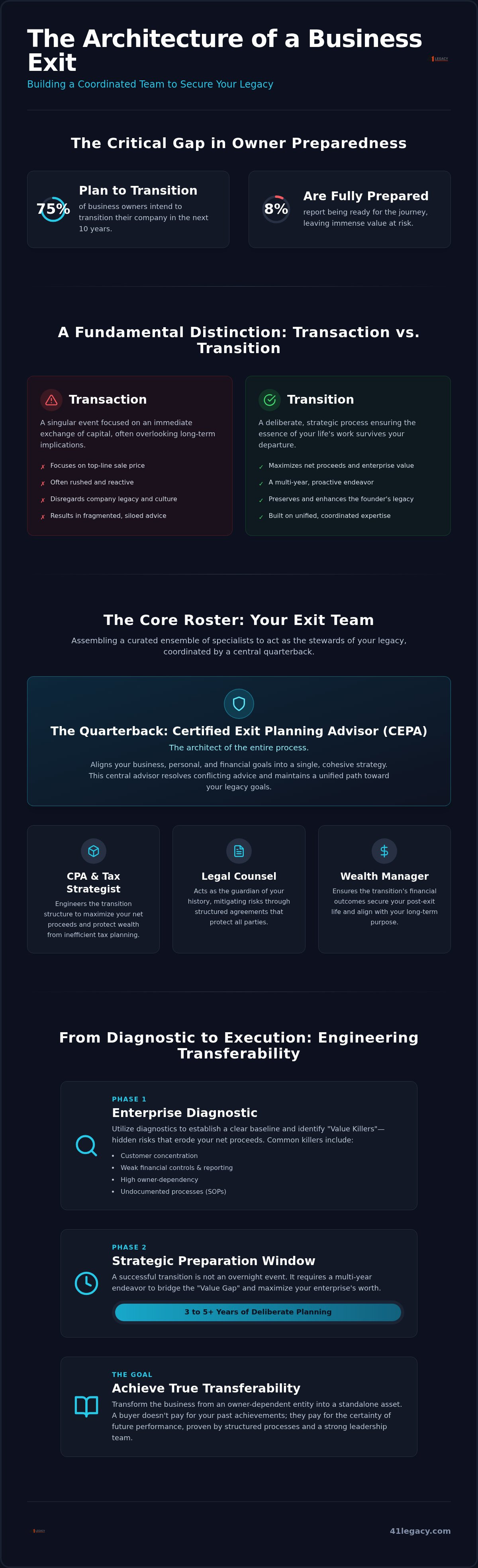
Approximately 75% of business owners intend to transition their companies within the next decade, yet only 8% report being fully prepared for the journey ahead. In the pursuit of preserving what you've built, building a business exit team is not merely a logistical necessity; it's a deliberate act of stewardship. You recognize that your enterprise is more than a series of transactions. It's a life's work that deserves a future beyond your daily presence. Too often, the fear of leaving value on the table is compounded by advisors who operate in silos, leaving you to bridge the gaps in their fragmented perspectives.
You deserve a strategy that honors your history while engineering a precise future. This article reveals how to unify specialists into a high-performance advisory collective that maximizes enterprise value and ensures your legacy remains intact. We'll explore the diagnostic precision and strategic coordination required to transform a founder-dependent company into a transferable asset of enduring worth. By the end, you'll understand how a coordinated architecture reduces risk and prepares your business to thrive independently of your daily involvement. This is the path to securing a legacy that survives the founder's exit.
Key Takeaways
- Understand the fundamental distinction between a mere transaction and a successful transition to ensure your life's work retains its essence and value.
- Learn why building a business exit team requires a Certified Exit Planning Advisor (CEPA) to serve as the architect of your overall strategy and transferability.
- Shift your focus from top-line sale prices to net proceeds by integrating tax strategists early in the planning process to protect your wealth.
- Utilize an Enterprise Diagnostic to identify and mitigate "Value Killers" and owner-dependencies that could compromise the business's marketability.
- Establish a central "Quarterback" to resolve conflicting advice between siloed specialists and maintain a unified path toward your long-term legacy goals.
The Architecture of Exit: Why a Specialized Team is Essential
A business is more than a collection of assets; it's a narrative of ambition and meticulous craft. Many owners mistake a transaction for a transition, yet the difference is profound. A sale is a singular moment in time, often focused on the immediate exchange of capital. A transition is a bridge to the future, ensuring the essence of your life's work survives your departure. Building a business exit team early in this process is the only way to safeguard that legacy. Without a unified strategy, the value you've spent decades cultivating can easily dissipate through the cracks of uncoordinated advice.
Precision is lost when advisors operate in isolation. Your CPA, attorney, and wealth manager may each be masters of their specific disciplines, but they rarely speak the same language. This lack of harmony creates friction that devalues the enterprise. We view the exit team as more than service providers; they're the guardians of your company's historical and future essence. Their role is to transform the business from an owner-dependent entity into a standalone masterpiece that commands respect in any market.
Understanding the Value Gap
The "Value Gap" represents the distance between what your business is worth today and what you actually need to fund your next chapter. It's a silent risk that often goes unnoticed until it's too late to correct. A sophisticated team identifies the hidden "Value Killers"—risks like customer concentration or weak financial controls—that quietly erode your net proceeds. Exit planning isn't a task for the eleventh hour. It's a multi-year endeavor that requires at least 3 to 5 years of deliberate preparation to bridge this gap and maximize your enterprise's worth.
The Concept of Transferability Engineering
A buyer doesn't pay for your past achievements; they pay for the certainty of future performance. Transferability engineering is the process of making that certainty visible. It requires a shift from intuitive leadership to documented precision. Implementing structured SOPs in business is the cornerstone of this effort. These blueprints serve as the technical manual for your legacy, proving to a successor that the organization's excellence isn't tied to your daily presence. When your processes are polished to a high sheen, the business ceases to be a job and becomes a transferable asset of enduring value.
The Core Roster: Identifying Key Specialists for Your Exit Team
A successful transition requires more than generic advice; it demands a curated ensemble of specialists who view your business as a living entity worthy of preservation. When you begin building a business exit team, you aren't simply filling seats. You're selecting the stewards of your legacy. Each professional must bring extreme precision to their role, ensuring that the final transfer is as seamless as it is profitable. To achieve this level of coordination, you must assemble a team of experts who prioritize the long-term health of the enterprise over the speed of a transaction.
- The Certified Exit Planning Advisor (CEPA): Serving as the architect of the entire process, the CEPA aligns your business, personal, and financial goals into a single, cohesive strategy.
- The CPA and Tax Strategist: Their focus extends beyond annual compliance. They engineer the structure of the transition to maximize net proceeds, ensuring you don't leave capital on the table through inefficient tax planning.
- Legal Counsel: These professionals act as the guardians of your history, mitigating risks through structured agreements that protect both the founder and the future of the enterprise.
- Wealth Managers: A transition is only successful if it secures your future. These advisors ensure your post-exit life is financially stable and aligned with your long-term purpose.
The Role of the Strategic Advisor
A strategic advisor provides the elevated vision necessary to harmonize the efforts of various specialists. They utilize Enterprise Diagnostics to establish a clear baseline of current performance, identifying the specific levers that will drive future growth. This professional serves as an objective voice. They provide clarity when emotional weight might otherwise cloud your judgment during the transition process. By maintaining a calm, authoritative presence, they keep the focus on the long-term integrity of the asset.
Transactional vs. Readiness Professionals
There's a critical distinction between those who sell a business and those who prepare it for sale. Readiness advisors should be engaged years before an M&A broker enters the room. Hiring a selling agent before the building phase is complete is a common error that devalues the work. The focus must first be on increasing enterprise value through structural improvements and risk reduction. This preparation ensures that when the time comes to go to market, the business is positioned as a masterpiece of reliability. If you're ready to begin this curatorial process, our strategic advisory services can help anchor your team and guide your roadmap.
The Quarterback Advantage: Coordinating Siloed Advisors
Individual brilliance rarely translates into collective success without orchestration. When building a business exit team, many owners assemble a roster of elite specialists only to find themselves trapped in the friction of conflicting advice. A CPA might prioritize tax deferral, while an attorney focuses on immediate risk mitigation. These objectives often clash when they don't have a central authority to align them. The Quarterback serves as the central point of accountability, ensuring every strategic decision is weighed against the unified goal of the enterprise's long-term health.
This role eliminates the "Advice Conflict" that often plagues uncoordinated transitions. Instead of the owner spending hours reconciling opposing guidance, the Quarterback synthesizes these perspectives into a single path forward. It's a method that ensures no technical detail is overlooked while maintaining strategic momentum. Every professional on the roster is held to the same Value Growth Roadmap, ensuring that granular tasks serve the broader vision of transferability. This orchestration reduces the administrative burden on the owner, allowing them to remain focused on leading the company through its most critical evolution.
Aligning Incentives and Communication
Effective coordination requires more than occasional check-ins. Monthly implementation support and structured team meetings create a rhythm of accountability that keeps the roadmap on track. The Quarterback translates technical jargon into strategic clarity, ensuring you understand the implications of every choice without becoming lost in the details. This unified front presents a "clean" business to potential successors. It signals that the organization is managed with extreme precision and foresight, which directly impacts the perceived value of the asset.
Reducing Owner Dependency Through Team Leadership
A primary objective of this coordinated effort is the reduction of owner dependency. By empowering the internal management team, the Quarterback facilitates a shift in your role from "Rainmaker" to "Visionary Leader." This transition is essential for building a transferable asset that can thrive independently of any single individual. The Quarterback serves as the guardian of the owner's time and legacy, ensuring the preservation of the company's essence through every phase of the transition.
From Diagnostic to Execution: How Your Team Drives Value
Execution is the crucible where strategic vision is forged into tangible enterprise value. While the architecture and the roster are vital, the true power of building a business exit team lies in the disciplined application of a Value Growth Roadmap. This phase requires a rhythmic movement between the high-level vision of the founder and the granular technical improvements managed by the advisory collective. It's a process of refinement, much like the restoration of a classic masterpiece, where every brushstroke is intentional and every adjustment serves the integrity of the whole.
This collaborative effort ensures that your business doesn't just look prepared on paper but is actually engineered for a seamless transfer. By integrating specialized knowledge into a single, actionable plan, your team transforms the company from a personal income stream into a high-performance asset. This transition isn't accidental. It's the result of systematic risk mitigation and value enhancement driven by a team that understands the weight of your legacy.
The Diagnostic Phase
The journey begins with an Enterprise Diagnostic. This is the first collaborative mandate for your team. It provides a surgical analysis of market attractiveness and internal readiness, establishing a baseline valuation that all advisors accept as the ground truth. This phase is critical for identifying "Value Killers"—those hidden risks such as customer concentration or undocumented tribal knowledge that quietly erode your multiples. Conversely, it unearths the "hidden gems" within your operations that, when polished, drive the premium valuations sought by sophisticated successors.
The Implementation Support Model
Most exit strategies falter not for lack of vision, but for lack of execution. Without a structured accountability model, the daily demands of the business often starve the long-term goals of the transition. Monthly implementation support ensures that the roadmap remains a living document rather than a static binder on a shelf. Your advisors act as the guardians of momentum, ensuring that transferability engineering becomes a natural part of your daily operations. This persistent focus reduces owner dependency and prepares the company to stand as a self-sustaining entity of enduring worth.
If you're ready to measure your current readiness and begin the refinement process, our Enterprise Diagnostic provides the clarity needed to anchor your strategy.
Securing Your Legacy: Building Your Advisory Circle
Selecting the right strategic partner is the foundational act of building a business exit team. This individual serves as the anchor for the entire advisory circle, ensuring that every subsequent specialist is aligned with a singular, uncompromising vision of perfection. You aren't merely seeking technical proficiency; you're looking for a partner who understands that your company is a masterpiece of history and effort. This choice determines whether your transition feels like a fragmented transaction or a curated passage into your next chapter. By establishing this anchor early, you protect the integrity of the enterprise from the friction of uncoordinated advice.
This process requires a profound psychological shift. You must move from being the primary owner to becoming the steward of a transferable asset. It's an invitation to slow down and appreciate the craftsmanship inherent in your organization. When a business is truly transferable, it possesses a life of its own, thriving independently of any single individual. It ceases to be a reflection of your daily labor and becomes a standalone entity with its own story to tell. By viewing the enterprise through this curatorial lens, you ensure its essence remains intact long after your departure.
The First Meeting: What to Ask Potential Advisors
When building a business exit team, the initial consultation should establish the standard for all future collaboration. You must ask: "How do you coordinate with my existing CPA and Attorney?" A true strategic partner values the existing relationships you've built over decades and seeks to harmonize those efforts rather than replace them. Another vital inquiry is: "What is your process for reducing my personal dependency on the business?" A commitment to enterprise value is hollow without a roadmap for making the founder's daily presence optional. You're searching for a partner who respects the essence of your history while possessing the technical skill to engineer its future.
Begin Your Readiness Assessment
Moving from theoretical discussion to practical, actionable insights is the only way to secure a lasting impact. A structured assessment provides the high-level clarity and professional-room altitude required for strategic depth. It replaces the anxiety of the unknown with a coordinated path forward, allowing you to lead with confidence. This transition from founder to steward is a meticulous endeavor that rewards those who value precision. By taking this step, you ensure that the details of your transition are handled with the same dedication you used to build the company. Secure your legacy with a professional Exit Readiness Assessment.
The Masterpiece of Transition
The journey of building a business exit team is the ultimate act of stewardship for any founder. It requires shifting from the daily rhythm of operations to the elevated perspective of transferability engineering. A successful transition depends on the harmony of a coordinated advisory circle; a strategic quarterback ensures that tax, legal, and operational goals move in unison. By utilizing expert Enterprise Diagnostics and Value Growth Roadmaps, you transform your company from a personal income source into a standalone asset of enduring worth.
Led by a Certified Exit Planning Advisor (CEPA), we provide the strategic quarterbacking national business owners need to bridge the value gap. We help you reduce risk and owner dependency, ensuring your legacy is preserved with the same precision used to build it. Your life's work deserves a future that honors its history and thrives beyond your daily presence. Begin your journey toward a transferable legacy with 41 Legacy. The path to a successful transition is a deliberate process that rewards those who value excellence.
Frequently Asked Questions
What is the role of a Certified Exit Planning Advisor (CEPA) on an exit team?
The Certified Exit Planning Advisor acts as the architect of the overall transition strategy. They align your business, personal, and financial goals into a single, cohesive plan. By focusing on transferability engineering, a CEPA ensures that building a business exit team results in a company that can thrive independently. They coordinate with other specialists to maintain strategic clarity and ensure every decision serves the long-term enterprise value of the asset.
When is the best time to start building a business exit team?
The ideal timeline for assembling your advisory circle is three to five years before your anticipated transition. This window allows for the implementation of a Value Growth Roadmap and the mitigation of significant risks. Preparing early provides the time necessary to bridge the "Value Gap" and refine internal operations. It ensures that the transition is a deliberate passage rather than a rushed transaction, protecting both the owner's wealth and the company's legacy.
How does a 'quarterback' advisor differ from a business broker?
A quarterback advisor focuses on readiness and value growth long before a sale is initiated. Unlike a business broker, who manages the transactional exchange and buyer negotiations, the quarterback engineers the business as a transferable asset. 41 Legacy provides strategic advisory and implementation support rather than brokerage services. This distinction is vital; the quarterback prepares the masterpiece, while the broker eventually presents it to the marketplace once the building phase is complete.
Can my current CPA lead my business exit team?
Your current CPA is an essential specialist on the roster, but leading a transition requires a specific multidisciplinary framework. While a CPA masters tax and financial compliance, a CEPA is trained to harmonize the business, personal, and financial pillars of exit planning. Building a business exit team around a strategic quarterback allows your CPA to focus on their technical excellence while ensuring their work aligns with the broader roadmap for transferability and value growth.
What are the common 'value killers' that an exit team identifies?
Common "Value Killers" include high owner dependency, customer concentration, and a lack of documented processes. Exit teams identify these risks through an Enterprise Diagnostic to prevent them from devaluing the company during a transition. Other risks include weak second-tier management and inconsistent financial reporting. By addressing these hidden vulnerabilities early, the advisory team protects the enterprise's market attractiveness and ensures the founder doesn't leave money on the table due to poor planning.
How much does it cost to build a professional exit advisory team?
The investment in a professional exit advisory team typically involves two distinct structures. Initial assessments, such as an Enterprise Diagnostic, are often handled through project-based fees to establish a baseline valuation and identify risks. Ongoing implementation and coordination are managed via monthly strategic advisory retainer fees. These costs reflect the time-intensive nature of high-end craftsmanship and the sophisticated coordination required to build a transferable legacy that delivers long-term financial security for the owner.
What is an Enterprise Diagnostic and why is it the first step?
An Enterprise Diagnostic is a surgical assessment of a company's current value and market readiness. It's the first step because it establishes a factual baseline from which all strategic decisions are made. This process uncovers the "Value Gap" between your current net worth and your post-exit financial needs. By measuring market attractiveness and internal stability, the diagnostic provides the technical precision necessary to build an effective Value Growth Roadmap for the advisory team.
How do I reduce owner-dependency so my business is more attractive to buyers?
Reducing owner-dependency requires shifting from intuitive leadership to documented precision. This involves empowering a second-tier management team and implementing structured SOPs that allow the company to operate without your daily involvement. Transferability engineering focuses on making the business a standalone entity. When you move from "Rainmaker" to "Visionary Leader," the business becomes a more attractive asset to buyers who seek the certainty of future performance and a sustainable legacy.

Article by
Mike Laskowski
Mike Laskowski is a Business Value Growth Strategist who helps business owners uncover the truths that drive their performance, risk, and readiness. Blending forensic interviewing from a 26‑year federal career with Strategic Capacity analysis and CEPA methodology, he works upstream to reduce owner dependency, increase transferability, and strengthen enterprise value. Mike guides founders through clarity, operational evolution, and transition readiness so their companies become transferable, owner‑independent assets that endure beyond the founder.
Disclaimer
This article is for educational and informational purposes only and does not provide legal, tax, investment, or business brokerage advice. 41 Legacy does not offer M&A brokerage services, legal document drafting, tax preparation, or investment advisory services. Business owners should consult licensed professionals in those disciplines before making decisions related to business transactions, legal matters, tax strategy, or financial planning. All examples are illustrative and may not apply to your specific situation.