
Transferability & Owner Dependency
Converting Personal Goodwill to Enterprise Goodwill: A Strategic Roadmap for Transferability
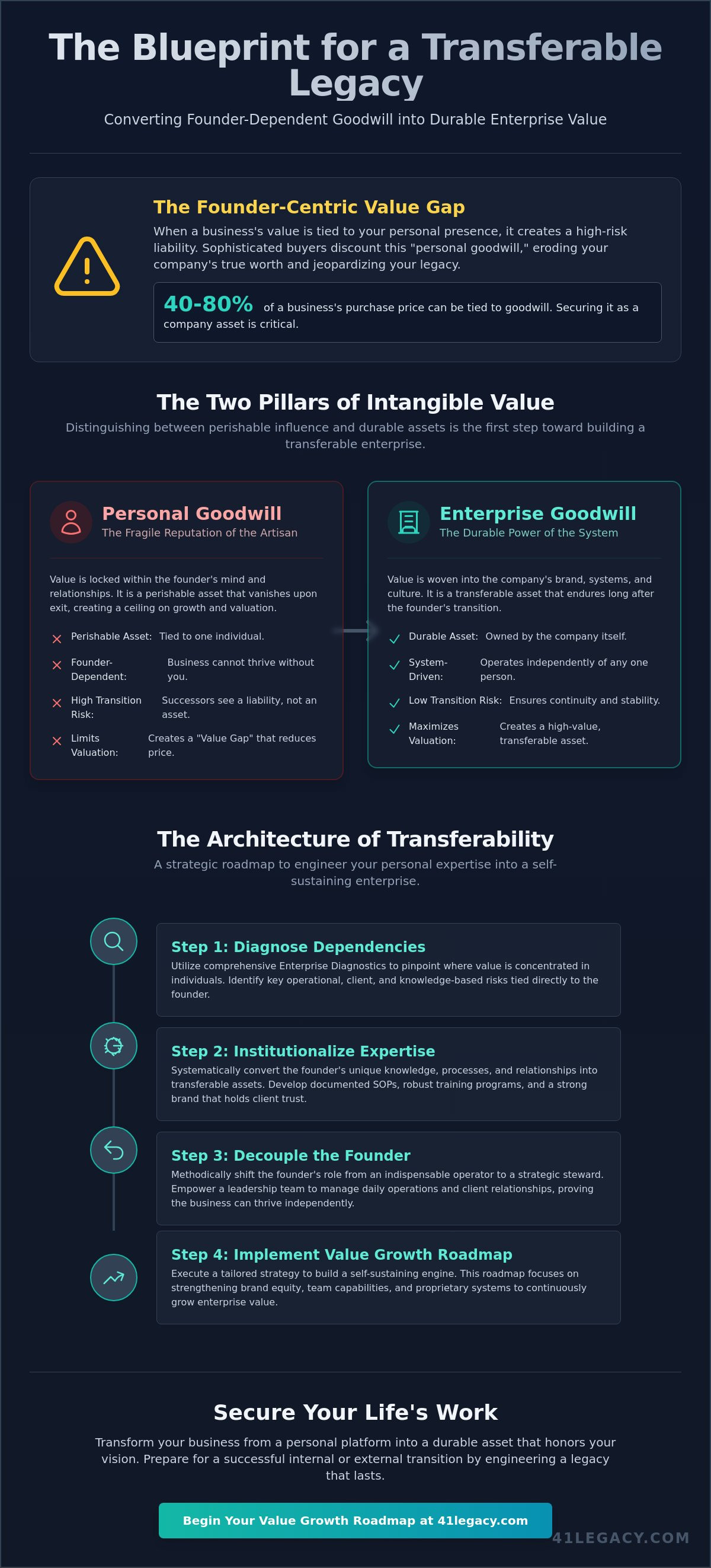
Most founders mistake their personal reputation for business value, yet a legacy built on a single name is a fragile architecture that rarely survives the transition of ownership. You've spent decades cultivating relationships and refining your craft, but you likely feel the weight of being the sole engine of your company's success. It's a common anxiety to realize that the value you've created might vanish the moment you step away, especially since goodwill often represents 40% to 80% of the total purchase price in middle-market sales. Converting personal goodwill to enterprise goodwill is not merely a financial maneuver; it's a deliberate act of curating your expertise into a durable, institutional asset.
We understand the profound reverence you hold for your life's work and the desire to see it flourish as a self-sustaining entity. This article provides a strategic roadmap for transforming founder-dependent influence into a transferable engine that thrives independently of its creator. You'll learn how to institutionalize your unique essence through precise systems and diagnostics, ensuring a higher enterprise valuation and the protection of your legacy. We'll explore the mechanics of transferability engineering and how to reduce owner-dependency to create a business that stands as a testament to your vision, long after the transition is complete.
Key Takeaways
- Distinguish between perishable personal influence and durable company assets to understand the true source of your enterprise's market value.
- Identify how being the primary driver of success creates a "Value Gap" that can derail future transitions and diminish your long-term legacy.
- Learn the sophisticated process of converting personal goodwill to enterprise goodwill by institutionalizing your unique expertise into transferable, durable systems.
- Utilize Enterprise Diagnostics and a Value Growth Roadmap to pinpoint dependency risks and engineer a business that operates as a self-sustaining engine.
- Prepare for successful internal or external transitions by shifting your role from an indispensable operator to a strategic steward of a transferable asset.
The Essence of Value: Understanding Personal vs. Enterprise Goodwill
In the architecture of a professional enterprise, value rests upon two intangible pillars. One is bound to the person; the other is woven into the fabric of the organization itself. For many founders, the success of their life's work is a testament to their individual brilliance, yet this very strength can become a structural weakness. When value is tied to your personal presence, it remains a perishable asset. It's a flame that flickers out the moment the artisan departs the workshop. To build something that endures, you must look beyond your own hands and consider the permanent structure of the entity.
The process of converting personal goodwill to enterprise goodwill begins with a fundamental philosophical shift. You're no longer merely a practitioner of a craft; you're the steward of a legacy. This transition requires you to view your business not as a personal platform, but as a self-sustaining engine. While your reputation may have opened the first doors, it's the company's internal systems that must keep them open for the next generation. True enterprise value resides within the infrastructure, surviving long after the founder has transitioned to their next chapter.
Personal Goodwill: The Reputation of the Artisan
Personal goodwill is the intangible reflection of an individual’s unique craftsmanship, reputation, and relational influence. It's built on specialized knowledge and the deep, personal trust clients place in a specific name. While this is a mark of high achievement, it presents a significant risk to the longevity of the firm. Sophisticated buyers often discount businesses where value is locked within the founder's mind, fearing that the "essence" of the company will vanish upon their exit. This dependency creates a ceiling on your enterprise's growth and complicates any future transition.
Enterprise Goodwill: The Power of the System
Enterprise goodwill represents the value that remains when the founder is no longer in the room. It's found in brand equity, proprietary systems, and the collective expertise of a well-trained team. These elements create a transferable asset that can be passed to new leadership without a loss in performance. By institutionalizing your unique processes, you ensure that the company's "memory" is held within its SOPs and culture rather than a single individual. This shift is essential for converting personal goodwill to enterprise goodwill, as it transforms your work from a personal service into a durable, high-value asset.
At 41 Legacy, we believe that every business should be a masterpiece of transferability. Through our Enterprise Diagnostics and Value Growth Roadmaps, we help you identify where your value is currently held and how to anchor it within the company’s own systems. This isn't just about efficiency; it's about the preservation of your impact. When you reduce owner-dependency, you don't just increase your valuation. You secure the future of your legacy.
The Rainmaker Trap: Why Personal Goodwill Limits Your Legacy
Success is often a deceptive mirror. For the founder who has spent a lifetime as the primary rainmaker, the very skills that built the enterprise now threaten its survival. This is the paradox of personal excellence. If the business cannot function without your specific touch, it possesses no independent life. In the eyes of a sophisticated successor, a company that relies entirely on its creator isn't an asset; it's a high-risk liability. This dependency creates a profound Value Gap, where the theoretical worth of the company is eroded by the uncertainty of its future without you.
The process of converting personal goodwill to enterprise goodwill requires a meticulous decoupling of your identity from the company's operational rhythm. We often hear owners suggest that "clients only stay because of me." While this may feel like a badge of honor, it's actually a diagnosis of a structural flaw. A business that cannot retain its clientele through its own systems and brand equity has a low Transferability Score. To protect your life's work, you must move beyond being the primary artisan and become the architect of a self-sustaining engine.
The Hidden Costs of Founder-Centricity
When an enterprise is overly dependent on its founder, its risk profile increases significantly during due diligence. This "Key Man" risk doesn't just deter potential successors; it actively suppresses the valuation multiples applied to the business. Professional buyers and financial institutions look for stability that outlasts any single individual. If the revenue is tied to your personal relationships rather than institutionalized processes, the business becomes difficult to finance and even harder to transition. Strengthening your owner dependency reduction strategy is the only way to ensure the entity retains its value in your absence.
The Psychological Shift Toward Stewardship
Moving from "I am the business" to "I am the steward of an asset" is perhaps the most difficult transition for any founder. It requires a deep reverence for the entity as a living history that deserves to outlast its creator. This shift isn't about stepping away; it's about stepping up into a role of strategic oversight. By treating the company as a masterpiece of engineering, you begin to see every system and SOP as a way to preserve your essence without requiring your presence. This curatorial approach ensures that your vision remains the guiding principle of the organization, even as the daily operations are handled by a capable team. Converting personal goodwill to enterprise goodwill is the ultimate act of leadership, ensuring that the impact you've made continues for generations to come.
The Architecture of Transferability: Engineering Enterprise Goodwill
While many advisors view goodwill as a static entry on a balance sheet, true stewards understand it as the living essence of the firm. It's the cumulative trust, reputation, and operational rhythm that defines your business's place in the market. To ensure this essence survives a transition, you must apply the principles of Transferability Engineering. This is the sophisticated process of capturing the artisan’s intuition and embedding it into the company’s infrastructure. By converting personal goodwill to enterprise goodwill, you're not just preparing for an exit; you're elevating the business into a durable, independent entity.
The first step in this architecture is identifying where your current value resides. Does it live in your personal cell phone's contact list, or in a centralized CRM? Is the "secret sauce" of your service delivery locked in your mind, or is it documented in a way that a talented team can execute with precision? We often find that the most valuable aspects of a business are the ones that have been successfully institutionalized. This requires a move away from personality-driven marketing toward a brand-centric position that represents a collective promise of excellence.
Institutionalizing the Artisan’s Knowledge
Documenting specialized expertise is the highest form of professional stewardship. You must transform your unique methods into Standard Operating Procedures that reflect your standard of perfection. This isn't about creating a rigid manual. It's about building a culture of technical excellence where every team member understands the "why" behind the "how." By leveraging technology to automate routine decisions, you free the organization from its reliance on your daily presence, allowing the "magic" of the founder to scale across the entire enterprise.
Client Relationship Transition Strategies
Relationships are the lifeblood of any professional enterprise, but they must belong to the firm, not just the individual. Transitioning from a "Primary Contact" model to a "Firm-Wide Support" model is essential for long-term stability. This involves introducing the next generation of leaders to key stakeholders early and often. When clients see that the brand promise is delivered by a cohesive system rather than a single person, their loyalty shifts from the individual to the institution. This ensures that the trust you've built remains a permanent asset of the company. This systematic approach is the core of converting personal goodwill to enterprise goodwill, turning a founder's legacy into a transferable masterpiece.
Strategic Implementation: Steps to Decouple the Founder
The transition from a founder-centric model to an institutionalized enterprise requires more than a shift in perspective; it demands a disciplined, technical execution. This is the stage where the abstract principles of stewardship are forged into a functional reality. By converting personal goodwill to enterprise goodwill, you're effectively engineering a business that can sustain its own weight. This process isn't a single event, but a series of deliberate movements designed to transfer the vital force of the company from the individual to the infrastructure.
We approach this decoupling with the same precision an artisan uses to restore a masterpiece. It begins with identifying the points of failure where the business still leans too heavily on your personal involvement. Once these dependencies are mapped, we can begin the work of building a self-sustaining engine. This involves not only the documentation of systems but the empowerment of a leadership team capable of making high-level strategic decisions without your direct intervention. Monthly accountability ensures these new rhythms become the permanent heartbeat of the organization.
Step 1: The Diagnostic Phase
Precision begins with an Enterprise Diagnostic. This rigorous assessment identifies the "Value Gap" between your current personal influence and the actual enterprise goodwill residing in the firm. We evaluate your strategic capacity, asking whether the business can handle significant growth or a change in leadership without collapsing. Diagnostics are the foundation of all strategic planning. They provide the clarity needed to see the business as a separate entity with its own strengths and vulnerabilities, allowing us to build a roadmap based on data rather than intuition.
Step 2: Talent and Systems Development
True transferability requires a "Next-Gen" leadership team trained in the technical precision of your craft. This phase focuses on building SOPs that aren't just instructions, but reflections of the company's commitment to excellence. By institutionalizing your unique methods, we reduce the friction in daily operations. This ensures that the brand's promise is delivered with consistency, regardless of who is in the room. This structured implementation support is what allows the founder to finally step back from the "rainmaker" role without risking the health of the enterprise.
Step 3: Measuring and Protecting the Asset
As owner-dependency drops, the enterprise value of the firm begins to rise. We track this progress through specific metrics that measure the strength of your systems and the autonomy of your team. Protecting this growing asset requires a coordinated effort, ensuring that your legal and financial planning aligns with the ultimate goal of a successful transition. This is where the "Quarterback" role becomes essential, acting as the central point of coordination for all your advisors. To begin this journey of preservation, we recommend establishing a comprehensive Value Growth Roadmap tailored to your specific legacy goals.
Securing Your Life’s Work: The Path to Exit Readiness
Exit readiness is the ultimate verification of a business owner’s stewardship. It's the moment when the enterprise is tested to see if it can stand as a separate, living entity or if it remains merely a shadow of its creator. True success isn't measured by the wealth generated during your tenure, but by the strength of the asset you leave behind. By converting personal goodwill to enterprise goodwill, you ensure that the essence of your life's work is preserved in a form that is both durable and transferable. This transition is a profound act of creation, turning a personal practice into a lasting institution.
Navigating the complexities of transferability requires a steady hand and a clear vision. At 41 Legacy, we serve as the guardians of this process, ensuring that every strategic decision is made with an eye toward long-term value. We help you move beyond the rainmaker trap, providing the technical precision needed to anchor your reputation within the company's own infrastructure. This isn't a journey you should take alone. It requires a coordinated effort from a team of specialists dedicated to the same uncompromising standard of perfection.
The Role of the Strategic Advisor
A successful transition relies on the seamless alignment of various professional disciplines. We act as the "Quarterback" in this process, coordinating with your CPAs, attorneys, and valuation experts to ensure everyone is moving toward a singular goal. This role is essential for maintaining a professional-room altitude, keeping the focus on high-level strategy rather than getting lost in transactional noise. We ensure your Value Growth Roadmap is executed with surgical precision, protecting your enterprise value from the risks of owner-dependency and market volatility.
Your Legacy, Institutionalized
There is a rare beauty in seeing a business thrive without its creator. It's the realization that you haven't just built a company; you've built a machine that works, a legacy that can continue for generations. Whether you're preparing for an internal succession or an external transition, the goal remains the same: to leave behind a masterpiece of transferability. Converting personal goodwill to enterprise goodwill is the final step in this curatorial journey, securing the impact you've made on your industry and your community.
To begin this transformation, Begin your journey toward transferability with an Exit Readiness Assessment. We invite you to slow down and appreciate the details of your enterprise’s potential, ensuring your life's work remains a vibrant, self-sustaining engine of success. By institutionalizing your unique expertise, you protect the historical significance of what you've built while opening the door to its future growth.
The Masterpiece of a Self-Sustaining Legacy
You've navigated the intricate process of decoupling your identity from your enterprise. By understanding the perishable nature of individual influence and building durable systems, you've begun the work of a true steward. The journey of converting personal goodwill to enterprise goodwill is the highest expression of business craftsmanship. It transforms a founder's intuition into a permanent, transferable asset that thrives independently of its creator. This evolution ensures that the essence of your work remains intact, even as the hands at the wheel change.
At 41 Legacy, our mission is led by a Certified Exit Planning Advisor (CEPA) who understands the surgical precision required for this evolution. Through our structured Enterprise Diagnostics process, we focus on the long-term transferability and value growth that secures your life's work. We provide the strategic clarity needed to move from being an indispensable operator to the architect of a lasting institution. Your legacy deserves a structure as enduring as the vision that founded it. Secure your legacy with a professional Exit Readiness Assessment. Build a future where your business continues to flourish as a testament to your dedication.
Frequently Asked Questions
What is the primary difference between personal and enterprise goodwill?
Personal goodwill is value tied directly to the founder's reputation, specialized knowledge, and personal relationships. It's a perishable asset that often departs when the owner leaves the firm. Enterprise goodwill, by contrast, resides within the company's infrastructure, brand equity, and proprietary systems. It remains a durable, transferable asset that continues to generate value regardless of who is at the helm.
How does high personal goodwill affect the sale price of my business?
High personal goodwill typically results in a lower valuation or significant discounts on multiples during a transition. Buyers view owner-dependency as a substantial risk, often requiring large earn-outs or hold-backs to ensure the business doesn't collapse post-sale. Since goodwill can represent 40% to 80% of a service business's purchase price, failing to institutionalize this value can cost a founder millions in walking-away capital.
Can personal goodwill be converted into enterprise goodwill?
Yes, the process of converting personal goodwill to enterprise goodwill is achieved through the deliberate institutionalization of the founder's expertise. This involves capturing unique processes in documented systems and transitioning client relationships to a team-based model. By shifting trust from a single person to the firm's collective brand and operational rhythm, you transform personal influence into a durable company asset.
Why do buyers prefer enterprise goodwill over personal goodwill?
Buyers seek predictability and lower operational risk, both of which are provided by enterprise goodwill. They're looking to acquire a self-sustaining engine rather than a role that depends on a specific individual's daily involvement. This institutional stability allows for easier financing and a higher probability of maintaining revenue after the founder departs, making the business a much more attractive investment.
How long does it typically take to decouple a founder from a business?
Decoupling a founder effectively usually requires 12 to 36 months of focused implementation. This timeline provides the space needed to introduce new leadership, document proprietary systems, and test the business's autonomy during the owner's absence. It's a thoughtful process that prioritizes technical precision over speed to ensure the entity's long-term health and transferability remain intact throughout the transition.
What role do SOPs play in building enterprise goodwill?
Standard Operating Procedures serve as the institutional memory that anchors personal expertise into the company's infrastructure. They ensure that technical excellence is delivered consistently by the team rather than being locked in the founder's mind. Well-crafted SOPs are the functional blueprints for transferability, making the business's value tangible and repeatable for a successor or new leadership team.
Is it possible to have a business with zero personal goodwill?
It's rare for a founder-led business to have zero personal goodwill, but mature, system-driven organizations can come very close. In these entities, the brand and systems are so dominant that clients interact with the institution's essence rather than any specific individual. Achieving this level of owner dependency reduction is the ultimate goal for those seeking to build a truly independent and high-value asset.
How does a Certified Exit Planning Advisor (CEPA) help with this conversion?
A CEPA acts as the strategic "Quarterback" who coordinates the entire conversion process through a high-altitude lens. They utilize Enterprise Diagnostics and Value Growth Roadmaps to identify specific dependency risks and align the efforts of other professional advisors. Their role is to ensure that every tactical move strengthens the business's transferability and prepares the owner for a successful, high-value transition.
Disclaimer
This article is for educational and informational purposes only and does not provide legal, tax, investment, or business brokerage advice. 41 Legacy does not offer M&A brokerage services, legal document drafting, tax preparation, or investment advisory services. Business owners should consult licensed professionals in those disciplines before making decisions related to business transactions, legal matters, tax strategy, or financial planning. All examples are illustrative and may not apply to your specific situation.