
How to Maximize Business Sale Price: Architecting Enterprise Value and Transferability
True enterprise value isn't negotiated at the closing table; it's methodically engineered into your operations years before an acquirer ever reviews your balance sheet. If you're exploring how to maximize business sale price, you must first recognize that institutional buyers don't pay premiums for founder heroics. They purchase resilient, transferable systems that operate independently of any single individual.
You've poured decades of discipline into crafting a distinguished company. It's deeply frustrating to watch disconnected legal, accounting, and wealth advisors operate in silos, leaving you uncertain about how buyers calculate risk discounts or where enterprise value leaks away. In this guide, you'll discover how to methodically elevate enterprise value and command premium acquisition multiples by transforming your business into an enduring, transferable asset. We'll explore the diagnostic criteria institutional buyers apply, the operational disciplines that eliminate owner dependency, and the strategic roadmap required to protect your legacy.
Key Takeaways
- Discover how to maximize business sale price by shifting your focus from baseline historical earnings to operational transferability and cash-flow durability.
- Learn how eliminating operational reliance on the founder removes the single greatest risk discount institutional buyers apply.
- Identify the financial reporting standards and customer diversification profiles required to prevent costly re-trades during confirmatory due diligence.
- Establish an intentional 24 to 36-month Value Growth Roadmap to methodically bridge the gap between present performance and institutional exit readiness.
- Unify your wealth, legal, and tax professionals under structured strategic advisory to protect enterprise value and secure your enduring legacy.
Understanding True Enterprise Value: Beyond Top-Line Revenue and Simple Multiples
Top-line revenue is an accounting record of the past. True enterprise value, by contrast, is a rigorous forecast of the future. Institutional acquirers evaluate a company not by what it generated yesterday under founder intuition, but by how reliably it will produce cash flow tomorrow under new stewardship. Understanding this distinction is fundamental for any owner evaluating how to maximize business sale price. Real equity value reflects cash flow predictability, commercial durability, and complete operational transferability.
Financial statements establish baseline earnings, but operational risks determine the valuation multiple applied to those earnings. Grounded in the standard enterprise value framework, sophisticated buyers assess the total economic engine, weighing capital structure and long-term earnings potential against underlying operational vulnerabilities. When you view your company as an enduring asset rather than an operational burden, learning how to maximize business sale price shifts from a transactional negotiation into a disciplined, multi-year engineering strategy.
The Anatomy of Valuation Multiples: What Buyers Actually Price
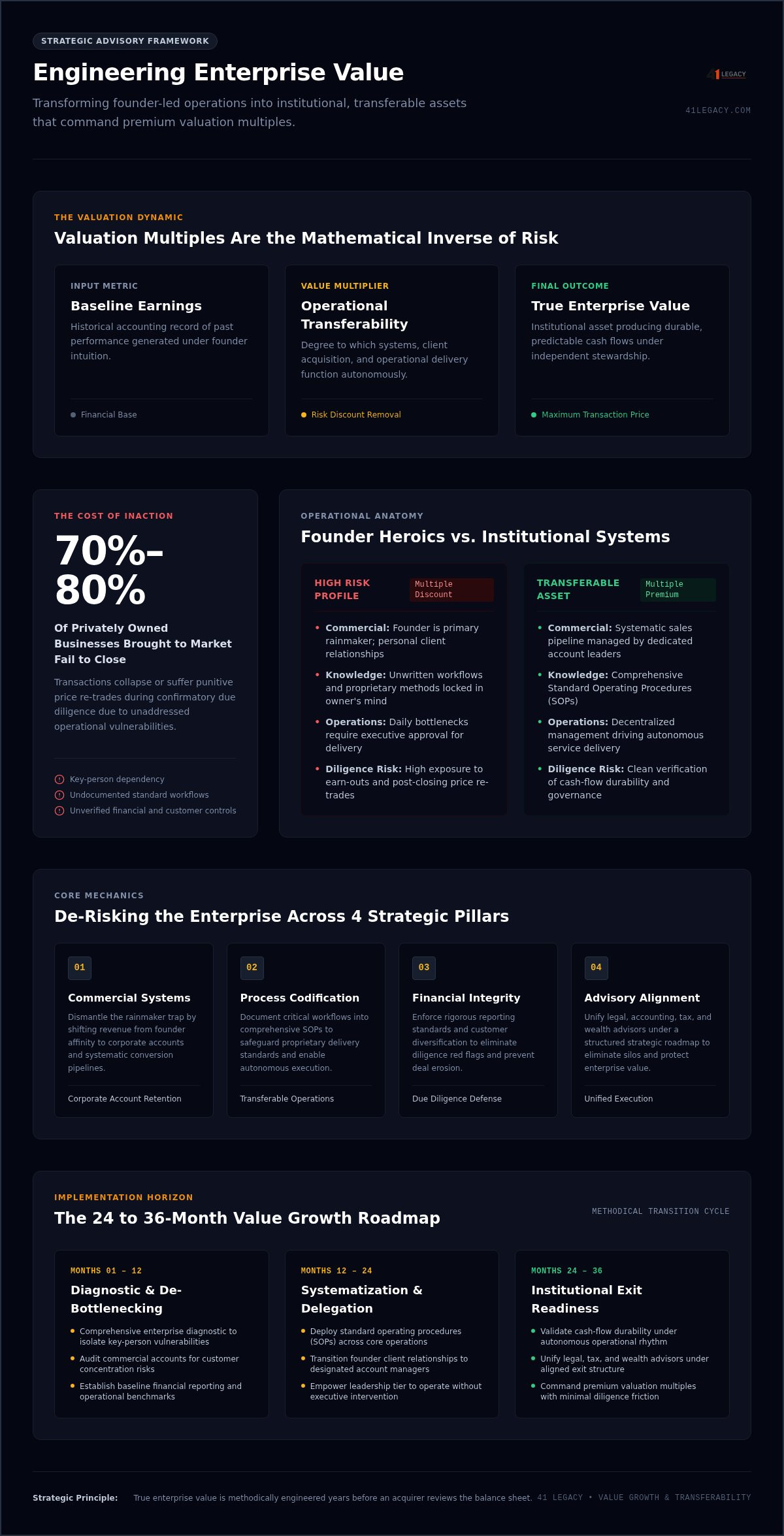
Valuation multiples are not arbitrary sector averages; they represent the mathematical inverse of perceived risk. When operational vulnerabilities surface during diligence, buyers immediately compress the multiple or restructure offers into contingent consideration. A business showing strong historical margins remains deeply fragile if its systems cannot run autonomously. Acquirers pay premium multiples for institutional capacity: predictable, repeatable revenue engines supported by deep operational infrastructure rather than unwritten founder expertise.
The Cost of Inaction: How Unmitigated Risks Depress Value
Unaddressed operational deficiencies quietly erode transaction outcomes long before an enterprise reaches the market. Industry data indicates that between 70% and 80% of privately owned businesses brought to market fail to close, driven predominantly by key-person dependency, undocumented processes, and unverified controls. When buyers discover operational inconsistencies during confirmatory reviews, price re-trades inevitably follow. Methodical enterprise preparation serves as your primary defense against deal erosion, ensuring your valuation reflects structural quality rather than hasty compromises.
De-Risking the Enterprise: Eliminating Founder Dependency Across Core Operations
Founder concentration represents the single greatest hazard to enterprise value and transferability. When your day-to-day presence dictates client retention, operational delivery, or strategic momentum, buyers perceive an acquisition of your personal labor rather than an enduring commercial asset. Addressing this operational bottleneck is the core mechanic for owners determining how to maximize business sale price. By deliberately transferring authority to institutional structures, you transform fragile personal goodwill into durable enterprise value.
Federal resources like the official SBA guide on selling your business consistently emphasize that operational readiness and clear organizational documentation directly dictate transaction viability. When you engineer your business to run autonomously, you protect historical earnings and expand the multiple acquirers are willing to pay.
Dismantling the Rainmaker Trap in Commercial Operations
Relying on founder-led sales creates severe key-person risk that chills buyer enthusiasm. Transitioning client relationships from personal founder affinity into structured corporate accounts ensures long-term customer retention. By introducing key account managers early and designing a systematic pipeline that converts without your direct involvement, you prove that commercial revenue belongs to the company, not your personal Rolodex.
Institutionalizing Operational Knowledge and Standard Operating Procedures
Unwritten knowledge locked inside an owner's mind cannot be transferred or scaled. Documenting essential workflows through comprehensive standard operating procedures captures your company's operational rhythm and protects proprietary delivery standards. These structured blueprints ensure consistent service quality under new leadership, effectively turning routine operational execution into protected structural capital.
Cultivating Autonomous Middle Leadership Capable of Scaling
A capable, empowered middle management tier proves that an organization thrives on systems rather than executive micromanagement. Establishing clear governance rhythms and operational scorecards allows department managers to solve problems independently. When prospective acquirers see a business operating smoothly across extended founder absences, operational continuity is verified, establishing the exact institutional credibility that unlocks top-tier market valuations.
Achieving this level of autonomy requires disciplined execution. Engaging structured strategic advisory helps founders identify operational bottlenecks, systematically eliminate owner dependency, and build an enterprise that stands as an enduring commercial asset.
Financial and Strategic Assets: What Sophisticated Acquirers Scrutinize
Tax minimization strategies and enterprise valuation objectives run in opposite directions. For years, your accounting practices likely focused on legally reducing taxable income. Institutional acquirers, however, inspect earnings through an uncompromising lens of cash durability, accounting integrity, and strategic asset health. If your goal is learning how to maximize business sale price, you must elevate your financial reporting from simple compliance filings to defensible, normalized earnings backed by institutional intangible capital.
Rigorous financial hygiene transforms basic tax records into an institutional Quality of Earnings profile. While traditional company valuation methods emphasize discounted cash flows and market multiples, acquirers heavily discount companies whose reported figures cannot survive rigorous audit scrutiny. Establishing documented, defensible normalized earnings defends your enterprise against aggressive adjustments during confirmatory diligence, protecting the closing valuation you deserve.
Financial Hygiene and Defensible Normalized Earnings
Discretionary owner perks and non-operational expenses cloud historical profitability. Systematically identifying and removing discretionary items yields a clear, defensible baseline of normalized EBITDA. Upgrading internal reporting from cash-basis records to disciplined accrual methodology ensures revenues align precisely with matching expenses. Conducting pre-transaction reviews allows you to resolve balance sheet ambiguities before an institutional buyer subjects them to forensic scrutiny.
Mitigating Customer and Supplier Concentration Vulnerabilities
Excessive commercial concentration remains an immediate deal breaker for institutional underwriters. When a single client accounts for more than 15% of annual revenue, acquirers see catastrophic downside risk. You can insulate the business through specific structural safeguards:
- Exposure Caps: Methodically diversify new client acquisitions to dilute major account concentration over time.
- Contractual Formality: Convert informal handshake accounts into multi-year master service agreements with clear transferability clauses.
- Vendor Redundancy: Establish qualified secondary and tertiary suppliers to guarantee uninterrupted operations during market disruptions.
Engineering Intangible Capital to Expand Acquisition Multiples
Tangible assets provide a baseline floor, but intangible capital dictates how to maximize business sale price across every private sector. Acquirers evaluate four distinct capitals: Human (the depth and stability of your leadership team), Structural (proprietary software, workflows, and documented processes), Customer (contractual lifetime value and low churn rates), and Social (commercial reputation decoupled from the founder's personal persona). Quantifying these intangible assets proves your competitive advantage is institutional, driving premium multiples well above peer medians.
Executing a Value Growth Roadmap: Timing, Milestones, and Advisory Alignment
Engineering premium enterprise value requires patience, structure, and a deliberate twenty-four to thirty-six month strategic horizon. Rushing an unprepared business to market invites severe risk discounts from institutional buyers. Implementing a comprehensive exit planning strategy methodically closes the gap between your current baseline and aspirational enterprise valuation. This structured discipline represents the most reliable path for founders learning how to maximize business sale price on their own terms.
The Multi-Year Horizon: Staging Operational Enhancements
Meaningful operational change cannot be compressed into a few frantic quarters before a transaction. A multi-year horizon gives you the necessary runway to stage operational enhancements logically. By prioritizing risk reduction before commercial acceleration, you eliminate systemic vulnerabilities first. Quarterly accountability reviews ensure the leadership team hits concrete transferability milestones, steadily expanding your valuation profile month over month.
Enterprise Diagnostics: Establishing Baseline Attractiveness
You can't optimize what you haven't objectively measured. Enterprise diagnostics evaluate company attractiveness and structural readiness across every core operational discipline before an external party initiates review. Grounded in disciplined enterprise value assessment principles, diagnostic frameworks reveal hidden operational friction points that suppress market multiples. Identifying these vulnerabilities early gives you time to remediate them quietly and effectively.
The Quarterback Advisory Model: Unified Strategic Execution
Most business owners retain capable accountants, corporate attorneys, and wealth managers. These professionals often work in isolation, offering well-intentioned advice that contradicts broader succession goals. Research from the Chase for Business Advisory Study reveals that owners operating without an aligned interdisciplinary advisory team are four to eight times more likely to stall or abandon transition processes entirely. A strategic quarterback harmonizes these separate disciplines under a unified plan, ensuring every decision directly serves long-term enterprise health.
To master how to maximize business sale price and protect the legacy you've built, you need an objective operational partner. Reach out to develop your Value Growth Roadmap and start engineering a self-sustaining asset today.
Architecting Your Enduring Legacy with 41 Legacy's Strategic Advisory
Every exceptional business is the product of deliberate craftsmanship. Yet, preserving what you've built requires a profound shift in mindset: moving from a master operator who drives every outcome to an architectural steward who designs a self-sustaining asset. Discovering how to maximize business sale price isn't an exercise in aggressive eleventh-hour negotiation. It's an intentional practice of engineering operational autonomy, institutional credibility, and structural transferability. 41 Legacy partners with founders nationwide to transform complex enterprises into enduring, highly transferable market leaders.
Led by Chris Giammarco, Certified Exit Planning Advisor (CEPA), 41 Legacy brings disciplined institutional rigor to every phase of value development. Rather than providing transactional brokerage or isolated financial compliance, we deliver high-altitude strategic advisory. We serve as the quarterback uniting your CPA, legal counsel, and wealth advisory partners around a singular objective: methodically eliminating risk to expand your valuation multiple.
The Exit Readiness Assessment and Value Growth Roadmap
True value engineering starts with uncompromising diagnostic clarity. The Exit Readiness Assessment deploys structured enterprise diagnostics to evaluate company attractiveness and structural maturity across your entire organization. It pinpoints hidden founder dependencies, governance weaknesses, and operational friction points that erode buyer confidence.
These findings translate directly into a custom Value Growth Roadmap. This prioritized execution blueprint bridges the gap between your baseline performance and aspirational wealth targets. By establishing clear operational milestones, you systematically de-risk cash flows, improve reporting rigor, and construct an enterprise capable of thriving under future ownership.
Continuous Implementation Support and Value Protection
A roadmap creates clarity, but sustained execution builds enduring wealth. Through Monthly Implementation Support, 41 Legacy provides the external discipline needed to keep internal teams accountable to strategic milestones. We work alongside executive leadership to safeguard operational gains and monitor critical value drivers quarter by quarter.
- Strategic Capacity Evaluation: Assess organizational bandwidth to ensure management teams execute growth priorities without founder intervention.
- Transferability Engineering: Convert tribal operational instincts into codified systems that ensure repeatable delivery.
- Owner Dependency Reduction: Transition vital commercial, vendor, and team relationships to institutional governance structures.
When you're ready to master how to maximize business sale price and protect the life's work you've created, partner with proven guides. Engage 41 Legacy's strategic advisors to elevate, de-risk, and steward your enterprise toward its greatest valuation potential.
Steward Your Enterprise Toward Its Ultimate Valuation Potential
Maximizing your company's value isn't a frantic sprint before a transaction; it's a deliberate act of stewardship. If you want to understand how to maximize business sale price, look directly to your operational foundations. By replacing founder reliance with documented systems, building institutional management depth, and establishing defensible accrual reporting, you convert past performance into an enduring, transferable asset that commands institutional respect.
Achieving this level of enterprise maturity requires strategic precision and dedicated operational guidance. Under the leadership of a Certified Exit Planning Advisor (CEPA), 41 Legacy deploys proprietary Exit Readiness Assessment and Value Growth Roadmap methodologies. Our disciplined quarterback advisory model harmonizes your legal, tax, and operational partners into a cohesive force, ensuring no enterprise value is left behind.
Your business represents decades of discipline, focus, and craft. It deserves a transition strategy that honors that commitment. Architect your enduring enterprise value with 41 Legacy and build an asset engineered to thrive independently for generations to come.
Frequently Asked Questions
How far in advance should an owner prepare to maximize their business sale price?
Business owners should ideally begin preparing twenty-four to thirty-six months before pursuing an exit. This multi-year runway provides adequate time to eliminate founder reliance, implement accrual accounting practices, and demonstrate consistent financial performance under autonomous systems. Rushing into a process without this foundation invites severe risk discounts from prospective buyers, whereas methodical preparation allows you to discover how to maximize business sale price by engineering verifiable transferability across every internal discipline.
What is the difference between increasing annual profit and maximizing enterprise value?
Annual profit reflects short-term operational cash flow, while enterprise value measures the durability, predictability, and transferability of that cash flow into the future. A profitable firm can still hold minimal enterprise value if earnings rely on founder relationships or undocumented tribal knowledge. Maximizing enterprise value focuses on expanding your valuation multiple by institutionalizing workflows, diversifying client revenue, and building independent middle management that thrives long after the founder steps aside.
How does owner dependency directly affect the company valuation multiple?
Owner dependency directly compresses valuation multiples by signaling elevated transition risk to acquirers. When critical commercial relationships, vendor terms, or operational decisions reside solely with the founder, buyers discount their offers or structure payouts as heavy earnouts to hedge against post-closing disruption. Eliminating owner dependency proves the business operates as an autonomous economic engine, allowing the enterprise to command premium multiples reserved for self-sustaining institutional assets.
What core factors cause buyers to discount business purchase prices during due diligence?
Acquirers primarily discount purchase prices when they uncover unverified financial reporting, severe client concentration, and undocumented operating workflows during diligence. Discrepancies between cash-basis bookkeeping and accrual earnings often prompt aggressive quality-of-earnings write-downs. Similarly, having a single client generate over fifteen percent of revenue introduces volatility that underwriters immediately penalize. Resolving these operational vulnerabilities well ahead of time preserves transaction terms and prevents costly re-trades.
Why is an Exit Readiness Assessment necessary before engaging transaction intermediaries?
An Exit Readiness Assessment provides an objective, diagnostic baseline of your company's operational strengths and market attractiveness before outside parties evaluate your books. Engaging transaction intermediaries without knowing your structural vulnerabilities often leads to broken negotiations or disappointing offers. By deploying enterprise diagnostics early, you identify friction points and execute a custom roadmap to resolve value gaps, ensuring your organization enters discussions fully prepared to command top value.
How does the strategic quarterback model coordinate with my existing CPA and attorney?
The strategic quarterback serves as the unifying conductor aligning your existing CPAs, corporate attorneys, and wealth managers around a single master roadmap. While traditional advisors provide valuable technical expertise in isolation, they rarely coordinate operational value creation. As an advisory partner led by a Certified Exit Planning Advisor (CEPA), 41 Legacy synchronizes these separate disciplines. This collaborative alignment ensures every tax, legal, and operational initiative actively supports how to maximize business sale price.

Article by
Mike Laskowski
Mike Laskowski is a Business Value Growth Strategist who helps business owners uncover the truths that drive their performance, risk, and readiness. Blending forensic interviewing from a 26‑year federal career with Strategic Capacity analysis and CEPA methodology, he works upstream to reduce owner dependency, increase transferability, and strengthen enterprise value. Mike guides founders through clarity, operational evolution, and transition readiness so their companies become transferable, owner‑independent assets that endure beyond the founder.
Disclaimer
This article is for educational and informational purposes only and does not provide legal, tax, investment, or business brokerage advice. 41 Legacy does not offer M&A brokerage services, legal document drafting, tax preparation, or investment advisory services. Business owners should consult licensed professionals in those disciplines before making decisions related to business transactions, legal matters, tax strategy, or financial planning. All examples are illustrative and may not apply to your specific situation.

