
Business Transferability Assessment: Is Your Company Ready to Thrive Without You?
What would happen to your company’s performance if you stepped away for a month? A business transferability assessment examines whether the enterprise can sustain its operations, relationships, and results without relying on you at every turn. It tests a question that a strong revenue figure alone can’t answer: can the business thrive under new leadership?
It’s reasonable to see a profitable company as a valuable one. But value and transferability are not the same. If key decisions, customer relationships, or essential knowledge remain concentrated with the owner, continuity may be at risk, even when the business is performing well.
A clear assessment brings those risks into focus. You’ll learn what it evaluates, how to interpret findings across operations, leadership, and strategy, and how to prioritize the gaps that matter most. The goal isn’t to promise a particular valuation or outcome. It’s to help you build a more resilient enterprise that can function beyond its founder. At 41 Legacy, enterprise diagnostics can inform a practical Value Growth Roadmap and structured advisory support, helping turn insight into deliberate progress.
Key Takeaways
- A business transferability assessment examines whether the company can sustain performance beyond its current owner, even before a transition is imminent.
- Review leadership capacity, documented processes, customer concentration, decision rights, and strategic continuity to locate owner-dependency risks.
- Use valuation to understand estimated worth under a defined approach; use transferability findings to assess organizational readiness.
- Prepare by clarifying your goals, mapping owner-held responsibilities, gathering relevant records, and ranking the gaps that most affect continuity.
- Enterprise diagnostics can turn findings into a Value Growth Roadmap aligned with your goals and focused on strengthening the business over time.
What a Business Transferability Assessment Reveals About Your Company
Business transferability is a company’s capacity to sustain performance and transition beyond its current owner. A business transferability assessment examines whether leadership, operating practices, customer relationships, and decision-making can continue when the founder steps back. It is a strategic diagnostic, not a valuation, transition plan, or promise of a particular outcome. Its purpose is to show how much continuity the enterprise can support today and where stronger systems may be needed.
What does it mean for a business to be transferable?
A transferable company doesn’t need its owner to personally carry every important relationship, solve each unusual problem, or approve every meaningful decision. Leaders understand their authority. Employees can follow reliable processes. Customers have durable connections to the company, not only to its founder. These capabilities work together. Documenting a process helps, but it won’t create continuity if no one is prepared to own the work or make decisions when circumstances change.
Consider a company where the founder alone knows how to handle a key customer’s urgent request. If that knowledge stays in the founder’s memory, the team may struggle to respond in their absence. A more transferable practice records the customer’s needs, clarifies who can make decisions, and assigns a capable team member to follow through. The written procedure is one part of the system; authority, training, and customer trust complete it.
Transferability isn’t achieved through a single document or isolated improvement. It develops as responsibilities, knowledge, relationships, and operating routines become clear and repeatable across the company. The question isn’t whether the owner remains important. It’s whether the business can preserve performance and judgment without depending on that person for every essential function.
Why assess transferability before choosing a transition path?
Owners don’t need to be preparing for an immediate transition to benefit from an early assessment. A clear view of dependencies gives them time to strengthen leadership, clarify decision rights, and build repeatable processes while they continue to lead. It can also help distinguish urgent continuity risks from improvements that can be addressed over time.
Stronger continuity can preserve options. A business with capable leaders and dependable operations may be better positioned to consider an internal or external transition, depending on the owner’s goals and circumstances. An assessment doesn’t choose the path. It helps show what the enterprise may need to support different paths before timing or pressure narrows the choices.
Succession planning addresses how leadership and responsibility may pass to others. The overview of Succession Planning in Business offers useful context, while a transferability assessment focuses on the company’s readiness to continue beyond its current owner. Together, these perspectives can help owners approach transition planning with greater clarity. Early insight gives you room to strengthen the enterprise as a durable asset, whether a change in ownership is near or still years away.
How a Business Transferability Assessment Examines Owner Dependency
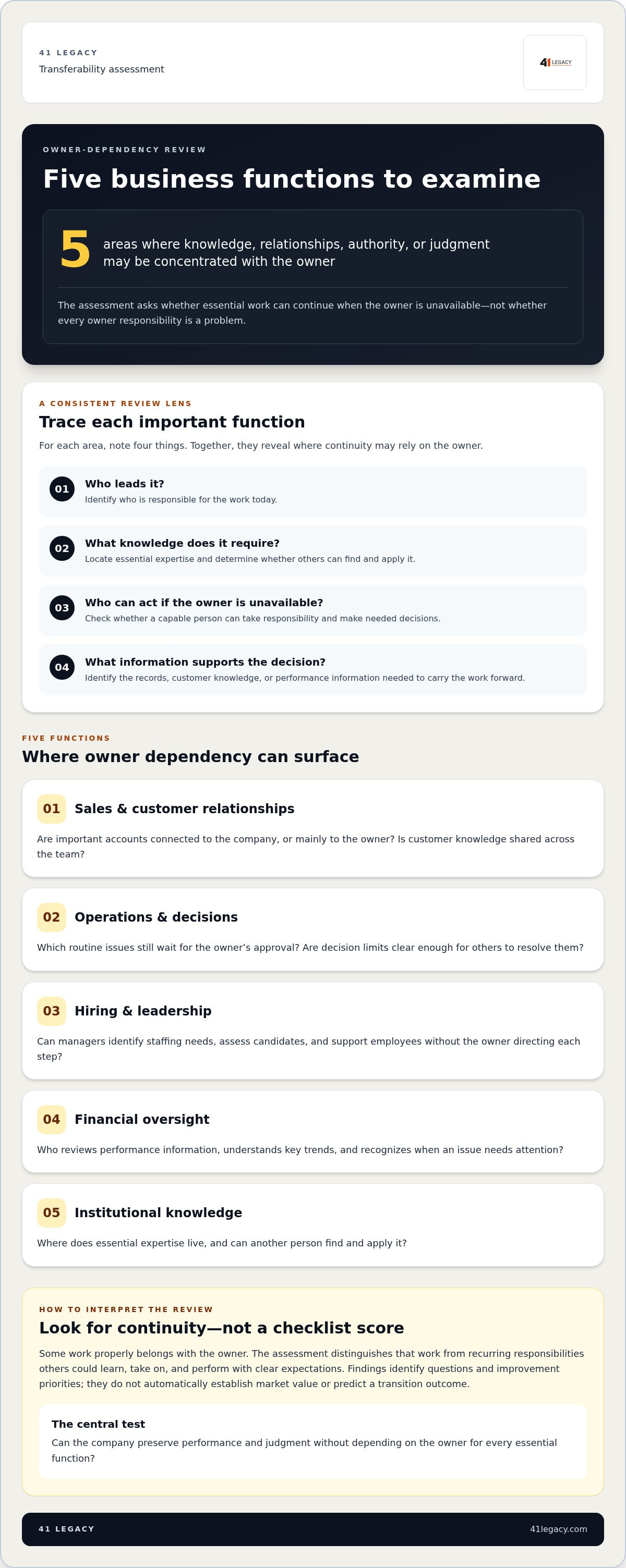
A business transferability assessment reviews how the company operates when the owner steps back. It looks beyond a list of duties to identify where knowledge, relationships, authority, or judgment are concentrated, and what happens if the owner is unavailable. Owner dependency can interrupt continuity when essential decisions or relationships have no capable backup. It can also limit transferability because the company’s performance may be difficult to sustain without the person who built it.
The goal isn’t to label every owner responsibility as a problem. Some work properly belongs with the owner. The assessment distinguishes that work from recurring responsibilities others could learn, take on, and perform with clear expectations. Findings identify questions and priorities for improvement. They don’t automatically establish market value or predict a particular transition outcome.
Which business functions rely most heavily on the owner?
Trace work through the business. For each important function, note who leads it, what knowledge it requires, who can act when the owner is unavailable, and what information supports the decision. Review areas such as:
- Sales and customer relationships: Are important accounts tied to the company, or do they depend on the owner’s personal relationships? Is customer knowledge shared across the team?
- Operations and decisions: Which routine issues still wait for the owner’s approval? Are decision limits clear enough for others to resolve them?
- Hiring and leadership: Can managers identify staffing needs, assess candidates, and support employees without the owner directing each step?
- Financial oversight: Who reviews performance information, understands key trends, and knows when an issue needs attention?
- Institutional knowledge: Where does essential expertise live, and can another person find and apply it?
Separate duties that require the owner’s unique judgment from tasks that remain owner-held mainly because responsibility was never reassigned. Standard operating procedures (SOPs) can make recurring work more repeatable by recording the steps, decision points, and handoffs. They’re most useful when the right people can access them, understand them, and keep them current. A useful SOP goes beyond a checklist: it explains what to do when a routine situation changes.
How do leadership and operating systems support continuity?
Examine whether the leadership team knows who owns each outcome, what decisions it can make, and when to escalate an issue. Clear roles prevent delays and conflicting direction. Then consider whether the team has reliable performance information, such as agreed operating measures and regular reviews, to spot problems and act without waiting for the owner to interpret every result.
Strategic continuity matters, too. Can leaders explain the company’s current priorities and how their decisions support them? If direction exists only in the owner’s conversations, capable managers may still struggle to maintain it. An SOP guide can provide more detail on documenting repeatable work; an assessment connects that documentation to leadership, decision rights, customer concentration, and continuity across the enterprise. Owners who want to examine these dependencies systematically can explore 41 Legacy’s enterprise diagnostics as a starting point for turning observations into focused priorities.
Transferability Assessment vs. Business Valuation: What Each Can Tell You
A business transferability assessment and a valuation answer different questions. One examines whether the organization can continue operating through a change in ownership or leadership. The other estimates business worth for a stated purpose, using a defined approach. Neither replaces the other, and neither alone tells an owner everything needed to make a sound transition decision.
| Lens | Central question | Evidence examined | Decision supported |
|---|---|---|---|
| Business valuation | What is the business estimated to be worth for a particular purpose? | Financial performance, risk, and other factors relevant to the purpose and methodology. | Decisions that require an estimate of worth. |
| Transferability assessment | Can the company sustain performance beyond the current owner? | Leadership capacity, operating systems, decision-making, and the resilience of key relationships. | Priorities for strengthening continuity and organizational readiness. |
A valuation is an estimate, not a universal figure detached from context. The purpose and method matter, as do the financial results, risks, and other business factors considered. A transferability review focuses on the company’s ability to carry forward its work, knowledge, and relationships if the owner’s role changes. Its findings can inform value-growth priorities, but they aren’t a certified valuation.
What does a valuation answer that a transferability assessment does not?
A valuation addresses estimated worth under a defined approach. Depending on its purpose, the work may examine financial performance, risks, and other relevant characteristics of the company. The resulting estimate can support decisions that depend on a view of worth. It doesn’t, by itself, establish whether the organization can maintain its performance under different leadership or ownership.
That distinction matters in practice. A strong financial picture may coexist with a fragile operating structure. If one person holds essential customer knowledge or makes decisions that no one else is prepared to make, the company’s continuity remains an open question, whatever a separate valuation may estimate.
What transferability questions require a different lens?
Transferability asks how the organization performs when responsibilities shift. Can leaders carry out the company’s priorities without the owner’s daily direction? Are customer and supplier relationships connected to the business, or do they rely heavily on the owner personally? Can the team resolve operating issues using clear authority, shared knowledge, and consistent information?
These questions help identify where the organization may need stronger leadership depth, clearer decision rights, or more dependable operating practices. They don’t establish market value or guarantee a particular transition outcome. Assessment results also can’t promise a particular valuation or future performance. They offer something distinct: a structured view of readiness that owners can use to set priorities, work toward greater continuity, and discuss aligned next steps with their professional advisors.
How to Prepare for a Business Transferability Assessment and Prioritize Findings
Preparation doesn’t require perfect records. It requires an honest view of how the company works today and what you want it to support in the future. A business transferability assessment is most useful when owners bring clear goals, relevant evidence, and a willingness to distinguish critical gaps from lower-priority improvements.
Use this sequence to prepare:
- Define your goals. Clarify what you want the business to make possible, such as greater owner independence, stronger leadership continuity, or readiness for a future transition.
- Map owner-held responsibilities. List recurring decisions, relationships, and activities that depend on your direct involvement. Note who else could learn or assume each responsibility.
- Gather existing evidence. Organize financial reports, organizational roles, process documentation, and information about key customer and supplier dependencies. Include what the company already tracks, not only formal documents.
- Rank the gaps. Consider each finding’s potential enterprise impact, degree of owner dependency, continuity risk, and the team’s realistic capacity to address it.
What information helps make the assessment useful?
Look for evidence that shows how work and decisions move through the company. Existing financial reports can show what the business monitors. Organization charts or role descriptions can clarify where responsibilities sit. Process documents can reveal whether recurring work is repeatable or rests on informal knowledge. Customer and supplier information can highlight relationships that may be concentrated around the owner.
Also record decisions that regularly come to you: approving an exception, resolving a delivery issue, setting priorities, or reviewing a key account concern. Ask relevant leaders what they handle independently and where they still need your direction. Professional advisors can contribute distinct financial or operational perspectives within their roles. The aim is a fuller picture, not a larger file collection.
How should owners turn assessment findings into action?
Not every gap deserves attention at once. Separate foundational issues, such as unclear accountability for an essential function, from improvements that can wait. A practical priority has a clear reason, an accountable person, and a next step small enough to begin. For example, if customer knowledge is concentrated with the owner, a first step might be to document key account information and decide who will maintain it.
Sequencing improvement work helps owners focus limited attention on the gaps most likely to affect continuity. Revisit priorities as people, systems, and business needs change. Track whether the underlying capability is strengthening, not simply whether a task was completed. If you’re ready to turn assessment findings into focused enterprise priorities, explore 41 Legacy’s enterprise diagnostics.
How 41 Legacy Turns Transferability Findings Into a Value Growth Roadmap
A business transferability assessment is most useful when its findings lead to deliberate action. 41 Legacy’s enterprise diagnostics help owners see the company’s current strengths, dependencies, and strategic gaps in relation to their goals. The aim isn’t to produce a checklist that sits on a shelf. It is to clarify where focused work can strengthen the enterprise and make it less dependent on the owner.
From enterprise diagnostics to prioritized strategic work
Diagnostics create a clearer picture of the distance between the company’s current position and the owner’s goals. They may reveal, for example, that the business has capable managers but lacks clear decision authority, or that growth opportunities are constrained by too much operational responsibility resting with the founder. The significance of each finding depends on the company’s priorities and its capacity to address the issue.
Those findings can inform a Value Growth Roadmap: a practical sequence of priorities aligned with the owner’s goals. Work may focus on strengthening transferability, reducing owner dependency, building strategic capacity, or addressing other factors that support enterprise value. The roadmap helps distinguish foundational work from opportunities that can follow, giving improvement efforts a clear purpose and order.
Value growth is not a single initiative. It depends on how leadership, operations, strategy, and owner priorities fit together. A roadmap gives those efforts a shared direction while leaving room to adjust as the business develops. Owners can explore 41 Legacy’s strategic approach to enterprise value as they consider how diagnostic findings might shape their priorities.
How ongoing advisory support helps sustain implementation
A sound plan still requires ownership and follow-through. 41 Legacy’s monthly implementation support provides a structure for revisiting priorities, maintaining accountability, and keeping strategic work in view alongside daily operations. The focus is progress against agreed priorities, not treating completion of a task as proof that a capability is firmly established.
Coordination also matters. As strategic quarterback, 41 Legacy can help align execution with the owner’s existing professional advisors, including CPAs and attorneys. Each advisor contributes within their own role; coordinated work helps keep business priorities connected without replacing that expertise or implying legal, tax, or investment advice. The owner remains central to decisions about goals, resources, and the pace of implementation.
For owners ready to connect diagnostic insight with structured strategic support, explore 41 Legacy’s strategic approach. A clear roadmap gives the work direction. Consistent attention helps turn priorities into stronger capabilities and a more resilient enterprise over time.
Build a Business That Can Carry Its Strength Forward
A more transferable company is built through intentional choices, not a single transition event. Each step that makes the business less dependent on you can give its people clearer responsibility, strengthen continuity, and preserve more options for the future. A business transferability assessment can help you decide where to begin, but lasting value comes from acting on what it reveals.
That work starts with your goals. What should the business be capable of doing without your daily involvement? Which responsibilities are ready to move, and what support would make that shift durable? Clear answers turn an abstract desire for independence into a practical direction for the enterprise.
Founded and led by Chris Giammarco, a Certified Exit Planning Advisor, 41 Legacy helps owners bring strategic clarity to this work and coordinate progress with their existing professional advisors. Explore 41 Legacy’s Exit Readiness Assessment and take the next step toward a more transferable business.
Your company’s next chapter can be shaped deliberately. Begin with the capabilities you want it to carry forward.
Frequently Asked Questions
What is included in a business transferability assessment?
A business transferability assessment should produce more than observations; it should show what the owner can do with them. Useful findings distinguish confirmed strengths from assumptions, identify the evidence behind each concern, and rank follow-up questions by importance. For example, a role description may say a manager owns a function, while interviews reveal that approvals still routinely return to the owner. That gap between formal responsibility and actual practice is worth investigating.
When should an owner complete a transferability assessment?
An owner can use an assessment to review the company’s direction, even without a planned transition. It may be useful before setting growth priorities, changing how leadership is organized, or deciding where to invest management attention. To make the work relevant, state the decision you hope it will inform. That keeps the assessment focused on the company’s present needs rather than turning it into a general review with no clear purpose.
Can a small, owner-led business become more transferable?
Yes. A small business can improve transferability without adding layers of bureaucracy. Start with a short coverage map: identify the critical tasks that need a backup, name who could provide that coverage, and note what training or access they need. For a lean team, the goal isn’t to create a manual for every activity. It’s to make essential work less vulnerable to one person’s absence or changing responsibilities.
Does a transferability assessment mean I have to sell my business?
No. The assessment itself doesn’t require a sale or commit you to a particular transition. You can use what you learn to guide decisions about the company’s structure, leadership development, or operating priorities while retaining ownership. For example, an owner who wants to spend more time on long-term planning might use the findings to clarify which day-to-day responsibilities should move to others first.
Who should take part in a business transferability assessment?
Include people who can provide evidence, not simply those with senior titles. A useful participant can explain how a decision is made, where work gets delayed, or what information is difficult to access. Before discussions, prepare a few focused prompts, such as “What routinely waits for approval?” or “Where do handoffs break down?” This helps surface how the company functions in practice while keeping participation purposeful.
How often should a business revisit its transferability assessment?
There’s no universal review interval. To make updates useful, keep a dated record of the original findings, the evidence supporting them, and any assumptions that still need testing. On a later review, compare current evidence with that baseline rather than relying on memory. This can show whether a concern has been resolved, changed, or needs a different response as the company’s circumstances evolve.
Can transferability improvements support an internal succession?
Yes. A potential internal successor can build readiness by taking the lead on defined responsibilities before a formal role change. For example, they might chair an operating review, present the team’s priorities, or lead a planning discussion while the owner observes. These assignments create opportunities to assess preparation and judgment in context. The findings can help identify development needs without assuming that readiness follows automatically from a job title.

Article by
Mike Laskowski
Mike Laskowski is a Business Value Growth Strategist who helps business owners uncover the truths that drive their performance, risk, and readiness. Blending forensic interviewing from a 26‑year federal career with Strategic Capacity analysis and CEPA methodology, he works upstream to reduce owner dependency, increase transferability, and strengthen enterprise value. Mike guides founders through clarity, operational evolution, and transition readiness so their companies become transferable, owner‑independent assets that endure beyond the founder.
Disclaimer
This article is for educational and informational purposes only and does not provide legal, tax, investment, or business brokerage advice. 41 Legacy does not offer M&A brokerage services, legal document drafting, tax preparation, or investment advisory services. Business owners should consult licensed professionals in those disciplines before making decisions related to business transactions, legal matters, tax strategy, or financial planning. All examples are illustrative and may not apply to your specific situation.

