
Why Business Sales Fall Through, and How Owners Can Reduce the Risk
A business sale rarely becomes fragile only when a buyer appears. The conditions behind why business sales fall through often take shape much earlier: unclear financial information, operations that rely too heavily on the owner, or expectations that aren’t aligned. Some uncertainty is specific to a transaction. Readiness gaps are often visible before one begins.
It’s understandable to wonder whether your business is ready to transfer, especially if financial or operational weaknesses might surface late. Preparation can’t control every buyer decision or deal-specific complication. It can help you see where the business is strong, where questions may arise, and which issues are within your influence.
This article explains common points where a sale can lose momentum, without relying on broad failure-rate claims. You’ll find practical questions to consider before a sale process: whether financial information gives a clear, current picture and whether the company can operate without your daily involvement. These are more than transaction details. They shape how confidently another owner can understand and carry the business forward.
Key Takeaways
- Understand why business sales fall through by recognizing readiness gaps such as unclear financial information, owner reliance, and undocumented processes.
- Separate issues you can examine, including reporting clarity and business processes, from transaction uncertainties outside your control.
- Before a sale process, clarify your goals, review financial information, identify owner dependencies, and prioritize the gaps that need attention.
- A profitable business may still need stronger transferability. Consider whether it can operate effectively without your daily involvement.
- 41 Legacy’s fixed, six-week financial clarity intensive includes one working session per week and a custom KPI tracking sheet.
Why Business Sales Fall Through: Where Risk First Appears
A promising sale can still stall. A buyer’s priorities may change, financing or other transaction conditions may shift, or the parties may decide they aren’t aligned. Some risks are part of a transaction’s uncertainty; others may reflect questions about the business that could have been surfaced earlier. Understanding why business sales fall through starts with separating those categories, not assuming every delay could have been prevented.
A sale that falls through is a transaction that does not reach completion after discussions or meaningful progress. The phrase can describe different situations, from parties ending talks after reviewing initial information to a transaction stopping after more detailed discussions. A stalled conversation is not necessarily a failed transaction: talks may pause, continue later, or end before the parties have made substantial progress. The stage and circumstances matter.
What does it mean when a business sale falls through?
There is no single failure pattern. One process may stop because the owner’s expectations don’t match what a buyer is prepared to consider; another may end because the buyer’s plans or circumstances change. A transaction that doesn’t complete also doesn’t automatically mean the company itself has failed. For broader context, the reasons for business failure concern a company’s continued operation, while an incomplete sale describes an outcome in a particular transaction.
Which risks can an owner examine before a sale?
Owners can assess the quality and timeliness of financial information, how clearly the business operates without them, and whether important processes are documented. These areas help show how readily another person could understand and oversee the company. They don’t determine whether a buyer will proceed or whether transaction conditions will remain acceptable. Preparation improves visibility but cannot guarantee a transaction.
A useful starting point is to sort the sources of risk by where they sit:
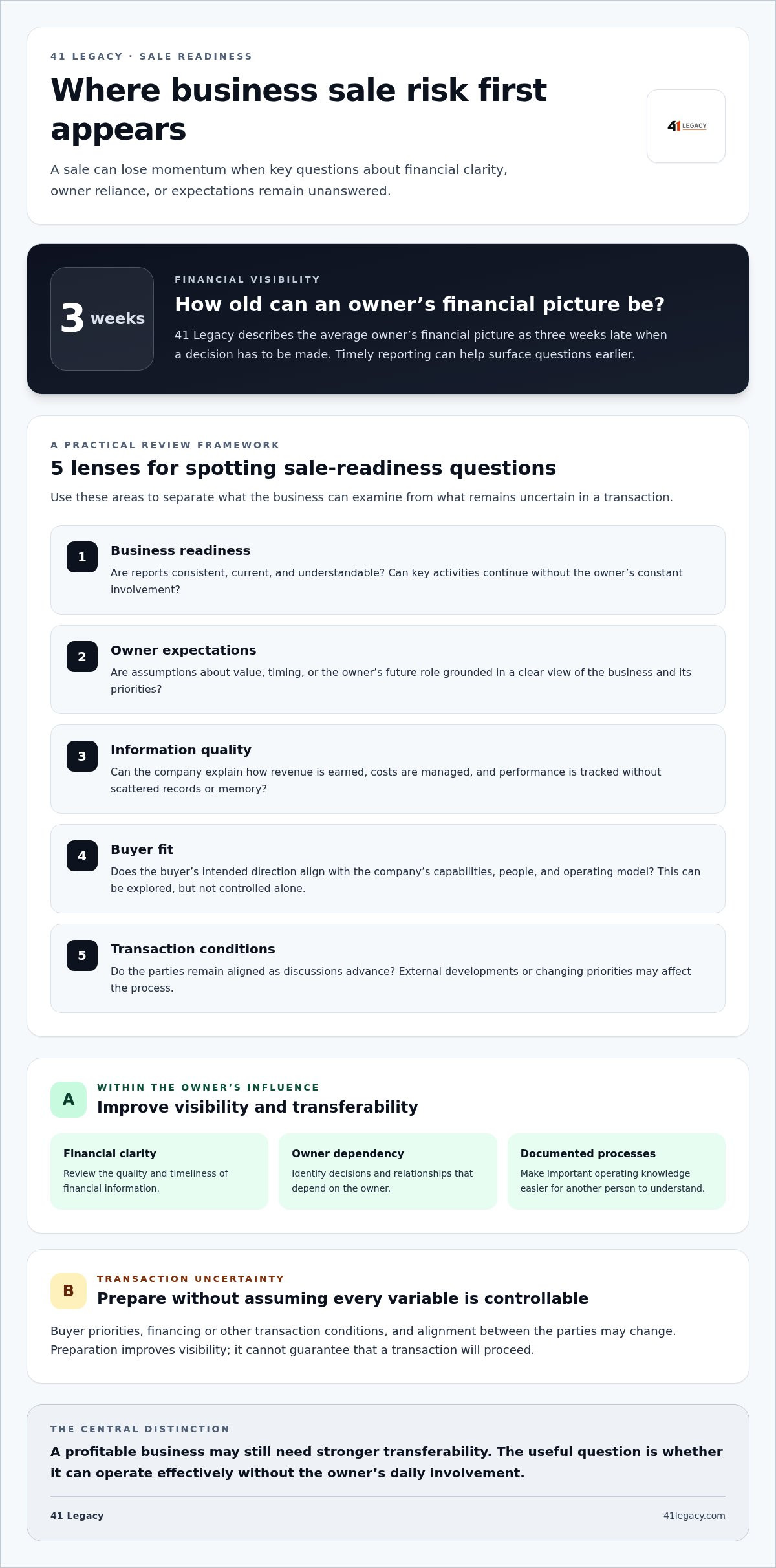
- Business readiness: Are financial reports consistent, current, and understandable? Can the company’s key activities continue without the owner’s constant involvement?
- Owner expectations: Are assumptions about value, timing, or the owner’s future role grounded in a clear view of the business and its priorities?
- Information quality: Can the company explain how revenue is earned, costs are managed, and performance is tracked without relying on scattered records or memory?
- Buyer fit: Does the buyer’s intended direction align with the company’s capabilities, people, and operating model? This is a question to explore, not something the owner can control alone.
- Transaction conditions: Do the parties remain aligned as discussions advance? External developments or changing priorities may affect the process even when the business is prepared.
This distinction helps owners focus their effort. Financial clarity, transferability, and reduced owner dependency are areas to examine before a sale is imminent. Buyer decisions and changing conditions call for judgment and flexibility, not the belief that every variable can be managed. Preparation is valuable because it reveals what is known, what needs attention, and what remains uncertain.
Five Readiness Gaps That Can Undermine a Business Sale
Readiness gaps don’t make a sale inevitable, and they don’t guarantee that a buyer will walk away. They can leave important questions unanswered or make it harder to explain how the business performs and operates. The following five areas are useful prompts for review, not a complete list of causes.
Financial clarity, value expectations and buyer review questions
Clear financial information helps an owner explain what drives revenue, costs, cash flow, and changes in performance. If reports are inconsistent or results depend on adjustments that aren’t well documented, it may be harder to support expectations with a coherent account of the business. As 41 Legacy puts it, “Three weeks late is how old the average owner’s financial picture is when the decision has to be made”. Timely information can help owners see emerging questions earlier.
An understanding of enterprise value is useful for planning, but it isn’t the same as a certified business valuation. It helps an owner consider how financial performance, concentration risks, and reliance on key people or processes may affect the company’s ability to transfer. Northern Trust also describes pitfalls in business transactions, including issues that may emerge as financial controls and other business factors receive closer attention. Reviewing the underlying information beforehand can make questions that arise during a buyer’s review easier to address.
Owner dependency and business continuity
When the owner holds key customer relationships, approves routine decisions, or carries essential knowledge informally, another person may reasonably ask how the company would continue without that daily involvement. That doesn’t predetermine a buyer’s response, but it can make continuity harder to demonstrate. Start by listing decisions only you make. For each one, identify who could take responsibility and what information or authority that person would need.
Documented procedures can help turn individual knowledge into repeatable work. A process that lives only in the owner’s memory may be difficult for others to follow consistently. Transferability grows when responsibilities, decision paths, and essential routines are visible and understood. The stakes are personal as well as operational: “80 to 90 % of an owner’s net worth sits inside the business”.
Five gaps to examine
- Unclear financial information: Reports don’t reconcile, or performance drivers are difficult to explain.
- Unsupported expectations: The owner’s view of value or timing lacks a clear connection to business performance and goals.
- Owner reliance: Important relationships, approvals, or knowledge depend on one person.
- Weak process documentation: Essential work is handled inconsistently or isn’t recorded in a way others can use.
- Poor fit: A buyer’s goals, capabilities, or intended direction may not align with the company’s model.
These gaps can overlap. A key customer relationship managed only by the owner, for example, may raise questions about both continuity and the reliability of future revenue. Reviewing them early can help distinguish issues the owner can address from questions that depend on another party. Owners considering stronger transferability can explore 41 Legacy’s readiness and value-growth support.
When a Business Sale Is at Risk: Separate Readiness Gaps from Deal Uncertainty
As a sale develops, it can be difficult to tell whether a concern points to a gap inside the business or uncertainty in the transaction itself. The distinction matters. Owners can examine the quality of their information, how decisions are made, and whether essential processes are documented. They can’t decide another party’s priorities or guarantee that circumstances will remain unchanged. Understanding why business sales fall through is partly a matter of knowing where preparation can help and where uncertainty remains.
| Readiness issues an owner can examine | Uncertainties an owner cannot control |
|---|---|
| Reporting clarity: Are financial reports current, consistent, and understandable? Can the owner explain the factors behind changes in performance? | Changing priorities: Another party’s goals may shift as circumstances or plans change. |
| Owner dependency: Which decisions, relationships, or essential knowledge rely heavily on the owner? Could others take on those responsibilities? | Fit: The parties may have different views about the company’s direction, strengths, or future role. |
| Documented processes: Are recurring tasks and decision paths clear enough for others to follow? | Transaction-specific decisions: Whether discussions continue or the parties reach alignment depends on decisions beyond the owner’s control. |
Which sale risks are within the owner's influence?
Start with the company’s financial picture: how timely is it, and can you connect reported results to the underlying business activity? Then map decisions that concentrate with you, including approvals, customer relationships, and knowledge that has not been recorded. Review key processes to see whether another capable team member could follow them. These are preparation priorities, not a checklist that guarantees approval or a completed sale.
It can help to record each concern in two parts: what you can examine and what evidence would clarify it. If financial reporting arrives too late to inform decisions, identify what information is missing and establish a regular review rhythm. If a process depends on personal memory, write down the steps and identify who needs to understand them. The aim is greater visibility, not a claim that every concern will disappear.
Which parts of a transaction remain uncertain?
Another party’s priorities, assessment of fit, and decision to continue are not controlled by the owner. A company can be well prepared and still encounter a mismatch or changing circumstances. Improved readiness can make the business easier to understand; it cannot make closing certain.
This distinction also keeps attention in the right place when a concern arises. If an issue relates to reporting, decision concentration, or undocumented work, the owner can assess it and decide what readiness work is appropriate. If it rests on another party’s priorities or a change in circumstances, the owner can seek clarity while recognizing that the outcome is not theirs alone to determine. Preparation strengthens the owner’s view of the enterprise, even when the transaction remains uncertain.
How Owners Can Reduce Preventable Sale Risk Before a Transaction
Readiness work is most useful when it supports the business now, rather than being treated as a last-minute response to a possible sale. A practical sequence can help an owner clarify priorities, strengthen the information used to make decisions, and identify where the company relies too heavily on one person. It won’t control another party’s choices, but it can make the business’s condition easier to understand.
A practical readiness sequence for business owners
Begin with your broad transition horizon and the decisions the business needs to make today. A possible transition may be years away, while choices about hiring, investment, or working capital are immediate. With that context, work through these steps:
- Clarify your goals. Consider what a transition could mean for your role, timing, and the company’s future. Record which questions are settled and which still need thought.
- Review available financial information. Look at what is current, what is delayed, and what is difficult to explain. Note unanswered questions about performance, cash needs, or the measures used to track progress.
- Identify owner dependency. List decisions, relationships, and recurring responsibilities that rely on you. Consider who could take them on and what context, authority, or process documentation they would need.
- Prioritize a few gaps. Choose improvements that matter to current business decisions as well as future transferability. Assign an owner and a next step to each priority, rather than trying to fix everything at once.
- Establish a review cadence. Set a regular time to revisit financial information, key performance indicators, and progress on readiness priorities. A consistent rhythm makes it easier to spot changes and decide what deserves attention.
Build a decision rhythm around current information
Delayed financial visibility can narrow the time available to respond. If a key cost is rising or cash needs are changing, information that arrives after decisions have been made is less useful for planning. A forecast can help frame what may lie ahead, while key performance indicators give the team shared measures to discuss. Neither predicts outcomes with certainty; both can support more informed questions and timely decisions.
Coordinate this work with the professional advisors who already understand your circumstances. You can bring forward business priorities and questions, while each advisor contributes within their own role. This keeps readiness planning connected without confusing strategic business preparation with legal, tax, investment, or transaction representation. Exit planning is a longer-term discipline: revisit goals as the company and your priorities change.
For owners who want a clearer view of financial performance and business readiness, discuss financial clarity and readiness with 41 Legacy. The first contact is a 30-minute conversation: “No pitch. No pressure.” The scope of each engagement is defined in the client’s written agreement. Information on this site is general in nature and not advice for any specific situation.
How 41 Legacy Helps Owners Build Greater Sale Readiness
Understanding why business sales fall through can help owners identify where preparation may matter, but readiness is valuable well before a transition is imminent. 41 Legacy helps owner-operated companies build financial clarity and examine how decisions affect both current performance and the business’s ability to transfer. The focus is a clearer view of the enterprise, not a promise about a future transaction.
What the six-week financial clarity intensive establishes
For companies with $1 M to $30 M in annual revenue, the fixed, six-week financial clarity intensive provides a structured opportunity to review the company’s financial picture and identify the top profit levers. It includes one working session per week and a custom KPI tracking sheet, giving the owner a defined rhythm for examining performance and the measures that inform decisions.
The structure balances consistency with customization. Weeks 1 and 6 are identical for every client; weeks 2-5 are customized after week 1. The Week 3 deliverable is a 13-week cash-flow forecast. Together, these elements help owners understand what the available information indicates, identify questions that warrant attention, and consider where changes could strengthen financial clarity. They support readiness work without determining whether a transaction will proceed.
That clarity can also help owners assess how their business is prepared to function beyond their direct involvement. Current financial information provides a stronger basis for discussing performance, while clear indicators can bring attention to changes and priorities. Readiness is not a single event. It develops through informed decisions over time.
How ongoing financial support relates to readiness
After the intensive, the ongoing CFO Seat provides a monthly strategic finance rhythm for budgeting, forecasting, KPI review, decision support, working-capital discipline, and enterprise-value tracking. The focus is forward-looking: helping owners understand tradeoffs and keep business priorities visible as circumstances evolve. It is not transaction representation.
Every recommendation uses a dual-lens evaluation: profit and cash impact, and enterprise-value impact. This connects immediate operating decisions with the longer-term health and transferability of the company. For example, an owner can consider both how a decision affects current cash needs and how it aligns with the goal of building an enterprise that can operate with less dependence on its founder. The appropriate priorities differ by business, and no single measure can settle every decision.
The scope of each engagement is defined in the client’s written agreement. To explore whether greater financial clarity could support your readiness priorities, start with a 30-minute conversation. No pitch. No pressure. Information on this site is general in nature and not advice for any specific situation.
Make Readiness Part of How You Lead
The next step doesn’t have to be a decision to sell. It can be a deliberate choice to make the business clearer, less dependent on you, and better equipped to carry its purpose forward. That work supports stronger decisions today while giving you more room to consider a future transition on your own terms.
Understanding why business sales fall through is useful, but readiness is not about eliminating uncertainty. It’s about building a business whose performance, responsibilities, and direction are easier to understand, whether the next chapter involves a sale, an internal transition, or continued growth.
If you’re ready to consider what greater transferability could look like for your company, explore a readiness conversation with 41 Legacy. Each thoughtful step can help you steward an enterprise built to endure beyond your daily involvement.
Frequently Asked Questions
Can a business sale fall through after the parties agree on terms?
Yes. Agreement on key terms doesn’t necessarily mean every remaining question has been resolved or that the transaction will be completed. Information may prompt further discussion, circumstances may change, or the parties may decide their priorities no longer align. Understanding why business sales fall through means recognizing that agreement is a meaningful step, not certainty. Owners can keep business decisions grounded in the company’s needs while the process develops.
Does a business sale fall through only because of the asking price?
No. Price can be one point of disagreement, but it isn’t the only possible source of friction. The parties may have different expectations about the company’s future, the owner’s continuing role, or how clearly the business’s performance can be understood. For example, an owner may see a strong opportunity while another party has a different view of the company’s risks. Clear reasoning helps distinguish a pricing gap from broader misalignment.
What happens to a business after a sale falls through?
A sale not proceeding doesn’t automatically mean the business stops operating. The owner may continue running it, revisit priorities, or pause transition discussions while addressing questions that surfaced. A useful first move is to separate immediate operating needs from lessons specific to the process. For example, if discussions highlighted reliance on one person, the owner can consider strengthening continuity whether or not another sale process follows.
Can a business sale fall through because the owner is too involved?
It can be a concern, though owner involvement alone doesn’t determine an outcome. If approvals, customer knowledge, or daily decisions all run through the owner, it may be harder for another person to picture how responsibilities would continue. A practical test is to identify a recurring decision you usually make, document the context behind it, and see whether a capable team member can handle it with appropriate authority.
How can an owner prepare if a sale is not planned soon?
Build a company that can make sound decisions without relying on your constant presence. Choose a recurring responsibility you hold, name a team member who could gradually assume it, and define what information and decision authority they would need. Review progress as the role changes. This approach can develop leadership capacity and operational continuity while supporting the business’s current goals, without requiring an immediate decision about a future transition.
Is a signed letter of intent a guarantee that a business sale will close?
No. A letter of intent records the parties’ current understanding of key points they may use to guide further discussions. Signing one doesn’t, by itself, establish that the transaction will be completed. The parties may continue reviewing information, reconsider priorities, or decide not to proceed. The document’s effect depends on its wording and circumstances.

Article by
Mike Laskowski
Mike Laskowski is a Business Value Growth Strategist who helps business owners uncover the truths that drive their performance, risk, and readiness. Blending forensic interviewing from a 26‑year federal career with Strategic Capacity analysis and CEPA methodology, he works upstream to reduce owner dependency, increase transferability, and strengthen enterprise value. Mike guides founders through clarity, operational evolution, and transition readiness so their companies become transferable, owner‑independent assets that endure beyond the founder.
Disclaimer
This article is for educational and informational purposes only and does not provide legal, tax, investment, or business brokerage advice. 41 Legacy does not offer M&A brokerage services, legal document drafting, tax preparation, or investment advisory services. Business owners should consult licensed professionals in those disciplines before making decisions related to business transactions, legal matters, tax strategy, or financial planning. All examples are illustrative and may not apply to your specific situation.

