
When Do You Need a Sell-Side QofE Report? A Strategic Guardian of Enterprise Value
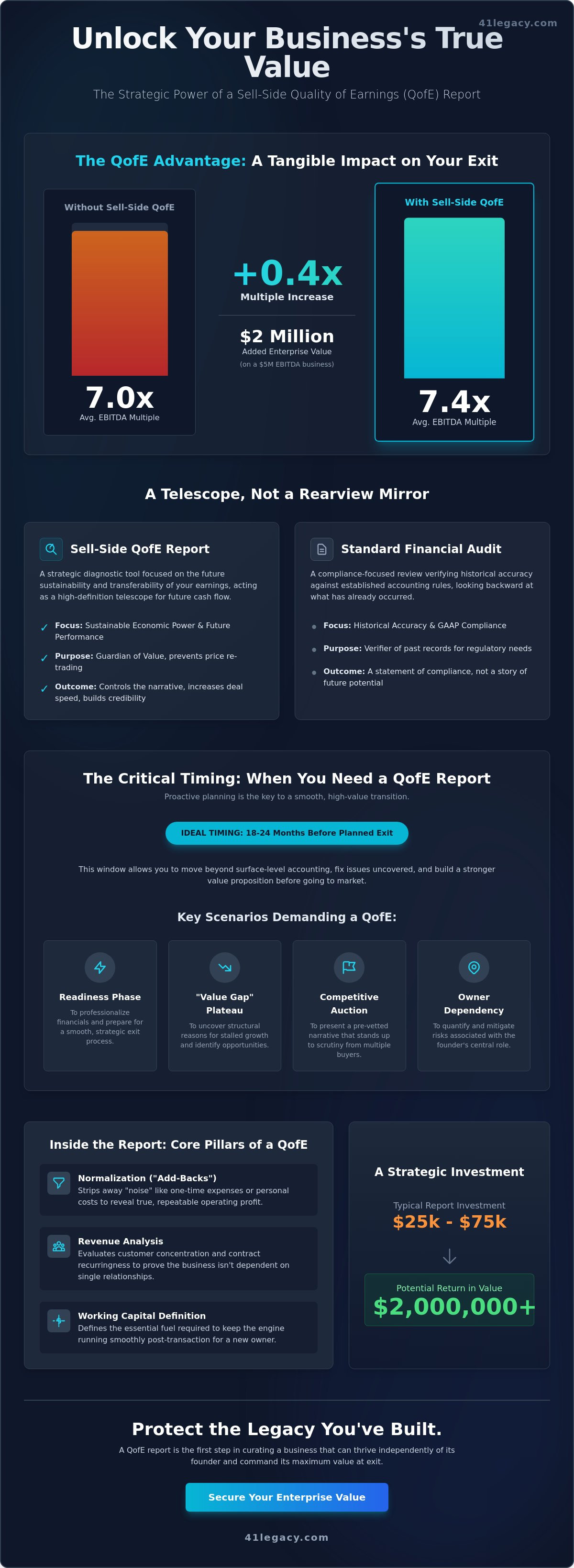
Recent 2026 data reveals that sellers who provide a sell-side Quality of Earnings report achieve an average EBITDA multiple of 7.4x, compared to 7.0x for those who do not. On a business with $5 million in EBITDA, this 0.4x difference amounts to $2 million in enterprise value that either stays with the founder or vanishes at the closing table. You might wonder exactly when do you need a sell-side QofE report to secure this advantage. It isn't merely a transaction hurdle; it's a diagnostic tool designed to engineer transferability and protect the soul of the enterprise you've spent a lifetime building.
We understand the quiet anxiety of knowing your financial records might harbor hidden skeletons or that your personal involvement masks the true profitability of the operation. You've poured your craftsmanship into this legacy; the fear of a buyer re-trading the price during due diligence is a risk you shouldn't have to bear. This article promises to reveal the precise moments when a QofE report transitions from a luxury to a strategic necessity for protecting your business. We'll preview how this analysis, typically costing between $25,000 and $75,000 for mid-market firms, provides strategic clarity and creates a clear roadmap for increasing your enterprise value before the first handshake.
Key Takeaways
- Understand how a QofE report acts as a guardian of your enterprise value by analyzing the sustainability of earnings rather than just historical accuracy.
- Learn exactly when do you need a sell-side QofE report to bridge the gap between your current financial health and your transition goals, ideally 18 to 24 months before a planned exit.
- Distinguish between the compliance focus of a standard audit and the strategic foresight of a QofE report, which serves as a high-definition telescope for future cash flow.
- Discover how to proactively identify "add-backs" and curate three years of meticulous records to reduce transaction risk and prevent price re-trading.
- Explore how to integrate diagnostic findings into a long-term value growth roadmap, turning financial red flags into opportunities for structural enhancement.
What is a Sell-Side QofE and Why is it a Guardian of Your Legacy?
A business is a living legacy, not just a series of cold entries in a ledger. A sell-side Quality of Earnings (QofE) report acts as a rigorous diagnostic of a company's financial DNA. While a standard audit merely verifies historical accuracy and compliance with accounting rules, the QofE focuses on the sustainable economic power of the enterprise. It examines the Earnings quality to ensure that the profitability you claim is both repeatable and transferable to a future steward.
This report serves as a strategic guardian. It protects you from the predatory practice of "re-trading," where a buyer discovers a financial discrepancy and uses it to lower their offer during the final hours of due diligence. By commissioning this analysis early, you take control of the narrative. You transform raw, often complex data into a sophisticated story of a resilient, transferable asset. This level of preparation is vital when determining when do you need a sell-side QofE report to preserve the value you've spent a career building. At 41 Legacy, we view this as the first step in curating a business that can thrive independently of its founder.
The Core Components of Earnings Quality
Meticulous financial storytelling requires looking at three specific pillars. First is normalization. This process strips away "noise" such as one-time legal settlements or personal expenses to reveal the true operating profit. Second is revenue analysis. We evaluate customer concentration and the recurring nature of your contracts to prove the business isn't dependent on a single relationship. Finally, we define the working capital. This is the essential fuel required to keep the engine running smoothly once the keys are handed over. Each component ensures the buyer sees a high-performance machine, not a project in need of repair.
Why 'Sell-Side' Matters Over 'Buy-Side'
Choosing to initiate this process yourself offers distinct advantages. You maintain absolute control over the first impression. You define the financial narrative before a buyer’s team begins their scrutiny. It also establishes immediate credibility with sophisticated investors and M&A professionals. When you present a verified set of financials, you signal that the business is a professional-grade asset. Most importantly, it increases deal speed. By resolving potential issues upfront, you reduce the time spent in the high-stress due diligence period. This efficiency prevents the "deal fatigue" that often destroys enterprise value.
The Critical Timing: When Do You Need a Sell-Side QofE Report?
Determining when do you need a sell-side QofE report is a matter of strategic foresight rather than tactical necessity. It shouldn't be a reactive response to a buyer's request but a proactive measure taken by a steward of legacy. In our experience, timing is the difference between a smooth transition and a fragmented deal that loses momentum. There are four specific scenarios where commissioning this diagnostic becomes essential for protecting the soul of the enterprise.
The first scenario is the Readiness Phase, occurring 18 to 24 months before a planned transition. This window allows you to move beyond surface-level accounting. If your business has reached a "Value Gap" where growth has plateaued, a QofE uncovers the structural reasons behind the stall. It's also an essential tool when entering a competitive auction process. When multiple sophisticated buyers are at the table, a pre-vetted financial narrative prevents the friction that leads to deal erosion. Forbes provides an excellent overview in their piece, What Is A Sell-Side Quality Of Earnings Report?, highlighting how these reports set the stage for a successful exit.
Perhaps most critically, a QofE addresses owner dependency. In many privately held firms, the founder is the central nervous system of the operation. If the business can't thrive independently, its value is compromised. A QofE quantifies this risk, allowing you to mitigate it before an external party discovers it. This is why we recommend starting with a comprehensive Exit Readiness Assessment to see how your financial health aligns with your long-term vision.
The 'Readiness' Sweet Spot
A 24-month horizon is the ideal period for a preliminary diagnostic. It provides the luxury of time. You can identify "Value Detractors," those subtle inefficiencies or accounting irregularities, while you still have the runway to correct them. By the time you reach the 18-month mark, these corrections should be visible in your trailing twelve-month (TTM) data. This meticulous preparation ensures that when you finally go to market, you're presenting a high-performance asset that's been polished to a high sheen.
Trigger Events for Professional Advisors
Professional advisors often act as the first line of defense in identifying the need for a QofE. A CPA might notice complex revenue recognition issues that could confuse a buyer. An attorney might suggest a corporate restructuring that requires a fresh look at the books. In these moments, a Certified Exit Planning Advisor (CEPA) often "quarterbacks" the decision to engage a QofE firm. They ensure the financial story is told with precision and clarity, moving the business toward a state of uncompromising transferability.
QofE vs. Financial Audit: Understanding the Precision of Financial Storytelling
Distinguishing between a financial audit and a Quality of Earnings report requires an appreciation for the difference between a historical archive and a blueprint for the future. A standard financial audit serves as a rearview mirror. It is a clinical exercise in compliance and historical accuracy, designed to ensure that records adhere to Generally Accepted Accounting Principles (GAAP). While this provides a baseline of institutional trust, a "clean audit" rarely translates to a "clean deal" during the heat of a transaction. This realization often dictates when do you need a sell-side QofE report to properly defend the enterprise value you have meticulously cultivated.
A QofE report functions as a high-definition telescope. It peers through the fog of historical data to focus on the sustainability of future cash flow. The precision involved in these adjustments is surgical. While an auditor might view a founder's salary or personal perks as mere line-item expenses, a QofE analyst recalibrates these figures to reflect market-rate management costs. They identify non-recurring events that an audit might gloss over. This process strips away the noise to reveal the true economic soul of the business, translating raw data into a story of uncompromising performance. The 0.4x difference in EBITDA multiples observed in 2026 market data highlights why the clinical nature of an audit is insufficient for a sophisticated transition.
Scope and Methodology Differences
Audits rely on "Materiality" thresholds, where minor variances are often dismissed if they do not fundamentally alter the financial statement. A QofE report operates on "Deal Logic." Every dollar is scrutinized for its potential to affect the final valuation multiple. Buyers often view audits as a basic requirement but place their true confidence in the QofE. This is because the focus shifts from GAAP compliance to the reality of Adjusted EBITDA, providing the strategic clarity necessary for a successful transition. It ensures that the "fuel" of the business is accurately measured before the keys are handed over.
The Emotional Weight of the Numbers
Standard audits are cold and detached. In contrast, a QofE report is evocative of the business's potential. It serves as a validation of the Master Craftsman’s effort, documenting the systems and efficiencies that define your legacy. This level of transparency is not just about numbers; it is about protecting the heritage of the enterprise. By providing a clear, unvarnished view of the financial health, you ensure that the transition is handled with the reverence and respect your life's work deserves. This uncompromising approach builds a bridge between the founder's past achievements and the successor's future success.
Preparing for the Diagnostic: How to Leverage a QofE to Reduce Risk
Building a transferable asset requires more than just high revenues; it demands a clean, unvarnished history. We encourage owners to view their three years of financial records as the heritage of the business. This meticulous record-keeping provides the provenance necessary for a sophisticated buyer to feel secure in the investment. By identifying "add-backs" before the analysts arrive, you perform an internal audit that preserves your credibility and protects the soul of the enterprise. This preparation is a core reason why owners ask when do you need a sell-side QofE report, as it allows them to address concentration risk and owner dependency while they still hold the wheel.
A business that rests on a single client or the founder's daily touch is a fragile entity. The QofE diagnostic forces you to quantify these vulnerabilities with surgical precision. If 35% of your revenue originates from one source, or if operations stall when you are away from the office, the report will highlight these as significant risks. Addressing these "cracks in the chassis" early transforms the business from a person-centric operation into a durable, transferable asset. This proactive stance ensures that the value you've built isn't eroded by deal fatigue or last-minute price adjustments.
The Internal Diagnostic Phase
Before the formal engagement begins, we recommend a deep review of your internal structures. Examine customer and vendor contracts for transferability clauses that could hinder a transition. It's also vital to clean up discretionary spending to ensure your operating margins reflect the true performance of the machine. Finally, ensure your Standard Operating Procedures (SOPs) align with the financial narrative. If the numbers suggest efficiency but the manual processes show chaos, the narrative fails. This alignment is the hallmark of a professional-grade enterprise.
Coordinating the Advisory Team
Success in this phase requires a "Quarterback" to align your CPA, CEPA, and the QofE team. This coordination maintains a professional-room altitude, keeping the focus on strategic clarity rather than getting lost in minor accounting minutiae. We use these findings to refine your Value Growth Roadmap, ensuring every adjustment serves the long-term health of the enterprise. If you're ready to strengthen your business's foundation, you should schedule a strategic diagnostic to begin your journey toward uncompromising transferability.
Beyond the Report: Integrating QofE into Your Value Growth Journey
A Quality of Earnings report is often mischaracterized as a mere pre-sale chore, a final box to check before the keys are handed over. At 41 Legacy, we view it as the essential baseline for our entire strategic process. It is the moment where the "soul" of the numbers is revealed and the structural integrity of the enterprise is tested. By converting "red flags" into specific value growth initiatives, you shift from being a reactive seller to a proactive steward of a high-performance asset. This is precisely when do you need a sell-side QofE report; not just when you are ready to exit, but when you are ready to engineer a business that outlasts your daily involvement. It identifies the strategic delta between your current state and the ultimate vision for your legacy.
The philosophy of the Transferable Asset is rooted in the belief that a business should be a meticulously engineered masterpiece. It isn't just a number on a spreadsheet; it's a living entity with a story to tell and a future to secure. When you address the vulnerabilities identified in the diagnostic, you are essentially polishing the heritage of the enterprise. This preparation ensures that the transition is not a loss of identity but an evolution. Building a legacy that thrives independently of the founder is the ultimate mark of a Master Craftsman, ensuring that the soul of the business remains intact through the transition and beyond.
From Diagnostic to Implementation
The true value of a QofE lies in what happens after the report is delivered. Monthly implementation support turns these insights into tangible equity by addressing the "Value Detractors" we discussed in earlier sections. By systematically reducing your risk profile, you naturally attract "A-tier" buyers who value stability, clarity, and uncompromising quality. There is a profound peace of mind that comes from knowing your business is "Market Ready" long before you ever sit down at a negotiation table. It's about moving the needle from a 7.0x multiple to a 7.4x multiple through structural excellence, a difference that can represent millions in protected enterprise value.
The Final Polish: Preparing for a Successful Transfer
In the final 12 months of your journey, the focus shifts to the final polish. This is where Enterprise Diagnostics play a crucial role in ensuring every system is optimized for a seamless transfer of stewardship. A business that commands respect in the marketplace is one where the financial narrative and the operational reality are in perfect harmony. It's about building a transferable asset that carries your vision into the future with precision and grace. If you are ready to begin this curatorial process, we invite you to Begin your Enterprise Diagnostic today and secure the future of your legacy.
Curating the Future of Your Enterprise
Strategic preparation is the hallmark of a master steward. You've learned that a sell-side QofE report is more than a financial document; it's a defensive shield against deal erosion and a roadmap for structural excellence. By identifying the precise moment when do you need a sell-side QofE report, typically 18 to 24 months before a transition, you ensure the true economic soul of your business is visible to the market. This proactive approach protects your legacy from the 0.4x multiple reduction often seen in unprepared transactions, preserving millions in hard-earned enterprise value.
Our team, led by a Certified Exit Planning Advisor (CEPA), uses a structured "quarterback" approach to align your advisory team and engineer uncompromising transferability. We focus on transforming your business into a masterpiece that thrives independently of your daily touch. Take the first step in this curatorial journey to protect what you've built. Secure Your Business Legacy with an Exit Readiness Assessment and ensure your transition is handled with the reverence it deserves. Your life's work is a heritage worth preserving for the next generation.
Frequently Asked Questions
Is a sell-side QofE report the same as a business valuation?
No, a valuation estimates the market price based on comparable assets and multiples, while a QofE verifies the quality and sustainability of the earnings driving that price. Think of the valuation as the sticker price and the QofE as the mechanical inspection. It ensures the EBITDA used in the valuation is accurate and repeatable for a future steward.
How much does a sell-side QofE report typically cost?
Mid-market firms typically pay between $30,000 and $75,000 for a comprehensive report. For smaller enterprises with revenue under $10 million, costs generally range from $25,000 to $35,000. Larger, multi-entity organizations can expect fees between $60,000 and $100,000 according to 2026 industry data. These figures reflect the meticulous nature of the analysis required to protect your legacy.
Can my internal CPA perform the QofE analysis?
While your internal CPA possesses deep knowledge of your books, buyers require the objectivity of an independent third-party firm. Internal teams often focus on tax compliance and historical accuracy. A specialized QofE firm applies deal logic to uncover the sustainable economic power of the enterprise. This third-party verification is essential when you decide when do you need a sell-side QofE report to establish credibility with sophisticated investors.
What happens if the QofE report uncovers a major financial issue?
Uncovering a major issue early is a strategic advantage rather than a setback. It allows you to address the problem or frame the narrative before a buyer discovers it during their own due diligence. This transparency prevents the deal fatigue and price re-trading that often occur when financial "skeletons" emerge at the eleventh hour of a transaction.
How long is a sell-side QofE report considered 'fresh' by buyers?
Most buyers consider a report fresh for approximately six months. If the transition process extends beyond this window, a "roll-forward" update is typically required to include the most recent trailing twelve-month data. Keeping the analysis current ensures that the financial narrative remains accurate and reflects the most recent performance of the machine.
Is a QofE necessary for a small business with under $5M in revenue?
Yes, a QofE is increasingly valuable for smaller enterprises. Even for businesses with under $5 million in revenue, this diagnostic signals that you're a serious steward of a professional-grade asset. It reduces perceived risk for buyers and helps quantify owner-dependency, which is often a significant hurdle in smaller transitions where the founder is the central operator.
Does a QofE report include a review of the management team?
The report indirectly evaluates the management team by analyzing how their roles impact revenue sustainability and operational efficiency. It highlights owner-dependency by showing how much of the "soul" of the business rests with the founder. This clarity allows you to strengthen your leadership structure and improve transferability before entering the marketplace.
How does a QofE report impact the final purchase price of a business?
A QofE report significantly impacts the final price by defending the EBITDA multiple. 2026 data indicates that sellers providing these reports achieve an average multiple of 7.4x, compared to 7.0x for those who don't. On a business with $5 million in EBITDA, this 0.4x difference protects $2 million in enterprise value. Knowing when do you need a sell-side QofE report is the key to capturing this premium.

Article by
Mike Laskowski
Mike Laskowski is a Business Value Growth Strategist who helps business owners uncover the truths that drive their performance, risk, and readiness. Blending forensic interviewing from a 26‑year federal career with Strategic Capacity analysis and CEPA methodology, he works upstream to reduce owner dependency, increase transferability, and strengthen enterprise value. Mike guides founders through clarity, operational evolution, and transition readiness so their companies become transferable, owner‑independent assets that endure beyond the founder.
Disclaimer
This article is for educational and informational purposes only and does not provide legal, tax, investment, or business brokerage advice. 41 Legacy does not offer M&A brokerage services, legal document drafting, tax preparation, or investment advisory services. Business owners should consult licensed professionals in those disciplines before making decisions related to business transactions, legal matters, tax strategy, or financial planning. All examples are illustrative and may not apply to your specific situation.