
What to Do When You Fall Out of Love With Your Business: A Strategic Reframe
Your waning enthusiasm isn't a sign of defeat; it's a signal that your role as a master craftsman must evolve into that of a strategic steward. It's a profound realization for any founder who has spent decades refining a vision. You've built a legacy of substance, yet the daily friction of operations now feels like a weight on your creative spirit. Many high-performing owners reach this crossroads and struggle with what to do when you fall out of love with your business, fearing the enterprise's soul will vanish without their constant presence. The 2023 State of Owner Readiness Report from the Exit Planning Institute reveals that 75% of owners lack a formal transition plan, which often results in the erosion of the very value they spent a lifetime creating.
We recognize the emotional weight of this transition. It's a meticulous process of decoupling your identity from the business's daily mechanics to ensure its ultimate longevity. This guide will show you how to transform your current detachment into a catalyst for building a transferable asset that thrives independently. You'll gain a clear roadmap to reduce owner-dependency and enhance enterprise value. We'll prepare you for a lucrative exit that preserves your heritage while providing the freedom you've earned.
Key Takeaways
- Reframe waning passion as a vital signal of business maturity, marking the necessary evolution from an active operator to a visionary steward.
- Discover what to do when you fall out of love with your business by applying a diagnostic framework to distinguish temporary burnout from true exit readiness.
- Learn to dismantle the "Rainmaker Trap" by identifying value drivers and documenting institutional knowledge that exists independently of the founder.
- Identify the strategic steps required to transform your enterprise into a transferable asset that maintains its integrity and performance without your daily involvement.
- Understand how a structured transition roadmap restores a sense of purpose, turning current apathy into a precise strategy for a successful legacy.
The Founder’s Dilemma: Why Passion Fades and What It Truly Signals
For many owners, a business begins as a bespoke creation, a reflection of personal identity and creative drive. Over time, a friction point inevitably emerges where individual passion and operational complexity collide. This is the Founder's Dilemma. It is not a failure of vision. Instead, it is a clear signal that the enterprise has reached a new stage of maturity. When you find yourself questioning what to do when you fall out of love with your business, realize that this shift typically occurs between year seven and year ten of the company's lifecycle.
This evolution marks the transition from a founder-led project to a transferable asset. Validating this experience is essential; losing interest is a natural part of the entrepreneurial journey. It often reveals the "Value Gap," which is the quantifiable distance between the current state of operations and the strategic goals required for a successful transition. Owners who recognize this gap can begin to view their business as a separate entity with its own soul and trajectory, rather than a personal job they must perform forever.
Reframing Burnout as Strategic Maturation
True burnout is often confused with a fundamental shift in professional alignment. While physical fatigue can be solved with a sabbatical, a loss of passion usually indicates that the owner is under-challenged by the current structure. This state, sometimes described as Boreout syndrome, suggests the business has outgrown the founder's daily involvement. Doubling down on "hard work" is the wrong response. At this stage, the owner must transition from being the primary engine of the company to becoming the steward of its legacy. This shift requires a focus on building a vehicle that carries its own weight through systems and leadership.
The Cost of Staying in Love Too Long
Excessive emotional attachment can eventually become a strategic liability. When sentimentality overrides market data, "founder's ego" often leads to delayed pivots and missed opportunities. According to industry research from the Exit Planning Institute, owner-dependency is a primary factor in the 80% of small businesses that fail to sell. Ignoring the signals that it's time to step back diminishes the very asset you worked to build. To protect the heritage of the firm, you must prioritize the health of the entity over your personal attachment to its origins.
Enterprise Value is a measure of a business's ability to thrive without its creator.
If you're ready to assess the current health and transferability of your enterprise, explore our resources at 41 Legacy to begin your strategic reframe.
Diagnosing the Disconnect: Is It Burnout or Exit Readiness?
Apathy is rarely a sudden event. It's an accumulation of friction points that eventually obscure the original vision of the enterprise. When determining what to do when you fall out of love with your business, you must first distinguish between temporary exhaustion and a fundamental shift in your role as a steward. This diagnostic process requires an objective look at the three pillars of exit readiness: personal, financial, and business maturity. Each pillar must be aligned to ensure the enterprise remains a source of pride rather than a burden.
Many owners find themselves trapped in a lifestyle business rather than a transferable asset. In a lifestyle entity, the owner is the primary engine of value. If you stop, the revenue stops. This owner dependency is the most common driver of emotional exhaustion. According to the 2023 State of Owner Readiness Report, nearly 80% of an owner's wealth is often locked within their business. When the company cannot function without your constant intervention, it becomes a cage rather than a legacy. True value lies in the ability of the machine to run without the inventor.
The Personal Readiness Assessment
Succession is as much a psychological evolution as it is a financial transaction. You must evaluate your "Third Act" with the same precision you applied to your startup phase. Most owners struggle to exit because their identity is inextricably linked to their professional title. A successful transition requires both a push factor, such as a desire for new challenges, and a pull factor, which is a concrete vision for life after the sale. Without a clear destination, the vacuum created by an exit often leads to profound regret, a sentiment shared by 75% of owners one year after selling their companies.
Business Health vs. Owner Happiness
A business can possess a healthy EBITDA while the owner remains deeply miserable. This is the "Gilded Cage" scenario. High cash flow often masks the underlying risk of a detached leader. When an owner loses interest, growth often plateaus at a specific revenue ceiling, often between $5 million and $20 million, because the systems aren't robust enough to scale without the founder's direct oversight. Neglecting this evolution devalues the company in the eyes of sophisticated buyers who seek institutionalized excellence. To begin refining these systems and restoring your vision, owners should focus on strengthening the transferable value of their enterprise.
Deciding what to do when you fall out of love with your business requires a pivot from operator to architect. By analyzing the business through the lens of a potential buyer, you can identify where the "soul" of the company resides. If it resides solely in your daily effort, the disconnect is a signal to build systems that allow the business to thrive independently. This transition from a labor-intensive model to a systemized asset is often the very thing that reignites an owner's passion for the craft of leadership.
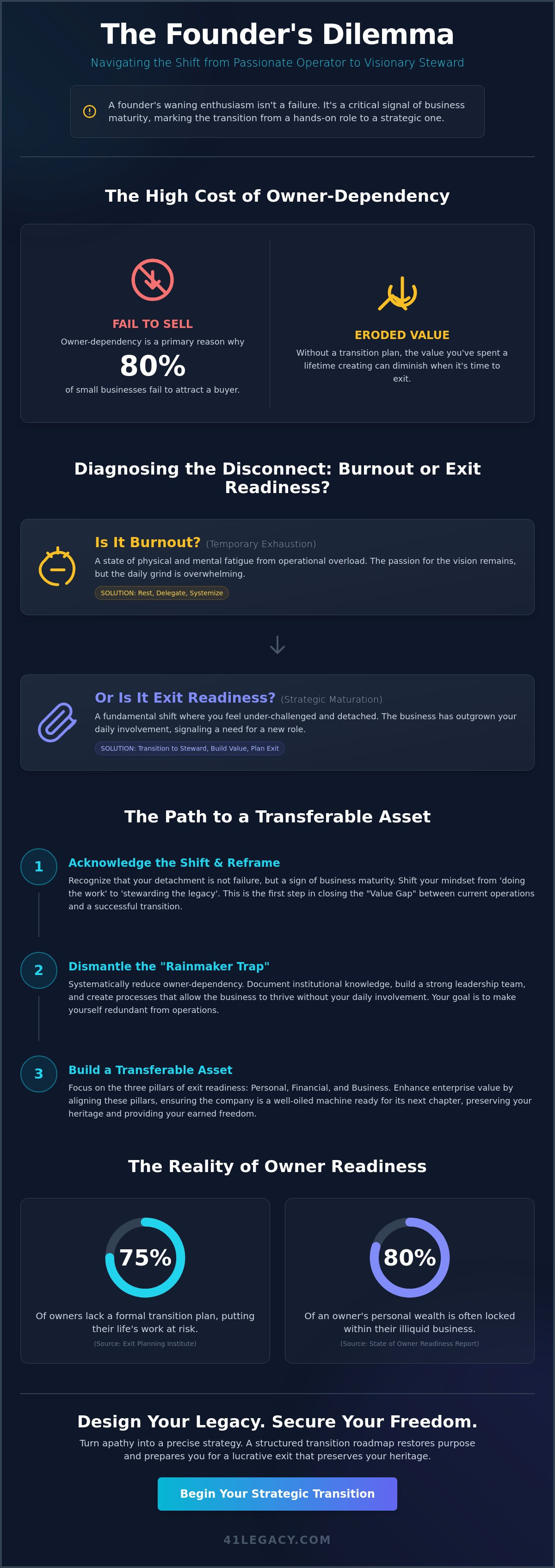
Transitioning from Operator to Steward: The Path to a Transferable Asset
The transition from operator to steward is an intentional evolution. It's the process of separating your daily labor from the enterprise's enduring value. When you find yourself questioning what to do when you fall out of love with your business, the most sophisticated response is to refine it into a transferable asset. This shift doesn't just prepare the company for a future sale; it restores the owner’s autonomy today. By understanding what to do when you fall out of love with your business, you can pivot from exhausting management to high-level oversight.
The path follows five critical milestones:
- Enterprise Diagnostic: Perform a deep dive into operational health to uncover risks that suppress valuation.
- Value Drivers: Pinpoint assets, such as proprietary processes or brand equity, that function independently of your presence.
- Value Growth Roadmap: Execute a sequence of improvements designed to close the "Value Gap" between current worth and future needs.
- Advisory Alignment: Assemble a team including a CPA, Attorney, and a Certified Exit Planning Advisor (CEPA) to ensure the business strategy serves your personal legacy.
- Independence Testing: Validate the company's durability through a series of owner-absentee trials to prove the business can thrive without you.
The Power of Enterprise Diagnostics
A diagnostic provides a clinical, data-driven view of a company's market attractiveness. According to the 2023 State of Owner Readiness Report, roughly 80% of an owner's net worth is often locked within their business. Relying on "gut feel" for valuation is a risk that sophisticated stewards don't take. A formal diagnostic reveals how a buyer perceives your operation, focusing on the quality of your team and the strength of your systems. You can learn more about these diagnostic processes at 41 Legacy to move toward empirical strategic planning and away from uncertainty.
Building the Value Growth Roadmap
A clear roadmap prioritizes "low-hanging fruit" that increases transferability immediately. For example, addressing customer concentration is vital; ensuring no single client represents more than 15% of annual revenue significantly de-risks the asset. Focusing on recurring revenue models further stabilizes the company's future and enhances its multiple. When a founder follows a structured roadmap, the emotional weight of the business begins to lift. The enterprise is no longer a burden to manage but a legacy to curate. This clarity provides the owner with the ultimate luxury: the choice to stay or the freedom to depart on their own terms.
Reducing Owner Dependency: Protecting Value When Your Heart Isn't in the Daily Grind
The most significant obstacle to a graceful exit is often the owner's own excellence. This is the "Rainmaker Trap." When a founder remains the primary driver of sales or technical execution, the enterprise loses its character as a transferable asset and becomes a high-stakes job. For those wondering what to do when you fall out of love with your business, the first step is to decouple your identity from the daily operations. A business that relies on a single individual's charisma or intuition is inherently fragile; sophisticated buyers view this dependency as a critical risk factor that often leads to a 40% to 50% discount in valuation.
Institutional knowledge must be harvested from the mind of the founder and distilled into Standard Operating Procedures (SOPs). This isn't mere paperwork. It's the creation of a blueprint that allows the soul of the company to persist without its creator. By empowering a leadership team to handle high-stakes decisions, you transition from Chief Everything Officer to Chairman of the Board. This shift preserves the legacy while granting you the emotional distance needed to evaluate your next chapter with clarity. It ensures the machine continues to hum with precision, regardless of who is at the helm.
Engineering Transferability into Your DNA
Buyers don't purchase a founder's past success; they purchase the certainty of future cash flows. Transferability Engineering is the process of making a founder's skills redundant. If the business cannot pass the "Vacation Test," surviving for 30 days without your input, it isn't yet a transferable asset. Strategic buyers pay a premium for companies that demonstrate operational independence. This structural integrity ensures the craft remains consistent and the revenue remains stable during a transition. It's about building a legacy that is durable enough to outlast your daily presence.
Strategic Capacity Evaluation
A Value Growth Roadmap requires a team capable of execution. You must identify "Key Man Risk" early. If 70% of your operational knowledge resides in one person, the risk profile is unacceptable for a professional transition. Mitigating this risk involves cross-training and the deliberate delegation of authority. There's a profound psychological relief in watching your legacy thrive independently. It confirms that you've built something of lasting substance, a machine that runs with the precision of a fine-tuned engine. Understanding what to do when you fall out of love with your business involves realizing that your greatest contribution is no longer your labor, but the systems you leave behind.
To begin the process of detaching yourself from the daily grind while increasing the worth of your company, you can strengthen your enterprise's transferability through our structured advisory framework.
Designing Your Legacy: How Exit Readiness Turns Boredom into Opportunity
Falling out of love with your business isn't a sign of failure. It's an indicator that your role as a founder has reached its natural conclusion. When the daily mechanics of operation no longer provide fulfillment, it's time to shift your focus from maintenance to stewardship. This transition marks the difference between selling out and graduating. Graduation is the ultimate achievement for any creator; it signifies that the entity you've built is strong enough to thrive without your constant presence. By focusing on exit readiness, you transform emotional fatigue into a strategic advantage that increases the enterprise value of your life's work.
The 'Quarterback' Advisory Model
Most business owners possess a trusted circle of advisors, including a CPA and legal counsel. These professionals are essential, yet they often operate in silos, focusing on specific tax or compliance issues rather than the holistic health of the legacy. 41 Legacy serves as the central coordinator, or "Quarterback," of this transition team. We ensure that every professional recommendation aligns with the long-term goal of maximizing transferability. This model removes the administrative and strategic weight from your shoulders, allowing you to focus on high-level vision while we synchronize the details.
- Alignment: We bridge the gap between financial planning and operational reality.
- Value Optimization: Every decision is filtered through the lens of increasing enterprise value.
- Reduced Burden: The owner moves from the center of every problem to the head of a coordinated strategy.
Your Next Chapter Starts with a Diagnostic
If you're questioning what to do when you fall out of love with your business, the answer lies in the data. Viewing this phase as a diagnostic period allows you to treat your company like a precision instrument. According to data from the Exit Planning Institute, nearly 80% of a business owner's net worth is locked within their company. Protecting that wealth requires a shift toward owner-dependency reduction. When a business can run flawlessly without its founder, it becomes a transferable asset rather than a high-paying job.
This process provides a profound sense of peace. You're no longer tethered to the mundane; you're refining a masterpiece for its next steward. This is the most profitable phase of your journey because it focuses on the structural integrity that buyers and successors prize most. It's about ensuring your heritage remains intact while you move toward your next calling. Explore how 41 Legacy can help you build your transferable asset and secure the future of your professional evolution.
From Founder to Steward: Preserving Your Enterprise Soul
A fading passion for daily operations doesn't signal the end of your story. It marks a pivotal transition from operator to steward. By reducing owner dependency and focusing on transferability, you transform a personal burden into a resilient, transferable asset. This shift protects the enterprise value you've spent years cultivating; it ensures the business maintains its integrity without requiring your constant presence. Every successful transition begins with this essential mental reframe.
Determining what to do when you fall out of love with your business is a strategic exercise in legacy building. 41 Legacy provides a structured "Quarterback" advisory model led by a Certified Exit Planning Advisor (CEPA) to guide this evolution. We treat your business with the same reverence a master craftsman shows a rare automotive masterpiece, focusing on the meticulous details that drive market readiness and long-term health. You've built something significant. Now, it's time to ensure it can thrive on its own merits.
Begin your Exit Readiness Assessment with 41 Legacy
Your business deserves a future that honors its past while securing your next chapter.
Frequently Asked Questions
Is it normal to fall out of love with a successful business?
It's a common occurrence for founders to feel a sense of detachment once a business reaches maturity. The 2023 State of Owner Readiness Survey indicates that 75% of owners experience this shift after the initial creative spark fades. You've transitioned from an artisan to a manager, which often feels like losing the soul of the work. Understanding what to do when you fall out of love with your business starts with recognizing this as a strategic inflection point.
How do I know if I should fix my business or sell it?
Deciding to repair or exit depends on the enterprise's current transferability. If the business relies on your personal involvement for 80% of its daily operations, it's not yet a transferable asset. You must decide if you have the energy to spend the next 18 months building the systems required for a legacy. A 2022 BizBuySell report shows that businesses with documented, independent processes command a 20% higher sales price than owner-centric firms.
What is the first step in preparing a business for exit when I'm feeling burnt out?
The first step is a comprehensive diagnostic to identify where your presence is a bottleneck. This assessment provides the clarity needed to separate your identity from the entity's operations. When determining what to do when you fall out of love with your business, you must first identify the 5 core processes that require your touch. Delegating these tasks to a capable team moves the business from a job you own to a legacy that stands alone.
Can I still sell my business if I am the primary driver of sales and operations?
You can sell an owner-dependent business, but the market will likely penalize the price. Data from the Value Builder System suggests that high owner dependency can reduce a business's valuation by 30% to 50%. Buyers seek a machine that runs without the original architect. To preserve your legacy and maximize value, you must document your craft so others can execute it with the same precision you once did.
How long does the exit readiness process typically take?
A thorough exit readiness process typically requires 12 to 36 months of focused effort. This duration allows for the meticulous refinement of operations and the seasoning of a management team. Industry benchmarks suggest a 24 month window is the standard for transforming a founder-led company into a transferable enterprise. It's a deliberate pace that mirrors the restoration of a classic vehicle, ensuring every component is ready for the next owner.
What happens to the value of my business if I just walk away without a plan?
Walking away without a structured plan often leads to a total loss of enterprise value. The Small Business Administration notes that 80% of businesses listed for sale never find a buyer, largely due to a lack of preparation. Without your stewardship or a functional system in place, the engine of the business quickly seizes. A planned transition is the only way to ensure the history you've built survives your departure.
How does an Exit Readiness Assessment differ from a standard business valuation?
A valuation is a static measurement of historical performance, while an assessment is a forward-looking roadmap. Valuation looks at the numbers; an assessment looks at the structural integrity of the legacy. It identifies the risks that could derail a future transition, such as client concentration or technical debt. This strategic clarity is what allows an owner to move from a state of exhaustion to a position of strength.
Do I need to tell my employees if I am falling out of love with the business?
You don't need to share your emotional state with your team, but you should share your vision for their autonomy. A 2021 Gallup report found that manager engagement drives 70% of team engagement, so your detachment will eventually be felt. Instead of discussing your loss of passion, focus on empowering your leaders to take ownership of the mission. This builds a culture that thrives independently, which is the hallmark of a true legacy.

Article by
Mike Laskowski
Mike Laskowski is a Business Value Growth Strategist who helps business owners uncover the truths that drive their performance, risk, and readiness. Blending forensic interviewing from a 26‑year federal career with Strategic Capacity analysis and CEPA methodology, he works upstream to reduce owner dependency, increase transferability, and strengthen enterprise value. Mike guides founders through clarity, operational evolution, and transition readiness so their companies become transferable, owner‑independent assets that endure beyond the founder.
Disclaimer
This article is for educational and informational purposes only and does not provide legal, tax, investment, or business brokerage advice. 41 Legacy does not offer M&A brokerage services, legal document drafting, tax preparation, or investment advisory services. Business owners should consult licensed professionals in those disciplines before making decisions related to business transactions, legal matters, tax strategy, or financial planning. All examples are illustrative and may not apply to your specific situation.