
What to Do Before Hiring an M&A Advisor: The Strategic Blueprint for Exit Readiness
What if the true worth of your life's work isn't found in a buyer's offer, but in the silence that follows your departure? It's natural to feel a sense of trepidation when considering the future of your enterprise. You've spent years building a heritage, yet the fear that the business might falter during due diligence or remain tethered to your daily presence is a profound weight. Understanding what to do before hiring an M&A advisor allows you to move from a place of uncertainty to one of absolute strategic clarity. This is the essential prerequisite for any founder who views their company as a masterpiece rather than a mere transaction.
We'll examine the diagnostic and value-engineering steps necessary to transform your company into a sovereign, transferable asset. You'll learn how to identify the hidden Value Gap and coordinate a team of specialists to ensure the enterprise thrives long after you've passed the torch. By focusing on owner-dependency reduction and enterprise diagnostics, you can secure a future that meets your retirement needs while preserving the essence of what you've created. This is your blueprint for a transition defined by precision and purpose.
Key Takeaways
- Define the vital distinction between the mechanics of a transaction and the structural health of Exit Readiness to preserve the integrity of your life's work.
- Employ an Enterprise Diagnostic to measure the "Value Gap," ensuring your current trajectory meets the weight of your future retirement needs.
- Engineer transferability by methodically reducing owner dependency, allowing the business to thrive as a sovereign entity beyond your daily stewardship.
- Discover exactly what to do before hiring an M&A advisor to ensure your CPA, attorney, and specialists are aligned with a single, uncompromising vision.
- Implement a Value Growth Roadmap that serves as a strategic bridge, turning technical excellence into a lasting and transferable legacy.
M&A Readiness vs. Exit Readiness: Understanding the Distinction
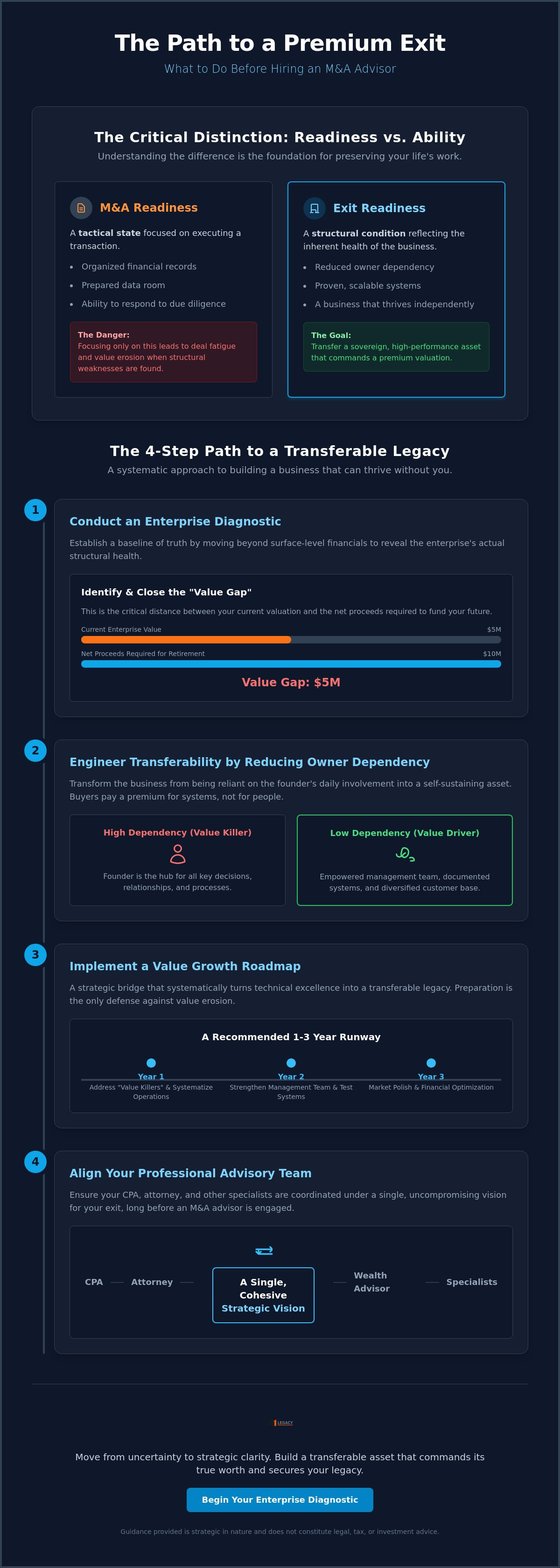
Many founders confuse the ability to sell with the readiness to exit. M&A readiness is a tactical state; it involves having your financial records organized and a data room prepared for scrutiny. It is the ability to execute a transaction effectively. Exit readiness, however, is a deeper, structural condition. It reflects the inherent health and transferability of the enterprise itself. A business might be ready for a transaction but entirely unready for an exit if its value remains inextricably linked to the founder's daily involvement. Understanding this distinction is the cornerstone of what to do before hiring an M&A advisor.
Engaging the transactional market with an unready business often leads to deal fatigue. When structural weaknesses emerge during due diligence, buyers frequently "retrade," lowering their initial offer to account for newly discovered risks. This devalues the company and exhausts the leadership team. Instead, the owner must act as a steward, refining the business into a transferable asset that commands a premium because it functions independently. True value is not found in the transaction itself, but in the strength of the asset being transferred.
The Danger of Premature Transactional Focus
Entering the market too early exposes your enterprise to sophisticated buyers who specialize in identifying operational fragility. If your systems are undocumented or your customer base is concentrated, these flaws will be used as leverage against you. The psychological toll of a failed deal is immense. It leaves a founder feeling trapped and the business distracted. Attempting to "fix it in the transition" is a high-risk strategy. Sophisticated capital rarely pays for potential that the current owner failed to institutionalize. Preparation is the only defense against the erosion of value.
Building the Foundation for a Premium Exit
A premium exit requires a fundamental mindset shift. You are no longer merely "selling a business," you are transferring a legacy. This process ideally begins with a one to three year runway. This time allows for the implementation of a Value Growth Roadmap, which systematically addresses owner dependency and strengthens enterprise value. By establishing this professional-room altitude early, you ensure that when you eventually seek market representation, you are presenting a polished, high-performance asset. This strategic clarity is the most critical step in what to do before hiring an M&A advisor, ensuring the transaction reflects the true essence of your work.
Conducting an Enterprise Diagnostic: Identifying the Value Gap
Before a master artisan begins the restoration of a historic work, they first examine the canvas for structural fractures hidden beneath layers of paint. For the business owner, this meticulous examination is the Enterprise Diagnostic. It establishes a baseline of truth, moving beyond the surface level optimism of a profit and loss statement to reveal the actual health of the entity. This diagnostic is a fundamental part of what to do before hiring an M&A advisor, as it provides the strategic clarity required to enter the market from a position of strength rather than hope.
Central to this process is the identification of the Value Gap. This is the distance between the current market valuation of the business and the net proceeds the owner requires to fund their next chapter. Many founders discover too late that their enterprise, while profitable, lacks the structural integrity to command a multiple that meets their retirement needs. By identifying "Value Killers" like customer concentration or undocumented processes early, you can address these vulnerabilities before they become leverage for a buyer during due diligence. You must ensure the asset is as robust as the legacy it represents.
Measuring the Essence of the Enterprise
Valuation is as much a qualitative endeavor as it is a quantitative one. While a standard financial statement captures the history of revenue, it often fails to reflect the intangible assets that drive a premium multiple. These include the strength of your management team, the scalability of your systems, and the durability of your brand. An Enterprise Diagnostic uncovers red flags that sophisticated buyers will eventually exploit. By conducting a formal Enterprise Diagnostic now, you gain the opportunity to resolve these issues on your own terms, preserving the essence of the company you've built.
Closing the Value Gap
Once the gap is defined, the focus shifts to value engineering. Increasing revenue is a linear goal; increasing the valuation multiple is an exponential one. A Value Growth Roadmap prioritizes improvements that offer the highest return on investment for transferability. This might mean investing in strategic capacity or formalizing a leadership transition plan. This alignment of personal financial needs with the company's market reality is the most vital step in what to do before hiring an M&A advisor. It ensures that when you finally engage the market, the result is a successful transition that honors your life's work and secures your future.
Engineering Transferability: Reducing Owner Dependency
The most exquisite mechanism is one that functions with silent, autonomous grace. In the world of enterprise, this independence is known as transferability. Owner dependency remains the primary risk factor for private middle-market companies, acting as a structural flaw that can undermine decades of dedicated work. A business that requires the founder's constant touch is not yet a transferable asset; it is a high-performance machine that lacks its own internal drive. True value is found when the enterprise can sustain its excellence without its creator.
The "Rainmaker Trap" is a common affliction where the founder remains the primary architect of sales or the sole guardian of operational quality. While this dedication is commendable during the growth phase, it creates a point of failure that sophisticated buyers will avoid. They seek the assurance that the essence of the business will survive the transition. Proving this independence is the most vital part of what to do before hiring an M&A advisor. You must demonstrate that the enterprise possesses its own strategic capacity and can thrive long after the transition is complete.
The Transferability Audit
A transferability audit evaluates the structural health of your organization by testing its strategic capacity. We often suggest a 30 day absence test to determine if the business can maintain its rhythm without the founder's direct intervention. If the machinery slows or the quality of service falters, it reveals a lack of institutional depth. We must also examine the architecture of your relationships. If customer loyalty is tied exclusively to your person, it cannot be transferred. Building a management team capable of independent stewardship is essential to ensuring the business survives as a lasting legacy.
Codifying the Craftsmanship of the Business
Documenting your internal processes is an act of preservation. By transforming tribal knowledge into formal Standard Operating Procedures (SOPs), you are codifying the craftsmanship that has defined your success. These documents act as a guardian of your brand's essence, ensuring precision is maintained across every department. When a business is process-driven rather than founder-led, it becomes a far more attractive asset. This level of preparation is exactly what to do before hiring an M&A advisor to ensure you don't leave value on the table. It turns your daily work into a permanent, transferable asset that commands a premium multiple.
Aligning Your Professional Advisory Team
A masterpiece is never the result of a single hand working in isolation. It requires the coordinated effort of specialists who understand the weight of the legacy they are protecting. In the context of an exit, your CPA, attorney, and eventual M&A professional must function as a single, harmonious ensemble. The "Quarterback" concept is essential here. One lead advisor must coordinate these disciplines to ensure that every tactical decision aligns with your ultimate vision. This orchestration is a critical component of what to do before hiring an M&A advisor, as it prevents the friction that so often devalues an enterprise during the final stages of a transition.
Many founders possess long-standing relationships with their tax and legal professionals. However, being a competent tax preparer is not the same as being an "exit-minded" strategist. You require advisors who look beyond the current fiscal year to consider how structural decisions today will impact the net proceeds and the transferability of the asset tomorrow. Coordinated positioning ensures that your legal documents and tax strategies are prepared for the intense scrutiny of a sophisticated buyer's due diligence team. Without this alignment, you risk advisor friction, where conflicting advice creates paralysis and erodes deal value.
The Role of Coordinated Advisory
Tax preparation is a historical record; exit tax planning is a forward-looking strategy. Similarly, legal documents must be more than just compliant. They must be engineered to withstand the rigorous examination of an M&A team. Through our Strategic Advisory services, we provide the monthly implementation support necessary to keep every professional on the same page. This ensures that the technical excellence of your CPA and the precision of your attorney are channeled toward a single, uncompromising goal of enterprise value growth.
Preparing the Professional Room
Facilitating a high-level dialogue between your long-term advisors and an M&A expert requires a specific professional-room altitude. It is about setting clear expectations for communication and strategy execution before the pressure of the transaction market begins. By establishing these protocols early, you protect the essence of the company from being lost in a sea of transactional noise. This preparation is a vital part of what to do before hiring an M&A advisor, ensuring that when the time comes, your team is ready to defend the premium valuation you have worked so hard to build.
The Value Growth Roadmap: Your Path to a Successful Transition
The final phase of preparation is the distillation of all prior efforts into a cohesive Value Growth Roadmap. This document isn't merely a checklist; it's a strategic bridge that connects your current operational reality to a future of limitless potential. By the time you reach this stage, the Value Gap has been identified and the structural fractures of owner dependency have been repaired. This structured approach provides the absolute clarity required when determining what to do before hiring an M&A advisor. It ensures you aren't just entering the market, but presenting a turn-key asset that appeals to the most sophisticated strategic buyers who value heritage as much as performance.
Transitioning from value growth to transaction execution is a deliberate movement. It requires a shift in perspective, where the business is viewed as a completed work of art ready for its next curator. When the enterprise is positioned as a turn-key acquisition, it removes the friction of integration for the buyer, directly translating into a more seamless transition. This level of readiness is the ultimate expression of stewardship, transforming a private company into a lasting, transferable asset that stands independently of its creator.
Executing the Strategic Vision
Accountability is the catalyst that transforms a roadmap into a reality. Through monthly implementation support, the business evolves from a founder-centric entity into a sovereign enterprise. This transition allows the owner to shift their role from a daily operator to a strategic visionary. A business that has undergone this level of value engineering doesn't just sell; it commands a premium multiple and favorable terms. It's a reflection of the precision applied during the preparation phase, ensuring the transaction market recognizes the technical excellence and strategic capacity of the underlying asset.
Securing the Legacy
True success in a transition extends far beyond the final purchase price. It involves the preservation of an essence that has been nurtured over decades. When you focus on what to do before hiring an M&A advisor, you're securing the future of your employees, your customers, and your community. A well-prepared exit ensures that the craftsmanship of the company survives the transfer of ownership, remaining intact for the next generation of stewards. This is how a lasting impact is built. Begin your journey to transferability with an Exit Readiness Assessment to ensure your legacy is as enduring as the impact you've made.
The Architecture of a Lasting Legacy
The journey from a founder-led company to a transferable asset is a profound act of stewardship. It requires moving beyond the tactical mechanics of a sale to embrace the structural depth of exit readiness. By identifying the Value Gap and systematically reducing owner dependency, you transform your business into a sovereign entity that commands respect in any market. This strategic preparation is the definitive guide on what to do before hiring an M&A advisor; it ensures your life's work is preserved through precision and purpose.
At 41 Legacy, we serve as the dedicated guardians of this transition. Led by a Certified Exit Planning Advisor (CEPA), our team utilizes a proprietary Value Growth Roadmap process to engineer transferability and mitigate risk. We provide the expert 'quarterbacking' necessary to align your CPA, attorney, and specialists under a single, uncompromising vision of excellence. Secure your legacy with a comprehensive Exit Readiness Assessment from 41 Legacy.
Your enterprise is more than a set of accounts; it's a testament to your dedication. With a clear blueprint in hand, you can ensure its story continues with strength and clarity for years to come.
Frequently Asked Questions
Is an M&A advisor the same as a business broker?
No, they serve different tiers of the market with varying degrees of complexity. Business brokers typically handle smaller, high volume transactions often aimed at individual buyers. M&A advisors manage larger, more intricate deals involving strategic corporations or private equity firms. They bring a higher level of technical precision and strategic depth to the professional room, ensuring the enterprise is positioned as a sophisticated asset rather than a simple sale.
Can I hire an M&A advisor if my business is still dependent on me?
You can engage one, but it's often a premature move that devalues your life's work. If the enterprise cannot function without your daily presence, sophisticated buyers will perceive it as a high risk investment. Understanding what to do before hiring an M&A advisor involves engineering transferability first. This ensures you aren't tethered to the business post sale through lengthy earn-outs or consulting requirements that restrict your freedom.
How much time should I allow for exit planning before hiring a transaction professional?
A runway of one to three years is the ideal standard for high end craftsmanship. This duration allows for a comprehensive Enterprise Diagnostic and the steady implementation of a Value Growth Roadmap. Rushing into the transaction market without this preparation often leads to deal fatigue. Taking the time to refine the internal machinery of your company ensures you enter negotiations from a position of absolute strategic clarity.
What is the difference between a business valuation and an enterprise diagnostic?
A valuation is a numerical snapshot of current worth based largely on historical financials. An Enterprise Diagnostic is a deeper, more qualitative examination of the structural health and transferability of the entity. It identifies the hidden "Value Killers" and operational fractures that a standard valuation might miss. While a valuation tells you what the business is worth today, a diagnostic reveals how to increase that worth before a sale.
Do I need an M&A advisor for an internal transition or ESOP?
Internal transitions often require a different set of specialists focused on leadership development and structural engineering. While you may not need a market representative to find a buyer, you still require strategic advisory to ensure the business survives the transfer. The focus shifts toward building the strategic capacity of your successors. You must ensure they are prepared to steward the legacy with the same precision you applied during your tenure.
How do I know if my current CPA is prepared for an M&A process?
Assess whether their focus is purely on historical tax compliance or forward looking strategic positioning. An exit-minded CPA understands how to prepare financial statements for the intense scrutiny of a buyer's due diligence team. They should be willing to participate in a coordinated advisory team where their work is aligned with your ultimate vision. If they only react to past data, they may not possess the altitude required for a complex transition.
What happens if I hire an M&A advisor before I am exit ready?
You risk the enterprise being "retraded" during the final stages of the deal. When a buyer discovers structural weaknesses or heavy owner dependency during due diligence, they will often lower their initial offer. Knowing what to do before hiring an M&A advisor prevents this erosion of value. Without proper readiness, you may find yourself trapped in a transaction that doesn't meet your financial needs or protect the company's essence.
Can I reduce my owner dependency while still growing the business?
These two objectives are actually perfectly aligned. Reducing dependency requires the creation of documented processes and the empowerment of a management team, both of which are catalysts for scalable growth. As you build the strategic capacity of the organization, it becomes more efficient and more profitable. You aren't just preparing for an exit; you're creating a high performance machine that can reach its full potential under its own power.

Article by
Mike Laskowski
Mike Laskowski is a Business Value Growth Strategist who helps business owners uncover the truths that drive their performance, risk, and readiness. Blending forensic interviewing from a 26‑year federal career with Strategic Capacity analysis and CEPA methodology, he works upstream to reduce owner dependency, increase transferability, and strengthen enterprise value. Mike guides founders through clarity, operational evolution, and transition readiness so their companies become transferable, owner‑independent assets that endure beyond the founder.
Disclaimer
This article is for educational and informational purposes only and does not provide legal, tax, investment, or business brokerage advice. 41 Legacy does not offer M&A brokerage services, legal document drafting, tax preparation, or investment advisory services. Business owners should consult licensed professionals in those disciplines before making decisions related to business transactions, legal matters, tax strategy, or financial planning. All examples are illustrative and may not apply to your specific situation.