
What Strategic Buyers Look for in an Acquisition: Engineering a Transferable Asset
A business that requires its founder to breathe life into it every day is not an asset; it is a high-stakes job. You have spent years patiently refining your enterprise, yet the very dedication that fueled its growth can become the unseen weight that prevents a successful transition. When considering your exit, the essential inquiry remains: what do strategic buyers look for in an acquisition? While many owners focus on past performance, sophisticated institutional buyers are searching for something far more rare: a self-sustaining entity that thrives in your absence.
We understand the complexity and the quiet anxiety that often accompanies the due diligence process. It is natural to feel protective of the legacy you have built, yet true stewardship requires preparing the business to stand on its own. In this guide, we will explore the core criteria used by strategic acquirers to evaluate enterprise value and the precise engineering required to ensure your company is truly transferable. You will gain a clear roadmap to increase your valuation and the confidence that your business can flourish as a standalone asset.
Key Takeaways
- Distinguish between a personal lifestyle business and a transferable asset to ensure your company meets the institutional standards of enterprise value.
- Gain a definitive understanding of what do strategic buyers look for in an acquisition by analyzing financial integrity and the risks of customer concentration.
- Identify and dismantle the "Rainmaker Trap" to prove your business can sustain its momentum and vision without founder dependency.
- Implement structural scalability through standardized processes, transforming your daily operations into a precise blueprint for future growth.
- Coordinate your advisory team under a unified strategy to navigate the complexities of exit readiness and preserve the integrity of your legacy.
The Institutional Mindset: Why Buyers Value Independence Over Performance
A business is a living entity with a story to tell. For the founder, it is a life's work; for the institutional buyer, it is a machine designed to produce predictable cash flow. To bridge this gap, an owner must master the concept of enterprise value. We define enterprise value as the intrinsic worth of the company as a standalone entity, functioning independently of any single individual. Most owners unknowingly operate a lifestyle business. This is an enterprise that provides a comfortable living but ceases to function if the owner steps away. In contrast, a transferable asset is engineered for permanence. When considering what do strategic buyers look for in an acquisition, the focus shifts from your personal charisma to the company's future independence. Sophisticated buyers view a founder-dependent business as a liability. True stewardship requires you to build a legacy that survives your presence.
Strategic vs. Financial Buyers: Understanding the Motivation
Strategic buyers seek horizontal or vertical integration to expand their reach or secure their supply chains. They look for synergies that make the combined entity more valuable than the sum of its parts. Private equity firms, however, look for platform companies with the scalable infrastructure to support aggressive growth. Despite these different motivations, both groups are central participants in the broader landscape of Mergers and acquisitions (M&A). The common denominator is absolute. They require a business that functions with surgical precision without founder intervention. If the essence of the company is tied to your personal relationships or specific technical skill, the enterprise value remains capped.
The Three Pillars of a Transferable Asset
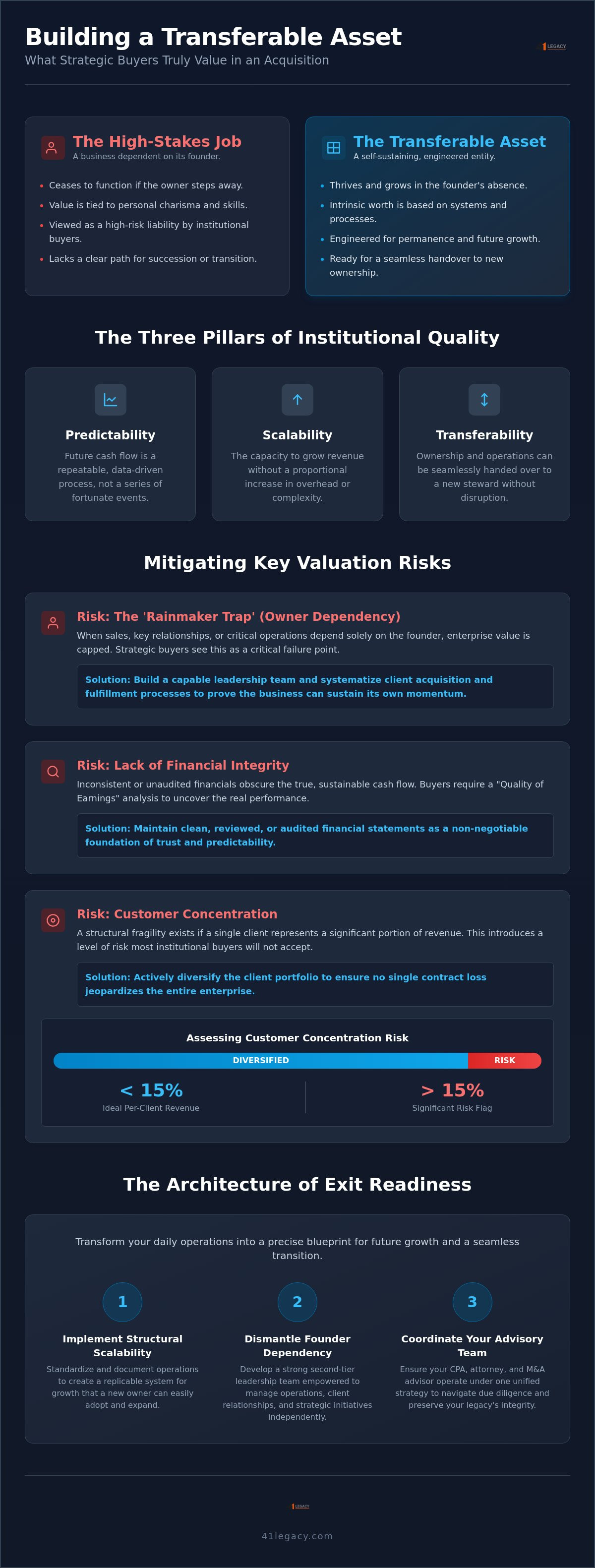
Engineering a high-value exit requires a focus on three technical pillars that define institutional quality. First is predictability. This involves using historical data as a map for future cash flow, ensuring that performance is not a series of fortunate events but a repeatable process. Second is scalability. This is the capacity to grow revenue without a linear increase in overhead, a hallmark of meticulous operational design. Finally, there is transferability. This represents the ease with which ownership and operations can be handed over to a new guardian. At 41 Legacy, we believe that refining these pillars is a philosophical endeavor. It transforms a simple company into a masterpiece of engineering that can thrive for generations.
When you begin to view your company through this lens, the transition from operator to steward begins. You are no longer just managing day-to-day tasks. You are crafting an asset that possesses its own heartbeat. This shift in perspective is the first step in understanding what do strategic buyers look for in an acquisition and securing the future of your legacy.
Financial Integrity: The Metrics of Predictable Future Cash Flow
Financial statements are more than historical records; they are the architectural drawings of your company's future. While a surface-level EBITDA figure provides a glimpse of the present, a Strategic Acquisition requires a rigorous "Quality of Earnings" analysis. This process strips away one-time anomalies to reveal the sustainable pulse of the business. When examining what do strategic buyers look for in an acquisition, the scrutiny inevitably turns to the integrity of these numbers. Clean, reviewed, or audited statements are not optional; they are the foundation of trust between a steward and a successor.
A significant risk factor that often remains hidden is customer concentration. If a single client represents more than 15% of your total revenue, it creates a structural fragility that institutional buyers find difficult to ignore. They seek a diversified portfolio where the loss of one contract does not threaten the integrity of the whole. We utilize Enterprise Diagnostics to identify these hidden financial leaks and value gaps long before a transaction begins. Conducting an Enterprise Diagnostics assessment allows you to address these vulnerabilities with the precision of a master artisan.
Revenue Quality and Predictability
The nature of your revenue dictates the stability of your legacy. Strategic buyers distinguish sharply between transactional sales and recurring, contract-based revenue. Transactional revenue requires a constant, exhausting effort to replenish, while recurring streams offer a predictable map for future growth. High retention rates and "sticky" services lower the buyer's perceived risk significantly. It's essential to identify revenue streams that are tied to the company brand rather than the owner's personal charisma. This ensures the essence of the business remains intact after the transition.
Margin Stability and Operational Efficiency
Precision in operations manifests in your margins. Buyers look for EBITDA margins that consistently outperform industry benchmarks, such as the 7.5x average currently seen in the professional services sector as of July 2026. This requires a meticulous look at "Owner Add-backs" to normalize the financial statements. Normalized earnings are the profit remaining after the owner is replaced by market-rate management. This transparency is vital because what do strategic buyers look for in an acquisition is a machine that operates with maximum efficiency and minimum waste. Achieving this level of financial clarity transforms a standard business into a high-value, transferable asset.
Solving the 'Rainmaker Trap': Reducing Owner Dependency
The most profound paradox of entrepreneurship is that the very force required to launch a company often becomes the primary obstacle to its successful transition. This is the "Rainmaker Trap." It occurs when the founder remains the singular driver of vision, sales, and high-level client relationships. While this personal magnetism may have fueled early growth, it creates a structural fragility that institutional buyers view as an unacceptable risk. When investigating what do strategic buyers look for in an acquisition, they search for an asset that possesses its own momentum. If the business is merely an extension of your personality, it lacks the independence required to command a premium valuation.
Founder dependency creates a definitive valuation ceiling. Sophisticated acquirers will not cross this threshold because they are not purchasing your past achievements; they are investing in the future certainty of the asset. To break through this ceiling, you must establish a mid-level management layer that owns specific Key Performance Indicators (KPIs) and operational outcomes. This shift requires moving from an "Owner-to-Client" relationship model to a "Company-to-Client" model. This transition ensures that the value resides within the brand and its systems, rather than a single individual's influence.
Engineering Transferability Through Delegation
A simple yet rigorous diagnostic for business health is the "Vacation Test." If you cannot step away from operations for 30 days without a degradation in service or revenue, your company is not yet a transferable asset. True transferability is engineered by systematizing the "Critical Few" tasks. These are the high-impact activities that drive the majority of your results. By delegating or automating the "Trivial Many," you foster a culture of accountability that thrives on precision rather than charismatic leadership. This structural discipline is exactly what do strategic buyers look for in an acquisition when they evaluate the long-term viability of a target.
Leadership Succession and Key-Man Risk
Acquirers are acutely aware of key-man risk. This is why many transactions require a "rollover" or transition period where the founder remains involved for 12 to 24 months. However, the most attractive businesses are those that have already identified and groomed internal successors. Reducing risk involves cross-training and the formal documentation of institutional knowledge. By transforming your unique expertise into a shared company resource, you mitigate the risk of a leadership vacuum. This process of Owner Dependency Reduction is the final act of a true steward, ensuring the legacy you built continues to flourish under new guardianship.
Strategic Scalability: Building the Infrastructure of Growth
Scalability is the hallmark of a masterpiece in operational engineering. It is the ability to handle increased volume while decreasing marginal costs, ensuring that the company's expansion doesn't lead to a degradation of quality or a loss of control. When we investigate what do strategic buyers look for in an acquisition, we find they seek businesses where growth doesn't require a proportional increase in overhead. This requires Standard Operating Procedures (SOPs) that serve as a blueprint for the future. Technology and information systems act as a force multiplier here, transforming manual labor into automated precision. A truly scalable sales and marketing engine must operate with clinical efficiency, entirely independent of the founder's personal influence.
Strategic buyers don't just buy what you have; they buy what they can do with it. If your growth is tied to your personal hours, it isn't scalable. It's a bottleneck. We focus on "Transferability Engineering" to remove these constraints, allowing the business to expand without the friction of founder dependency. Understanding what do strategic buyers look for in an acquisition allows you to build the very infrastructure they are willing to pay a premium for, turning a successful company into a high-performance asset.
The Value Growth Roadmap
Every journey toward a high-value exit begins with clarity. We use Enterprise Diagnostics to identify the gap between current valuation and potential worth. This allows us to prioritize operational improvements that offer the highest ROI for a prospective buyer. The Exit Readiness Assessment is the foundational first step in this process. It provides the diagnostic clarity needed to begin the work of refinement. By following a structured path, you can systematically address value gaps and ensure the business is positioned for institutional-grade attractiveness.
Systems as Intangible Assets
Documented processes are often more valuable to a buyer than physical machinery. They represent the company's "secret sauce" captured in a repeatable, teachable format. This ensures the essence of the work is preserved and can be executed by others with the same level of excellence. 'IS Service' integration ensures data integrity during the due diligence process, providing a clear and unvarnished view of the enterprise. When your systems are transparent and robust, you remove the shadow of doubt that often lingers during a transition. You can begin this journey today by establishing a Value Growth Roadmap to secure your legacy.
The Architecture of Exit Readiness: Coordinating the Advisory Team
A successful transition is a symphony of diverse disciplines. For many owners, the final obstacle isn't the buyer, but the friction within their own advisory circle. A disjointed team, where the CPA, attorney, and wealth manager operate in silos, often leads to deal fatigue and missed opportunities. When you consider what do strategic buyers look for in an acquisition, they seek a seamless narrative. They want to see that your financial, legal, and operational structures are perfectly aligned. This is where the "Quarterback" becomes essential. A Certified Exit Planning Advisor (CEPA) serves as this central coordinator, bridging the gap between your daily operations and the ultimate goal of a high-value transfer.
Preparing for the due diligence gauntlet requires more than just clean books. It requires a business that has been pressure-tested before an LOI is even signed. In 2026, with regulatory scrutiny like HSR filings affecting deals over $133.9 million and increased CFIUS enforcement, the complexity of a transaction has never been higher. By the time a buyer begins their investigation, the architecture of your exit should be so robust that the process feels like a formality rather than a threat. This level of preparation ensures that the essence of your legacy remains protected throughout the scrutiny.
The Coordinated Advisory Approach
Your CPA is naturally focused on tax mitigation, a vital task for preserving wealth. However, a strategic buyer is focused on growth potential and future earnings. These two objectives can sometimes conflict if they aren't managed with a unified strategy. Aligning your legal structures and entity types with long-term transferability goals ensures you don't sacrifice enterprise value for short-term gains. Monthly implementation support keeps your Value Growth Roadmap on track, ensuring that the refinements we've discussed, like reducing owner dependency, actually take root in the company's culture.
Final Diagnostic: The Exit Readiness Assessment
The final diagnostic of your journey is the Exit Readiness Assessment. This formal evaluation provides an unvarnished view of your company's enterprise value and its readiness for transition. It's not a mere checklist; it's a strategic mirror. It reflects the true state of your operations, revealing exactly what do strategic buyers look for in an acquisition and where your asset stands today. You can use this assessment data to negotiate from a position of strategic strength, proving that your business is a high-value, standalone asset. Begin the journey of securing your legacy with a Strategic Advisory partner today.
Securing the Future of Your Legacy
You have built more than a company; you have cultivated an essence that deserves to endure. Transforming that work into a transferable asset requires moving beyond the "Rainmaker Trap" and embracing a structure of strategic scalability. By prioritizing financial integrity and operational independence, you ensure that your life's work remains a high-value entity long after your tenure ends. True stewardship is found in the quiet confidence that your business can flourish without your daily intervention.
Understanding what do strategic buyers look for in an acquisition is the essential first step in this architectural refinement. At 41 Legacy, we provide the national expertise in transferability engineering required to navigate this transition with surgical precision. Led by a Certified Exit Planning Advisor (CEPA), our team guides owners through a proprietary Value Growth Roadmap process designed to bridge the gap between current operations and institutional readiness. We invite you to Begin Your Exit Readiness Assessment with 41 Legacy today. Your legacy is too important to be left to chance; let's build an asset that stands the test of time.
Frequently Asked Questions
How long does it take to prepare a business for a strategic acquisition?
Achieving institutional-grade readiness typically requires a window of 18 to 36 months. This duration allows for the meticulous execution of a Value Growth Roadmap, ensuring that operational refinements and owner dependency reductions are reflected in long-term financial trends. Rushing this process often results in leaving significant enterprise value on the table, as buyers require evidence of sustained, independent performance.
Do buyers always replace the owner immediately after the sale is finalized?
Strategic buyers rarely replace the founder on the day of closing. They usually require a transition period, often 12 to 24 months, to ensure a smooth handover of institutional knowledge and key relationships. If the business is already engineered for high transferability, this period may be shorter. This reflects the buyer's confidence in the existing management layer's ability to maintain the company's essence.
What is the difference between an EBITDA multiple and the total enterprise value?
An EBITDA multiple is a valuation shorthand used to compare businesses within an industry, such as the 7.0x average currently seen in the distribution sector. Total enterprise value is the comprehensive worth of the business as a standalone asset, including debt and cash positions. When evaluating what do strategic buyers look for in an acquisition, they look for qualitative factors that justify a higher multiple within that total value.
Can I sell my business if I have high customer concentration?
You can sell your business with high customer concentration, but it often leads to a lower valuation multiple or more aggressive deal terms. Buyers view any single client representing more than 15% of revenue as a structural fragility. To maximize value, we focus on diversification strategies during the preparation phase. This proves the company's revenue is tied to the brand's excellence rather than a single contract.
What is the most common reason acquisitions fall through during the due diligence phase?
The most frequent cause of deal failure is the discovery of "value gaps" or discrepancies in financial records that erode trust. When the initial representations don't match the verified data, buyers often "re-trade" on the price or walk away entirely. Rigorous Enterprise Diagnostics before entering the market mitigates this risk. It allows you to resolve hidden leaks and operational inconsistencies before they become deal-killers.
How does owner dependency specifically lower my company’s valuation?
Owner dependency acts as a structural bottleneck that prevents the business from scaling without your direct intervention. If the founder is the primary driver of sales or vision, the buyer sees a "job" rather than a transferable asset. This risk is quantified by applying a discount to the valuation multiple. The buyer must factor in the cost and uncertainty of replacing your unique contribution with market-rate management.
What role does a Certified Exit Planning Advisor (CEPA) play in the process?
A Certified Exit Planning Advisor (CEPA) acts as the "Quarterback" for your advisory team, aligning the efforts of your CPA, attorney, and wealth manager. Their role is to ensure that every strategic decision serves the ultimate goal of maximizing enterprise value and transferability. They bridge the gap between daily operations and the final transaction through structured diagnostics and implementation support, preserving the integrity of your legacy.
What are the first steps to take if I want to sell my business in 3-5 years?
The first step is to undergo a formal Exit Readiness Assessment to establish a clear baseline of your company's current health. This diagnostic provides the clarity needed to build a multi-year roadmap focused on transferability engineering and risk reduction. Early preparation ensures that what do strategic buyers look for in an acquisition is already fully integrated into your company's culture and performance long before the transition begins.

Article by
Mike Laskowski
Mike Laskowski is a Business Value Growth Strategist who helps business owners uncover the truths that drive their performance, risk, and readiness. Blending forensic interviewing from a 26‑year federal career with Strategic Capacity analysis and CEPA methodology, he works upstream to reduce owner dependency, increase transferability, and strengthen enterprise value. Mike guides founders through clarity, operational evolution, and transition readiness so their companies become transferable, owner‑independent assets that endure beyond the founder.
Disclaimer
This article is for educational and informational purposes only and does not provide legal, tax, investment, or business brokerage advice. 41 Legacy does not offer M&A brokerage services, legal document drafting, tax preparation, or investment advisory services. Business owners should consult licensed professionals in those disciplines before making decisions related to business transactions, legal matters, tax strategy, or financial planning. All examples are illustrative and may not apply to your specific situation.