
Transferability & Owner Dependency
What Makes a Business Sellable: Engineering a Transferable Asset
If you stepped away from your company for six months, would it continue to function with the same meticulous precision, or would the entire mechanism seize? Many founders find themselves trapped in the daily rhythm of operations, fearing that their years of craftsmanship have created a job rather than a transferable asset. Understanding what makes a business sellable is not merely a matter of preparing for a transaction; it is the ultimate test of an enterprise's health and its ability to exist as a legacy independent of its creator.
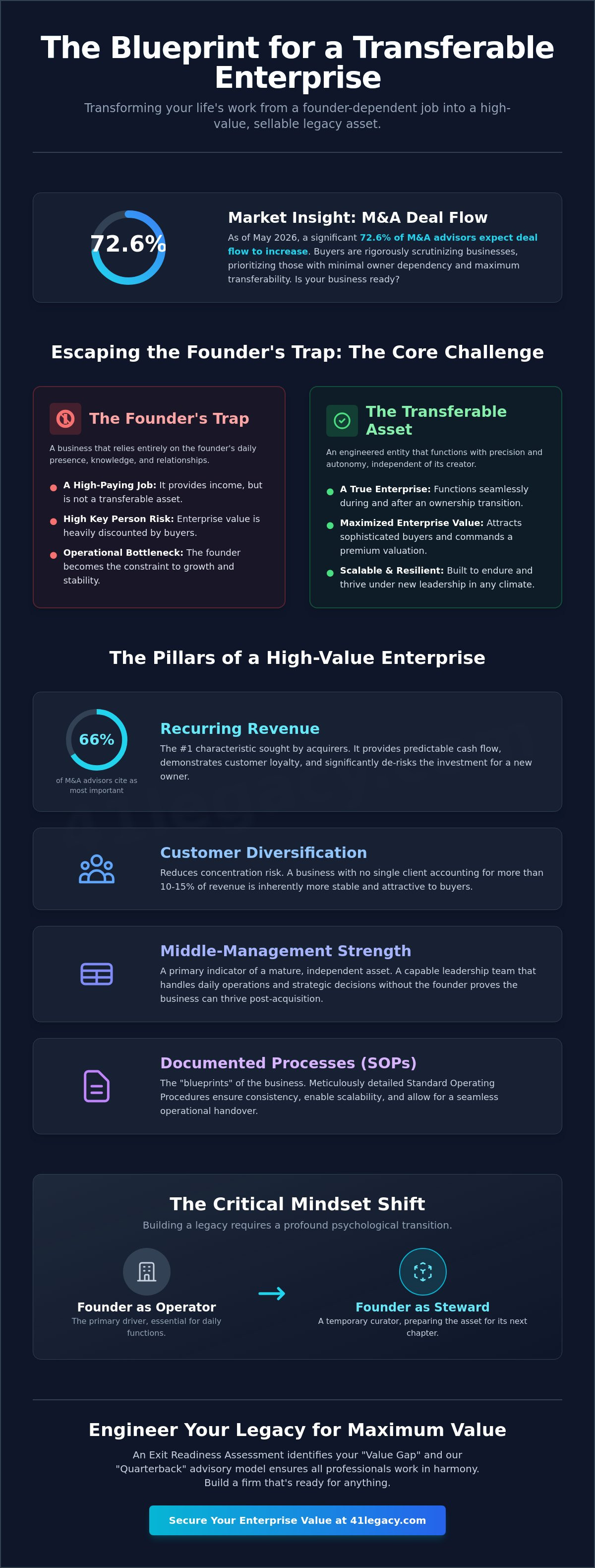
As of May 2026, 72.6% of M&A advisors expect deal flow to increase, yet buyers are exercising rigorous scrutiny, prioritizing businesses with defensible cash flows and minimal owner dependency. We understand the weight of ensuring your life's work can thrive without your constant intervention. This article outlines the critical pillars of transferability engineering, providing you with a clear roadmap to increase enterprise value and the confidence to know your legacy is secure. You will learn how to transition from an operator to a steward of a high-value, independent enterprise.
Key Takeaways
- True enterprise maturity is achieved when a business functions with precision without its founder, establishing transferability as the core of a lasting legacy.
- Discover what makes a business sellable by looking beyond basic financial records to prioritize recurring revenue and customer diversification.
- Identify the "Rainmaker Trap" and learn how reducing owner dependency transforms a company from a personal occupation into a transferable asset.
- Understand how an Exit Readiness Assessment bridges the "Value Gap," aligning the current health of your enterprise with your ultimate financial objectives.
- Explore the "Quarterback" model of strategic advisory, which ensures your legal, financial, and tax professionals work in harmony toward a successful transition.
Defining Transferability: The Core of a Sellable Enterprise
Transferability is the measure of how seamlessly a company’s ownership and operations can transition to a new hand. It represents the ultimate expression of business maturity. For many founders, the company is an extension of their personal identity; it's a lifestyle business that relies entirely on their daily presence. However, a truly transferable asset is an engineered entity that functions with the same autonomy as a restored vintage engine. It possesses a soul and a structure that endures beyond any single individual. Understanding what makes a business sellable requires shifting your focus from short-term income to the long-term health of the enterprise itself.
In the current 2026 fiscal environment, where 72.6% of M&A advisors expect deal flow to increase, the distinction between a job and an asset has never been more critical. Professional business valuation methods often discount companies where the key person risk is too high. If the collective knowledge of the firm resides solely in your head, the enterprise value suffers. We guide owners to see enterprise value as their North Star, directing every operational decision toward making the company more independent and robust. This approach ensures that the business is not merely a vehicle for the present, but a legacy for the future.
The Shift from Founder to Steward
Building a legacy requires a profound psychological transition. You must move from being the primary driver to becoming a temporary steward. This perspective acknowledges that you are curating an asset for its next chapter. When an owner views themselves as a steward, they prioritize documentation, process, and team development. This shift isn't just philosophical; it directly impacts market attractiveness. A business that doesn't need its founder to survive is a business that a successor can trust. It transforms the company into a bespoke piece of machinery, polished and ready for its next caretaker.
Why Sellability Matters Today (Even if You Never Sell)
You don't need an immediate exit plan to benefit from transferability engineering. In May 2026, market volatility and the rise of unsolicited offers mean that readiness is a vital form of risk management. A sellable business is inherently more profitable and easier to manage on a daily basis. By reducing owner dependency, you create strategic clarity that allows the business to thrive in any economic climate. At 41 Legacy, we help owners identify these structural weaknesses before they become liabilities. It's about building a firm that is ready for the unexpected, ensuring that your hard work remains a valuable asset rather than a personal burden. Strategic clarity today secures the enterprise's soul for tomorrow.
The Pillars of Enterprise Value and Market Attractiveness
If transferability is the soul of a sellable enterprise, then its structural pillars are the precision-engineered components that ensure its performance. To truly master what makes a business sellable, an owner must look beyond the surface of daily operations. A business that commands respect in the 2026 market is one built on financial integrity, diversified revenue, and documented excellence. These elements transform a company from a personal endeavor into a sophisticated, high-performance asset that appeals to the most discerning successors.
Documented processes, often referred to as Standard Operating Procedures (SOPs), serve as the blueprints of the business. Without these, the company's "engine" relies on the intuition of the founder rather than a repeatable system. When every role and responsibility is meticulously detailed, the business gains the strategic capacity to scale under new leadership. This structural soundness is what allows an enterprise to thrive independently, preserving the legacy you've spent years crafting.
- Financial integrity: Clean books are the baseline requirements for any serious transition, yet true value lies in pro forma precision.
- Recurring revenue: In January 2026, 66% of M&A advisors identified recurring revenue as the most important characteristic for acquirers.
- Customer diversification: Reducing reliance on a few major clients mitigates risk and stabilizes the enterprise's future.
- Middle-management strength: A capable team that makes decisions without the founder is a primary indicator of a mature asset.
Financial Integrity and Pro Forma Precision
Value-maximization reporting requires a shift from historical tax-minimization accounting to forward-looking diagnostics. In the current market, larger small businesses valued between $2 million and $50 million are typically traded at 3 to 6 times EBITDA. By normalizing these earnings and removing owner-specific expenses, you reveal the true economic power of the company. Financial transparency builds an immediate bridge of trust, allowing a successor to see the unvarnished potential of the asset. It's about presenting a clear, honest narrative of profitability that stands up to the most rigorous scrutiny.
Market Attractiveness and Growth Roadmaps
Successors aren't merely paying for your past achievements; they're investing in the future capacity of the enterprise. A documented growth roadmap proves that the business has a clear trajectory for expansion beyond its current state. Identifying the specific "Value Drivers" of your niche, such as proprietary technology or exclusive geographic territories, elevates your market position. We often find that owners who engage in a structured Value Growth Roadmap are better equipped to articulate this potential. This strategic clarity ensures that the transition is not just an end, but an evolution into a new era of excellence.
Breaking the Founder’s Trap: Reducing Owner Dependency
The most significant barrier to a successful transition is often the founder's own excellence. When you are the primary source of revenue generation, you've fallen into the 'Rainmaker Trap.' This devalues the company because a successor cannot easily replicate your personal relationships or unique charisma. To a professional acquirer, a business dependent on a single personality is a high-risk liability. Understanding what makes a business sellable requires an honest appraisal of how much the company relies on your daily presence to generate cash flow.
Many enterprises operate on a 'Hub and Spoke' model. In this configuration, the owner is the central axis for every decision, from high-level strategy to granular procurement. This structure is inherently fragile. True enterprise maturity requires delegating institutional knowledge into documented systems. We focus on Owner Dependency Reduction to ensure the business can breathe and expand without your constant intervention. It's about transforming your intuition into a repeatable, engineered process that others can execute with the same meticulous care you've always provided.
The Litmus Test for Transferability
The 'Four-Week Vacation' test is the definitive litmus test for transferability. If the mechanism of your business seizes in your absence, you've identified a single-point-of-failure risk. As of May 2026, the prime rate of 6.75% makes the cost of capital a significant consideration for any buyer. They won't pay a premium for a business that requires your 60-hour work week to stay solvent. Building a culture of accountability ensures that your team manages the daily rhythm, allowing you to step into the role of a true strategist.
Empowering the Next Generation of Leadership
Investing in talent isn't just a personnel decision; it's a value-growth strategy. A strong management team is the cornerstone of transferability engineering. By developing leaders who own their departments, you create a buffer that protects the enterprise during a transition. Using structured incentives to retain these key employees is essential. It ensures the 'soul' of the business remains intact even after the founder departs. This strategic capacity is what distinguishes a legacy asset from a mere job, providing the confidence that your life's work will continue to thrive under new stewardship.
The Exit Readiness Assessment: Identifying the Value Gap
An enterprise diagnostic is the surgical examination required to understand what makes a business sellable in a competitive market. While previous sections detailed the pillars of value and the necessity of reducing owner dependency, the assessment phase provides the empirical data needed to begin the work. We define the "Value Gap" as the distance between the current economic value of your asset and the net proceeds required to fund your future legacy. Without this baseline, any attempt at growth is akin to restoring a vehicle without first inspecting the chassis. You may improve the exterior, but the underlying structure remains unverified.
True readiness is a triad of personal, financial, and business maturity. Many founders possess a high-performing business but lack personal readiness, fearing the loss of identity that follows a transition. Others may be personally ready but face a significant financial gap where the business's current value cannot support their post-exit lifestyle. A formal Exit Readiness Assessment serves as the first step in any Value Growth Roadmap, ensuring that all three dimensions of readiness are aligned before you approach the market. This structured approach replaces uncertainty with strategic clarity.
Measuring What Matters
Our diagnostics utilize an Attractiveness vs. Readiness matrix to pinpoint where the enterprise stands. Attractiveness measures how the market perceives your industry and company, while Readiness evaluates the internal structural integrity of your operations. This analysis often reveals hidden risks that standard accounting audits overlook, such as high customer concentration or undocumented proprietary processes. By establishing a baseline valuation early, you gain the ability to track how specific improvements directly correlate to enterprise value growth. It's about measuring the soul of the business through the lens of its future caretaker.
Bridging the Value Gap
Closing the Value Gap is a deliberate process that requires a 3 to 5 year window for optimal results. This timeline allows for structural changes to manifest in the financial statements and for the management team to demonstrate their autonomy. We prioritize "Value Drivers" that offer the highest return on effort, such as securing recurring revenue contracts or formalizing the middle-management layer. This sequence ensures that every hour invested in the business increases its ultimate transferability. By following a structured implementation plan, you transition from a founder trapped in daily operations to a steward of a high-value, independent enterprise. If you are ready to identify the current health of your asset, you can begin by requesting an Exit Readiness Assessment today.
Engineering Your Legacy with 41 Legacy
Most business owners possess a collection of capable advisors, yet these professionals often operate in isolation. A CPA minimizes tax liability; an attorney mitigates legal risk; an RIA manages personal wealth. None are inherently responsible for the mechanical integrity and transferability of the enterprise itself. At 41 Legacy, we serve as the Quarterback, ensuring that every specialist is aligned toward a singular, uncompromising vision of enterprise value. By focusing on what makes a business sellable, we transform your company from a daily operation into a curated, transferable asset that commands respect in any market.
The transition from running a business to building a transferable asset is a deliberate evolution. It requires a shift in focus from short-term gains to the long-term health of the organization. Our role as Certified Exit Planning Advisors (CEPAs) is to act as the guardian of your life's work. We provide the strategic depth and structural engineering necessary to ensure the business possesses a soul that can endure beyond your tenure. This high-level guidance ensures that your enterprise is not just a source of income, but a masterpiece of professional maturity.
A Coordinated Approach to Value Growth
Siloed advice is the enemy of transferability. When your professional team doesn't communicate, the strategic clarity of the business can become fragmented. The 41 Legacy process replaces this disjointed approach with a rhythmic, unhurried sequence of Diagnostics, Roadmaps, and Monthly Accountability. We provide the structured implementation support that owners often lack, moving beyond theoretical discussion into granular execution. Through our strategic advisory services, we ensure that the engineering of your business matches the high standards of your own craftsmanship. Every operational adjustment is an intentional step toward a more valuable, independent enterprise.
Securing the Future of Your Life's Work
Exit planning is the final act of stewardship. It's a commitment to the employees who have stood by you and the family who will benefit from your legacy. A truly sellable enterprise provides a sense of peace that is only possible when you know the mechanism is sound. By engineering a business that thrives without your constant input, you secure its future and yours. This is the ultimate expression of a life's work well-curated. When you are ready to move from daily operator to a steward of a lasting asset, you can begin your Exit Readiness Assessment with 41 Legacy. We invite you to slow down and appreciate the details of this final, most important restoration.
Cultivating an Enduring Enterprise
Building a legacy is an act of meticulous engineering. It requires moving beyond the friction of daily operations to create a mechanism that functions with absolute autonomy. You've explored how reducing owner dependency and establishing uncompromising financial integrity form the bedrock of a mature firm. Understanding what makes a business sellable is the fundamental difference between owning a high-pressure job and curating a transferable asset that thrives independently of its creator.
By identifying your specific Value Gap through our structured Enterprise Diagnostic process, you gain the strategic clarity necessary to elevate your company to its highest potential. As a CEPA-led firm providing national strategic advisory for high-value enterprises, we specialize in this precise evolution. You deserve the profound peace of mind that comes from knowing your life's work is structurally sound and prepared for its next caretaker. Secure your legacy and grow your enterprise value with 41 Legacy. The future of your enterprise is a masterpiece ready for its definitive chapter.
Frequently Asked Questions
What is the difference between a business valuation and an exit readiness assessment?
A business valuation provides a historical estimate of economic worth, while an exit readiness assessment evaluates the structural integrity and transferability of the enterprise. Valuation methods look at what the business has achieved in the past; however, the assessment determines if the company can survive the transition to a new owner. This diagnostic identifies the internal mechanisms that either strengthen or weaken the soul of the asset.
Can a business be sellable if the owner is still heavily involved in daily operations?
Heavy founder involvement significantly diminishes what makes a business sellable because it creates a single point of failure. If the daily operations rely on your personal intuition, the asset is considered fragile by sophisticated successors. True transferability requires that the business functions as an independent entity, allowing the founder to step away without the engine seizing.
How long does it typically take to make a business sellable?
The process of engineering a transferable asset typically requires a window of 3 to 5 years. This duration allows for the implementation of new leadership structures and ensures that the resulting growth is visible in at least three years of financial reporting. It provides the necessary time to transition from a founder-dependent model to an autonomous enterprise that thrives on its own merits.
What are the most common 'value killers' that stop a business from being transferable?
The most prevalent value killers include high customer concentration and a lack of documented Standard Operating Procedures. If a single client accounts for more than 15% of your total revenue, the perceived risk to a successor increases significantly. Similarly, institutional knowledge that remains undocumented acts as a friction point that prevents the business from being a truly transferable asset.
Why is recurring revenue so important for a business's sellability?
Recurring revenue is vital because it provides a predictable narrative for future cash flows. In 2026, 66% of M&A advisors identified recurring revenue as the most sought-after characteristic for acquirers. This stability reduces the uncertainty of the transition, ensuring that the enterprise's momentum continues unabated under new stewardship and reducing the overall risk for the successor.
How does owner dependency affect the final sale price of a company?
Owner dependency directly correlates to lower valuation multiples and more restrictive transition terms. When a business relies on the founder's personal "rainmaking" abilities, buyers often demand significant price discounts to offset the risk of your departure. Reducing this dependency is the most effective way to protect the enterprise value you've spent years meticulously building and refining.
What is a 'Value Gap' and how do I know if I have one?
A Value Gap is the mathematical difference between your current enterprise value and the net proceeds required to fund your desired future legacy. You identify this gap by conducting a baseline valuation and comparing it to your long-term financial objectives. Understanding this distance is the first step in creating a structured Value Growth Roadmap that aligns your business performance with your personal goals.
Do I need to be planning to sell right now to start an exit readiness assessment?
You don't need an immediate plan to depart to benefit from an exit readiness assessment. This diagnostic is essentially a health check that clarifies what makes a business sellable, resulting in a more profitable and efficient company today. A business that is ready to be transferred is simply a better-run enterprise, providing you with more strategic options and peace of mind for the future.
Disclaimer
This article is for educational and informational purposes only and does not provide legal, tax, investment, or business brokerage advice. 41 Legacy does not offer M&A brokerage services, legal document drafting, tax preparation, or investment advisory services. Business owners should consult licensed professionals in those disciplines before making decisions related to business transactions, legal matters, tax strategy, or financial planning. All examples are illustrative and may not apply to your specific situation.