
What Is My Business Worth? A Strategic Valuation Guide
A business that cannot thrive without its founder is not an asset; it is a high-pressure job. While many owners ask "what is my business worth" based on historical earnings, true enterprise value is found at the intersection of financial precision and strategic transferability. We view your company not merely as a source of income, but as a legacy that demands meticulous stewardship. If your daily presence remains the primary driver of growth, you are likely caught in the rainmaker trap, which can significantly compress the multiples a sophisticated buyer is willing to pay.
You've likely felt the weight of uncertainty regarding the gap between your current valuation and your ultimate retirement needs. We understand this tension. This guide provides a clear roadmap to increasing your enterprise value by reducing owner dependency and aligning your professional advisors. You'll gain a sophisticated understanding of how to engineer a transferable asset that commands respect in the market. We'll explore the current landscape of EBITDA multiples, which currently range from 4x to 7x for many lower-middle-market firms, and the strategic shifts needed to ensure your business flourishes long after your transition.
Key Takeaways
- Learn why the true answer to "what is my business worth" depends more on the structural integrity of your organization than a simple spreadsheet of historical earnings.
- Identify the "Rainmaker Trap" and understand how over-reliance on the founder can significantly devalue an asset during a transition.
- Discover how an Enterprise Diagnostic can reveal the "Value Gap" between your company's current market attractiveness and your ultimate retirement needs.
- Explore the roadmap for Transferability Engineering to transform your business into a self-sustaining entity that thrives independently of your daily involvement.
- Understand the importance of a strategic advisor who coordinates your professional team to ensure your legacy is preserved through a disciplined growth process.
The Philosophy of Value: Beyond the Spreadsheet Calculation
True value is rarely captured in the sterile columns of an accounting ledger. While a spreadsheet can tally assets and liabilities, it often fails to account for the structural integrity that allows a business to survive the departure of its founder. When you ask, "what is my business worth," you aren't just looking for a multiple of earnings; you're seeking the market's assessment of your life's work as a transferable entity. This distinction is vital for any owner who views their organization as more than a temporary income stream. We believe that enterprise value exists at the rare intersection of financial health and the sophisticated engineering of systems that ensure continuity.
A single "number" without context is a dangerous metric for a business owner. Relying on a static valuation can lead to a false sense of security or, conversely, a missed opportunity for growth. Market conditions, such as the interest rates for SBA 7(a) loans which currently sit between 9.0% and 11.5% as of May 2026, directly influence what a buyer can afford to pay. Contextualizing your value requires understanding the difference between book value, an accounting artifact of the past, and transferable market value, which is the reality of what an outside party will pay for the future of your enterprise. We approach this as stewards of your legacy, treating the business as a separate, living entity that must be nurtured to stand on its own.
The Emotional Weight of the Enterprise
Owners often find themselves at a complex crossroads when assessing their company's worth. The tendency to overvalue based on decades of sacrifice is as common as the tendency to undervalue due to the weight of daily operational fatigue. Moving from an operator's mindset to an asset-builder's perspective requires a profound psychological shift. You're no longer just running a company; you're curating a vessel for legacy. This transition ensures the essence of the enterprise is preserved, allowing it to function as a source of impact rather than just a paycheck. A comprehensive business valuation overview provides the framework, but the emotional clarity of the owner provides the direction.
Financial Precision Meets Strategic Artistry
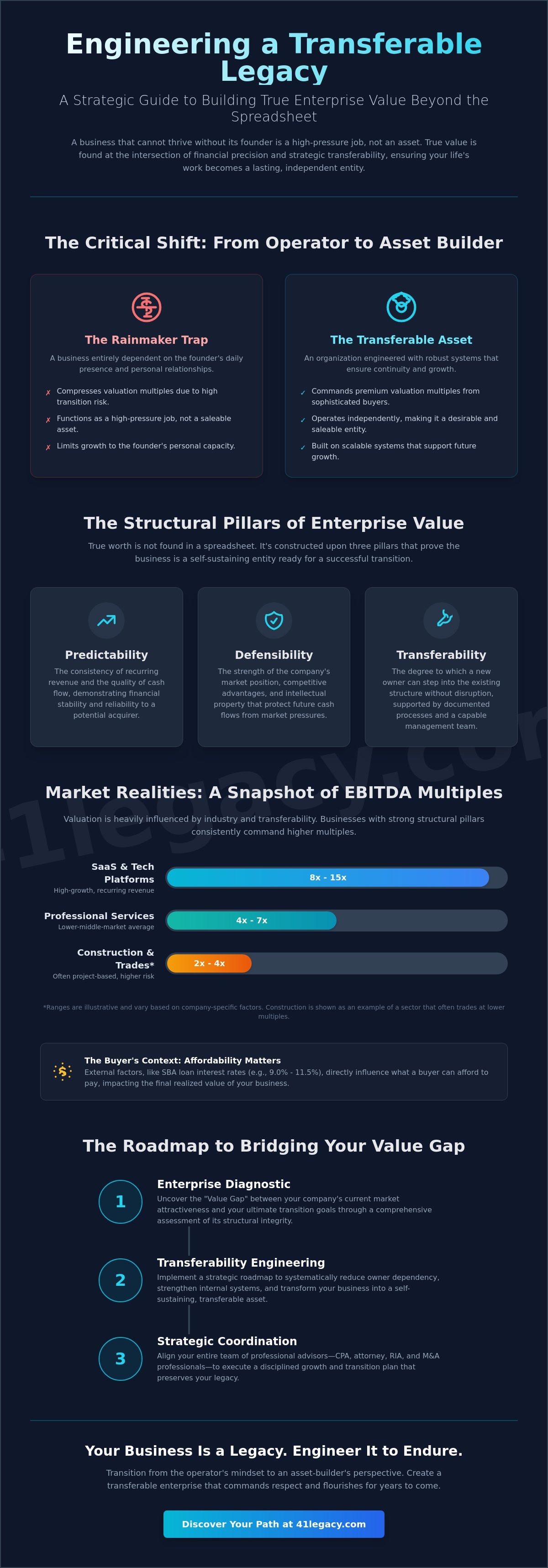
Technical metrics serve as the canvas for this architectural endeavor. Historical data and EBITDA multiples provide the baseline, yet the "art" lies in the strategic capacity of the organization. For instance, lower-middle-market businesses in the professional services sector are currently seeing multiples between 4x and 7x, but reaching the higher end of that range requires more than just high revenue. It demands a refusal to settle for less than perfection in your internal processes. Enterprise value is the present worth of future transferable cash flows. By blending financial precision with strategic engineering, we help you prepare for a transition that honors the history you've built while securing its future. We look at the following pillars to define this value:
- Predictability: The consistency of recurring revenue and cash flow quality.
- Defensibility: The strength of your market position and competitive advantages.
- Transferability: The ease with which a new owner can step into the existing structure without disruption.
When you finally determine "what is my business worth," the answer should reflect a balance of these elements. It's about ensuring the work you've done continues to tell its story long after you've moved on to your next chapter.
The Structural Pillars of Enterprise Value
The architecture of a company's worth is built upon more than just past profits. It's a deliberate construction of systems and stability. When you evaluate what is my business worth, you must look at the structural integrity of the enterprise itself. Financial performance provides the baseline, but the true strength of the asset is found in its strategic capacity. This is the organization's ability to absorb and manage future growth without the founder's constant intervention. Precision engineering in your internal processes doesn't just improve efficiency; it reduces buyer anxiety by proving that the business's success is repeatable and documented.
Market attractiveness depends on where your business sits in the current economic environment. As of May 2026, industry multiples show significant variation. SaaS companies might command 8x to 15x EBITDA, while construction firms often trade between 3x and 5x. Positioning your business at the higher end of these ranges requires a focus on risk mitigation and the preservation of the company's essence. A business that's been meticulously prepared for transition is viewed as a masterpiece of professional stewardship, commanding respect from sophisticated buyers.
EBITDA vs. SDE: Choosing the Right Lens
Institutional buyers focus on EBITDA (Earnings Before Interest, Taxes, Depreciation, and Amortization). It's the global standard for measuring a company's raw earning power. For smaller, owner-operated firms, we often look through the lens of Seller’s Discretionary Earnings (SDE). This metric includes the owner's salary and personal benefits. Understanding "Add-Backs" is essential here. These adjustments remove one-time expenses or personal costs to reveal the business's true economic essence. Defining these clearly ensures that you aren't leaving value on the table during a transition.
Intangible Assets and the "Value Multiple"
Intangible assets often define the multiple that separates a mediocre business from a premium one. Brand reputation and proprietary intellectual property are the high-value components of your legacy. Buyers also scrutinize customer concentration. If a single client represents a large percentage of your revenue, the risk profile rises. Documented SOPs serve as the mechanical blueprint for a buyer, proving the business can function independently. Adhering to IRS valuation guidelines ensures that these qualitative factors are grounded in recognized regulatory standards. Developing a Value Growth Roadmap allows you to bridge the gap between your current state and a premium market position.
The Owner Dependency Trap: Why Your Success Might Devalue Your Asset
The most profound paradox in the life of an entrepreneur is that the more essential you are to daily operations, the less valuable your company becomes to an outsider. This is the Rainmaker Trap. If you are the primary salesperson, the chief visionary, and the sole arbiter of critical decisions, you haven't built a transferable asset; you've created a high-level job. When assessing what is my business worth, sophisticated buyers look for an engine that runs without its architect. They aren't just purchasing your past success; they're investing in the future stability of the systems you've left behind.
Measuring this risk requires an honest look at your Owner Dependency Index. If your departure would cause a significant drop in revenue within six months, your valuation multiple will inevitably suffer. While valuation methods from Harvard emphasize the mathematics of cash flow, the qualitative reality of owner dependency can slash those numbers in half. True enterprise value demands a business that possesses its own heartbeat, independent of the founder’s pulse. The goal is to move from being the primary value driver to being the steward of a self-sustaining system.
Transferability Engineering
Escaping this trap requires the disciplined application of transferability engineering. This isn't merely about delegating tasks; it's about delegating the authority to fail and the wisdom to succeed. You must build owner-independent sales and marketing systems that function as a mechanical blueprint for growth. By cultivating a leadership team capable of preserving the essence of the brand, you transform the business from a personal extension into a durable legacy. This structural shift is what allows a company to command a premium multiple in any economic climate.
The Role of the Coordinated Advisory Team
Protecting your enterprise value is not a solitary endeavor. It requires a symphony of professional advisors, including your CPA and attorney, all pulling in the same strategic direction. Too often, these experts operate in silos, leading to uncoordinated advice that increases operational risk. We believe in a "Quarterback" approach to advisory support. At 41 Legacy, we coordinate this team to ensure that every legal document and financial report strengthens the transferability of your asset. By reducing owner dependency and aligning your advisors, we help you prepare for a transition that honors your life’s work. Explore our Strategic Advisory services to see how we bridge the gap between your current operations and a truly transferable legacy.
The Diagnostic Path: Measuring and Bridging the Value Gap
A static calculation is a snapshot of the past; a strategic roadmap is a vision for the future. Many online tools offer a one-time number, but they fail to provide the architectural plan required to actually improve that figure. When you ask "what is my business worth," you aren't just looking for a destination. You're looking for a baseline from which to build a masterpiece of enterprise value. The journey begins with a rigorous Enterprise Diagnostic, followed by the identification of the Value Gap. This path ensures that your business isn't just surviving, but is being meticulously engineered for a premium transition in a market where global M&A deal value reached $4.81 trillion in 2025.
Moving beyond the spreadsheet requires a commitment to structural excellence. The diagnostic process isn't a mere formality; it's a surgical assessment of the company's inner essence. We look for the hidden friction points that devalue your hard work. Once these are exposed, we can begin the disciplined work of refinement. This isn't about rapid, unsustainable growth. It's about the steady, unhurried implementation of systems that ensure your legacy remains untarnished and your asset remains highly attractive to sophisticated connoisseurs of business performance.
The Enterprise Diagnostic Process
We evaluate the structural integrity of your organization across the eight pillars of business value, including financial performance, growth potential, and owner dependency. This examination goes far beyond revenue to identify "Red Flags" that would cause a potential deal to collapse during due diligence. These might include undocumented intellectual property or high customer concentration. You can learn more about our Enterprise Diagnostics to see how this clarity serves as the foundation for your future transition. By exposing these vulnerabilities early, we protect the essence of what you've built.
Closing the Value Gap
The Value Gap is the financial bridge between where you are and where you need to be for a successful transition. Bridging this distance requires a focus on "Value Levers" rather than a blind pursuit of top-line sales. Increasing revenue is often a hollow victory if your margins are eroding or if your processes remain tied to your personal involvement. We utilize financial forecasting to prove future viability to buyers, showcasing a predictable trajectory of transferable cash flow. This is where your Value Growth Roadmap becomes essential, prioritizing high-impact structural changes over superficial metrics. It's a deliberate progression toward perfection.
The final stage in this architectural endeavor is Monthly Implementation. Building a transferable asset isn't a weekend project; it's a disciplined process of refinement. It requires the steady hand of a steward who understands that true value is grown, not just calculated. If you're ready to determine your current standing and map your future, we invite you to begin your Strategic Advisory engagement today to ensure your life's work reaches its full potential.
Building a Transferable Asset: The 41 Legacy Approach
Our mission at 41 Legacy is the preservation of the essence you've spent a lifetime building. We don't view your company as a mere transaction; we see it as a living entity that requires a guardian's touch. When you ask, "what is my business worth," the answer is found in the strength of your legacy's transferability. We act as the Strategic Quarterback for your existing professional advisors, ensuring that your CPA, attorney, and financial planners are no longer working in isolation. This coordinated approach maintains a professional-room altitude, providing the calm, authoritative guidance necessary to navigate the complexities of enterprise growth.
We position the business owner as a steward of a lasting, transferable legacy. This perspective shifts the focus from daily firefighting to long-term architectural health. By aligning your advisory team, we reduce the operational risks that often go unnoticed until it's too late. Our role is to ensure that every strategic decision strengthens the structural integrity of the firm, preparing it to thrive independently of its founder. This is the rare intersection where creative artistry meets technical engineering, resulting in an asset that commands respect from the most sophisticated buyers.
Our Structured Implementation Support
Valuation often remains a theoretical exercise until it's met with disciplined execution. We move beyond the initial calculation through Monthly Implementation Support, turning your strategic vision into practical, measurable growth. This process involves deliberate systems engineering designed to reduce owner dependency. We focus on Transferability Engineering to ensure the essence of the business survives the transition. It's about creating a mechanical blueprint that allows your organization's unique story to continue, even after you've stepped away from the helm.
Your Invitation to Strategic Clarity
The most opportune time to evaluate your company's standing is years before you intend to depart. Waiting until an exit is imminent often leaves significant value on the table, as there is little time to correct structural flaws. There is a profound peace of mind that comes from a documented Value Growth Roadmap. This roadmap provides the strategic clarity needed to bridge the gap between your current worth and your ultimate goals. It's an investment in certainty, ensuring that your life's work is protected and prepared for its next chapter.
We invite you to step into a space of uncompromising excellence and strategic depth. By addressing the health of your enterprise today, you secure the impact of your legacy for tomorrow. Begin your journey toward Exit Readiness with 41 Legacy and discover the profound intersection of financial precision and strategic transferability that defines your company's true worth.
Engineering Your Future Transferability
The journey from business operator to legacy steward is a deliberate architectural process. It requires moving beyond the simple question of what is my business worth to ask how your company can thrive independently of your daily presence. By identifying the value gap and addressing structural dependencies, you transform a source of income into a transferable masterpiece. This evolution ensures that the essence of your life's work is preserved through the meticulous application of transferability engineering and strategic clarity.
Under the leadership of a Certified Exit Planning Advisor (CEPA), our team provides national strategic advisory expertise to guide you through this transition. We utilize a structured Enterprise Diagnostic process to reveal the hidden levers that drive premium valuation multiples. The path to a successful transition is built on precision, not chance. It's time to elevate your organization to its highest potential and ensure your impact endures. Secure your legacy with a professional Exit Readiness Assessment and begin the disciplined work of building an asset that stands the test of time.
Frequently Asked Questions
What is the difference between a business valuation and an exit readiness assessment?
A valuation provides a historical price at a specific point in time, while an exit readiness assessment evaluates the structural integrity of the asset for a future transition. One tells you what the business might be worth today; the other reveals the friction points that could prevent a successful transfer. We view the assessment as a diagnostic of the company's essence, ensuring it can function as a standalone entity.
How does owner dependency specifically impact my business’s multiple?
High owner dependency serves as a risk multiplier that compresses your valuation multiple. If the founder is the primary driver of sales or strategy, the business is viewed as a job rather than a transferable asset. In sectors like manufacturing where multiples range from 5x to 7x, an owner-dependent firm will likely struggle to reach even the lower end of that spectrum because the risk of failure increases after the founder's departure.
Can I increase my business’s worth without significantly increasing my revenue?
You can increase enterprise value by improving the quality of your systems and reducing operational risk. By focusing on transferability engineering and leadership depth, you can elevate your multiple from a 4x to a 6x. This structural refinement increases what is my business worth by proving to a buyer that your cash flows are predictable, durable, and independent of your personal involvement, making the existing revenue more valuable.
What is a "Value Gap" and why does every business owner have one?
The Value Gap is the financial bridge between your company's current market value and the wealth required to secure your post-exit lifestyle. Most owners have one because businesses are often grown for lifestyle cash flow rather than for maximum transferability. Identifying this gap early allows you to use a Value Growth Roadmap to align your current operations with your ultimate retirement needs, ensuring your legacy is fully funded.
Why shouldn’t I just use a free online business valuation calculator?
Free online calculators rely on generic algorithms that ignore the qualitative nuances and strategic capacity of your specific organization. These tools cannot measure the Rainmaker Trap or the strength of your proprietary intellectual property. To truly understand what is my business worth, you need a sophisticated diagnostic that considers the intersection of financial precision and the company's internal essence, which no automated tool can capture.
What role does my CPA play in determining my business’s transferable value?
Your CPA ensures that your financial records are maintained with the technical precision required for a rigorous due diligence process. They provide the historical data that serves as the foundation for your valuation. However, their work must be coordinated with a strategic advisor to ensure that tax-focused accounting doesn't inadvertently obscure the true transferable earning power of the enterprise when viewed by a sophisticated buyer.
What are "Add-Backs" and how do they affect my EBITDA?
Add-Backs are adjustments that remove one-time, non-recurring, or personal expenses from your profit and loss statement. These adjustments are essential for revealing your EBITDA, which represents the raw earning power of the business. By identifying these costs, you present a clearer picture of the enterprise's economic essence to a buyer. This process often results in a higher valuation by showcasing the true profitability available to a new owner.
How long does it typically take to bridge a significant Value Gap?
Bridging a significant Value Gap generally requires a commitment of twenty-four to thirty-six months of disciplined implementation. This duration is necessary to engineer the systems and leadership structures that reduce owner dependency. It is a steady and unhurried process that allows your management team to prove they can maintain performance and preserve the brand's essence long after the founder has transitioned out of the daily operations.

Article by
Mike Laskowski
Mike Laskowski is a Business Value Growth Strategist who helps business owners uncover the truths that drive their performance, risk, and readiness. Blending forensic interviewing from a 26‑year federal career with Strategic Capacity analysis and CEPA methodology, he works upstream to reduce owner dependency, increase transferability, and strengthen enterprise value. Mike guides founders through clarity, operational evolution, and transition readiness so their companies become transferable, owner‑independent assets that endure beyond the founder.
Disclaimer
This article is for educational and informational purposes only and does not provide legal, tax, investment, or business brokerage advice. 41 Legacy does not offer M&A brokerage services, legal document drafting, tax preparation, or investment advisory services. Business owners should consult licensed professionals in those disciplines before making decisions related to business transactions, legal matters, tax strategy, or financial planning. All examples are illustrative and may not apply to your specific situation.