
Transferability & Owner Dependency
What Is an Exit Readiness Assessment? A Strategic Guide for Business Owners
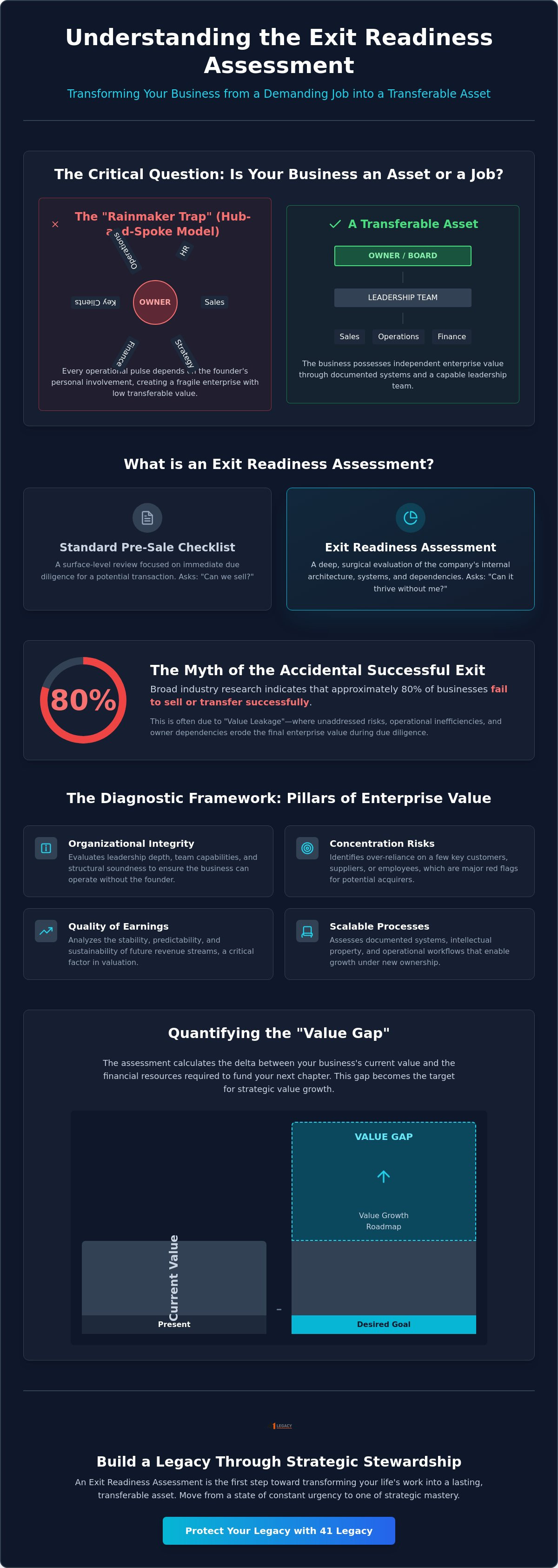
If your business cannot survive a month without your presence, you haven't built a transferable asset; you've merely crafted a very demanding job. Many owners find themselves caught in the "Rainmaker Trap," where every operational pulse depends on their personal involvement. You likely feel the weight of this dependency, sensing that while revenue is strong, the underlying enterprise value remains fragile and uncoordinated among your various advisors. Understanding what is an exit readiness assessment is the first step in moving from a state of constant urgency to one of strategic mastery. It is the diagnostic tool that reveals whether your life's work is a transferable masterpiece or a collection of disconnected efforts.
We'll show you how a comprehensive exit readiness assessment identifies hidden value gaps and transforms your business into a high-value asset that thrives independently of your daily input. This guide explores the precision required to reduce owner dependency and align your professional team around a singular, cohesive vision. You'll discover a clear roadmap to increase enterprise value, giving you the confidence that your legacy is protected and your operational stress is finally diminished. By treating your company as a work of art to be preserved, you ensure it remains a lasting testament to your stewardship and a valuable prize for its next curator.
Key Takeaways
- Learn what is an exit readiness assessment by distinguishing between mere saleability and the deeper essence of enterprise transferability.
- Quantify the "Value Gap" to understand the distance between your current business value and your desired financial destination.
- Address the "Hub-and-Spoke" model to eliminate owner dependency; this is the primary obstacle to a high-value transition.
- Move from evaluation to execution by developing a Value Growth Roadmap that prioritizes immediate refinements and long-term structural health.
- Understand how the stewardship of a Certified Exit Planning Advisor protects your business's history while preparing it for a future without you.
Defining the Exit Readiness Assessment: Beyond the Pre-Sale Checklist
True business mastery isn't found in the daily hustle but in the quiet strength of an organization that functions without its creator. Many owners confuse a profitable operation with a transferable one. So, what is an exit readiness assessment? It's a formal, surgical evaluation of your company's internal architecture to determine its attractiveness to the market and its ability to thrive under new stewardship. Unlike a standard pre-sale checklist that focuses on surface-level due diligence, this assessment digs into the marrow of the enterprise to ensure the foundation is sound.
A fundamental distinction exists between saleability and transferability. Saleability asks if a transaction can occur. Transferability asks if the business can flourish once the founder’s hands are off the wheel. Waiting until a transaction is imminent is the most common mistake owners make; by then, the distance between current value and the desired outcome is often too wide to bridge. Instead, viewing your role as a steward allows you to build with the end in mind. This perspective shifts the focus from short-term gains to the long-term preservation of the company's essence. For those navigating the complexities of mergers and acquisitions (M&A), this clarity is the difference between a successful legacy and a failed transition.
The Difference Between a Job and a Transferable Asset
Many "successful" businesses are actually high-paying jobs for their founders. If the gears stop turning the moment you step away, you've built a dependency, not an asset. A transferable asset possesses independent enterprise value. It requires documented systems, a capable leadership team, and a brand that exists outside the founder's persona. We believe readiness is the ultimate form of business health. It's the assurance that your life's work remains a living entity, capable of sustaining its impact long after your departure.
The Myth of the Accidental Successful Exit
The market is notoriously unforgiving to the unprepared. While many dream of a seamless transition, broad industry research indicates that approximately 80% of businesses fail to sell or transfer successfully. This often occurs because of "value leakage," where unaddressed risks and owner dependencies erode the final price. Exit planning is a distant event; exit readiness is a state of constant preparedness. It's the difference between hoping for a favorable outcome and engineering one through precise diagnostics and strategic intent.
The Diagnostic Framework: Measuring the Value Gap and Market Attractiveness
Precision is the hallmark of any master artisan. To truly grasp what is an exit readiness assessment, you must look beyond the surface of a balance sheet and into the mechanical synchronization of the firm itself. This process begins with Enterprise Diagnostics, a rigorous examination of the company’s internal gears. We analyze specific pillars of the business to establish a baseline valuation, including:
- Organizational structural integrity and leadership depth
- Customer and vendor concentration risks
- The quality and predictability of future earnings
- Documented intellectual capital and scalable processes
This diagnostic provides the essential North Star for every strategic decision that follows. The intersection of internal operational readiness and external market attractiveness determines your ultimate success. A business might be internally efficient but operate in a declining industry, or it might possess immense potential but remain too dependent on the founder to attract institutional interest. By identifying these friction points early, you can begin the work of Enterprise Diagnostics to ensure the asset is as polished as it is profitable.
Quantifying the Value Gap
Every successful transition must account for the human element. The assessment calculates the "Value Gap," which is the delta between the current enterprise value and the net-worth goal required to fund your next chapter. While your financial advisor might focus on the "Wealth Gap," which is the total assets needed for your lifestyle, we focus on how the business must evolve to bridge that distance. The Value Gap represents the fundamental hurdle between a current operational reality and the realization of a successful, lasting legacy.
Evaluating Market Attractiveness
Market attractiveness is the lens through which a potential successor views your work. It isn't enough to be profitable; institutional buyers seek "Strategic Capacity," which is the ability of the business to handle future growth without breaking. We evaluate how industry trends, buyer types, and competitive positioning influence your readiness. Institutional buyers often overlook businesses that lack a clear growth narrative, even if the current cash flow is strong. Understanding these external forces allows you to position your enterprise not just as a stable entity, but as a high-performance vehicle ready for its next driver.
Deconstructing Owner Dependency: The Invisible Ceiling on Enterprise Value
The most profound risk to a company's longevity often sits in the founder's chair. While your vision and tireless effort built the enterprise, those same qualities can become an invisible ceiling on its ultimate value. In mid-market valuations, owner dependency is the primary risk factor cited by sophisticated successors. If the business cannot function without your constant oversight, it possesses limited enterprise value. Understanding what is an exit readiness assessment requires a deep look at this dependency, as the process acts as a mirror reflecting the structural integrity of your leadership model.
Many founders operate within a "Hub-and-Spoke" model. In this configuration, every department and every critical decision flows directly through the owner. While this provides control, it creates a single point of failure that institutional buyers find unacceptable. An assessment audits the "Transferability Engineering" of your firm, identifying where the "spokes" must be strengthened to support the "hub" independently. Reducing this reliance isn't merely a matter of operational ease; it's a powerful Value Driver. By decoupling your personal identity from the company's daily pulse, you effectively increase the EBITDA multiple a buyer is willing to pay for the asset.
The Rainmaker Trap
Success often breeds the "Rainmaker Trap," where the founder remains the primary salesperson or the sole keeper of technical expertise. This creates a significant valuation discount during due diligence. A buyer isn't just purchasing your current cash flow; they're purchasing the certainty that those flows will continue after you leave. Moving from "Rainmaker" to "Strategic Architect" requires a psychological shift. You must transition from being the person who does the work to the person who designs the system that ensures the work is done to a specific, uncompromising standard.
Transferability Engineering
The assessment meticulously evaluates the strength of your next level of management and the depth of your documented systems. We look for Standard Operating Procedures (SOPs) that aren't just files on a server but living breath within the organization. This engineering ensures that the company's "inner essence" is captured and repeatable. We believe that a truly transferable business is one where the owner is optional. When your team has the strategic capacity to lead and your systems provide the guardrails for excellence, you have successfully transformed a personal endeavor into a lasting, transferable masterpiece.
From Assessment to Action: The Value Growth Roadmap
The diagnostic phase provides the clarity; the Value Growth Roadmap provides the momentum. Once you understand what is an exit readiness assessment, the focus shifts from observation to surgical refinement. This roadmap is a living document that prioritizes your efforts into two distinct categories: "Quick Wins" that provide immediate de-risking and "Long-Term Value Drivers" that fundamentally shift the company’s multiple. Without this structured sequence, many owners succumb to initiative fatigue, attempting to fix everything at once while perfecting nothing.
Execution is where most strategic plans fail. To bridge this gap, we provide Monthly Implementation Support, ensuring that the refinements outlined in the roadmap are integrated into the organization's daily rhythm. This steady, unhurried cadence reflects the thoughtful nature of high-end craftsmanship, moving the business closer to its peak valuation month by month. By focusing on consistent, incremental progress, we ensure that the strategic vision becomes an operational reality.
The Strategic Advisory Quarterback
A common friction point in the transition journey is the lack of coordination among a founder’s professional circle. CPAs, attorneys, and financial advisors often operate in silos, offering advice that's technically sound within their discipline but strategically dissonant for the enterprise as a whole. We act as the strategic advisory quarterback, ensuring that every professional is aligned with the singular goal of asset transferability. This alignment provides the strategic clarity necessary for all stakeholders to move in unison, preventing the value leakage that occurs when specialists pull in opposite directions.
Strategic Capacity Evaluation
An institutional buyer isn't just looking at what you've built; they're evaluating the infrastructure you've laid for their future expansion. Through a Strategic Capacity Evaluation, the roadmap identifies the precise talent development and financial forecasting tools needed for a successor to scale the business. This phase protects the enterprise value by ensuring the growth process doesn't outpace the company’s operational foundation. It’s about building a vehicle that can handle higher speeds under new management, ensuring the legacy you’ve crafted can sustain its impact in the hands of a new steward.
To begin engineering a business that thrives beyond your tenure, explore our Value Growth Roadmap and strategic support options.
The 41 Legacy Perspective: Building a Legacy Through Strategic Stewardship
At 41 Legacy, we view a business not as a mere collection of contracts and cash flows, but as a living testament to an owner's vision and sacrifice. Our philosophy is rooted in a profound reverence for your life’s work. We position ourselves as guardians of this history, ensuring that the essence of what you’ve built is preserved even as the mechanics are refined for transfer. Understanding what is an exit readiness assessment through our lens means seeing it as a curatorial act. We don't just identify weaknesses; we uncover the hidden value that has been layered into the enterprise over decades of dedicated stewardship.
The technical precision of our process is guided by the framework of a Certified Exit Planning Advisor (CEPA). This designation ensures that the assessment isn't a solitary exercise but a coordinated effort that integrates your business, personal, and financial goals. We believe that every owner deserves the opportunity to successfully transfer their legacy on their own terms. By applying Enterprise Diagnostics with surgical care, we help you prepare the organization for a future where it can thrive independently, honoring the past while embracing a new era of growth.
Protecting Your Life’s Work
Transferring a business carries an immense emotional and philosophical weight. It's the moment where years of effort must be distilled into a transferable form. We act as a guardian of the company’s "essence," ensuring that the cultural and operational DNA remains intact while we improve the underlying mechanics of transferability. This sophisticated journey of legacy building begins with a shift in perspective. You aren't just leaving a business; you're graduating a masterpiece into the hands of its next curator. The assessment serves as the first deliberate step in ensuring that transition is as seamless as it is rewarding.
The Path Forward
The most successful transitions are those that begin long before a transaction is even considered. Starting the readiness process early allows for the unhurried implementation of strategic refinements, reducing operational stress and maximizing enterprise value. By addressing owner dependency and value gaps now, you secure the freedom to choose your exit timing rather than having it dictated by market whims or internal fatigue. We invite you to move beyond the daily operational pulse and begin the work of engineering a lasting impact. Your legacy is too important to be left to chance.
Begin your journey toward a transferable legacy with 41 Legacy
Engineering Your Business for the Next Generation
The transition from a founder-led company to a transferable enterprise is a profound evolution. It requires more than just operational efficiency; it demands a shift toward strategic stewardship. You now understand that your role as an owner is to build an asset that possesses its own internal pulse, independent of your daily oversight. By defining what is an exit readiness assessment, you have identified the precise diagnostic path required to close the value gap and eliminate the risks of owner dependency.
Our work at 41 Legacy is led by a Certified Exit Planning Advisor (CEPA) who ensures your advisory team moves in harmony. We don't merely provide a report. We deliver a comprehensive Value Growth Roadmap and offer structured Monthly Implementation Support to bridge the distance between current reality and your ultimate legacy goals. This process transforms your business into a masterpiece of transferability, ensuring its essence remains intact for years to come. We invite you to take the first step toward this sophisticated state of readiness.
Secure your enterprise legacy with a 41 Legacy Exit Readiness Assessment
Frequently Asked Questions
How long does a typical exit readiness assessment take to complete?
A typical assessment usually takes between 30 and 90 days depending on the complexity of the enterprise. This timeframe allows for a meticulous gathering of data and a deep dive into the organizational architecture. We believe high-end craftsmanship shouldn't be rushed. The goal is to uncover the true essence and value of your life's work through precise diagnostics and thoughtful analysis.
Is an exit readiness assessment the same as a business valuation?
An exit readiness assessment isn't the same as a business valuation; while a valuation provides a numerical snapshot in time, the assessment analyzes the "why" behind those numbers. It evaluates the structural integrity and transferability of the firm. While a valuation tells you what the business is worth today, the assessment reveals what's required to increase that value and ensure the legacy is protected.
Why should I do an assessment if I don’t plan on selling for 10 years?
Conducting an assessment early ensures that you're building a healthy, transferable asset from the beginning rather than reacting to a future crisis. Readiness is the ultimate form of business health. By understanding what is an exit readiness assessment today, you gain a decade of strategic clarity to reduce risks and enhance the eventual multiple. This long-term stewardship ensures your legacy remains a masterpiece.
Will an assessment help me reduce my daily involvement in the business?
Yes, the assessment specifically identifies owner dependencies and provides a roadmap to decouple your personal identity from daily operations. By shifting from a "Hub-and-Spoke" model to one of strategic leadership, you empower your team to operate without your constant oversight. This reduction in daily stress is a natural byproduct of engineering a business that possesses independent enterprise value and structural harmony.
What documents are required for a comprehensive diagnostic?
A comprehensive diagnostic requires three to five years of financial statements, corporate governance documents, and detailed operational manuals. We also examine customer concentration reports and organizational charts to evaluate leadership depth. This granular data acts as the raw material for our curatorial process. It allows us to see the inner essence of the organization and identify any hidden value gaps that require refinement.
How does an exit readiness assessment impact my company’s EBITDA multiple?
An assessment identifies the specific value drivers and risk factors that institutional buyers use to determine your EBITDA multiple. By addressing owner dependency and documenting intellectual capital, you effectively reduce the perceived risk of the transition. Lower risk results in a higher multiple. This ensures that the marketplace rewards the precision and care you've invested in building a high-value, transferable asset.
Can an assessment help with internal transitions, like passing the business to family or employees?
Yes, an assessment is essential for internal transitions to family members or employees as it ensures the business can flourish under new stewardship. Transferability is a universal requirement regardless of who the successor is. The diagnostic framework helps prepare the next generation of leaders. It ensures they inherit a stable, well-engineered organization that isn't reliant on the founder's personal charisma or technical expertise.
What is the role of my CPA and attorney during this assessment?
Your CPA and attorney serve as critical technical specialists who provide the financial and legal data necessary for a precise diagnostic. We act as the strategic quarterback to ensure their specific advice aligns with your broader vision for transferability. This coordination prevents conflicting guidance. It ensures that every professional is working in unison to protect your legacy and enhance the enterprise's long-term health.
Disclaimer
This article is for educational and informational purposes only and does not provide legal, tax, investment, or business brokerage advice. 41 Legacy does not offer M&A brokerage services, legal document drafting, tax preparation, or investment advisory services. Business owners should consult licensed professionals in those disciplines before making decisions related to business transactions, legal matters, tax strategy, or financial planning. All examples are illustrative and may not apply to your specific situation.