
What is a Key Employee Retention Plan (KERP)? A Strategic Guide to Talent Preservation
The true value of your enterprise does not live in the ledger; it breathes through the collective genius of the people who sustain it. If those vital individuals depart the moment you begin a transition, your legacy risks becoming a hollow shell rather than a lasting monument. This is why sophisticated owners must ask: what is a key employee retention plan (KERP) and how does it safeguard the future?
You've spent years meticulously crafting a business that stands as a testament to your vision. It's natural to feel a sense of unease regarding how much of that value resides in the hands of a few key leaders. This guide will show you how a KERP acts as a surgical instrument for talent stewardship, ensuring your most valuable human capital remains anchored to the company during pivotal shifts. We will examine the strategic architecture of these plans, the legal boundaries of retention incentives, and the precise methods for aligning executive interests with the long-term health of a transferable asset. By acting as the strategic quarterback who coordinates legal and tax advisors, you can transform a founder-dependent company into a resilient, independent masterpiece.
Key Takeaways
- Understand how a key employee retention plan (KERP) functions as a surgical instrument for talent stewardship, preserving the essence of your company during transitions.
- Discover why buyers prioritize "living entities" and how securing key staff eliminates the "Value Gap" that often threatens a successful exit.
- Navigate the legal intricacies of Section 503(c) by distinguishing between insider and non-management roles to structure compliant, effective stay bonuses.
- Utilize a Strategic Capacity Evaluation to identify the critical roles that must be anchored to the company to ensure operational harmony and transferability.
- Learn how integrating a KERP into your broader Exit Readiness Assessment strengthens your position as a steward of a lasting, transferable legacy.
Defining the Key Employee Retention Plan (KERP): Beyond the Legal Basics
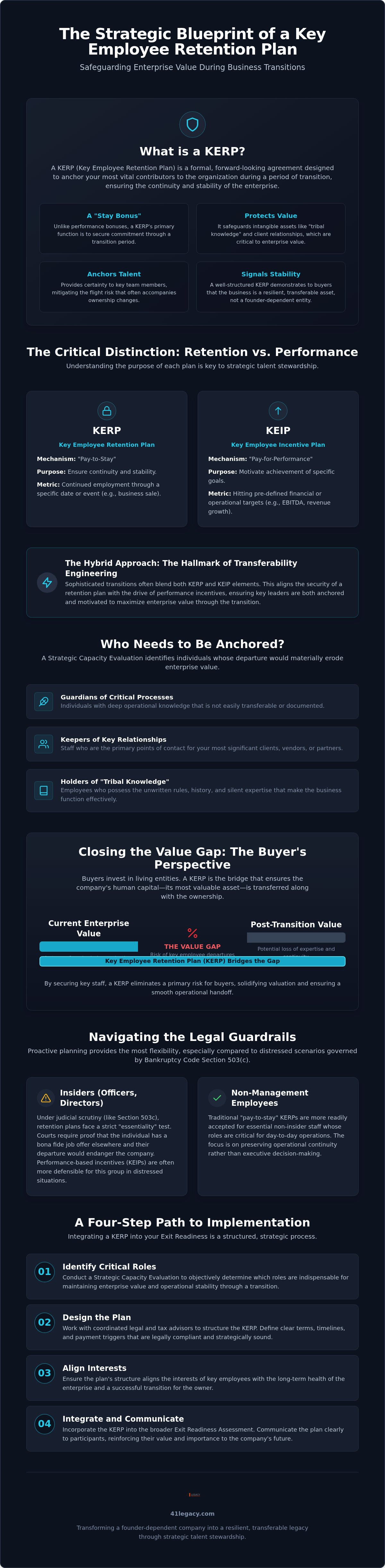
A business is more than its inventory or its intellectual property; it is a living entity sustained by the dedication of its people. When you begin to contemplate a transition, the stability of this entity becomes your most critical concern. At its core, what is a key employee retention plan (KERP)? It is a formal, structured agreement designed to anchor your most vital contributors to the organization during a period of evolution. Unlike traditional bonuses that reward past performance, a KERP is a forward-looking instrument. It acts as a "stay bonus," engineered specifically to ensure that the individuals who drive your company's success remain in place until a transition is fully realized.
We define a "Key Employee" as someone whose sudden departure would materially erode the enterprise value. These are the guardians of your processes and the primary points of contact for your most cherished clients. A KERP serves a dual purpose. Tactically, it provides a legal safeguard that outlines the terms of their commitment. Strategically, it functions as a protector of value, signaling to potential successors that the business is a stable, transferable asset capable of thriving long after your departure.
The Essence of Talent Stewardship
Viewing your staff as mere "assets" fails to capture the intricate reality of a high-performance culture. These individuals are the curators of your company's history and the architects of its daily triumphs. A transition often brings an emotional weight that can lead to uncertainty among long-term staff. By prioritizing talent stewardship, you acknowledge their role in the company's legacy. A KERP preserves the "tribal knowledge" and silent expertise that buyers value most, ensuring the essence of the business remains intact during the handoff.
KERP vs. KEIP: Distinguishing Retention from Performance
It is vital to understand the distinction between a Key Employee Incentive Plan (KEIP) and a KERP. While a KEIP is a tool of motivation tied to specific financial targets, a KERP is primarily a "pay-to-stay" mechanism. Its success isn't measured by new growth, but by the continuity of leadership. In many sophisticated transitions, we utilize a hybrid approach. This blends the security of a retention plan with the drive of a performance-based incentive. This combination is a hallmark of Transferability Engineering, as it aligns executive interests with the long-term health and stability of the enterprise.
By coordinating with your legal and tax advisors, we help you draft these plans to ensure they meet every regulatory requirement while fulfilling your strategic vision. The goal is to move beyond the transactional and toward a model of excellence that respects the past while securing the future.
The Legal Landscape: Bankruptcy Code Section 503(c) and Beyond
The architecture of a business transition is often governed by invisible but unyielding legal frameworks. When an organization faces restructuring or financial distress, the implementation of a retention strategy shifts from a private management decision to a matter of public and judicial scrutiny. To understand what is a key employee retention plan (KERP) within this context, one must first master the constraints of the Bankruptcy Code Section 503(c). This statute serves as a rigorous gatekeeper, specifically designed to prevent the siphoning of estate value through excessive "insider" bonuses. It demands that any retention payment be justified not just by intent, but by undeniable operational necessity.
The law draws a sharp distinction between insiders, such as officers and directors who exert control, and non-insider staff. For those in leadership, the court applies an "essentiality" test. You must prove the individual has a bona fide job offer elsewhere and that their departure would truly endanger the company's survival. Courts have grown increasingly vigilant; a 2023 case involving Aviation Safety Resources saw the denial of bonuses that were deemed simple "don't quit" payments rather than earned incentives. This highlights the shift toward performance-based plans for executives, leaving traditional KERPs as tools primarily reserved for essential non-management employees. Proactive planning outside of these distressed scenarios offers significantly more flexibility, allowing you to engineer transferability before the court's shadow falls over the enterprise.
Navigating Insider Limitations
Defining control is the first step in legal stewardship. The law looks beyond titles to examine who truly influences the company's trajectory. Under Section 503(c), a retention payment to an insider cannot exceed ten times the mean amount of similar payments given to non-management employees within the same calendar year. This 10:1 ratio acts as a mathematical ceiling on executive preservation. Successfully justifying these payments requires a meticulous alignment of the plan with industry standards, ensuring the compensation reflects the meticulous nature of the work being protected. Performing enterprise diagnostics early allows you to establish these benchmarks while the company is in a position of strength.
Pre-Bankruptcy Planning and Clawback Risks
The most sophisticated stewards of value don't wait for a crisis to secure their legacy. Implementing a retention plan well before any financial turbulence provides a strategic advantage, yet it requires precision to avoid "fraudulent transfer" claims. If a bonus is paid shortly before a filing, creditors may attempt a clawback, arguing the payment was intended to hinder their recovery. We act as the advisory quarterback in these moments, coordinating with your legal counsel to ensure every agreement is polished, defensible, and reflective of a genuine effort to preserve the living entity of your business. This foresight transforms a potential legal liability into a cornerstone of your transferability engineering.
Protecting Enterprise Value: Why Buyers Demand Retention
To a sophisticated buyer, understanding what is a key employee retention plan (KERP) is not a matter of human resources policy; it is a matter of investment security. When an enterprise changes hands, the buyer isn't merely acquiring equipment or contracts. They are investing in a living entity, a machine composed of human expertise and historical momentum. If the architects of that momentum leave during the transition, the buyer is left with a hollow shell. This creates a "Value Gap," where the perceived risk of talent attrition forces a significant discount on the final purchase price. By implementing a KERP, you provide a structural guarantee that the essence of the business will remain intact. This effectively de-risks the human capital and preserves the premium you've worked decades to build. We see this as the ultimate act of stewardship, protecting the very soul of the company from the turbulence of change.
Reducing Owner Dependency Through Talent
The "Rainmaker Trap" is a common fragility where the owner's personal brilliance is the only thing keeping the gears turning. For a business to be truly transferable, it must demonstrate that it can thrive independently of its founder. A KERP is a powerful signal to a successor that the management team is not only capable but committed. It aligns the interests of your key leaders with the new owner's vision, ensuring a harmonious transition. We consider this a core pillar of Transferability Engineering. It transforms a founder-led company into an enduring institution that commands respect. When your team is anchored by a strategic plan, the buyer sees a self-sustaining asset rather than a risky venture dependent on a single individual.
The ROI of a Strategic KERP
The financial logic for talent preservation is undeniable. Replacing a senior executive can cost upwards of 200% of their annual salary when accounting for recruitment, lost productivity, and the erosion of client relationships. A stable team also directly influences the "Multiple" applied to your EBITDA. Buyers pay a premium for a business with a proven, anchored leadership team. Industry observations suggest that even a 10% attrition rate among key staff can devalue a potential sale by as much as 20% due to the perceived instability and loss of institutional knowledge. Investing in a KERP is not a mere expense. It is a strategic move to maximize your enterprise value and ensure your legacy remains a masterpiece of operational excellence. Our work in Enterprise Diagnostics often reveals that the strongest businesses are those where the staff is as invested in the future as the owner.
Designing a Strategic KERP for Exit Readiness
Designing the architecture of a transition requires more than just intent; it demands a disciplined, step-by-step approach to ensure the result is a masterpiece of transferability. When you ask what is a key employee retention plan (KERP) in a practical sense, you're looking for a blueprint that secures your legacy. The process begins with a Strategic Capacity Evaluation, where we look past titles to find the individuals who truly hold the keys to operational continuity. Following this, you must determine the "Cliff," which is the specific point in time when the retention bonus is paid, usually several months after a transition is finalized. Benchmarking follows to ensure the incentives are competitive enough to anchor the talent without being so excessive that they erode the very enterprise value you're trying to protect. Finally, we draft the agreement with surgical precision alongside your legal and tax advisors, concluding with a communication strategy that treats your staff with the reverence they deserve.
Identifying Your Key Personnel
Finding the right people for a KERP requires looking beyond the C-Suite. While executives are obvious candidates, the true "linchpins" often reside deep within operations. These are the individuals with the specific, rare knowledge that makes the company run smoothly. There's a profound difference between a high performer who hits sales targets and a strategically essential employee whose departure would halt production. We use Enterprise Diagnostics to map these critical knowledge paths, ensuring that the people who carry the "tribal knowledge" of your history are the ones prioritized for preservation. This focus on essentiality over mere performance is what separates a standard bonus from a strategic retention tool.
Structuring the Payout: Timing and Conditions
The structure of the payout is what gives the plan its strength. we often recommend a "Double Trigger" structure. This means the employee only receives the bonus if two things happen: the business is sold, and the employee stays for a predetermined period, such as twelve months, following the sale. This is more secure for a buyer than a "Single Trigger," which pays out immediately upon a sale and may leave the new owner with a sudden leadership vacuum. By including clawback provisions, which require the return of the bonus if the employee leaves early, you protect the long-term health of the asset. This level of detail is essential for successful Transferability Engineering, as it ensures the business remains a stable, living entity during and after the handoff.
If you're ready to identify the linchpins in your organization, our Strategic Capacity Evaluation provides the clarity needed to build a resilient leadership foundation.
Talent Stewardship with 41 Legacy: Building a Lasting Impact
A business transition is the ultimate test of an owner's stewardship. It is the moment when the meticulous work of decades is distilled into a single, transferable asset. To ensure this asset retains its brilliance, one must look beyond the balance sheet and focus on the people who animate the enterprise. Understanding what is a key employee retention plan (KERP) is only the beginning. The true challenge lies in integrating that plan into a broader strategy that reduces owner dependency and elevates the company's intrinsic value. At 41 Legacy, we serve as the advisory quarterback, coordinating with your legal and tax professionals to ensure your retention strategies are both compliant and profoundly effective.
Our Exit Readiness Assessment is designed to uncover the hidden human capital risks that could devalue your life's work. We don't merely identify these gaps; we provide the architectural framework to bridge them. By shifting the focus from the founder to a self-sustaining management team, we help you build a company that thrives independently. This transition honors the dedication of your team while securing the financial legacy you've earned. It is a process of curation, ensuring that every element of the business is polished and prepared for its next chapter.
The 41 Legacy Approach to Value Growth
We believe that strategic clarity is the foundation of excellence. This is why we integrate retention plans directly into your comprehensive Value Growth Roadmap. It's not enough to have a vision; you must have the discipline to execute it. Our team provides Monthly Implementation Support to ensure that your talent strategies aren't just concepts on a page, but living components of your organizational culture. We bridge the gap between the craftsmanship of the past and the performance requirements of the future, creating a narrative of continuity that buyers find irresistible.
Your Next Steps Toward a Successful Exit
The journey toward a successful transition begins with a clear understanding of your current standing. An initial Enterprise Diagnostic allows us to evaluate your talent pool with surgical precision, identifying the linchpins who require anchoring. Starting the conversation with your team is a delicate endeavor that requires transparency and respect. When handled with the right strategic guidance, it builds a sense of shared purpose and reverence for the company's future. If you're ready to protect your enterprise value and ensure a harmonious transition, it's time to act. Schedule your Exit Readiness Assessment with 41 Legacy today to begin engineering a legacy that stands the test of time.
Securing the Future of Your Enterprise
The preservation of your company's essence requires more than financial foresight; it demands a profound commitment to the individuals who sustain its excellence. Understanding what is a key employee retention plan (KERP) is the foundation of this strategic evolution. You've explored how these plans bridge the Value Gap, navigate complex legal landscapes, and transform a founder-led business into a resilient, self-sustaining asset. By anchoring your most vital talent, you ensure the transition is a celebration of continuity rather than a period of fragility.
At 41 Legacy, we provide the strategic clarity necessary to navigate these transitions with poise. Our team, led by Certified Exit Planning Advisors (CEPA), utilizes a structured Value Growth Roadmap to ensure your enterprise thrives independently. We serve as a national authority in transferability engineering, helping owners refine their operations and reduce dependency on any single leader. This meticulous approach ensures that your legacy remains a living, breathing monument to your dedication.
Take the first step toward a resilient future. Protect your enterprise value—start your Exit Readiness Assessment today. Your business is a masterpiece; let's ensure it is preserved for the generations to follow.
Frequently Asked Questions
What is the primary purpose of a Key Employee Retention Plan?
The primary purpose is to anchor essential contributors to the organization during a period of transition or restructuring. By providing a financial incentive for continued service, you protect the enterprise value and ensure the business remains a stable, transferable asset. This strategic tool prevents the loss of institutional knowledge that often occurs when a founder prepares to exit.
Is a KERP legal in a Chapter 11 bankruptcy case?
Yes, it is legal but subject to the rigorous constraints of Section 503(c) of the Bankruptcy Code. Courts apply strict tests for "insiders" to prevent excessive payouts, while plans for non-management staff are generally more accessible. To be approved, you must often prove that the employee is essential to the company's survival and has a bona fide offer elsewhere.
How is a KERP different from a standard performance bonus?
A what is a key employee retention plan (KERP) is primarily a "pay-to-stay" mechanism contingent on time, whereas a standard performance bonus is tied to specific financial targets. While a performance incentive motivates growth, a retention plan is designed specifically to ensure leadership stability during a handoff. It focuses on the continuity of the entity rather than the achievement of new milestones.
Can a buyer refuse to honor a KERP after an acquisition?
A buyer's obligation depends on whether the transaction is structured as a stock or asset sale and how the agreement is drafted. In most sophisticated transitions, the plan is negotiated as part of the closing liabilities. This ensures the buyer inherits a committed management team, which is a primary driver of the premium paid for the business.
What happens to a KERP if the business sale falls through?
If a sale fails to materialize, the payout typically does not occur unless the agreement specifies a "single trigger" based on time alone. Most plans are structured to remain in place, preserving the team's commitment for the next potential transition opportunity. This keeps the "living entity" of the business intact while you evaluate your next strategic move.
How do I determine which employees are truly "Key" for my exit plan?
Identifying key personnel requires a Strategic Capacity Evaluation to find "linchpin" employees whose departure would halt operations. We look beyond high-level titles to identify those who possess the "tribal knowledge" and critical client relationships that a buyer values. This process ensures your retention efforts are focused on the individuals who truly drive the company's transferability.
Are KERP payments considered taxable income for the employee?
Yes, these payments are considered ordinary taxable income for the employee and are typically reported on a Form W-2. Because these bonuses can be substantial, it's vital to coordinate with your tax advisor to understand the withholding requirements. Proper planning ensures the financial impact is managed correctly for both the individual and the enterprise.
Can I implement a KERP if my business is currently healthy and not in bankruptcy?
You can and should implement a what is a key employee retention plan (KERP) when your business is healthy to maximize your strategic flexibility. Proactive planning allows you to engineer transferability without the judicial oversight and insider restrictions that apply during financial distress. It's a hallmark of sophisticated stewardship to secure your team long before a transition begins.

Article by
Mike Laskowski
Mike Laskowski is a Business Value Growth Strategist who helps business owners uncover the truths that drive their performance, risk, and readiness. Blending forensic interviewing from a 26‑year federal career with Strategic Capacity analysis and CEPA methodology, he works upstream to reduce owner dependency, increase transferability, and strengthen enterprise value. Mike guides founders through clarity, operational evolution, and transition readiness so their companies become transferable, owner‑independent assets that endure beyond the founder.
Disclaimer
This article is for educational and informational purposes only and does not provide legal, tax, investment, or business brokerage advice. 41 Legacy does not offer M&A brokerage services, legal document drafting, tax preparation, or investment advisory services. Business owners should consult licensed professionals in those disciplines before making decisions related to business transactions, legal matters, tax strategy, or financial planning. All examples are illustrative and may not apply to your specific situation.