
Transferability & Owner Dependency
What Happens in the Due Diligence Process: A Guardian’s Guide to Enterprise Scrutiny
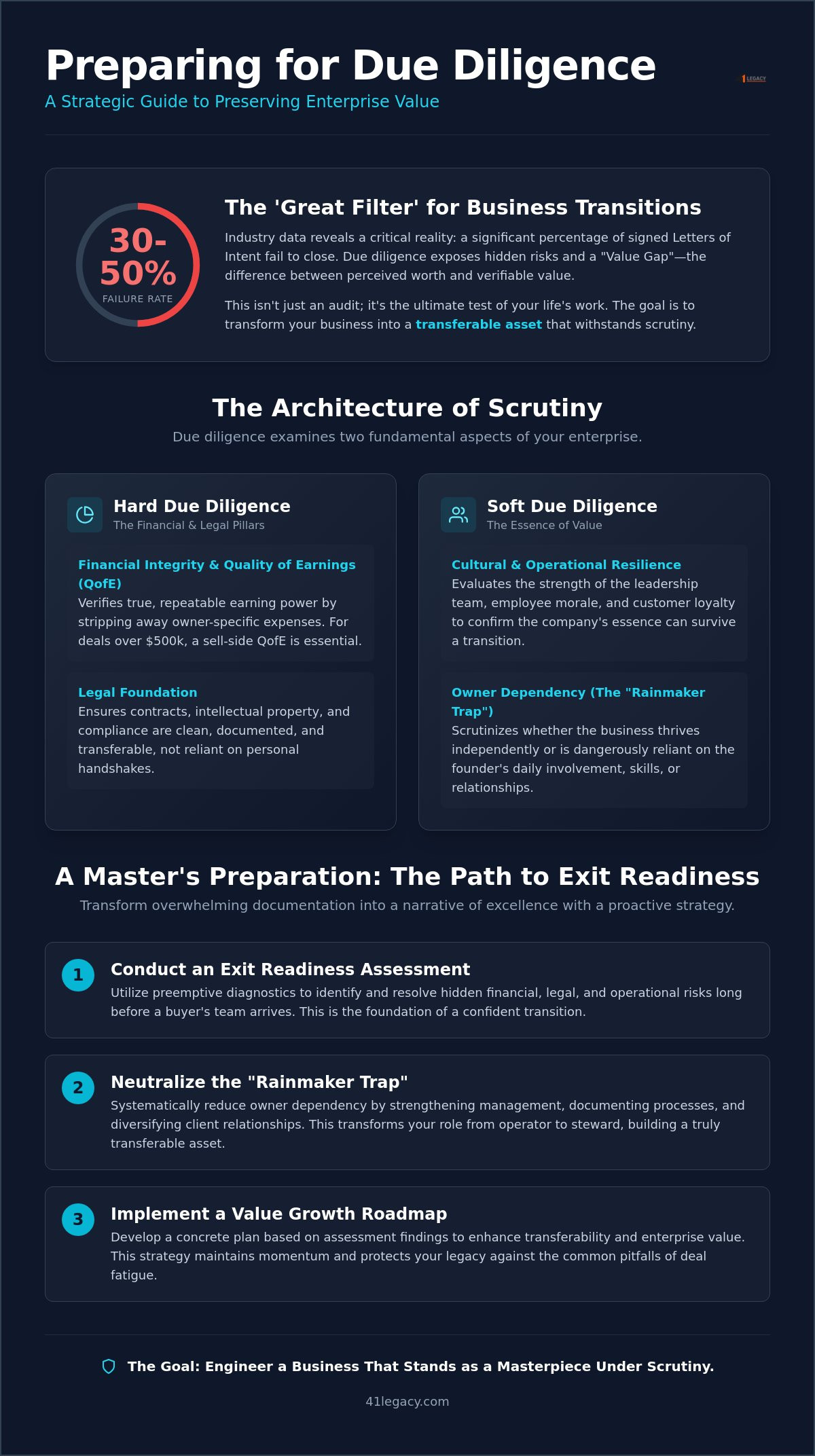
Industry data for 2026 reveals a sobering reality: between 30% and 50% of signed Letters of Intent fail to reach the closing table, often because the enterprise cannot withstand the weight of its own examination. For the dedicated owner, the realization that their life's work is fragile often comes too late. Understanding how to prepare for due diligence as a seller is not merely a matter of organizing files; it is an act of preservation. It requires you to view your business through the lens of a curator, ensuring every operational layer is polished to a high sheen before the first inspector arrives.
You have likely felt the weight of this impending scrutiny, wondering if the "Value Gap" will be exposed or if your daily presence is too woven into the fabric of the company's success. We believe your business should be a transferable masterpiece, one that stands as a testament to your stewardship. This guide explores the intricate phases of the due diligence process and provides a clear path to improve transferability. You will discover how to transform overwhelming documentation into a narrative of excellence, ensuring your legacy is protected and your enterprise is ready for its next chapter.
Key Takeaways
- View due diligence as the ultimate verification of enterprise integrity, shifting the focus from a mere intent to purchase to a rigorous confirmation of lasting value.
- Master how to prepare for due diligence as a seller by utilizing an Exit Readiness Assessment to identify and resolve hidden risks long before a transition begins.
- Distinguish between "Hard" financial audits and "Soft" cultural evaluations to ensure the inner essence of your company remains resilient under scrutiny.
- Neutralize the "Rainmaker Trap" by reducing owner dependency, transforming your business into a transferable asset that thrives independently of your daily involvement.
- Implement a Value Growth Roadmap as a preemptive strategy to maintain momentum and protect your legacy against the common pitfalls of deal fatigue.
Beyond the Definition: Due Diligence as the Ultimate Test of Enterprise Value
Every business tells a story, but due diligence is the moment that story is fact-checked against the ledger of reality. It represents the meticulous examination of a company’s inner essence and operational integrity. For the dedicated owner, this phase signals a profound shift. The initial excitement of a transition moves from a mere "intent to purchase" to a rigorous "verification of value." Every claim made during negotiations must now be substantiated by unassailable evidence, moving the conversation from abstract potential to concrete proof.
The ultimate goal of this scrutiny is to confirm the existence of a transferable asset. This is a business that possesses the structural integrity to thrive independently of its founder. Many owners find themselves overwhelmed at this stage because they lack preemptive diagnostics. Without a clear view of their own vulnerabilities, they're often surprised by the depth of investigation required. Understanding how to prepare for due diligence as a seller involves more than just gathering tax returns; it requires engineering a business that can stand as a masterpiece under the most intense light.
The Standard of Care in Business Transitions
A steward’s responsibility to their life’s work extends far beyond daily operations. We view this responsibility as a "standard of care," a commitment to protecting the enterprise’s future through proactive value protection. Reactive checking is insufficient for an asset of this caliber. If enterprise value only exists in the mind of the owner and can't survive a rigorous audit, it isn't real value. True transferability is engineered through precision and foresight. It ensures the business remains a viable, standing legacy even when the original artisan departs.
Why Due Diligence is the 'Great Filter' for Owners
Statistics from 2026 suggest that 30% to 50% of signed deals never reach the closing table. This high failure rate is rarely due to a lack of interest. It's often the result of deal fatigue and the exposure of the "Value Gap." This gap represents the distance between what an owner believes the business is worth and what the buyer can actually verify. When you master how to prepare for due diligence as a seller, you address these discrepancies before they become deal-killers. A strategic advisor helps close this gap by conducting an Exit Readiness Assessment years in advance, identifying risks that would otherwise lead to late-stage price reductions or a total collapse of the transaction.
The Architecture of Scrutiny: Financial and Legal Pillars
The hard due diligence phase is where the poetic vision of a founder meets the clinical precision of an auditor. It's the architectural inspection of your enterprise. While the initial phase of a deal relies on trust, this stage demands verification. Every line item on your balance sheet is scrutinized to ensure it represents a sustainable reality rather than a temporary peak. For the owner, mastering how to prepare for due diligence as a seller means ensuring that these financial and legal pillars are not just standing, but are strong enough to support a new steward.
Financial Integrity and Quality of Earnings
A Quality of Earnings (QofE) report is more than a financial audit; it's a narrative of health. In the current 2026 market, a sell-side QofE is considered the most essential financial document for any acquisition exceeding $500,000. It strips away the noise of owner-specific expenses to reveal the normalized EBITDA. This figure represents the true, repeatable earning power of the business. Buyers look for revenue quality, examining if profits are derived from a diverse client base or if they're precariously tied to a single source. Pro forma statements then project how this engine will perform once your hands are no longer on the controls. If you want to understand where your financial structure might need reinforcement, a structured Enterprise Diagnostics process can reveal these gaps before an external auditor does.
The Legal Foundation of a Transferable Asset
If financials are the engine, the legal framework is the chassis. A transferable asset requires clean, documented contracts that aren't dependent on a personal handshake with the founder. Every client agreement and vendor contract must be reviewed for change-of-control clauses. These clauses can trigger termination upon a sale, potentially devaluing the enterprise at the moment of transition.
Equally vital is the ownership of intellectual property. In many founder-led firms, trademarks or proprietary processes are informally held by the owner. During due diligence, these must be clearly documented as assets of the enterprise. We often see deals stall when the "inner essence" of the work, the IP, isn't legally tethered to the company. Coordinating this readiness requires a "quarterback" who can align legal counsel with the broader strategic goal of transferability. This ensures that when the inspection begins, every document is polished and every liability is accounted for.
The Essence of Value: Soft Due Diligence and Owner Dependency
Soft due diligence is the audit of the invisible. While financial audits examine the architecture of an enterprise, this phase interrogates the culture, leadership, and the very "soul" of the company. It's a trial of business maturity. A buyer seeks to understand if the excellence they've observed is a permanent feature of the organization or merely a reflection of the founder's daily presence. If the essence of the work is tied exclusively to your personality, the value of the enterprise is precariously fragile. Learning how to prepare for due diligence as a seller requires a shift in perspective from being the hero of the story to being the architect of a system.
The most frequent deal killer in this phase is the "Rainmaker Trap." This occurs when the owner is the primary driver of sales, the sole keeper of key relationships, or the only person capable of making critical operational decisions. From a buyer's perspective, this represents extreme owner dependency. They aren't looking to purchase a job for themselves; they're looking to acquire a self-sustaining engine. If your departure causes the engine to fail, the deal will either collapse or face significant price reductions to account for the risk.
Engineering the Reduction of Owner Dependency
Transforming a business into a transferable asset requires a Strategic Capacity Evaluation of your current leadership team. You must determine if your managers have the autonomy to lead without your constant intervention. Documented Standard Operating Procedures (SOPs) serve as the "instruction manual" for the enterprise, ensuring that the precision of your work is repeatable. When you master how to prepare for due diligence as a seller, you present a business that functions as a masterpiece of systems rather than a cult of personality. This transition from a founder-led entity to a process-driven organization is the hallmark of a truly mature company.
Cultural Continuity and Talent Development
A buyer assesses the "soul" of your company through its people and their collective alignment with your vision. They look for a culture of accountability and a pipeline of talent development that ensures a smooth transition of power. Cultural clashes are the silent killers of post-sale value. If the team's loyalty is to you personally rather than to the mission of the enterprise, value erosion is almost certain once you exit. We believe that true stewardship involves building a culture that can survive your absence. By focusing on Owner Dependency Reduction, you protect your legacy and ensure that the impact of your life’s work continues long after the transition is complete. You can begin this process by exploring our Strategic Capacity Evaluation to identify where your leadership team can be strengthened.
A Master’s Preparation: Steps to Exit Readiness
True preparation is not a frantic race to the finish line; it is a slow, deliberate curation of the enterprise that begins years before a transition is even contemplated. For the owner who views their business as a masterpiece, the work of readiness is a continuous act of stewardship. Understanding how to prepare for due diligence as a seller involves more than gathering documents; it requires a deep, structural alignment of the business with the standards of a sophisticated buyer. This process begins with a comprehensive Exit Readiness Assessment, a diagnostic tool that reveals the hidden vulnerabilities and untapped strengths of your life's work.
Once the assessment is complete, we develop a Value Growth Roadmap. This is your strategic guide to addressing the risks identified during the diagnostic phase. It moves the business from its current state toward a vision of extreme transferability. This roadmap is not merely a plan; it is a commitment to the precision and performance of the company. By identifying and resolving "skeletons" in the closet early, you ensure that the eventual due diligence process is a validation of excellence rather than an exposure of flaws.
The Pre-Due Diligence Audit
Owners who succeed under scrutiny often conduct their own internal due diligence first. Learning how to prepare for due diligence as a seller means becoming your own toughest critic, ensuring no detail is left to chance. Through Transferability Engineering, we polish the business’s appeal, ensuring that every system and contract is optimized for a seamless transition of power. Enterprise diagnostics serve as the foundational step in value protection, providing the clarity needed to fortify the enterprise. This preemptive exercise ensures that when the formal inspection begins, your business stands as a resilient and transferable asset.
The Coordinated Advisory Team (The Quarterback Role)
Building a transferable masterpiece requires a symphony of professional expertise. While your existing CPA and Attorney are essential guardians of your financial and legal interests, they often require a "quarterback" to align their efforts toward the specific goal of exit readiness. A Certified Exit Planning Advisor (CEPA) fills this role, coordinating with your advisory ecosystem to ensure every decision maximizes enterprise value. This collaboration prevents the fragmented advice that often leads to deal fatigue. To maintain the momentum of the Value Growth Roadmap, we provide monthly implementation support, ensuring that the strategic vision is translated into granular, everyday excellence. If you are ready to begin this journey of preservation, we invite you to schedule your initial Exit Readiness Assessment today.
The 41 Legacy Approach: Protecting Your Life’s Work
At 41 Legacy, we serve as the guardians of your enterprise's history and its future impact. We don't just see a company; we see a masterpiece of engineering and personal dedication that deserves to be preserved. Our approach moves beyond the transactional to focus on the preservation of your company's essence through the rigorous application of Transferability Engineering. By the time a buyer initiates their inspection, the transformation from a founder-led company to a transferable asset is already complete. This structured process doesn't just increase value. It removes the friction and anxiety that typically haunt the due diligence phase, replacing them with the confidence of a master artisan.
When you master how to prepare for due diligence as a seller, you're not just organizing files. You're ensuring that your life's work can endure. We help you view your business through the eyes of a connoisseur, identifying the subtle cracks in the foundation before they become structural failures. Our goal is to ensure that your exit is not an end, but a transition that honors everything you've built. We treat your legacy with the reverence it deserves, ensuring the bridge between your past and the company's future is built on a foundation of technical excellence.
Building a Business That Thrives Beyond You
The ultimate success for any steward is creating a work that thrives independently of its creator. We define this as the ability to transfer your enterprise with both honor and profit. Being "exit ready" at any moment provides a level of peace of mind that few owners ever experience. It allows you to lead from a position of strength rather than necessity. Through our Strategic Advisory support, we provide the consistent implementation required to maintain this state of readiness. This ongoing partnership ensures that value growth isn't a one-time event but a permanent feature of your enterprise's architecture.
Next Steps: From Diagnostic to Roadmap
Your journey begins with a clear-eyed look at the present. We start with an initial Enterprise Diagnostic to identify the "Value Gap" that might exist between your current operations and a buyer's expectations. This isn't a cold audit; it's a philosophical and technical inquiry into the health of your business. Once we've mapped the terrain, we transition to a Value Growth Roadmap, providing monthly strategic implementation to close those gaps. This disciplined rhythm ensures that your business remains a transferable masterpiece, ready for scrutiny whenever the time is right. We invite you to begin your journey toward exit readiness with 41 Legacy and secure the future of your legacy today.
Engineering the Enduring Enterprise
Scrutiny is the final validation of your stewardship. It reveals whether the business is a self-sustaining asset or a role dependent on your presence. By fortifying your financial pillars and neutralizing the "Rainmaker Trap," you ensure the company’s inner essence remains intact during the transition. True value isn't found in past performance alone; it's found in the structural integrity that allows the business to thrive under new leadership. This is the difference between a job and a legacy that stands the test of time.
Mastering how to prepare for due diligence as a seller transforms an overwhelming administrative burden into a strategic victory. Our national strategic advisory, led by a Certified Exit Planning Advisor (CEPA), utilizes a structured Value Growth Roadmap to guide you through this transition. This process ensures your enterprise stands as a transferable masterpiece, ready for the most rigorous inspection. Your life's work deserves to be preserved with honor and precision, ensuring its impact continues long after your departure.
Secure your legacy-schedule your Exit Readiness Assessment today.
Frequently Asked Questions
How long does the due diligence process typically take for a private business?
The formal due diligence period typically spans 30 to 90 days, though the preparation for this window should begin months or years in advance. This timeframe allows the buyer to verify every financial and operational claim made during the initial negotiations. Given that industry data for 2026 shows 30% to 50% of signed deals fail to close during this phase, speed is often less important than the precision of the documentation provided.
What are the most common reasons a business fails due diligence?
Deal failure is most often triggered by financial discrepancies, high customer concentration, or the sudden exposure of a "Value Gap." When a single customer represents more than 15% of revenue, buyers perceive a significant risk to the enterprise's stability. Additionally, discovering that the business cannot function without the founder's daily intervention often leads to immediate price reductions or a complete withdrawal of the offer.
Can I perform my own due diligence before putting my business on the market?
Conducting a preemptive audit is the most effective way to understand how to prepare for due diligence as a seller without the pressure of a ticking clock. By initiating an Exit Readiness Assessment, you can identify vulnerabilities and resolve them before they're discovered by an external party. This proactive approach allows you to polish the enterprise and present a masterpiece of transferability to prospective buyers.
What is the difference between hard and soft due diligence in an M&A context?
Hard due diligence focuses on the "chassis" of the business, including audited financials, tax compliance, and legal contracts. In contrast, soft due diligence evaluates the "soul" of the company, focusing on cultural alignment, management depth, and employee retention. While the numbers establish the price, the soft elements often determine whether the buyer believes the value is sustainable after the founder departs.
What documents are usually included in a due diligence checklist?
A standard checklist includes three to five years of financial statements, tax returns, a sell-side Quality of Earnings (QofE) report, and all material contracts. You should also include documentation regarding intellectual property ownership, employee handbooks, and organizational charts. Organizing these documents in a virtual data room well in advance ensures a professional presentation that reflects the maturity of your enterprise.
How does owner dependency impact the valuation during the due diligence process?
High owner dependency significantly devalues an enterprise because it suggests the business is a "job" rather than a transferable asset. When a founder is the primary rainmaker or decision-maker, the buyer must account for the risk of the engine failing upon the founder's exit. We utilize Strategic Capacity Evaluation to identify these risks, helping owners transition their business into a system-driven entity that commands a premium valuation.
What role does a CPA play in the due diligence process compared to an exit planner?
A CPA provides the surgical precision required for financial audits and QofE reports, while an exit planner serves as the strategic "quarterback" for the entire transition. The exit planner coordinates between your CPA, attorney, and other advisors to ensure every decision maximizes enterprise value and transferability. This holistic approach ensures that technical accuracy is wrapped in a narrative of long-term strategic health.
Is the due diligence process different for an internal transition versus an external sale?
While the fundamental questions of value and risk remain the same, an internal transition often places a heavier emphasis on leadership development and long-term equity structures. External buyers may focus more on immediate market fit and synergy, whereas internal successors require a structured Value Growth Roadmap to ensure they can maintain the enterprise's essence. In both scenarios, knowing how to prepare for due diligence as a seller is essential to protecting your legacy.
Disclaimer
This article is for educational and informational purposes only and does not provide legal, tax, investment, or business brokerage advice. 41 Legacy does not offer M&A brokerage services, legal document drafting, tax preparation, or investment advisory services. Business owners should consult licensed professionals in those disciplines before making decisions related to business transactions, legal matters, tax strategy, or financial planning. All examples are illustrative and may not apply to your specific situation.