
What Happens If I Can't Sell My Business? Navigating the Path to Transferability
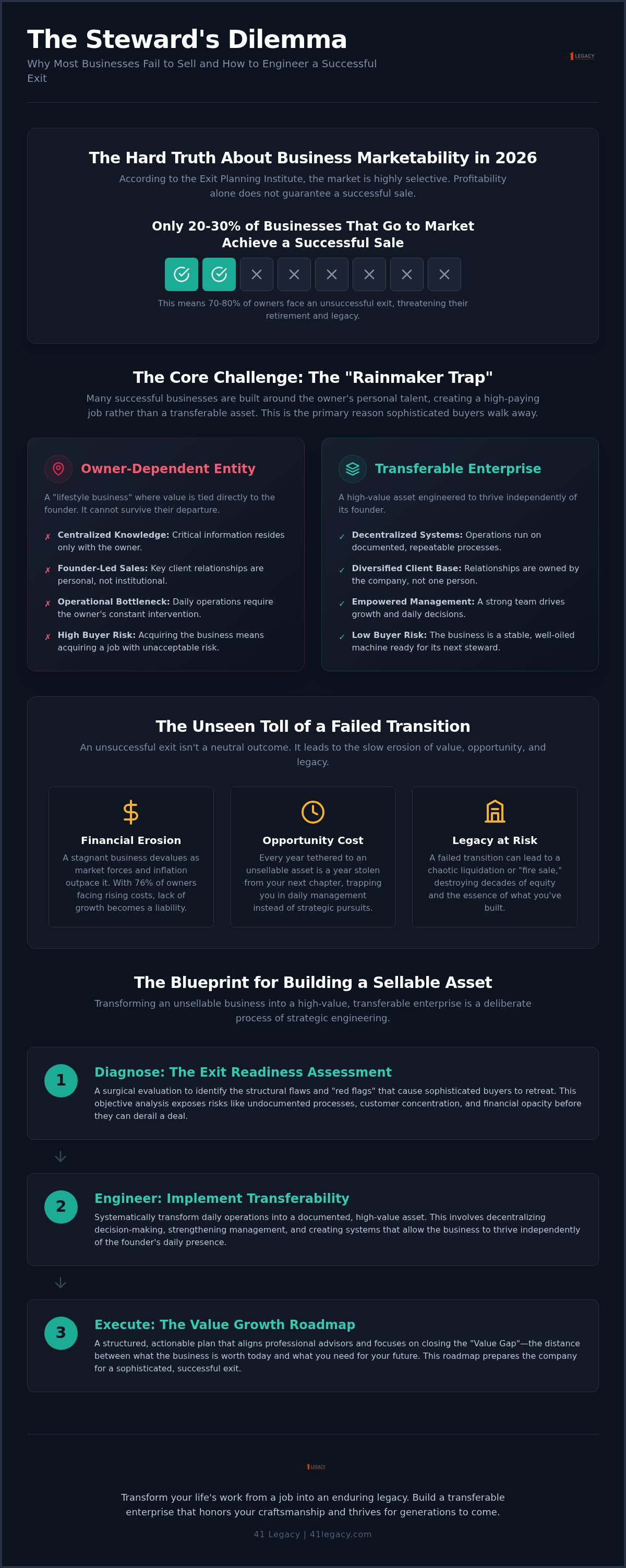
According to the Exit Planning Institute, only 20 to 30 percent of businesses that go to market in 2026 actually achieve a successful sale. For the dedicated steward of a company, this statistic is more than a data point; it's a chilling confrontation with the question of what happens if I can't sell my business. You've spent decades refining your craft and building a reputation, yet you might find that the market views your enterprise as a collection of parts rather than an enduring, transferable asset. This realization often stems from the quiet fear that the business cannot survive without your constant touch, leaving your retirement funding and your legacy in a state of precarious uncertainty.
We believe that an unsellable business isn't a final verdict, but a call to higher craftsmanship in your organizational structure. You'll discover the strategic steps required to transform an owner-dependent entity into a high-value asset that thrives independently of its founder. This guide provides a roadmap to diagnose structural flaws and implement a Value Growth Roadmap. By the end, you'll have the clarity to move beyond the fear of liquidation and gain the confidence required for a successful, sophisticated exit that honors your life's work.
Key Takeaways
- Recognize the critical distinction between exit readiness and market attractiveness to navigate a landscape where only one in four businesses successfully transitions.
- Address the structural risks of the "Rainmaker Trap" to understand exactly what happens if I can't sell my business in its current, owner-dependent state.
- Identify strategic alternatives, such as internal transitions or management buyouts, that allow a steward to preserve the company’s essence while securing financial stability.
- Implement transferability engineering to decentralize decision-making and transform your daily operations into a documented, high-value asset.
- Utilize a Value Growth Roadmap and Enterprise Diagnostics to align your professional advisors and prepare for a sophisticated, successful exit.
The Hard Truth About Business Marketability in 2026
The current marketplace is a discerning curator, often rejecting enterprises that lack structural integrity. According to the Exit Planning Institute, as of July 2026, only 20 to 30 percent of businesses that go to market achieve a successful close. This is reflected in the 2,117 businesses sold in Q2 2026, which represents a 10 percent decrease from the previous year. This reality forces a sobering reflection on what happens if I can't sell my business. Success in this arena rests upon two distinct pillars: exit readiness and market attractiveness. Readiness is an internal metric, focusing on the quality of your records and the health of your systems. Attractiveness is external, reflecting how a buyer perceives the business's position within its industry.
When these pillars are weak, a "Value Gap" emerges. This is the silent distance between the capital you require for your next chapter and the actual price the market is willing to pay. Viewing an "unsellable" status as a diagnostic result allows you to approach the problem with the precision of an artisan rather than the weight of personal failure. It's simply a signal that the essence of the business hasn't yet been distilled into a transferable form. In 2026, buyers are more selective than ever, placing a premium on operational resilience and quality of earnings amidst rising operating expenses.
Why Profitable Businesses Often Fail to Sell
Profitability is often mistaken for transferability. Many owners inadvertently build a "lifestyle business," which is essentially a high-paying job where they remain the central engine. A true transferable asset must possess an "inner essence" that remains intact after the founder departs. While market timing is a force beyond your control, internal readiness is entirely within your hands. High owner dependency acts as a rigid ceiling on enterprise value. Sophisticated buyers refuse to acquire a company that relies on the singular genius of one individual, as it presents an unacceptable risk to their investment.
The Role of the Exit Readiness Assessment
The path to correction begins with a surgical evaluation of your current state. An Exit Readiness Assessment serves as this primary diagnostic tool, exposing the "red flags" that cause private equity and strategic buyers to retreat. These flaws often include undocumented processes, a concentrated customer base, or financial records that lack clarity. Without transferability, your revenue figures are merely "vanity metrics" that fail to translate into a secure legacy. Identifying these gaps early allows you to engineer a business that isn't just profitable, but profoundly attractive to the next generation of stewards. This structured approach ensures you aren't just selling a company, but passing on a healthy, independent entity.
The Hidden Costs of an Unsuccessful Business Exit
The cost of an unsuccessful transition extends far beyond the absence of a wire transfer. When you ask what happens if I can't sell my business, you must consider the slow, quiet erosion of the enterprise's soul. A stagnant business doesn't merely hold its value; it actively devalues as market forces and inflation outpace internal innovation. In 2026, with over 76 percent of business owners reporting increased operating expenses, a business that isn't engineered for growth becomes a liability. Every year you remain tethered to an unsellable asset is a year your net worth is tied to a depreciating machine.
The "Rainmaker Trap" creates a heavy emotional and physical toll. You've become the sole engine of the company, a role that demands constant presence. This dependency limits your "Strategic Capacity," which is the organization's ability to grow without your direct intervention. Delaying your exit also carries a profound opportunity cost. Every month spent managing daily fires is a month stolen from your next life's work, whether that's philanthropy, a new venture, or the quiet enjoyment of your heritage. Without a plan, you risk a forced liquidation or a "fire sale" during a health crisis, which can destroy decades of equity in weeks.
The Impact on the Owner's Legacy
An unsellable business doesn't just affect the founder; it creates deep uncertainty for employees and family members who rely on the company's stability. If a transition fails, the "essence" of what you've built risks being lost to a chaotic liquidation. This creates a psychological weight that can fracture a founder's identity. By conducting Enterprise Diagnostics, you can identify these risks before they become catastrophic, ensuring your life's work remains a source of pride rather than a burden for the next generation.
Owner Dependency: The Primary Value Killer
Buyers seek a predictable stream of future cash flow, not a portrait of your personal brilliance. If you're the primary salesperson or the only one who understands the inner essence of your process, the company is effectively worthless to an outsider. This dependency creates a massive "Value Gap" between your needs and the market's offer. To bridge this, you must transition from a creator to a curator of systems. You can explore deeper strategies in our Guide to Exit Planning, which details how to decentralize your role. Reducing owner dependency is the most significant lever you have to ensure you never have to face the grim reality of what happens if I can't sell my business when you need the capital most.
Strategic Alternatives When the Market Rejects Your Current Model
When the market declines to acquire your enterprise, it isn't an indictment of your life's work. It's a signal that the current structure doesn't yet meet the rigorous standards of a transferable asset. When facing the uncertainty of what happens if I can't sell my business, you must decide whether to embark on a period of intensive retooling or explore internal paths that preserve the company's essence. This moment requires the steady hand of a steward rather than the reactive stance of a seller.
Retooling for transferability involves staying in the business to surgically address the flaws identified during diagnostics. By implementing a Value Growth Roadmap, you can shift from the "Rainmaker" model to a structure that operates independently. This phase often requires twelve to thirty-six months of deliberate effort but fundamentally changes the answer to what happens if I can't sell my business. Alternatively, you might adopt a "passive owner" model, transitioning to a board-level role while retaining equity. If the structural integrity cannot be restored, an orderly liquidation may serve as a final act of guardianship to protect remaining equity and employee interests.
Retooling vs. Liquidation: A Comparison
Retooling is a proactive investment in the future, while liquidation is a reactive conclusion. While retooling requires more time, the financial outcomes are often vastly superior, frequently yielding a two to three times higher exit value once the structural flaws are corrected. This period is dedicated to increasing enterprise value through meticulous documentation and systemization. Liquidation, conversely, often nets pennies on the dollar and erodes the legacy you've spent decades building. Choosing to retool allows you to wait for a more favorable bid-ask spread, which has been narrowing throughout 2026.
The Management Buyout (MBO) Path
If an external sale isn't feasible, an internal transfer to key employees offers a path to continuity. A successful MBO requires a leadership team with the strategic capacity to manage the business without your daily guidance. This path often involves vendor financing, where you act as the bank for the new owners. While this carries risk, it allows for a gradual transition of power. Preparing the next generation of leadership is a form of craftsmanship; it ensures the "inner essence" of the organization survives your departure. You're not just selling a job, you're passing on a healthy, independent entity to those who have helped build it.
Engineering Transferability: Turning a Job into a Sellable Asset
The transformation from a personalized practice to a transferable asset requires the precision of an architect. When you confront the reality of what happens if I can't sell my business, the solution lies in the "Blueprint" phase of your evolution. This involves distilling the inner essence of your operations into a format that a successor can replicate without your presence. Beyond internal systems, you must also address external vulnerabilities, such as customer concentration risk. A business where a single client represents more than 15 percent of revenue is often viewed as a fragile collection of contracts rather than a durable enterprise. Mitigating this risk through diversification is a fundamental step in securing your legacy.
The Role of Standard Operating Procedures (SOPs)
Documenting your process is the first act of true stewardship. Most founders carry their most valuable insights as "tribal knowledge," which evaporates the moment they exit the building. By ensuring SOPs act as the blueprint for your organization, you create a documented, repeatable system that buyers recognize as a turnkey operation. Sophisticated investors pay a premium for clarity; they aren't just buying your past profits, they're buying the certainty that those profits will continue under new management. A well-crafted SOP library is the mechanical proof of your company's independence.
Talent Development and Bench Strength
A transferable asset is powered by a team of stewards, not a group of assistants. Strengthening your "Strategic Capacity" means identifying and developing key leaders who can execute the vision without your daily intervention. This requires incentivizing long-term commitment from essential management through structured growth paths and clear accountability. Transferability Engineering is the deliberate removal of the founder from daily operations. By decentralizing decision-making, you prove that the business has a life of its own and provide a definitive answer to what happens if I can't sell my business in its current state. If you're ready to begin this technical transition, our Transferability Engineering services provide the diagnostic clarity needed to identify your specific value-killers. This process ensures that when you finally step away, the essence of what you've built remains unshakeable.
Securing Your Legacy: The 41 Legacy Advisory Model
The realization of what happens if I can't sell my business is often the catalyst for a more profound commitment to stewardship. Securing a legacy requires an orchestrator who understands the rare intersection of operational artistry and technical engineering. At 41 Legacy, we serve as the "Quarterback" for your transition, aligning your CPA, attorney, and wealth manager toward a singular, uncompromising goal. Most owners possess a talented team of specialists, yet these advisors often operate in silos without a unified strategic vision. Our role is to coordinate these disciplines, ensuring that every tactical decision contributes to the growth of your enterprise value and the reduction of structural risk.
Our process begins with Enterprise Diagnostics, a surgical audit of your company’s health that identifies the quiet "value-killers" preventing a successful transfer. Once these gaps are exposed, we distill the findings into a Value Growth Roadmap. This step-by-step implementation plan typically spans twelve to thirty-six months, providing a clear path to bridge the "Value Gap" between your current worth and your financial needs. To ensure this vision doesn't get lost in the friction of daily operations, we provide Monthly Implementation Support. This consistent accountability keeps the focus on high-level strategic growth while you continue to manage the essence of your craft.
Why Your Current Advisors Aren't Exit Planners
Most professional advisors are masters of their specific niches, yet their focus is often retrospective or purely compliant. A CPA excels at tax compliance, and an attorney protects you from legal liability; however, neither is typically trained in value growth engineering. A Certified Exit Planning Advisor (CEPA) bridges this gap by focusing on the future transferability of the asset. We provide the strategic clarity required before you ever engage an M&A professional, ensuring the business is attractive to the market long before a transaction is even considered. This preparation turns a chaotic exit into a sophisticated transition of power.
Building a Business That Thrives Independently
The ultimate goal of our advisory model is to build a business that is "built to sell," regardless of whether you ever choose to depart. There is a profound peace of mind that comes from owning a truly transferable asset that no longer depends on your daily presence. When the business possesses its own Strategic Capacity, you've moved from being a prisoner of your success to a true steward of a legacy. You've ensured that the inner essence of what you've built can survive and flourish for generations to come. We invite you to begin your Enterprise Diagnostic today and take the first step toward a future defined by confidence rather than uncertainty.
Transforming Your Enterprise into an Enduring Asset
The transition from a founder-led company to a transferable asset requires the deliberate precision of a master artisan. We've explored how identifying structural flaws through diagnostics and reducing owner dependency can shift your business from a lifestyle job to a high-value entity. The uncertainty of what happens if I can't sell my business is a signal to begin the technical work of retooling your operations. By focusing on strategic capacity and documented systems, you ensure that the essence of your life's work remains intact for the next generation of stewards.
Securing this future requires a unified approach. Led by a Certified Exit Planning Advisor (CEPA), our team acts as the quarterback to coordinate your existing advisors toward a singular goal. We provide customized Value Growth Roadmaps that bridge the gap between your current state and a successful, sophisticated exit. You've spent decades building your enterprise; it deserves a structure that honors that effort. Secure Your Legacy with a Professional Exit Readiness Assessment and take the first step toward a future defined by clarity and confidence.
Frequently Asked Questions
What is the #1 reason businesses fail to sell?
High owner dependency is the primary reason businesses fail to achieve a successful sale. Buyers seek an independent entity that generates consistent cash flow without the founder's daily presence. If the business is a lifestyle model where the owner is the sole rainmaker, the market views it as a job rather than a transferable asset. In 2026, buyers are increasingly selective, prioritizing operational resilience and documented systems over revenue that relies on a single individual.
Is it possible to sell a business that is 100% dependent on the owner?
It is technically possible to sell such a business, but usually only for the value of its tangible assets or at a severe discount. Sophisticated buyers and private equity firms avoid these companies because the primary engine of value departs at the closing table. To achieve a successful exit, you must engineer transferability. This involves decentralizing decision-making and empowering a leadership team to execute the vision independently of your constant, daily supervision.
How much does an Exit Readiness Assessment cost?
The investment for a professional evaluation varies based on the size and complexity of the enterprise. While we don't quote fixed fees for our Exit Readiness Assessment, we view it as a foundational diagnostic tool. It uncovers the structural flaws that lead to the question of what happens if I can't sell my business. This process identifies value-killers early, allowing you to fix them before incurring the high costs of a failed market entry.
How long does it take to make a business 'market-ready' after a failed sale?
Transforming an unsellable business into a transferable asset typically requires twelve to thirty-six months of deliberate effort. This timeframe allows for the implementation of a Value Growth Roadmap and the documentation of Standard Operating Procedures. It also provides the necessary runway to prove that the business can sustain its performance under new leadership. Rushing this process often leads to recurring structural issues that sophisticated buyers will quickly identify during their due diligence.
Should I lower my price if my business isn't selling?
Lowering your price is often a reactive solution that fails to address the underlying structural flaws. If the market rejects your business, the issue is usually transferability rather than just the number on the page. Instead of devaluing your life's work, focus on Enterprise Diagnostics to identify why the asset is perceived as high-risk. Fixing these issues often restores the enterprise value and allows you to exit on your own terms.
What happens to my employees if I can't sell my business?
If you are concerned about what happens if I can't sell my business, the impact on your team is paramount. A failed transition may lead to an orderly liquidation, resulting in job losses and the erosion of your legacy. Alternatively, you can choose to retool the enterprise. This path protects your employees by building a resilient organization that thrives under new ownership or internal management, ensuring the company's essence survives your departure.
Can I transition my business to my children if it's currently unsellable?
You can transition the business to family members, but the same transferability standards apply. If the business is unsellable to an outsider because it depends entirely on you, it is often too heavy a burden for your children to carry successfully. Engineering a transferable legacy ensures your heirs receive a healthy, independent entity rather than a demanding job. Proper planning allows you to pass on the essence of the business without the risk of operational collapse.

Article by
Mike Laskowski
Mike Laskowski is a Business Value Growth Strategist who helps business owners uncover the truths that drive their performance, risk, and readiness. Blending forensic interviewing from a 26‑year federal career with Strategic Capacity analysis and CEPA methodology, he works upstream to reduce owner dependency, increase transferability, and strengthen enterprise value. Mike guides founders through clarity, operational evolution, and transition readiness so their companies become transferable, owner‑independent assets that endure beyond the founder.
Disclaimer
This article is for educational and informational purposes only and does not provide legal, tax, investment, or business brokerage advice. 41 Legacy does not offer M&A brokerage services, legal document drafting, tax preparation, or investment advisory services. Business owners should consult licensed professionals in those disciplines before making decisions related to business transactions, legal matters, tax strategy, or financial planning. All examples are illustrative and may not apply to your specific situation.