
Transferability & Owner Dependency
What Do Buyers Look for in a Business Acquisition? Building a Transferable Asset
What if the very brilliance that built your company is the single greatest obstacle to its preservation? Many founders spend decades perfecting their craft only to realize that their own presence is the primary dependency holding the enterprise back. When you begin to ask what do buyers look for in a business acquisition, you'll find they aren't merely purchasing your past success; they're investing in the certainty of a future that doesn't require your daily intervention. A sophisticated buyer seeks the quiet hum of a well-tuned machine, not the frantic energy of a solo performer.
It's natural to feel a sense of unease when considering whether your legacy can withstand a change in stewardship. You've likely felt the weight of being the primary value driver, fearing that the business might lose its essence or attract low-ball offers without your direct oversight. This article promises to reveal the critical value drivers that prioritize long-term stability over temporary gains. We'll explore how to transform your company into a high-value, transferable asset through strategic clarity and owner-dependency reduction, ensuring your life's work survives the transition and thrives independently.
Key Takeaways
- Adopt a curatorial mindset by viewing your company as a risk-adjusted return rather than just a source of daily income.
- Identify and dismantle the "Rainmaker Trap" to ensure the enterprise thrives independently of its founder's daily involvement.
- Understand exactly what do buyers look for in a business acquisition by prioritizing transferability engineering and the codification of institutional knowledge.
- Elevate your financial integrity by shifting from tax-focused accounting to the "Exit-Ready" quality of earnings that sophisticated buyers demand.
- Utilize enterprise diagnostics and a Value Growth Roadmap to coordinate your professional advisory team and secure a lasting legacy.
From Business Owner to Asset Steward: The Buyer’s Perspective
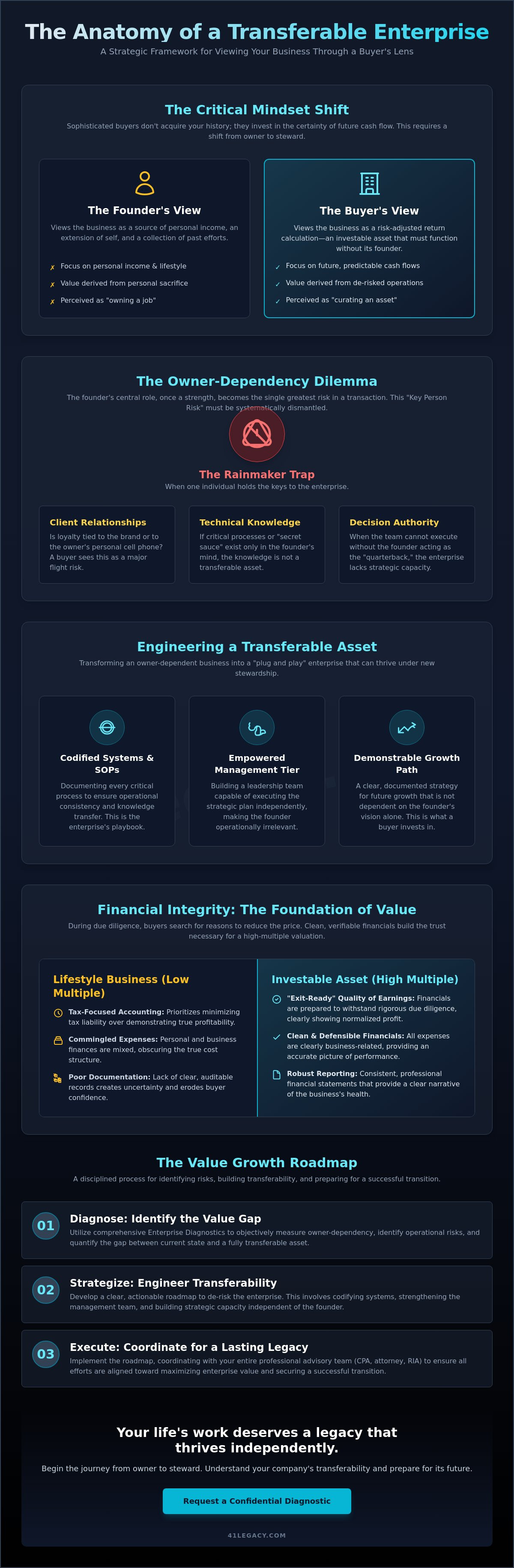
To move from a founder to a steward, you must first understand the lens through which your company is viewed by those on the outside. Most owners see their business as a collection of years, efforts, and personal sacrifices. A sophisticated buyer sees something entirely different. They view your company as a risk-adjusted return calculation. They aren't purchasing your history; they're purchasing the future cash flows that history suggests are possible. This fundamental shift in perspective is the foundation of Mergers and acquisitions and dictates the ultimate success of any transition.
When asking what do buyers look for in a business acquisition, the answer is rarely found in the past. They look for Enterprise Value rather than mere Owner Income. While a lifestyle business might provide a handsome salary for a founder, an enterprise asset creates value that exists independently of that founder. This is the difference between owning a job and curating an asset. As a steward, your role is to refine the business until it possesses a life of its own, ensuring the essence of the organization remains intact long after you've stepped away.
The Investable Asset Framework
A transferable enterprise is built on the concept of a "plug and play" model. Buyers seek a machine that already works, not a project they must manage daily. If the business relies on your personal relationships or unique technical skills to function, it isn't an asset; it's a liability. This discrepancy creates a "Value Gap" between what you believe the business is worth and what the market is willing to pay. To bridge this gap, we use Enterprise Diagnostics to identify where the business is over-dependent on its owner and where strategic capacity can be expanded.
The Psychology of the Sophisticated Buyer
The primary driver for any acquisition team is the mitigation of risk. During due diligence, they're searching for reasons to walk away or lower the price. Their greatest fear is that the "secret sauce" of the company will evaporate once the founder leaves. This is why the certainty of future earnings dictates the valuation multiple. Whether the buyer is a private equity firm looking for a platform or a strategic corporate buyer seeking synergy, they all prioritize stability. In the current economic climate, where the prime rate sits at 6.75% as of May 2026, the cost of capital is a significant factor. Buyers are more selective than ever, seeking assets that offer clear, documented paths to growth without the need for founder intervention.
Reducing Owner Dependency: The Ultimate De-Risking Strategy
Many founders take pride in being the primary driver of their company's success. However, this pride often conceals a structural weakness known as the "Rainmaker Trap." This occurs when the owner remains the sole repository of key relationships, technical expertise, or decision-making authority. When you consider what do buyers look for in a business acquisition, the absence of the founder is often more valuable than their presence. If the engine stops when the operator steps away, the asset has no inherent value to an outsider.
Owner-dependency is the most common reason why transitions fail during the final stages of due diligence. Buyers view "Key Person Risk" as a catastrophic threat to their future return on investment. If a transition is to be successful, the founder must embark on a deliberate path toward becoming operationally irrelevant. This is not an admission of unimportance. Instead, it's a testament to the strength of the systems you've built. By extracting yourself from the daily gears of the business, you prove that the enterprise can thrive under new stewardship.
Identifying Your Operational Footprint
To begin this extraction, you must identify where your personal involvement has become a bottleneck. We often recommend a Strategic Capacity Evaluation to map out these dependencies with precision. You should analyze whether customer loyalty is tied to the brand or to your personal cell phone number. If the team cannot execute their roles without you acting as the "quarterback" for every minor decision, the enterprise lacks the strategic clarity required for a high-multiple valuation. A business that requires the founder's constant touch is a business that is not yet ready for the market.
Building the Management Tier
A transferable asset requires a management tier that functions with the precision of a master artisan's workshop. This involves cultivating a second-in-command who is empowered to lead after the ownership changes. You must transition from a founder-led culture, where every choice is filtered through one person, to a systems-led culture. This shift ensures that the institutional knowledge and the inner essence of the company are preserved. Incentivizing key employees to remain through the transition period further reinforces the stability that sophisticated buyers prioritize during an acquisition.
Engineering Transferability: Systems, SOPs, and Strategic Capacity
Engineering transferability is the deliberate act of translating your company’s unique rhythm into a repeatable, codified language. While many owners focus exclusively on the bottom line, sophisticated acquirers look deeper into the structural integrity of the operation. This process, which we call Transferability Engineering, acts as the bridge between a business that relies on a founder’s intuition and an enterprise that thrives on institutional knowledge. When you investigate what do buyers look for in a business acquisition, you'll find that documented systems are the primary currency of trust.
A buyer’s greatest ally is the Standard Operating Procedure (SOP). These documents shouldn't be viewed as mere administrative chores; they're the blueprints of your legacy. They ensure that the precision you've cultivated over decades isn't lost during the transition. By codifying every critical process, you create "Strategic Capacity," which is the ability of the organization to scale and absorb new growth without adding unnecessary complexity or chaos. This level of preparation signals to a buyer that the business is a finished work of art, ready for its next curator.
Codifying the Secret Sauce
Every successful company has an "Inner Essence" that defines its unique value proposition. The challenge lies in capturing this essence so it can be executed with extreme precision by any qualified team member. We utilize Enterprise Diagnostics to identify the silent gaps in your documentation where tribal knowledge still resides. By documenting these hidden nuances, you transform personal expertise into a corporate asset. This level of craftsmanship in your internal systems reduces the perceived risk for a buyer, as they can see exactly how the "secret sauce" is produced every day without your presence.
Scalability as a Value Driver
Acquirers don't just buy what you are; they buy what you can become. They evaluate your infrastructure for growth to see if it can withstand the pressure of expansion. This is where technology and information services play a vital role, automating repeatable processes to ensure consistency at scale. A robust "Value Growth Roadmap" provides a clear, actionable vision for the future, showing a new owner exactly where the levers of growth are located. When the path to expansion is visible and the systems are already in place to support it, the valuation multiple reflects that certainty. It proves that the business isn't just surviving, but is engineered for a lasting impact.
Financial Integrity and the Quality of Earnings
Financial records are the technical blueprints of your enterprise's health. While most owners operate under "Tax Accounting" designed to minimize liabilities, a sophisticated acquirer demands "Exit-Ready Accounting." This shift focuses on the Quality of Earnings (QofE) rather than just top-line revenue. When you evaluate what do buyers look for in a business acquisition, you'll find they're searching for the truth behind the numbers. They want to see that your profits are a result of sustainable operations rather than temporary market fluctuations or aggressive accounting maneuvers.
A high-value asset is defined by its transparency and the predictability of its future cash flows. Pro forma statements play a vital role here, as they allow you to present a clear picture of the company's potential once non-recurring expenses are removed. This level of financial integrity builds a foundation of trust that is essential for high-altitude negotiations. Without clean, defensible data, even the most innovative company will struggle to command a premium valuation multiple.
Transparency and Due Diligence Readiness
Clean books are the primary currency of trust during the due diligence process. A skeptical buyer will scrutinize every line item, searching for hidden risks such as customer concentration. If 80% of your revenue comes from 20% of your clients, the "80/20 risk rule" suggests a fragile foundation that could crumble if a single relationship falters. You must also ensure that "add-backs"—those personal or one-time expenses returned to the bottom line—are documented with extreme precision. If an add-back isn't defensible, it doesn't just lower the valuation; it erodes the buyer's confidence in your entire financial narrative.
Predictability: The Holy Grail of Valuation
The most sought-after attribute in any acquisition is the certainty of future performance. Buyers prefer recurring, contract-based revenue streams over transactional, one-off sales because they offer a clearer vision of the years ahead. Historical consistency acts as a powerful predictor, proving that the business possesses the strategic capacity to maintain its rhythm under new stewardship. By utilizing financial forecasting and rigorous internal reporting, you demonstrate that the enterprise's success is a matter of design rather than luck. To ensure your financials tell the right story, we recommend starting with an Exit Readiness Assessment to identify and rectify any structural weaknesses before they reach the negotiation table.
The Value Growth Roadmap: Preparing for Your Ultimate Legacy
The journey toward a successful transition begins long before the first conversation with a prospective acquirer. It starts with a shift in perspective, moving from the daily demands of operation to the intentional design of an enduring asset. The Exit Readiness Assessment serves as the diagnostic foundation for this process, providing the strategic clarity needed to understand the current state of your enterprise. By identifying the silent vulnerabilities and hidden strengths within your organization, you can begin to make decisions that prioritize long-term health over short-term convenience.
When exploring what do buyers look for in a business acquisition, the most compelling trait is a clear, documented trajectory of growth that does not rely on the founder's presence. This is where Monthly Implementation Support becomes vital. It bridges the "Value Gap" by ensuring that the strategic goals established in the initial assessment are executed with the precision of a master artisan. We believe the owner should act as the architect of a legacy, one that maintains its inner essence while flourishing under new stewardship. This preparation ensures that when the time comes to step away, the transition is a natural progression rather than a disruptive event.
The Multi-Year Preparation Arc
Effective exit planning is, at its core, exceptional business planning. It's a multi-year arc that should ideally begin years before a transition is even contemplated. The Value Growth Roadmap follows a logical progression: Assess, Protect, Grow, and Transition. By reducing risk today through Owner Dependency Reduction and Transferability Engineering, you ensure an exclusivity of interest from sophisticated buyers tomorrow. This disciplined approach transforms the business into a rare and sought-after asset, commanding a premium multiple because the infrastructure for future success is already firmly in place.
Coordinating Your Advisory Team
Building a transferable asset requires a symphony of professional expertise. However, your CPA or attorney, while essential for their specific technical precision, shouldn't be the lead architect of your overall exit strategy. Their focus is often transactional or regulatory. To ensure the preservation of your legacy, you need a "Quarterback" to coordinate these specialists. A Certified Exit Planning Advisor (CEPA) fills this role, aligning the efforts of your entire advisory team with the singular goal of Enterprise Value Growth. This collaborative approach ensures that every legal, financial, and operational move is synchronized, protecting the harmony of the enterprise and securing its impact for the next generation.
Securing Your Enterprise for the Next Generation
The successful transition of a business is the final and most significant act of stewardship. By shifting your focus from the exhaustion of daily management to the meticulous curation of a transferable asset, you ensure your impact survives the transition. We've explored how reducing owner dependency and engineering transferability create the technical precision and predictability that sophisticated acquirers demand. When you understand what do buyers look for in a business acquisition, you realize they seek the quiet harmony of a well-documented, independent enterprise that can thrive without its founder's constant touch.
Our team, led by a Certified Exit Planning Advisor (CEPA), provides a national advisory focus on enterprise value. We guide you through a structured Value Growth Roadmap process designed to bridge the gap between your current worth and your ultimate potential. Your life's work deserves a transition that reflects its true value and preserves its inner essence for the next curator. It's time to transform your company into a legacy that stands the test of time and rewards your years of dedication.
Begin Your Exit Readiness Assessment Today and take the first step toward a secure, high-value future.
Frequently Asked Questions
What is the most important factor buyers look for in a business?
The most critical factor is the certainty of future earnings independent of the founder's daily presence. When considering what do buyers look for in a business acquisition, they prioritize a risk-adjusted return rather than just historical revenue. They want an enterprise that functions as a well-tuned machine, ensuring the essence of the company remains intact after the transition.
How far in advance should I start preparing my business for an acquisition?
Preparation should ideally begin three to five years before a planned transition. This timeframe allows for the thorough execution of a Value Growth Roadmap and Transferability Engineering. It provides the necessary space to identify structural weaknesses and implement owner-dependency reduction strategies that maximize enterprise value long before you enter a negotiation.
Why is my EBITDA high but my valuation multiple low?
A low valuation multiple despite high EBITDA often indicates high perceived risk within the enterprise. Buyers discount the price when they see significant owner dependency, customer concentration, or a lack of documented systems. They're pricing the uncertainty of whether those earnings will continue once the founder steps away from the helm.
What is the difference between an "Exit Readiness Assessment" and a "Business Valuation"?
A business valuation is a historical snapshot of worth, whereas an Exit Readiness Assessment is a strategic diagnostic of your company's transferability. The assessment identifies the structural obstacles that prevent you from attracting high-multiple offers. It serves as the architectural plan to strengthen the enterprise and reduce risk before it ever reaches the market.
Can I sell my business if I am still the main person handling sales?
You can sell, but the valuation will likely be significantly lower due to the "Rainmaker Trap." If you're the primary driver of revenue, a buyer sees a high risk of the business collapsing after your departure. Transitioning these relationships to a dedicated sales team is a vital step in de-risking the asset and proving its independent value.
What does "Transferability" mean in the context of a business sale?
Transferability refers to the ease with which a business can maintain its rhythm and profitability under new ownership. It's the measure of how well institutional knowledge has been codified into systems and SOPs. A highly transferable asset is one where the inner essence of the brand is detached from the individual founder's daily intervention.
How do buyers evaluate a company’s management team during an acquisition?
Buyers evaluate a management team by their ability to lead without the founder's direct oversight. They look for a second-in-command and a middle-management tier that can execute the strategic vision independently. A team that demonstrates high strategic capacity and decision-making autonomy is a major driver of a premium multiple during an acquisition.
What are the most common "deal-killers" found during due diligence?
The most common deal-killers include financial opacity, excessive customer concentration, and unresolved key person risk. If a buyer discovers that the books are not "exit-ready" or that a single client accounts for more than 20% of revenue, they often walk away. These issues signal a lack of the technical precision required for a stable and successful transition.
Disclaimer
This article is for educational and informational purposes only and does not provide legal, tax, investment, or business brokerage advice. 41 Legacy does not offer M&A brokerage services, legal document drafting, tax preparation, or investment advisory services. Business owners should consult licensed professionals in those disciplines before making decisions related to business transactions, legal matters, tax strategy, or financial planning. All examples are illustrative and may not apply to your specific situation.