
Understanding Industry Trends Affecting Your Business Value
What if your strongest quarter is masking a shift that could make future earnings less reliable? Understanding industry trends affecting my business value means looking beyond headlines to assess whether changes in customer expectations, technology, costs, or competition could affect cash flow, risk, and transferability. The challenge is deciding which signals deserve attention, especially when current results still look strong.
This article offers a practical way to separate relevant shifts from passing noise. You’ll learn how trends can affect revenue and margins, change business risk, and influence how well a company operates without its owner. You’ll also find questions to help assess exposure and adaptability before making strategic decisions. A dual-lens view considers both profit and cash impact and enterprise-value impact. This article provides general information, not advice for a specific situation. The scope of each 41 Legacy engagement is defined in the client’s written agreement.
Key Takeaways
- Distinguish sustained industry shifts from temporary headlines by looking for patterns supported by evidence.
- Connect changes in demand, technology, competition, supply, or the economy to specific areas of company exposure.
- Review each relevant signal for its potential effects on cash flow, business risk, and operational transferability.
- Use a consistent process: identify signals, test exposure, review evidence, and decide whether action is warranted.
- Evaluate decisions through both a profit-and-cash lens and an enterprise-value lens.
Why industry trends can shape your business value before your results change
A headline captures attention; a trend earns attention through persistence. Industry trends are sustained shifts in markets, technology, customer behavior, or operating conditions. Their effects may first appear in customer expectations, cost pressures, or competitive requirements, before showing up in annual results. The useful question for an owner is whether a change is altering the conditions the company depends on.
An industry trend can influence perceived business value by changing expectations about future earnings, risk, or adaptability, but it does not determine a fixed outcome. Understanding industry trends affecting my business value starts with evidence, not reaction.
Industry trend, market cycle, or short-term event?
A short-term event is limited in duration or scope. A temporary disruption may delay a shipment, while an isolated announcement may attract attention without changing how customers buy. A market cycle is a broader rise or decline that may reverse. A trend is a sustained direction of change, such as customers repeatedly choosing a different service channel or competitors steadily adopting new technology.
One signal is a reason to investigate, not proof. Look for repetition across periods and observable effects inside the business. Are customers requesting different features more often? Are quote conversion, renewal patterns, delivery times, or input costs moving consistently? Compare customer feedback with operating and financial records. Financial analysis often involves trend analysis and industry comparisons. Those comparisons provide context, but the company’s own evidence helps determine whether a broad shift affects its operations.
Why owners should look beyond current-year performance
Strong current results describe what the company has achieved. They do not, by themselves, establish how durable future earnings and cash generation may be. A business can report healthy revenue while relying on a product category facing persistent demand changes, an input with unstable availability, or customer relationships held closely by the owner. These are not automatic signs of declining value. They are reasons to examine the assumptions behind future performance and the company’s ability to adapt.
Industry conditions inform the analysis, but they do not determine a company’s value alone. Margins, customer mix, operating discipline, adaptability, and the ability to function without constant owner involvement also matter. Ask: Which external changes could affect our most important revenue or cost drivers? What internal evidence would show that exposure is real? Could the business respond without disrupting cash generation or requiring the owner to manage every adjustment?
For an owner, the stakes are personal as well as operational: 80 to 90 % of an owner’s net worth sits inside the business. That makes measured attention more useful than either dismissing a shift or making a hurried change. This article provides general information, not advice for a specific business. The scope of each engagement is defined in the client’s written agreement.
Which industry trends can influence business value, and what each may signal
Useful trend analysis separates four things: the external signal, the company’s exposure, the available response, and the results observed so far. A change in customer preferences, for example, matters to a company to the extent that its customers, offer, or sales channels are affected. This distinction keeps broad industry commentary from becoming an unsupported forecast about an individual business.
Customer and competitive shifts can reshape demand, technology and economic changes can alter costs, and supply conditions can test operating resilience. The question is not whether a trend exists somewhere in the market. It is where it touches the company and what evidence would show that the exposure matters.
Demand, customer behavior, and competition
Look for changes in what customers value, how they buy, and how they find or receive a product or service. Compare repeated customer feedback with sales patterns, renewal behavior, and the mix of products or services generating demand. A brief rise or fall in inquiries may be seasonal or isolated. A consistent shift across customer conversations and operating records deserves closer review.
Competition can change the picture. New entrants or substitute offerings may give customers more choices and influence pricing power or retention. Consider whether the company is losing opportunities for a recurring, identifiable reason, or whether a competitor’s move is simply attracting attention. The answer can help distinguish a signal that calls for closer monitoring from one that merits a change to the offer or no immediate action.
Technology, supply conditions, and the wider economy
Technology may affect internal processes, customer expectations, or the way competitors deliver their offers. Assess the practical connection. Does a new tool address a bottleneck? Does a customer now expect a digital step? Is a competitor providing a service differently? Avoid assuming adoption itself creates an advantage. Look for evidence that technology changes customer outcomes, operating capacity, cost, or the company’s ability to adapt.
Supplier concentration, input availability, and delivery reliability can reveal exposure before an interruption becomes visible. Identify essential materials or services that depend on a narrow source, then track delays, substitutions, or changing terms. Economic or policy developments belong in the review when there is a clear link to the company, such as an effect on customer spending, borrowing conditions, input costs, or operating requirements. A headline without that connection is context, not a company-specific signal.
- Customer demand: Track shifts in priorities and buying patterns, then compare them with sales and retention evidence.
- Technology: Identify changes to processes, customer expectations, or competitive delivery, and assess their operational effect.
- Competition: Watch for new alternatives and recurring reasons customers choose or leave.
- Supply: Review dependence on key suppliers, availability, and delivery reliability.
- Economic or policy conditions: Follow developments when a clear business exposure can be identified.
For owners seeking a structured view of how external shifts relate to enterprise value, 41 Legacy’s enterprise-value advisory connects industry context with business-specific financial and strategic considerations. This article provides general information, not advice for a specific business.
How industry shifts flow through cash flow, risk, and transferability
An external shift matters through the way it changes company operations. A change in customer preferences might affect sales first, then margins or cash timing, while also raising questions about customer concentration and how easily the business can adjust. The same shift can affect companies differently depending on customer mix, pricing model, supplier choices, and reliance on particular people or processes.
Industry trends inform, but do not replace, company-specific analysis. Understanding industry trends affecting my business value means tracing a signal into the business, then separating possible consequences from those supported by company records.
From an external shift to financial implications
Consider a hypothetical example: a customer group begins preferring a different purchasing channel. A company with a concentrated customer base may have more revenue exposed than one serving varied segments. If responding requires a different sales process or added operating capacity, margins and working capital could also be affected. These are possible pathways, not predicted results. Test them by comparing customer mix, sales, costs, payment timing, and forecast assumptions over time.
A forecast should make assumptions visible. If the company expects demand to remain steady despite repeated customer changes, identify the evidence behind that expectation. If the observed effect is still limited to inquiries, label it as a signal under review. If company data shows changes in sales, margins, or cash timing, record those as measured impacts. Keeping these categories separate helps prevent a concern from becoming an unexamined assumption.
Compact exposure review
| Trend signal | Possible company exposure | Evidence to monitor | Strategic question |
|---|---|---|---|
| Customer preferences shift | Revenue mix, margins, or cash timing may change; retention may rely on a narrow customer group. | Customer concentration, sales by segment, renewals, margins, and payment patterns. | Can the offer or channel adapt without weakening cash generation? |
| New technology changes delivery | Processes may need adjustment; expertise or capacity may be concentrated in one person. | Service times, process costs, customer feedback, and reliance on key staff. | Can the team adopt a workable response without depending on the owner for each decision? |
| Supplier availability becomes less reliable | Delays or substitutions may affect delivery, inventory needs, and customer commitments. | Supplier concentration, delivery records, stock levels, and missed commitments. | Are alternatives and response steps clear enough to maintain continuity? |
Transferability, adaptability, and owner dependency
A company’s response matters as much as its exposure. Ask whether the team can recognize a shift, evaluate options, and adjust responsibilities without relying on the owner’s undocumented knowledge. Clear decision rights, accessible operating information, and capable managers can support continuity as customer, supplier, or technology conditions change. Transferability is stronger when a business can adapt through established ways of working rather than relying on one person’s memory or constant intervention.
For a practical review, connect each material signal to a financial assumption, an operational response, and the person accountable for acting. The scope of each engagement is defined in the client’s written agreement.
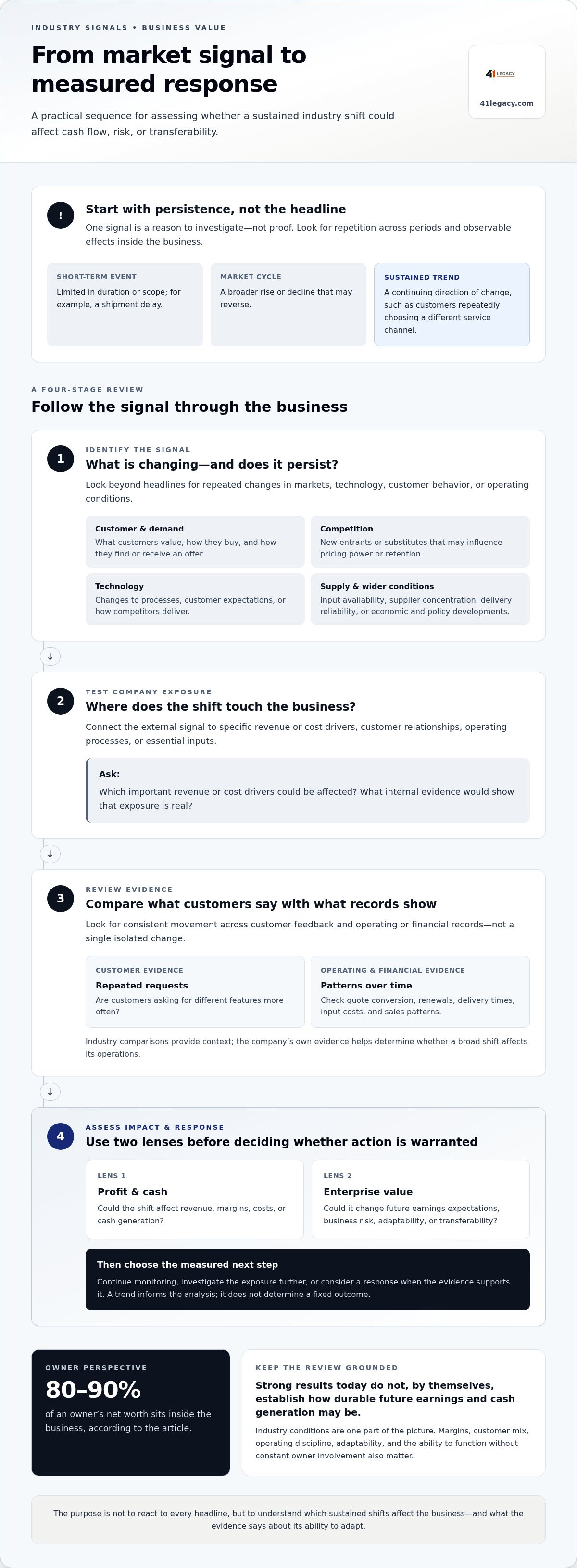
A practical framework for monitoring trends without chasing every headline
A disciplined review does not require tracking every market development. It requires a clear way to decide which signals deserve attention, what evidence would confirm exposure, and who will revisit the issue. This turns trend analysis into a repeatable management practice rather than a reaction to the latest headline.
Use this four-step sequence in existing financial and strategic discussions:
- Identify signals. Select a focused set tied to the company’s customers, suppliers, technology, or operating environment. Record the source and why the signal may matter.
- Test exposure. Trace the signal to a specific revenue stream, cost, process, customer group, or capability. If there is no clear connection, keep it as background information rather than making it a priority.
- Review evidence. Compare the assumption with company information as it becomes available. Look for relevant movement in sales patterns, margins, delivery, customer retention, or cash timing, rather than relying on commentary alone.
- Decide whether action is warranted. Consider whether the evidence supports a response, continued monitoring, or no change for now. Document the reasoning so the decision can be revisited as conditions evolve.
Keep the review brief and consistent, aligned with financial and strategic discussions already taking place. For each signal, note the assumption, the leading indicator that would strengthen or weaken it, the accountable decision-maker, and the next review date. A scheduled checkpoint helps prevent both neglect and constant reconsideration.
Build a focused trend-monitoring list
Choose signals with a plausible connection to the company’s operations. For each one, capture its source, the affected part of the business, and the evidence that could change the assessment. Label internal results separately from external commentary and assumptions. For example, a published report may suggest a shift, while customer orders or supplier records show whether the company is experiencing it directly.
Turn observation into a disciplined decision
At each review, compare the original expectation with actual operating and financial information. Has the indicator moved? Is the exposure larger, smaller, or unchanged? Assign someone to maintain the record and identify who will decide whether a response is appropriate. Revisit the issue on its scheduled date, or sooner if meaningful new evidence emerges, rather than making a major change based on an isolated report.
A concise record creates continuity: signal, exposure, evidence, assumption, owner, and review date. It also makes it easier to see whether a trend is gaining relevance or fading from view. To connect this disciplined review with enterprise-value priorities, read about 41 Legacy’s approach to enterprise-value advisory.
How 41 Legacy connects industry trends to a dual-lens financial view
Industry signals become more useful when considered alongside a company’s financial position and ability to adapt. 41 Legacy evaluates financial decisions through two lenses: their potential impact on profit and cash, and their impact on enterprise value. A decision about responding to a technology shift, for example, can be considered for its expected effect on current operations and for how it may influence resilience, transferability, and reliance on the owner.
This approach gives owners a structured way to connect external conditions with internal decisions. It does not treat a trend as a prediction. Instead, it brings relevant assumptions into view so they can be considered alongside financial information and strategic priorities. For owners assessing how industry trends affect business value, that distinction can help turn broad market signals into clearer leadership questions.
From financial clarity to a forward-looking CFO Seat
41 Legacy’s fixed, six-week financial clarity intensive includes one working session per week. Weeks 1 and 6 are identical for every client. Weeks 2-5 are customized after week 1, and the week 3 deliverable is a 13-week cash-flow forecast. The intensive establishes financial clarity before ongoing CFO Seat support.
The ongoing CFO Seat provides budgeting, forecasting, KPI review, decision support, working-capital discipline, and enterprise-value tracking. Its forward-looking focus lets owners consider trend questions alongside financial forecasts and operating indicators, rather than waiting for changes to appear in backward-looking reports.
Timeliness matters. Three weeks late is how old the average owner’s financial picture is when the decision has to be made. A current, decision-oriented view can help leadership assess assumptions while weighing both cash needs and longer-term enterprise considerations.
Scope, context, and a measured next step
41 Legacy provides fractional CFO, financial advisory, and enterprise-value services. Its recommendations use a dual-lens evaluation, considering profit and cash impact alongside enterprise-value impact.
This article provides general information, not advice for any specific situation. Owners can use the framework to clarify what they are observing, which financial or operating evidence matters, and what questions deserve discussion with leadership and professional advisors. A useful next step is to clarify the company’s current financial picture and strategic priorities.
Start with a 30-minute conversation: No pitch. No pressure.
Make trend awareness part of how you steward the business
Understanding industry trends affecting my business value is not about predicting every turn in the market. It is about building an enterprise that can recognize change, make deliberate choices, and operate with less dependence on the owner’s individual judgment. Start with a practical question: which capabilities would help the company remain responsive if customer, supplier, or competitive conditions shifted?
Use that question to guide discussions about priorities, leadership responsibility, and the information needed for sound decisions. Over time, this discipline can help align today’s choices with the transferable business you intend to build. Progress does not require certainty about what comes next. It requires a clear view of what the business can influence and a willingness to act on relevant evidence.
To discuss how external change connects to your company’s strategic priorities, start with a 30-minute conversation with 41 Legacy: No pitch. No pressure.
Frequently Asked Questions
What industry trends affect business value most?
The most important trend is one that could change an assumption behind a key business decision. For example, if customers increasingly request shorter delivery times, examine whether current pricing covers the additional capacity or scheduling demands that may follow. The practical test is whether the shift could affect a decision about pricing, investment, staffing, or customer commitments. Its importance depends on the decision at stake, not how much attention the trend receives.
How often should a business owner review industry trends?
Review trends before decisions become difficult to reverse, such as renewing a major supplier agreement, setting a budget, or committing to a new operating capability. A calendar checkpoint helps leadership revisit open questions before those decisions are made. If new information emerges between reviews, consider whether it changes an upcoming choice. The purpose is to keep decisions informed, not to create a separate reporting exercise for every market development.
Can the same industry trend affect businesses differently?
Yes. Consider a shift toward faster delivery. A company with flexible scheduling may be able to adjust its service commitments, while one with tightly booked capacity may face trade-offs among speed, cost, and existing customer obligations. The difference may depend on contract terms, available capacity, or how work is scheduled. Comparing those practical constraints can help leadership choose a response suited to its operating model rather than copying a competitor’s move.
What information helps assess whether an industry trend matters to my company?
Alongside financial statements, examine how information is grouped and connected. Compare customer activity by product, service, or contract type, then relate changes to the operating measures that support delivery. A shift in orders, for example, may have a different meaning if it coincides with longer fulfillment times or more discounting. Check that the periods and categories being compared are consistent. Mismatched records can make an apparent pattern difficult to interpret.
Do positive industry trends automatically increase business value?
No. A favorable trend creates potential, but the company still needs a workable way to respond. Consider the resources required, the margin expected after those costs, and how long the change may take to support cash generation. A growing market may still be a poor fit if meeting demand requires commitments the company cannot sustain. Evaluate the execution path, not only the attractiveness of the market.
How are industry trends different from business risks?
A trend describes a direction of change; a risk frames a possible adverse consequence for a specific business. To make the distinction useful, write the risk as a cause-and-effect statement: “If this change continues, this company may face this operational or financial difficulty.” For instance, if a key input becomes less available, delayed delivery could affect customer commitments. That wording helps leadership identify what to monitor and which response could reduce disruption.

Article by
Mike Laskowski
Mike Laskowski is a Business Value Growth Strategist who helps business owners uncover the truths that drive their performance, risk, and readiness. Blending forensic interviewing from a 26‑year federal career with Strategic Capacity analysis and CEPA methodology, he works upstream to reduce owner dependency, increase transferability, and strengthen enterprise value. Mike guides founders through clarity, operational evolution, and transition readiness so their companies become transferable, owner‑independent assets that endure beyond the founder.
Disclaimer
This article is for educational and informational purposes only and does not provide legal, tax, investment, or business brokerage advice. 41 Legacy does not offer M&A brokerage services, legal document drafting, tax preparation, or investment advisory services. Business owners should consult licensed professionals in those disciplines before making decisions related to business transactions, legal matters, tax strategy, or financial planning. All examples are illustrative and may not apply to your specific situation.

