
Transferability & Owner Dependency
Understanding EBITDA Multiples by Industry 2026: A Steward’s Guide to Enterprise Value
What if the true measure of your life's work isn't the profit it generates today, but its capacity to flourish long after you've stepped away? For many owners, the pursuit of understanding EBITDA multiples by industry 2026 feels like chasing a shifting horizon, marked by conflicting data and the quiet fear that their enterprise remains too dependent on their personal touch. You've spent decades refining your craft and building a legacy. It's only natural to seek a valuation that reflects that dedication rather than a generic market average.
We believe that an enterprise is a living entity, a masterpiece of engineering that deserves to be preserved and passed on with precision. In this guide, you'll discover how current industry benchmarks and the architecture of transferability define your market value in the coming year. We'll examine the specific multiples driving sectors like B2B SaaS and healthcare while providing a strategic framework to reduce owner dependency. By the end, you'll have the clarity needed to bridge the value gap and transform your business into a truly transferable asset.
Key Takeaways
- Recognize EBITDA as the operational pulse of your enterprise and the multiple as a profound measure of a buyer’s confidence in its future.
- Gain strategic clarity on understanding EBITDA multiples by industry 2026, acknowledging the inherent gap between public market data and the reality of private enterprise.
- Identify the "Rainmaker Trap" and learn why reducing owner dependency is the most critical lever for expanding your specific industry multiple.
- Bridge the "Value Gap" by utilizing Enterprise Diagnostics to uncover hidden worth and align your current valuation with your ultimate legacy goals.
- Transition from a founder to a steward by engineering a transferable asset that's designed to thrive independently of your daily involvement.
The Philosophy of the Multiple: Defining Enterprise Value in 2026
A business is more than a collection of ledger entries; it's a living entity with a story to tell. Understanding EBITDA multiples by industry 2026 requires looking beyond the spreadsheet to the underlying health of the asset. If EBITDA represents the pulse of your organization’s operational cash flow, the multiple is the market's stethoscope. It measures the depth of a buyer's confidence in your company's future. In the current economic climate, where interest rates have recalibrated the cost of capital, the multiple has become a sophisticated diagnostic tool rather than a simple arithmetic quotient.
There's a profound distinction between the price someone pays and the true enterprise value you've cultivated. Price is often a reflection of a moment in time, influenced by market cycles and buyer appetites. Enterprise value is the enduring essence of the business itself. It's the strength of the systems, the loyalty of the clientele, and the independence of the operations. For the dedicated steward, the goal isn't merely to find a buyer, but to engineer an asset so resilient that its value remains undeniable regardless of market volatility.
What is an EBITDA Multiple?
An EV/EBITDA multiple represents the market’s valuation of a company’s future earnings potential. It’s calculated by dividing the Enterprise Value by the Earnings Before Interest, Taxes, Depreciation, and Amortization. This figure serves as a vital shortcut for the risk-adjusted rate of return a buyer expects. It essentially tells a story of how many years of current earnings it would take to recoup the investment, adjusted for the perceived stability and growth prospects of the industry.
The Evolution of Valuation in 2026
The landscape of valuation has shifted significantly as we move through 2026. Technological integration is no longer a luxury; it's a baseline requirement that has expanded multiples in even the most traditional sectors. We're also witnessing the "Silver Tsunami" as a generation of owners prepares for transition. This surge in supply means that "A-tier" assets command a premium, while owner-dependent businesses face downward pressure. To capture true value, we must focus on "Adjusted EBITDA." This process normalizes owner-related expenses and one-time costs to reveal the raw, repeatable earning power of the enterprise. At 41 Legacy, we use these insights to help owners move from being the primary driver of revenue to the architect of a self-sustaining asset.
2026 Industry Benchmarks: Navigating the Landscape of Private and Public Multiples
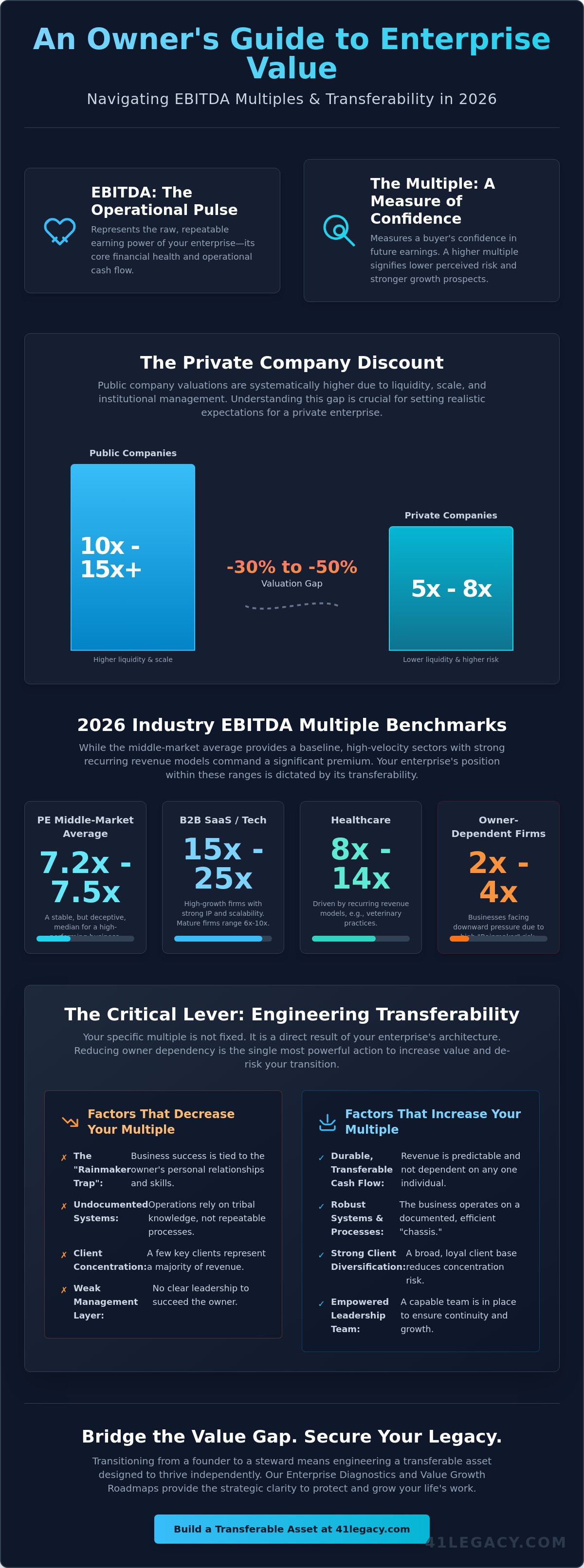
Relying on public market data to value a private enterprise is like comparing a mass-produced print to an original oil painting. While public indices offer a broad sense of direction, they often mask the intricate realities of the private market. Public company multiples are systematically 30% to 50% higher than those of private firms. This disparity stems from liquidity, scale, and the depth of institutional management. For a business owner, understanding EBITDA multiples by industry 2026 requires a more nuanced lens that accounts for this private company discount.
Market velocity serves as a primary driver of these benchmarks. In 2026, the average PE-sponsored middle-market deal multiple remains stable between 7.2x and 7.5x EBITDA. However, this median is a deceptive figure for a high-performing owner. It conflates the struggling firm with the "A-tier" asset. To truly grasp your position, you must look at how specific industry dynamics and recurring revenue models create a premium. A guide to EBITDA multiples can help frame these variations, but the architecture of your specific business determines where you land within the range.
High-Velocity Sectors: SaaS, Healthcare, and Tech
Sectors characterized by rapid scalability and intellectual property command the highest premiums in 2026. High-growth B2B SaaS companies often trade between 15x and 25x EBITDA. Even mature software firms maintain a 6x to 10x range. Healthcare also sees significant activity. Veterinary practices, for instance, range from 8x to 14x, though owner-dependent solo practices can dip as low as 3.5x. The common thread here is the premium on low-churn, subscription-based revenue. Recurring income can add a 15% to 60% premium to a multiple, as it offers a buyer the gift of predictable future cash flow.
Traditional Foundations: Manufacturing, Distribution, and Services
Capital-intensive industries like manufacturing and distribution typically operate within a 4x to 7x range. Aerospace and defense components are a notable exception, often reaching 8x to 12x due to high barriers to entry. In these sectors, supply chain resilience has become a vital valuation metric in 2026. A traditional firm can transcend its industry median by demonstrating Strategic Capacity. This involves showing that the business can scale without the founder's constant intervention. Uncovering these hidden levers is part of a thorough Strategic Capacity Evaluation, which helps move a business from a standard multiple to an elite valuation.
Beyond the Median: Why Transferability Dictates Your Specific Multiple
An EBITDA multiple is not a static verdict handed down by the market. It is a dynamic reflection of how well an enterprise can survive its creator. While NYU Stern valuation data provides the broad strokes of industry trends, your specific position within that range depends on the architecture of transferability. We often encounter the "Rainmaker Trap." This occurs when a founder’s brilliance becomes the firm’s greatest liability. If the owner remains the primary source of sales, strategy, and high-level problem solving, the business isn't an asset; it's a high-paying job. In the eyes of a sophisticated buyer, owner-dependency is the ultimate "multiple killer" in private markets.
A diversified customer base acts as an insurance policy for your enterprise value. If a single client represents more than 15% of your total revenue, your multiple will inevitably face downward pressure, regardless of your growth rate. Buyers seek the security of a resilient ecosystem. They want to see a business where the loss of one thread doesn't unravel the entire tapestry. True stewardship involves weaving a safety net that protects the integrity of the cash flow long after the transition is complete. This focus on risk reduction is what separates a standard business from a transferable masterpiece.
The Essence of Transferability
A transferable asset is a masterpiece of operational engineering that thrives independently of its creator. When a transition occurs, the buyer isn't paying for your past achievements or your personal charisma. They're purchasing the certainty of future cash flows. This certainty is anchored by a management team capable of sustaining the organization’s rhythm without the founder’s hand on the tiller. Precision in documenting Standard Operating Procedures (SOPs) is not a clerical task. It is an artisanal endeavor. It preserves the essence of your process, ensuring it can be replicated with extreme precision by those who follow in your footsteps.
Reducing Owner Dependency
The journey toward a premium valuation requires a shift from operator to strategist. You must transition from being the "Quarterback" who touches every play to the "Architect" who designs the system. Understanding EBITDA multiples by industry 2026 means recognizing that the most valuable businesses are the ones that need their owners the least. Start by evaluating how often you're pulled into daily tactical decisions. If the business cannot function for 30 days in your absence, its value is significantly impaired. We utilize Exit Readiness Assessments to identify these specific structural risks. This process provides the strategic clarity needed to engineer a roadmap for independence, ensuring your life's work is ready to stand on its own.
The Value Gap: Bridging the Distance Between Current Worth and Legacy Goals
Many owners operate under a model of "accidental growth," where success is the byproduct of hard work rather than deliberate architectural design. As we move through 2026, the market no longer rewards the accidental. It demands intentionality. Understanding EBITDA multiples by industry 2026 is only the first step in a much larger journey of stewardship. The true challenge lies in identifying the Value Gap. This is the silent, often unexamined distance between the current market value of your enterprise and the financial resources required to fund your next chapter and secure your legacy.
Closing this gap requires a surgical look at the internal mechanics of your organization. We utilize Enterprise Diagnostics to uncover the hidden value that often remains trapped beneath the surface of daily operations. These diagnostics reveal where risk is dragging down your multiple and where untapped potential can be polished into a premium asset. By moving from a reactive stance to a proactive strategy, you transform your business from a source of income into a transferable masterpiece that commands respect in any market environment.
Identifying the Gap
Aligning your personal financial goals with the reality of your business valuation is a profound exercise in strategic clarity. Many owners discover, too late, that their "life’s work" carries a value lower than their retirement needs. This realization often brings an emotional and financial cost that could have been avoided with early intervention. We believe this process requires a coordinated effort between the owner and their trusted circle of professional advisors, including CPAs and attorneys. Establishing this baseline early ensures that your transition is a planned coronation rather than a forced retreat.
Executing the Value Growth Roadmap
Once the gap is identified, the work of precision building begins. A Value Growth Roadmap provides a multi-year path to multiple expansion, focusing on the specific levers that drive enterprise value. This is where Transferability Engineering becomes essential. We systematically remove the founder from the critical path of the business, ensuring that every process is documented and every team member is empowered. Monthly Implementation Support serves as the harmonising force in this journey. It provides the steady, unhurried guidance needed to keep the organization aligned with its ultimate vision of perfection. If you are ready to see the true potential of your enterprise, we invite you to begin your journey with a comprehensive Enterprise Diagnostics assessment.
Engineering Exit Readiness: How 41 Legacy Protects and Grows Your Life’s Work
At 41 Legacy, we view ourselves as guardians of your enterprise’s essence. Our mission transcends mere consulting; we focus on the meticulous construction of businesses as transferable assets that can thrive independently of their creators. We understand that your company is a masterpiece of engineering and effort, a historical narrative that deserves to be preserved with the utmost reverence. By focusing on the architecture of transferability, we ensure that your transition is not merely a transaction, but the successful passing of a torch to the next generation of leadership.
The path to a successful transition is rarely a solitary journey. While your CPA and attorney provide essential technical and legal frameworks, they often operate within specialized silos. We serve as the "Advisory Quarterback," harmonizing these distinct voices into a singular, coordinated strategy. This ensures that every legal structure and financial report is intentionally designed to support the long-term health and value of the enterprise. We don't just provide data; we provide the strategic leadership necessary to align your professional team toward the preservation of your legacy.
The Diagnostic Advantage
Our process begins with a curatorial review of your organization's health. We treat this initial assessment as a surgical examination of the levers that drive your specific valuation. Through our Enterprise Diagnostics, we identify the exact operational drivers that will expand your position within the market. Understanding EBITDA multiples by industry 2026 allows us to pinpoint where your business currently sits and, more importantly, where it has the potential to go. A formal Exit Readiness Assessment is a vital prerequisite before entering the market, as it uncovers the hidden risks that could otherwise lead to a significant "Value Gap" during negotiations.
A Coordinated Vision for the Future
True stewardship requires a shift in perspective from being the owner of an entity to being the guardian of its future. This stewardship model ensures that the business remains resilient, scalable, and attractive to those who value heritage as much as performance. We align your CPAs, attorneys, and RIAs toward this unified goal, ensuring that the technical precision of their work serves your ultimate legacy goals. By engineering an organization that is no longer dependent on your daily presence, you create an asset that is truly timeless. It's time to move beyond the uncertainty of market medians and toward a future defined by strategic clarity. Begin your journey toward a transferable legacy with 41 Legacy and ensure your life’s work continues to flourish for decades to come.
The Architect’s Path to an Enduring Legacy
Your business is a living masterpiece. It's the culmination of years of meticulous craftsmanship and unwavering dedication. As we've explored, the true value of your enterprise isn't found in a static industry average. It's found in its ability to flourish independently of your daily touch. Understanding EBITDA multiples by industry 2026 is the first step toward reclaiming your role as the architect of a transferable asset. By reducing owner dependency and bridging the Value Gap, you transform a successful company into a resilient legacy that stands the test of time.
We believe every owner deserves a transition that reflects the excellence of their work. Our team, led by a Certified Exit Planning Advisor (CEPA), provides the surgical precision needed to coordinate your existing circle of CPAs and attorneys. Through customized Value Growth Roadmaps, we help you engineer an organization that's ready for its next chapter. Don't leave your life's work to the whims of the market. Secure your legacy with a professional Exit Readiness Assessment and begin the journey of transforming your enterprise into a lasting masterpiece. Your future deserves the same precision you've given your past.
Frequently Asked Questions
What is a "good" EBITDA multiple for a small business in 2026?
A "good" multiple is relative to your specific sector and the scale of your operations. In 2026, middle-market firms with $10M to $25M in EBITDA typically see multiples between 7.2x and 7.5x. Understanding EBITDA multiples by industry 2026 means recognizing that smaller businesses with under $1M in profit often trade on Seller's Discretionary Earnings (SDE) instead. Achieving a multiple at the top of your industry's range requires a focus on quality and transferability.
How does customer concentration specifically impact my EBITDA multiple?
High customer concentration acts as a significant drag on your valuation because it represents a singular point of failure. If one client accounts for more than 15% of your total revenue, buyers will inevitably apply a discount to your multiple to account for the risk. Diversifying your client base ensures that the enterprise’s essence remains secure. This stability is what allows a steward to command a premium in a competitive market.
Can I increase my industry multiple without increasing my revenue?
You can absolutely expand your multiple by improving the quality of your existing earnings. Shifting toward recurring revenue models can add a 15% to 60% premium to your valuation because it offers the buyer predictable future cash flow. Reducing owner dependency and engineering better transferability also makes the asset more attractive. When a business can thrive without its founder, its value increases regardless of the top-line revenue figure.
What is the difference between EBITDA and Adjusted EBITDA in a valuation?
EBITDA is a raw measure of operational cash flow, while Adjusted EBITDA provides a normalized view of the business’s true earning power. Adjustments involve adding back one-time expenses, non-recurring costs, or owner-related benefits that won't continue after a transition. This process requires surgical precision to ensure the buyer sees the repeatable financial essence of the organization. It’s a vital step in revealing the true enterprise value hidden within your ledger.
Why do SaaS companies have higher multiples than manufacturing firms?
SaaS companies command higher multiples because they offer extreme scalability and high levels of recurring revenue. A high-growth B2B SaaS firm can reach multiples of 15x to 25x because its growth isn't tied to heavy capital reinvestment. Manufacturing is traditionally capital-intensive with lower margins, often resulting in a 4x to 7x range. The market rewards the efficiency and predictable nature of the software model over the physical requirements of production.
How far in advance should I start planning for an exit to maximize my multiple?
Strategic planning should ideally begin three to five years before your anticipated transition. This timeframe allows you to execute a Value Growth Roadmap and implement Transferability Engineering with the necessary care. It takes time to document SOPs to an artisanal standard and to shift from an operator role to a strategic architect. Early preparation ensures that you aren't forced to accept a lower multiple due to lack of readiness.
What is the role of a Certified Exit Planning Advisor (CEPA) in determining value?
A CEPA serves as the strategic architect who coordinates your professional advisory team toward a unified goal. While they don't provide certified accounting services, they use Enterprise Diagnostics to identify the specific levers that will expand your multiple. Their role is to ensure that your business is a transferable asset. They bridge the gap between your current worth and your legacy goals by focusing on value growth and risk reduction.
Does my industry multiple change if I have a strong management team in place?
A strong management team is one of the most powerful catalysts for multiple expansion. Buyers pay a premium for businesses that function with extreme precision independently of the founder’s daily involvement. Understanding EBITDA multiples by industry 2026 requires acknowledging that "A-tier" assets always feature deep leadership teams. When you reduce owner dependency, you lower the buyer's perceived risk, which naturally pushes your multiple toward the highest end of the industry range.
Disclaimer
This article is for educational and informational purposes only and does not provide legal, tax, investment, or business brokerage advice. 41 Legacy does not offer M&A brokerage services, legal document drafting, tax preparation, or investment advisory services. Business owners should consult licensed professionals in those disciplines before making decisions related to business transactions, legal matters, tax strategy, or financial planning. All examples are illustrative and may not apply to your specific situation.