
Timeline for Preparing a Business for Sale: A Practical Guide
What if the right timeline for preparing a business for sale isn’t a countdown to a listing date, but a sequence of decisions that makes the company less dependent on you? The time required depends on the business’s financial records, operating systems, leadership depth, and how much still rests with the owner. Starting with those conditions gives you a more useful answer than picking a date and working backward without assessing what needs to change.
Preparation doesn’t have to pull focus from daily operations. Prioritize improvements that strengthen the enterprise while keeping attention on the work that sustains it. This guide explains how to build a practical preparation timeline, identify factors that affect the work, and set milestones across financial, operational, and leadership readiness.
Sale preparation works best as staged progress, not a fixed countdown. An Exit Readiness Assessment and tailored Value Growth Roadmap can establish a baseline and help sequence the work. The aim is a more transferable business, supported by clearer systems and less owner dependency, whether a transition is near or still taking shape.
Key Takeaways
- Build the timeline for preparing a business for sale around the company’s actual readiness, not an assumed countdown.
- Work backward from the owner’s desired transition to identify the capabilities the business needs to operate with less owner involvement.
- Assess financial, operational, and leadership readiness together. Stronger financial results alone don’t make a business transferable.
- Give each priority an accountable owner, a measurable outcome, and a point to review progress.
- Use an Exit Readiness Assessment to establish a baseline, then sequence the most important gaps into a practical Value Growth Roadmap.
When to Start Preparing Your Business for Sale?
Start before a transition is imminent. Preparing a business for sale means strengthening its ability to perform and transfer without depending on the owner for every important decision. It is ongoing readiness work, not simply the later task of assembling materials for a sale process.
There’s no dependable countdown that applies to every company. The right starting point depends on how the business operates today, what a future transition needs to accomplish, and how much change is needed to make the enterprise more transferable. The Mergers and acquisitions process provides the broader transaction context. Preparation comes earlier, building the conditions for a transition rather than trying to compress that work into the transaction itself.
Why there is no universal business-sale preparation timeline
Consider two companies with similar operations. In one, processes are documented, managers understand their responsibilities, and routine decisions are made without the owner. In the other, essential knowledge sits with the founder and procedures are informal. The second company has more foundational work to address before it can operate independently. That difference, along with the owner’s transition goals, makes readiness milestones more useful than a fixed timetable.
The timeline for preparing a business for sale should reflect its current transferability. A plan might begin with documenting recurring processes, improving management reporting, or clarifying who has authority to make particular decisions. Measure progress by whether the business can perform more reliably without the owner, not simply by how much time has passed.
Signs that preparation should begin before a sale is imminent
Readiness gaps often show up in daily operations before an owner sets a transition date. Notice whether routine approvals stall when you’re unavailable, key customer or operating knowledge rests with one person, or important decisions are rarely documented. Inconsistent management reports and shifting strategic priorities can also make it difficult to understand the business’s position and decide what needs attention.
These are practical signals, not reasons to rush into a sale. They point to work that may improve continuity and reduce risk while you continue leading the company. A broader exit planning for business owners framework can connect personal transition objectives with the capabilities the enterprise needs to develop.
Begin by listing recurring bottlenecks that require your involvement. For each one, note the decision, relationship, or process involved, who could take responsibility, and what information or authority they would need. This inventory can clarify the first readiness milestones and keep preparation connected to the business’s strategic priorities.
Core Phases of Preparing a Business for Sale
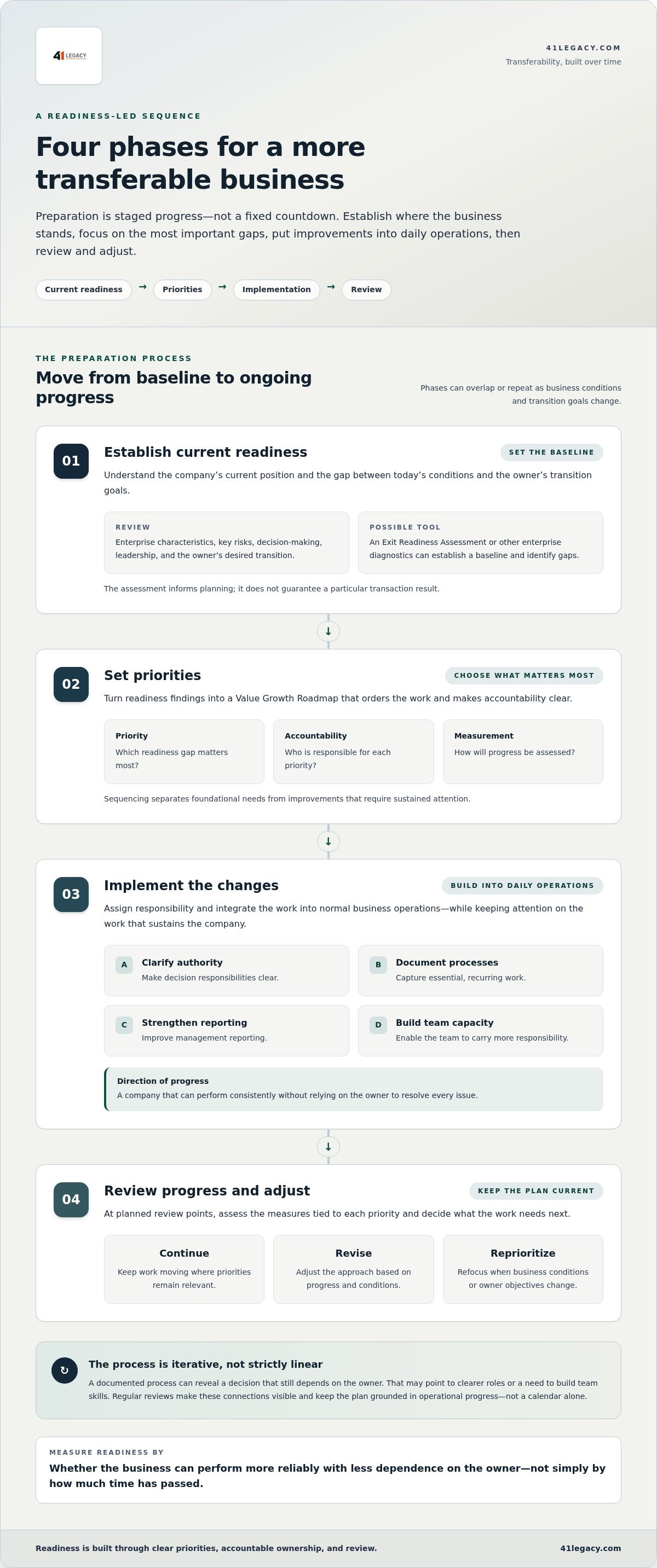
A useful preparation plan has an order, but it isn’t rigid. The work generally moves from understanding the company’s current position to choosing priorities, making changes, and reviewing whether those changes are improving transferability. Foundational tasks, such as clarifying reporting or documenting key processes, can proceed alongside longer-term work to reduce owner dependency or strengthen leadership capacity.
Use these phases as a working structure for the timeline for preparing a business for sale. They can overlap or repeat when business conditions or the owner’s transition goals change.
- Establish current readiness. Review the company’s enterprise characteristics, key risks, decision-making, leadership, and the owner’s desired transition. An Exit Readiness Assessment or other enterprise diagnostics can establish a baseline and identify the gap between current conditions and the owner’s goals. It provides direction for planning, not a guarantee of a particular transaction result.
- Set priorities. Turn the findings into a Value Growth Roadmap that identifies which readiness gaps matter most, who is accountable for each priority, and how progress will be measured. Sequencing helps distinguish foundational needs from improvements that require sustained attention.
- Implement the changes. Assign responsibility and integrate the work into normal business operations. Priorities might include clarifying decision authority, documenting essential processes, strengthening management reporting, or building the team’s capacity to carry more responsibility. The aim is a company that can perform consistently without relying on the owner to resolve every issue.
- Review progress and adjust. At planned review points, assess the measures tied to each priority and decide whether to continue, revise, or reprioritize the work. New business conditions or a change in the owner’s objectives may call for another readiness review.
Assessment and prioritization are often the clearest starting points, but implementation rarely happens in a straight line. Documenting a process, for example, may reveal a decision that still depends on the owner. That can point to a need to clarify roles or build the team’s skills. Regular reviews make these connections visible and keep the plan grounded in operational progress rather than a calendar alone.
For further perspective on how readiness work can support enterprise value, explore a guide to increasing enterprise value for business owners. 41 Legacy’s strategic advisory support helps owners assess priorities and maintain momentum.
What makes a business-sale preparation timeline longer or shorter?
The amount of preparation depends on how readily the business can explain and sustain its performance without the owner. Strong financial results may help, but they don’t resolve unclear responsibilities, undocumented decisions, or a leadership team that relies on the founder to keep work moving. The timeline for preparing a business for sale is shaped by the gaps between current practices and the continuity the owner’s transition goals require.
Use this comparison to identify where work may need to begin. These are areas to assess, not predictions about how long readiness will take.
| Current condition | Likely preparation focus |
|---|---|
| Processes and responsibilities are documented and followed consistently. | Test whether practices remain reliable across teams, customers, and changing conditions. |
| Important knowledge and decisions sit mainly with the owner or a key employee. | Document essential knowledge, clarify decision rights, and build shared responsibility. |
| Management information is inconsistent or difficult to interpret. | Improve the consistency and clarity of reporting so leaders can understand performance and act on it. |
| Leaders have defined roles and can manage routine operations. | Strengthen strategic capacity so the team can take on broader responsibility as needed. |
| Priorities change often or lack clear ownership. | Align the work around specific outcomes, accountable people, and regular progress reviews. |
How owner dependency and undocumented processes affect readiness
When customers, staff, or operating decisions rely on knowledge held by one person, continuity is harder to demonstrate. A company may be running well, yet still depend on the owner to resolve routine questions or maintain key relationships. Documented responsibilities and repeatable practices make it clearer how work gets done and who can carry it forward. A practical companion is a guide to SOPs and transferable businesses, which can help owners consider how to turn essential processes into shared business knowledge.
Why financial clarity and leadership capacity shape the work
Consistent, understandable management information helps leaders see what is happening and make informed operating decisions. The goal here isn’t to prescribe accounting work. It’s to ensure the business can explain its performance clearly and use its information to guide priorities.
Leadership matters just as much. If managers can make defined decisions and keep operations moving, the company is less reliant on the owner as its central point of coordination. Readiness is broader than a single valuation figure or a strong short-term result. It reflects whether the business has the people, practices, information, and strategic capacity to sustain its performance through a transition.
To keep preparation manageable alongside daily operations, connect each improvement to existing responsibilities and review routines. For instance, include process ownership in a manager’s role and review progress alongside normal operating priorities. Readiness work can then strengthen how the company runs instead of becoming a separate project competing with it.
How to build a realistic business-sale preparation timeline
Start with the transition you want, not a generic deadline. Consider what the next chapter should look like, what role you expect to have in the business, and what the company must be able to do without your direct involvement. Then work backward, identifying the capabilities and signs of readiness that would support that transition. This turns the timeline for preparing a business for sale into a practical plan rather than a countdown.
Translate each broad goal into a milestone the leadership team can observe. For example, “reduce owner dependency” could mean that a manager can handle a defined set of recurring decisions, or that a critical operating process is documented and followed consistently. For every initiative, record:
- Accountable owner: the person responsible for moving the work forward.
- Measurable outcome: the observable change that will show progress.
- Review point: when leaders will assess progress and decide whether to continue or adjust.
Turn readiness goals into milestones the leadership team can own
Place responsibility with the people closest to the work, and clarify which decisions they can make independently. If a priority is improving management reporting, define what information leaders need, who prepares it, and how it will inform decisions. Review milestones consistently, and change the sequence if operating conditions, leadership capacity, or the owner’s objectives shift. A useful roadmap stays accountable without becoming fixed.
Keep the preparation plan compatible with daily operations
Preparation should strengthen the business without becoming a second business to run. Rank initiatives by their effect on transferability, their dependencies, and the time and attention leaders can realistically give them. Some foundational work may need to come first, while other improvements can wait until the right people or systems are in place.
Resist making every gap urgent. Taking on too many changes at once can divide leadership attention and make it harder to sustain progress in daily operations. A focused set of priorities, reviewed at regular intervals, gives the team room to implement changes and learn from them before adding more work.
Owners can connect readiness priorities with broader strategic advisory services and coordinated support. 41 Legacy helps structure a roadmap around transition goals and business capacity through its strategic advisory support.
How 41 Legacy supports a more transferable business over time
Preparing for a transition is easier to manage when the work begins with a clear view of the business as it operates today. 41 Legacy’s Exit Readiness Assessment establishes that baseline by examining factors such as transferability, owner dependency, strategic capacity, and enterprise priorities. It helps identify the gap between current conditions and the owner’s desired transition, giving the preparation plan a grounded starting point.
From enterprise diagnostics to a tailored value growth roadmap
Assessment findings are most useful when they guide action. A Value Growth Roadmap translates diagnostic insights into sequenced priorities shaped around the company’s needs and the owner’s goals. Findings may point to documenting a core process, clarifying leadership responsibilities, or strengthening the team’s ability to make decisions without the owner. The roadmap helps determine what to address first and how to track progress, without promising a particular valuation, sale result, or completion date.
This structure keeps the timeline for preparing a business for sale connected to meaningful changes in the enterprise, rather than activity for its own sake. Priorities can be reviewed and adjusted as the business develops or the owner’s plans change. For owners seeking a coordinated approach, explore 41 Legacy’s strategic advisory approach.
Maintain momentum with coordinated implementation support
A roadmap creates direction; consistent follow-through turns that direction into progress. Monthly Implementation Support provides a recurring structure for reviewing initiatives, addressing obstacles, and maintaining accountability while the owner continues to lead the business. Progress reviews help leaders see whether responsibilities are clear, milestones remain relevant, and the work is strengthening the company’s ability to operate beyond its founder.
41 Legacy coordinates with the owner’s existing professional advisors, including CPAs and attorneys, as an advisory quarterback. This helps align strategic priorities across the owner’s professional team, while each advisor remains focused on their own area of expertise. The purpose is not to add activity for its own sake, but to keep important readiness work moving in a deliberate order.
A more transferable enterprise is built through steady, coordinated progress. Explore a structured readiness process to see how assessment, a tailored roadmap, and implementation support can bring clarity to the work ahead.
Build readiness into the next chapter
A realistic timeline for preparing a business for sale is built around readiness milestones, not a fixed countdown. The right priorities depend on the company’s current transferability, its reliance on the owner, and the transition the owner wants to make. Sequenced work helps strengthen the business while keeping daily operations in view.
Progress comes from more than improving financial results. Clear responsibilities, dependable leadership, and repeatable processes help the enterprise operate with less reliance on its founder. Review priorities as the business evolves, and keep each initiative connected to a meaningful outcome.
41 Legacy connects enterprise diagnostics with a tailored Value Growth Roadmap, turning findings into sequenced priorities. Monthly implementation support helps maintain accountability and coordinate progress with the owner’s existing advisory team. The result is a more deliberate path toward a business that can thrive beyond its founder.
Frequently Asked Questions
How long does it take to prepare a business for sale?
Preparation time depends on the company’s starting point and the changes needed to make it more transferable. The timeline for preparing a business for sale may involve addressing owner dependency, clarifying leadership responsibilities, improving management reporting, or documenting key processes. A company with established systems may have different priorities from one that relies on informal knowledge. Set milestones based on readiness gaps and review progress rather than assuming every business needs the same countdown.
When should I start preparing my business for sale?
Start before a sale is imminent, especially if important decisions, customer relationships, or operating knowledge depend heavily on you. Beginning early gives you room to strengthen the business while continuing to lead it, rather than treating readiness as a last-minute project. You don’t need a fixed transition date to begin. Clarify your goals, assess the company’s current transferability, and identify the first capabilities it needs to develop.
Can I prepare my business for sale while running it?
Yes. Preparation can be integrated into normal business operations when initiatives are prioritized and assigned to the people closest to the work. For example, a manager could document a recurring process while also taking responsibility for the related decisions. Avoid launching every improvement at once. Set clear outcomes and review points, then adjust the workload to fit leadership capacity and current operating demands.
What should I do first when preparing my business for sale?
Begin by defining the transition you want and assessing how well the business could operate without your direct involvement. Identify recurring decisions that depend on you, processes known only informally, and gaps in leadership or management information. This initial review helps distinguish foundational needs from longer-term improvements. From there, choose a focused priority, assign an accountable person, and define an observable result that will show progress.
Does a business need to be fully independent of its owner before a sale?
No. The owner doesn’t need to disappear from every part of the business, but the company is more transferable when essential operations and decisions don’t rely on one person alone. Start by identifying where your involvement is most critical, then clarify responsibilities, document key practices, and build leadership capacity in those areas. The aim is to reduce avoidable dependency and support continuity, not to remove the owner’s knowledge or contribution.
Which business records should be organized during sale preparation?
Organize records that help explain the company’s performance, operations, and responsibilities. This may include consistent management reports, organizational roles, process documentation, and records related to important customer or supplier relationships. Begin with materials leaders use to run the business and identify what’s missing, difficult to interpret, or held only by one person. The owner’s existing professional advisors can help address records within their respective areas of expertise.
How does an exit readiness assessment help create a timeline?
An Exit Readiness Assessment establishes a baseline by examining the business’s current transferability, owner dependency, strategic capacity, and priorities. It can help clarify the gap between current conditions and the owner’s goals, then inform a Value Growth Roadmap with sequenced work. The assessment doesn’t guarantee a transaction outcome or set a universal completion date. It gives the owner a more grounded basis for choosing milestones, assigning responsibility, and reviewing progress.

Article by
Mike Laskowski
Mike Laskowski is a Business Value Growth Strategist who helps business owners uncover the truths that drive their performance, risk, and readiness. Blending forensic interviewing from a 26‑year federal career with Strategic Capacity analysis and CEPA methodology, he works upstream to reduce owner dependency, increase transferability, and strengthen enterprise value. Mike guides founders through clarity, operational evolution, and transition readiness so their companies become transferable, owner‑independent assets that endure beyond the founder.
Disclaimer
This article is for educational and informational purposes only and does not provide legal, tax, investment, or business brokerage advice. 41 Legacy does not offer M&A brokerage services, legal document drafting, tax preparation, or investment advisory services. Business owners should consult licensed professionals in those disciplines before making decisions related to business transactions, legal matters, tax strategy, or financial planning. All examples are illustrative and may not apply to your specific situation.

