
The Strategic Timeline for Selling a Business: Engineering a Transferable Legacy
A business exit is not a singular transaction; it's the final, most refined act of leadership. For many founders, the enterprise has become a masterpiece that requires their constant touch, leaving them caught in a rainmaker trap that limits true growth. You've dedicated years to your craft, yet the uncertainty of your life’s work's actual market value can feel like an unresolved chord. We understand the weight of this stewardship and the frustration of uncoordinated advice from siloed professionals.
This article reveals why a successful exit planning timeline is actually a multi-year journey of engineering enterprise value and transferability. We'll provide a clear roadmap to closing the Value Gap, ensuring your business thrives independently of your daily presence. By treating your exit as a deliberate process of craftsmanship rather than a hurried sale, you can protect your legacy and ensure a seamless transition. You'll learn how to transform your business into a high-performance asset that commands respect in any market, allowing you to step away with the confidence that your essence remains preserved within a thriving, independent entity.
Key Takeaways
- Understand why a three-to-five-year exit planning timeline is the gold standard for engineering a business that commands its full market potential.
- Learn how to utilize an Enterprise Diagnostic to pinpoint the Value Gap and align your current operations with your ultimate financial goals.
- Discover the principles of Transferability Engineering to reduce owner dependency and ensure the business thrives beyond your daily involvement.
- Explore the concept of a coordinated advisory team to harmonize your CPA, attorney, and financial advisors toward a singular, strategic vision.
- Identify the steps to move from a diagnostic assessment to a structured Value Growth Roadmap that protects your legacy and enhances enterprise value.
Redefining the Timeline: Exit Readiness as a Multi-Year Architectural Pursuit
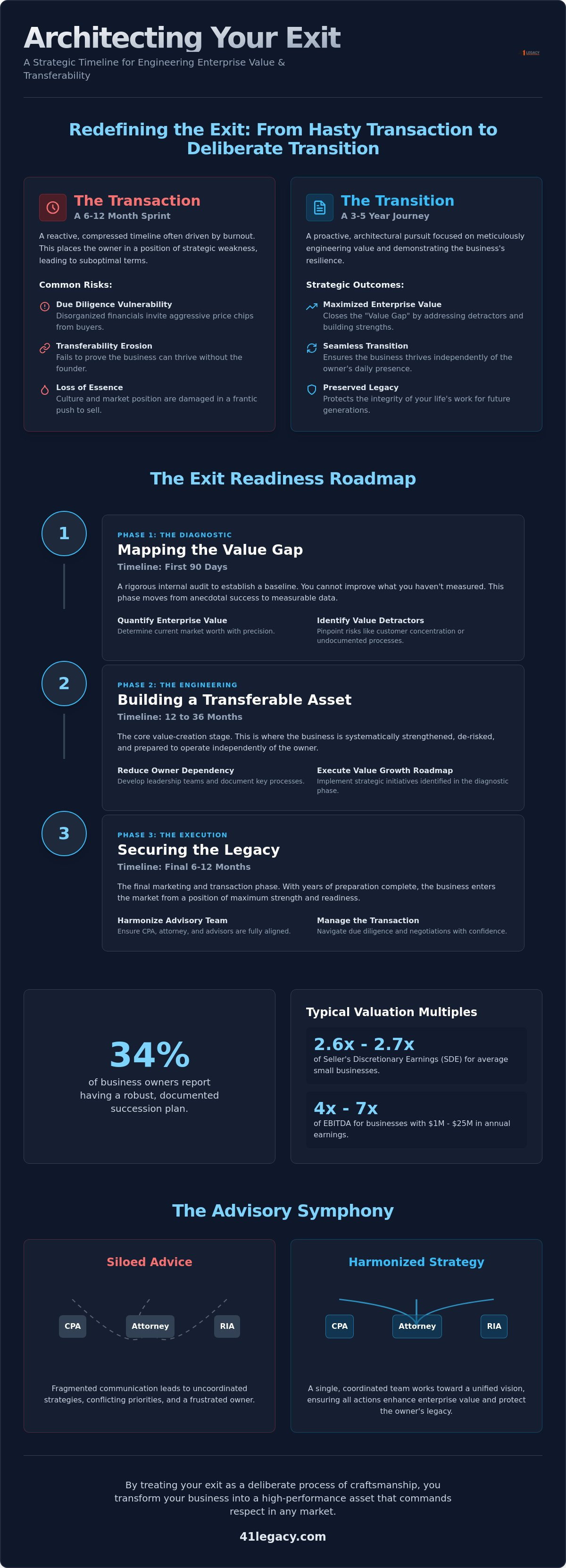
A business sale is often mistaken for a brief transaction, a mere exchange of signatures. In reality, a successful transfer of leadership is a deliberate, multi-year architectural pursuit. While some brokers suggest a sale takes six to twelve months, this only accounts for the final marketing phase. A truly strategic exit planning timeline spans three to five years. This window allows for the meticulous engineering of enterprise value and the reduction of owner dependency, ensuring the company thrives long after the founder's departure. We view this period as a season of stewardship. The owner acts as a curator, refining the essence of the business into a transferable asset that commands respect in the marketplace.
The Transaction vs. The Transition
A sale is a singular point in time. A transition is a profound evolution of the organization's soul. Relying on a compressed timeline often stems from burnout or unforeseen health changes, which places the owner in a position of strategic weakness. True exit readiness isn't a reaction to fatigue; it's a proactive commitment to exceptional management. Industry data indicates that only 34% of business owners report having a robust, documented, and communicated succession plan. By reviewing an Exit planning overview, it becomes clear that readiness is synonymous with operational excellence. It's about building a legacy that isn't tethered to one individual's brilliance. Instead, we focus on creating a resilient, independent system that functions with the precision of a fine timepiece.
The Cost of a Compressed Timeline
When the horizon is rushed, the Value Gap becomes an insurmountable chasm. This gap represents the distance between what the business is worth today and what the owner needs for their next chapter. Rushing often leads to deal fatigue, where the emotional and physical toll of the process causes the seller to accept suboptimal terms just to reach the end. Consider the following risks of a truncated approach:
- Due Diligence Vulnerability: Lack of preparation results in disorganized financials and loose contracts that invite aggressive price chips during the final hour.
- Transferability Erosion: A compressed timeline fails to demonstrate that the business can survive without the founder, leaving buyers wary of the enterprise's true durability.
- Loss of Essence: Without deliberate planning, the company's culture and unique market position can be eroded in a frantic push toward a liquidity event.
By extending the exit planning timeline, you protect the integrity of your life's work. You move from being a "rainmaker" to a steward of a lasting institution. This unhurried approach ensures that every detail is polished to a high sheen, reflecting the meticulous nature of the work you've performed for decades.
The Diagnostic Phase: Mapping the Value Gap in the First 90 Days
The first 90 days of an exit planning timeline are dedicated to a rigorous internal audit. We call this the Enterprise Diagnostic. It's a surgical examination of the company's current state, designed to move beyond anecdotal success and into the realm of measurable data. You cannot improve what you haven't measured. Without a baseline, any attempt to grow value is merely guesswork. This diagnostic phase establishes the foundation upon which your entire legacy will be built, ensuring that every subsequent action is rooted in strategic clarity.
The Enterprise Diagnostic Process
Precision is the hallmark of this stage. We begin by quantifying the current enterprise value with surgical accuracy. In 2026, the average small business in the U.S. sells for approximately 2.6x to 2.7x its seller's discretionary earnings (SDE). However, for businesses with $1 million to $25 million in EBITDA, the typical valuation range expands to 4x to 7x. Identifying where your company sits on this spectrum is the first step in identifying Value Detractors. These are hidden risks, such as high customer concentration or a lack of documented processes, that invite buyers to discount your life's work. Finally, we evaluate the strategic capacity of your existing leadership. A business that depends on the founder's brilliance is a fragile one. We look for a team capable of carrying the torch without your daily intervention, transforming the business from a personal job into a transferable asset.
Understanding the Wealth Gap
Success is measured by the alignment of business value with your personal financial and legacy goals. The Wealth Gap is the distance between the net proceeds you'll receive after taxes and the amount required to fund your next act. It's a sobering but necessary calculation. With the federal estate and gift tax exemption at $15 million per individual in 2026, the tax landscape offers unique opportunities for those who plan with foresight. Many owners discover that their current valuation doesn't yet support their desired lifestyle post-exit. This is where a Certified Exit Planning Advisor provides essential clarity. They act as the architect, ensuring that the business's growth trajectory is intentionally designed to meet your specific financial needs. Before moving into the engineering phase, it's vital to have an Exit Readiness Assessment to confirm your starting point and ensure your roadmap is built on solid ground.
Setting this baseline allows you to assess market attractiveness against your internal operational readiness. You might find your industry is commanding high multiples, but if your internal systems are unpolished, you'll fail to capture that premium. By addressing these gaps early in the exit planning timeline, you transition from a position of uncertainty to one of quiet confidence. You're no longer just running a business; you're curating a masterpiece for its eventual handover.
The Engineering Phase: Reducing Owner Dependency Over 12 to 36 Months
After the diagnostic phase establishes the strategic baseline, the focus shifts to the rigorous work of engineering. This phase of the exit planning timeline typically requires 12 to 36 months of dedicated effort. It's the period where we move from merely identifying the Value Gap to actively closing it. A common hurdle we encounter is the "Rainmaker Trap," where the founder’s individual brilliance becomes the company's greatest liability. To a sophisticated buyer, an owner-dependent business is a high-risk gamble. We view this phase as an act of preservation, ensuring the company’s essence is captured in systems rather than remaining locked within the founder's mind. The goal is to transform the business into a self-sustaining entity that commands a premium valuation.
De-Risking the Enterprise
Stabilizing the foundation is paramount for any successful transition. We focus on neutralizing concentrations that threaten future revenue and stability. If a single customer accounts for more than 15% of gross revenue, the enterprise is inherently vulnerable. We work to diversify customer and vendor bases, ensuring that no external entity holds undue leverage over the company’s future. This stage also requires a meticulous review of all intellectual property and contracts to ensure they're legally transferable. Clean, consistent financial reporting is not just an accounting task; it's a fundamental requirement for due diligence. By maintaining three years of pristine, accrual-based records, you demonstrate a level of professional discipline that signals quality to any prospective buyer.
Owner Dependency Reduction
The ultimate proof of a transferable asset is the Vacation Test. We ask founders a simple question: Can the business thrive if you step away for 30 days without checking your email? Achieving this level of independence requires documenting your "secret sauce" into repeatable, scalable processes. We call this Transferability Engineering. It involves shifting from an owner-operator mindset to that of a strategic steward. Standard Operating Procedures (SOPs) are the blueprints of your masterpiece, allowing the next level of leadership to execute with the same precision and passion you brought to the work. By developing a robust management tier, you ensure operational continuity and prove that the engine runs perfectly without you at the wheel. The exit planning timeline provides the necessary runway for this transformation, allowing you to mentor your successors and refine the systems that will protect your legacy for decades to come.
The Advisory Symphony: Harmonizing Your Professional Team
A business is a living entity with a story to tell, and its final chapter deserves a masterfully conducted symphony. Building a transferable legacy requires more than individual brilliance; it demands the orchestration of specialized disciplines. In a traditional setting, business owners often find themselves acting as the bridge between uncoordinated advisors. A CPA might focus on tax mitigation, while an attorney prioritizes risk avoidance, and a wealth manager looks at portfolio performance. Without a central "Quarterback" to harmonize these efforts, the advice often conflicts, creating friction that stalls progress along the exit planning timeline. We believe in the power of a unified front, where every professional is aligned toward the singular goal of maximizing enterprise value and ensuring a seamless transition.
The Role of the Strategic Advisor
Your traditional CPA is an expert in compliance and historical reporting, but they aren't necessarily a specialized exit planner. A strategic advisor brings a different lens, focusing on the future transferability of the asset. This role involves managing the significant emotional weight of a multi-year transition, acting as a steady hand when the complexities of the process feel overwhelming. By optimizing legal and tax structures years before a sale, you ensure the business is positioned for maximum impact. For instance, aligning with 2026 tax regulations, such as the $15 million federal estate tax exemption, requires foresight that typical year-end planning simply cannot provide. This level of coordination ensures that tax advice never contradicts your value growth objectives.
Implementation and Accountability
A vision without execution is merely a dream. The Value Growth Roadmap serves as a living document, a technical score that directs the engineering of the enterprise. We provide Strategic Advisory to ensure that the high-level vision is translated into granular, monthly actions. These check-ins are vital; they maintain strategic momentum and hold all parties accountable to the timeline. By acting as the bridge between your vision and the technical execution of your legal and financial team, we ensure that the engineering phase stays on track. This structured approach prevents the common pitfalls of uncoordinated advice and ensures that every refined detail of your business is preserved for the next generation of leadership. Consistent, monthly implementation support transforms a theoretical plan into a tangible, high-performance asset.
Ultimately, the goal of this advisory symphony is to protect the essence of your life's work. By integrating the technical precision of your CPA and attorney with a long-term value growth strategy, you create a resilient structure that commands respect. This collaborative environment allows you to focus on your role as a steward, confident that the intricate details of your exit planning timeline are being handled with the reverence they deserve. If you're ready to align your professional team toward a singular, elevated goal, consider beginning with a comprehensive Exit Readiness Assessment to establish your strategic baseline.
The 41 Legacy Framework: Architecting Your Transferable Asset
A legacy is built by design, not by chance. The 41 Legacy framework is the culmination of a multi-year exit planning timeline, providing the structure necessary to protect your life's work. We don't view the business as a commodity to be traded; we see it as a masterpiece to be preserved. By utilizing the CEPA methodology, we bridge the gap between creative artistry and technical engineering. This approach ensures that every refined detail of your enterprise is polished to its highest potential. Our "professional-room altitude" resonates with high-value owners because it prioritizes strategic depth over transactional hype. We aren't here to simply facilitate a sale. We're here to architect a transferable asset that thrives for generations.
Building Your Value Growth Roadmap
The journey begins with a transition from Enterprise Diagnostics to a customized Value Growth Roadmap. This document isn't a static report. It's a living blueprint for your company's future. It focuses on the relentless reduction of risk and the intentional growth of transferability. While the diagnostic phase identifies the current state, the roadmap provides the path toward your ultimate vision. It moves the conversation beyond the transaction to the preservation of your essence. You can begin this journey today by completing an Exit Readiness Assessment. This initial step provides the clarity needed to ensure your efforts are aligned with your legacy goals, allowing you to act as a steward rather than an operator.
The Quarterback Advantage
The complexity of a multi-year exit planning timeline requires a single point of coordination. We provide the Quarterback Advantage, a commitment to harmonizing your existing team of specialists. We don't replace your CPA, attorney, or wealth manager. Instead, we ensure they're all playing from the same sheet of music. Every decision made within this framework is evaluated through a singular lens: Does this increase the enterprise value of the company? By maintaining this focus, we protect the essence of what you've built. We act as the guardians of your history, ensuring that the transition to the next generation of leadership is as seamless as it is successful. This level of precision and reverent planning is the hallmark of the 41 Legacy experience, offering you the peace of mind that your life's work is in expert hands.
Architecting the Final Act of Your Masterpiece
Engineering a transferable legacy is the ultimate expression of business stewardship. You've spent years refining your craft; now, the focus must shift to ensuring your enterprise can thrive independently of your daily touch. By committing to a multi-year exit planning timeline, you move beyond the uncertainty of a transaction and into the precision of architectural readiness. This process allows you to close the Value Gap through rigorous diagnostics and the intentional reduction of owner dependency, transforming your business into a high-performance asset that commands respect in any market.
Led by a Certified Exit Planning Advisor (CEPA), we specialize in Enterprise Diagnostics and Value Growth Roadmaps designed to mitigate risk and protect the essence of your life's work. Our role is to harmonize your professional team, ensuring that every strategic decision increases the durability and value of your company. This unhurried, reverent approach ensures that your transition is as seamless as the legacy you've built. Begin your journey toward a transferable legacy with an Exit Readiness Assessment. Your masterpiece deserves a future that honors its past.
Frequently Asked Questions
How long does it actually take to sell a business from start to finish?
The final transaction stage typically takes six to twelve months, but the complete journey of engineering a transferable asset requires three to five years. This broader window ensures the business is operationally prepared to withstand the scrutiny of a buyer. Rushing the process often results in compromised valuations and unpolished handovers that fail to preserve the founder's legacy or the company's essence.
What is the difference between exit planning and a business sale?
A business sale is a singular transaction event, whereas exit planning is a comprehensive, multi-year process of engineering enterprise value. While a sale focuses on the exchange of assets, planning focuses on the business's ability to thrive independently. It is the deliberate act of curating a transferable asset that exists beyond the founder’s daily involvement, ensuring the organization’s soul remains intact.
Can I sell my business if I am still the primary driver of sales?
You can, but the enterprise value will likely be significantly diminished due to high owner dependency. Sophisticated buyers view a "rainmaker" founder as a major risk factor rather than a sustainable asset. To command a premium multiple, we recommend using a three to five year exit planning timeline to transition these relationships to a capable management team and documented systems before going to market.
What is an Exit Readiness Assessment and why do I need one?
An Exit Readiness Assessment is a surgical examination of your company’s operational and financial health to determine its current transferability. It serves as the baseline for your journey, identifying hidden risks and value detractors before they can derail a future transition. Without this diagnostic foundation, it is impossible to build a precise roadmap that aligns your business’s value with your personal financial goals.
How far in advance should I start planning my business exit?
We recommend starting the planning process at least three to five years before your desired transition date. This runway provides sufficient time for the engineering phase, where you can reduce owner dependency and improve financial reporting. Starting early ensures you aren't forced into a sale by burnout or health issues, allowing you to exit on your own terms with your legacy fully protected.
Why do most business sales fail during the due diligence phase?
Most failures occur because of a lack of documented processes and inconsistent financial reporting that comes to light under buyer scrutiny. When a buyer discovers unverified data or high customer concentration, they often re-price the deal or walk away entirely. Thorough preparation during the exit planning timeline ensures that every detail is polished to a high sheen, preventing these late-stage surprises from eroding trust.
What is a Value Gap in the context of selling a business?
The Value Gap is the difference between the current market value of your business and the net proceeds required to fund your next act. Identifying this gap early is critical for strategic clarity. If the business is worth less than your financial needs, we utilize a Value Growth Roadmap to intentionally engineer the necessary enterprise value before you ever initiate the final sale process.
How does owner dependency affect the final sale price of a company?
High owner dependency acts as a weight on your valuation multiple, often leading to lower offers or restrictive earn-outs. Buyers pay a premium for businesses that function like well-oiled machines without the founder’s intervention. By engineering transferability and empowering a leadership team, you transform the business from a personal job into a valuable, independent entity that commands a much higher market price.

Article by
Mike Laskowski
Mike Laskowski is a Business Value Growth Strategist who helps business owners uncover the truths that drive their performance, risk, and readiness. Blending forensic interviewing from a 26‑year federal career with Strategic Capacity analysis and CEPA methodology, he works upstream to reduce owner dependency, increase transferability, and strengthen enterprise value. Mike guides founders through clarity, operational evolution, and transition readiness so their companies become transferable, owner‑independent assets that endure beyond the founder.
Disclaimer
This article is for educational and informational purposes only and does not provide legal, tax, investment, or business brokerage advice. 41 Legacy does not offer M&A brokerage services, legal document drafting, tax preparation, or investment advisory services. Business owners should consult licensed professionals in those disciplines before making decisions related to business transactions, legal matters, tax strategy, or financial planning. All examples are illustrative and may not apply to your specific situation.