
The Steward’s Guide: How to Tell Your Employees You Are Selling the Business
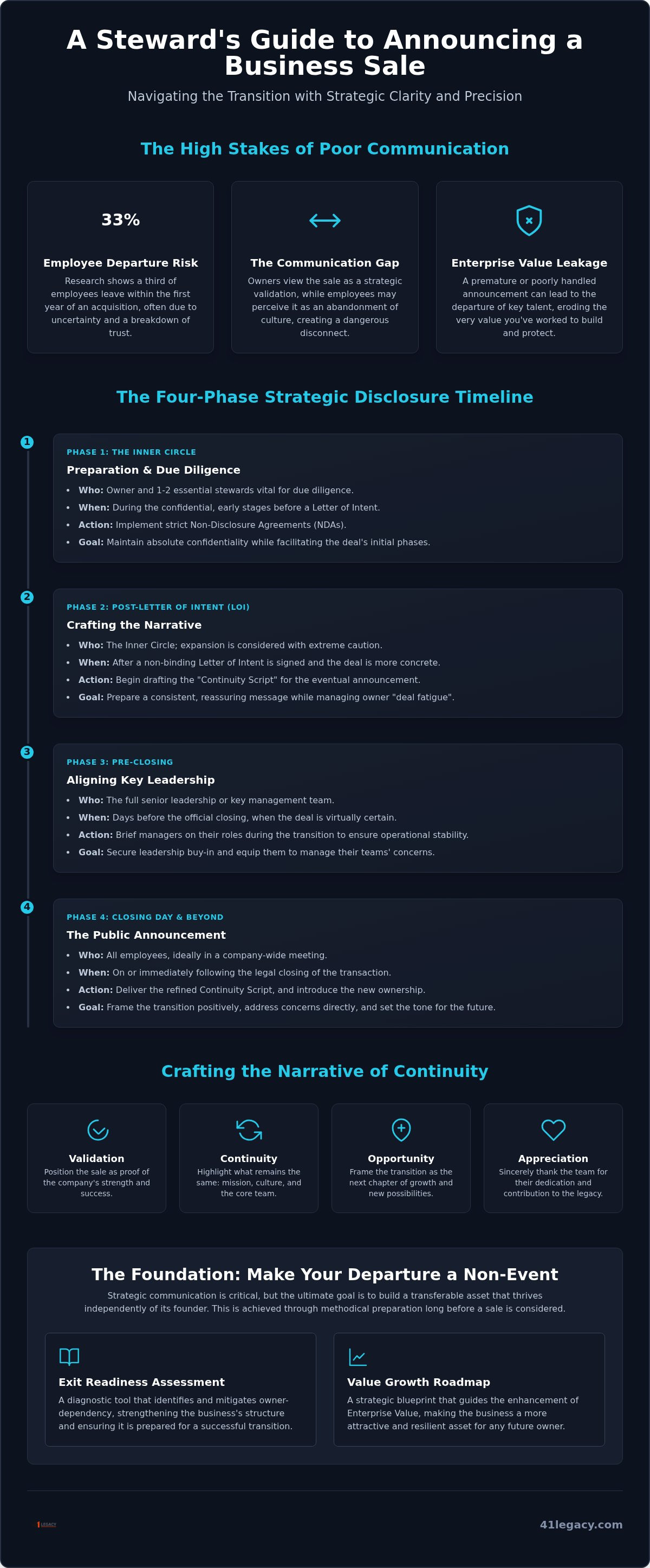
Research indicates that 33% of employees depart within the first year of an acquisition, a statistic that underscores the fragility of trust during a transition. You've spent decades curating a culture of excellence. The weight of holding this secret feels like a silent contradiction to the loyalty you've fostered. It's natural to worry that a poorly timed announcement might trigger a mass exodus or damage the buyer-employee relationship. Understanding how to tell your employees you are selling the business is not a mere administrative task; it is the final, most delicate act of stewardship. This guide provides the strategic clarity required to navigate this shift with the reverence your legacy deserves. You'll gain a clear communication timeline and a refined script designed to preserve morale while maintaining the stability of the enterprise. We will explore how to transition your team into the next chapter with the same precision you used to build the business itself.
Key Takeaways
- Learn why the timing of your announcement is a critical factor in preventing value leakage and maintaining the integrity of your enterprise during a transition.
- Discover a four-stage strategic timeline that aligns your communication with key deal milestones, ensuring your message is delivered with precision.
- Master how to tell your employees you are selling the business by identifying key stewards who require early disclosure to maintain operational continuity.
- Craft a narrative of continuity that reframes the transition as a strategic validation of the business's strength and the next chapter of its legacy.
- Understand how transferability engineering and an Exit Readiness Assessment can make your eventual departure a non-event for your loyal team.
The Weight of the Secret: Why Communication Timing Matters
The decision to transition your business is rarely about a single transaction. It is about the preservation of an essence you've cultivated over years, perhaps decades. A profound "Communication Gap" often exists during this period. While you view the transition as a strategic validation of the company's strength, employees may perceive it as an abandonment of the culture they've helped build. This dissonance creates an underlying emotional weight for the owner, who must act as a guardian of both the past and the future. You are not just managing a payroll; you are protecting a living entity with its own history and story.
The Risk of the Premature Reveal
Revealing a transition too early creates a vacuum of information. Without a clear narrative, uncertainty takes root, and employees often fill the silence with worst-case scenarios. This leads to "value leakage," where the departure of key talent erodes the very Enterprise Value you seek to protect. Within the landscape of Mergers and acquisitions (M&A), research suggests that 33% of acquired workers left within the first year of a company's acquisition. This turnover is often preventable through strategic timing. At 41 Legacy, we prioritize an Exit Readiness Assessment to ensure the business is structurally sound before the weight of a public announcement is introduced. Mastering how to tell your employees you are selling the business requires first ensuring the asset can thrive independently of your daily presence.
The Moral Dilemma of the Steward
The steward carries a unique psychological burden. You feel a pull toward absolute transparency with loyal staff, yet you hold a fiduciary duty to protect the company's future. An uncalculated disclosure can destabilize the business, harming the very people you wish to protect. You aren't merely "selling"; you are facilitating an evolution of your legacy. This shift requires a master craftsman's precision, ensuring the transition feels like a progression rather than a disruption. It's a process of honoring the history while engineering a future that no longer relies on your direct oversight. Stewardship in the context of a business exit is the disciplined commitment to preserving the enterprise's health and the team's security by choosing the right moment for every revelation. Understanding the nuances of how to tell your employees you are selling the business ensures that your final act as an owner is one of protection, not betrayal.
A Strategic Timeline for Disclosure
Transitioning a business is an intricate sequence of events that demands the same level of discipline as the original creation of the enterprise. It requires a "Quarterback" advisor to coordinate the rhythmic movement between Preparation, Due Diligence, the Letter of Intent, and the final Closing. This professional lead ensures that the timing of each revelation aligns with the deal's growing stability. A "Need to Know" basis isn't an act of deception; it is a tool of precision. By limiting sensitive information to those essential for the current phase, you prevent the premature disruption of the company's daily harmony. Your Value Growth Roadmap serves as the master blueprint for this sequence. It dictates when the business is structurally ready for the owner to step back, which in turn informs the ideal moment for disclosure.
Phase 1: The Inner Circle
In the early stages, you'll identify one or two key individuals whose operational depth is vital for the due diligence process. These are the primary stewards of your company's intellectual capital. Protecting this phase requires strict non-disclosure agreements (NDAs) to maintain the integrity of the deal and the peace of the workplace. A Certified Exit Planning Advisor acts as the architect of these early conversations. They ensure that even the most sensitive discussions are handled with the necessary gravitas and technical accuracy.
Phase 2: After the Letter of Intent (LOI)
Once a Letter of Intent is signed, the transition moves into a state of higher reality. However, this is also when "deal fatigue" often sets in for the owner. It's critical to assess the stability of the buyer's intent before expanding the circle of knowledge further. During this phase, you begin crafting the "Continuity Script" for the broader team. This document ensures that when you finally address how to tell your employees you are selling the business, the message remains consistent, authoritative, and deeply reassuring. If you're uncertain about your current team's readiness for such a shift, a structured Enterprise Diagnostic can reveal hidden risks before they impact your transition. Finalizing this timeline requires a balance of technical engineering and emotional intelligence. Every step must be intentional, moving the enterprise toward a future that honors its past while securing its next chapter.
Identifying Key Stewards vs. General Staff
Determining how to tell your employees you are selling the business begins with a surgical separation of your staff into two distinct groups: the core stewards and the general workforce. Key employees aren't merely those with the highest titles; they are the individuals who hold the company’s operational essence and intellectual capital. They are the guardians of the "secret sauce" that makes the enterprise a transferable asset. Identifying these people early allows you to secure the business's foundation before the winds of transition begin to blow. If a leak occurs prematurely, you must respond with poise and authority, addressing the rumor directly without compromising the deal's technical confidentiality.
Fear thrives in a vacuum of process. By institutionalizing knowledge through Standard Operating Procedures, you provide a tangible anchor for the team. These blueprints reduce the "fear of the unknown" by proving that the business's excellence is rooted in its systems, not just in your personal presence. When the team sees that the machinery of the company remains intact, their anxiety regarding a change in ownership diminishes significantly.
Engaging Your Management Team
When you sit down with your leadership team, frame the transition as a strategic evolution rather than an exit. This is their moment of professional maturation. By focusing on Owner Dependency Reduction, you've already begun the process of making them the true architects of the company's future. A transferable business empowers its management by transforming them from executors of a founder's vision into autonomous leaders of a lasting legacy. It's vital they understand that the new ownership isn't a threat, but a source of fresh resources and expanded horizons for their own careers.
Protecting the General Workforce
The general staff should often be the last to know, not out of a desire for secrecy, but as a protective measure to ensure operational stability. You have a duty to ensure the buyer shares your core values regarding employee treatment before any broad announcement is made. Once the deal is sealed, the "Introduction Meeting" serves as the formal unveiling of the next chapter. During this gathering, both you and the buyer should stand together, presenting a unified front that emphasizes continuity. This is the final step in how to tell your employees you are selling the business, where you hand over the keys to the future while reassuring your team that the essence of the company remains in safe hands.
Crafting the Narrative of Continuity
The announcement of a transition is the final stroke on a master craftsman’s canvas. It requires a steady hand and a profound sense of reverence for the collective history of the firm. When determining how to tell your employees you are selling the business, the narrative must pivot from the founder’s departure to the enterprise’s arrival at a new horizon. You aren't merely liquidating an interest; you are securing a guardian for the essence you've spent years refining. This "Guardian" approach reframes the buyer as a steward who possesses the resources, vision, and passion to elevate the business beyond its current capacity. By focusing the "Why" on growth and the next chapter of the legacy, you transform a moment of potential anxiety into a strategic validation of the team’s hard work.
Every employee’s first thought is a singular, visceral question: "What happens to my job tomorrow?" You must meet this concern with surgical precision. Explain that the buyer is investing in the company's future specifically because of the talent within its walls. The business's value is not found in its equipment or its lease, but in the people who execute its mission daily. By positioning the staff as the true value-drivers, you reinforce their importance and reduce the perceived risk of the transition.
The Announcement Script: Essential Elements
Crafting the perfect announcement requires a balance of technical detail and emotional resonance. When considering how to tell your employees you are selling the business, remember that clarity is your most powerful tool for maintaining morale. You must begin with a sincere expression of gratitude, acknowledging that the business’s success belongs to the collective effort of everyone in the room. This is followed by an introduction of the new owner, specifically highlighting their vision for continuity and the resources they bring to the legacy. Finally, you must provide a clear roadmap of next steps, ensuring that no one leaves the meeting wondering what happens next.
Handling Emotional Reactions
Maintaining a "professional-room altitude" is essential when faces show fear or skepticism. You must validate their emotions without offering hollow promises. It's better to say "we are working through the details" than to provide an unverified guarantee. This level of honesty builds lasting respect and preserves the integrity of the process. The Exit Planning for Business Owners process provides the structural foundation for these answers, ensuring you have the data and strategic clarity to lead the room with confidence. If you're ready to begin engineering this transition, our Value Growth Roadmap can help you prepare the business for its next steward.
Building the Transferable Asset with 41 Legacy
The final phase of stewardship involves ensuring the business is structurally prepared to stand alone. A successful transition isn't just about the moment of disclosure; it’s about the years of engineering that preceded it. An Exit Readiness Assessment serves as a high-precision diagnostic tool. It identifies operational risks that could otherwise destabilize the team during a sale. By resolving these issues early, you ensure that when you address how to tell your employees you are selling the business, you are speaking from a position of absolute strength. You aren't asking them to survive a crisis; you're inviting them to witness a graduation.
Transferability Engineering is the art of making your departure a non-event. When a business is owner-dependent, your exit feels like a structural failure to the staff. However, when the enterprise is driven by robust systems and autonomous leadership, your transition becomes a natural progression. This is the kindest gift a founder can give. It replaces the fear of collapse with the confidence of continuity. Our team facilitates this transformation through Monthly Implementation Support, ensuring that every strategic adjustment is polished to a high sheen before the transition begins.
We utilize a Quarterback model to maintain this precision. This approach ensures that your CPA, attorney, and other professional advisors are in perfect synchronization. A fractured advisory team leads to a fractured message. By coordinating every technical and emotional detail, we ensure the narrative remains cohesive and authoritative. This alignment allows you to focus on the long-term health of the enterprise rather than the friction of the process.
From Owner-Dependent to Enterprise-Driven
The shift from owner-dependent to enterprise-driven is a philosophical endeavor. It requires moving beyond the identity of the "doer" to become the ultimate curator of a transferable asset. You must embrace the psychological shift from "selling out" to "graduating" the business to its next stage of life. 41 Legacy facilitates this transformation by focusing on owner-dependency reduction, making the business a living entity that can thrive independently of its creator. When the team sees the business can operate without your constant intervention, their anxiety about new ownership evaporates.
Your Next Steps Toward a Successful Exit
Taking the first step with Enterprise Diagnostics provides the strategic clarity necessary for this journey. You gain the peace of mind that comes from a structured Value Growth Roadmap, knowing that your legacy is being handled with the reverence it deserves. It’s time to move beyond the anxiety of the unknown and lead your team with the confidence of a master craftsman. Begin your journey toward a transferable legacy with 41 Legacy and ensure your team’s future is as secure as the history you've built.
Leading Your Enterprise Into Its Next Chapter
The transition of a business is the ultimate validation of the asset you've built. By mastering the sequence of disclosure and crafting a narrative of continuity, you protect the culture and value of your enterprise. You've learned that timing prevents value leakage and that focusing on transferability engineering ensures your team feels secure in the next chapter. Understanding how to tell your employees you are selling the business is the final, most essential act of a master craftsman. It requires the same precision you applied to the company's inception.
At 41 Legacy, we provide the strategic clarity required for this delicate evolution. Our Certified Exit Planning Advisor (CEPA) leadership and structured "Quarterback" advisory model ensure every professional in your circle is aligned. We focus on long-term transferability, reducing owner dependency so the business remains a thriving, living entity long after your departure. This process transforms a potential crisis into a strategic graduation for your loyal staff.
Secure your legacy and begin your Exit Readiness Assessment today with 41 Legacy. Your commitment to stewardship today ensures a stable and prosperous future for the business you've so carefully refined.
Frequently Asked Questions
When is the absolute best time to tell my employees I am selling the business?
The ideal moment typically arrives once the deal is finalized or reaches a point of high certainty after the Letter of Intent. Announcing earlier risks unnecessary anxiety and potential staff turnover, which can erode enterprise value. By waiting, you protect the team from the volatility of negotiations that may not close. Mastering how to tell your employees you are selling the business involves choosing a moment when you can offer concrete answers rather than speculation.
Should I offer stay bonuses to my key employees during a sale?
Retention incentives are a standard tool for ensuring that those who hold the company’s operational essence remain through the transition. These bonuses align the interests of key stewards with the long-term health of the transferable asset. While financial incentives are helpful, they should be paired with a narrative of professional growth. This approach ensures that the most vital parts of your legacy remain intact during the ownership shift.
How do I handle an employee who finds out about the sale before the official announcement?
If a leak occurs, you must respond with immediate authority and calm. Avoid confirming specific transaction details that remain confidential, but acknowledge that you are always exploring strategic options to strengthen the company’s future. Redirect the conversation to the strength of the current systems and the importance of their roles. Maintaining a professional-room altitude prevents a single rumor from destabilizing the harmony you've worked so hard to cultivate.
What if my employees feel betrayed that I kept the sale a secret?
Reframe the period of confidentiality as a necessary act of protection for the enterprise and its people. Explain that your fiduciary duty as a steward required you to ensure the deal's stability before introducing potential uncertainty to the team. Most employees will understand that premature news could have jeopardized their job security. This perspective shifts the narrative from one of keeping secrets to one of guarding the future.
Can a buyer talk to my employees before the deal is closed?
Direct access is usually restricted to the final stages of due diligence and limited to a few essential individuals. Allowing a buyer to speak with the general workforce prematurely is a high-risk maneuver that can trigger mass anxiety. Any interaction should be coordinated by your advisory team under the Quarterback model to ensure the message remains consistent with your Value Growth Roadmap. Protecting the team’s focus remains your primary responsibility.
How do I introduce the new owner to my team effectively?
An effective introduction requires a unified front where you and the buyer stand together as successive guardians of the legacy. Focus the conversation on the buyer’s specific resources and their commitment to the company’s core values. This is the culmination of how to tell your employees you are selling the business, where you validate the buyer’s intent. Providing a clear timeline for the transition period helps the team visualize their place in the new chapter.
What are the most common mistakes owners make when announcing a sale?
Many owners falter by announcing the transition too early without a refined script or a clear reason behind the sale. Another frequent error is failing to address individual job security in the first few minutes of the meeting. Without a structured Exit Readiness Assessment, owners often lack the data to answer tough questions. These mistakes can lead to a vacuum of trust that is difficult for the new owner to refill.

Article by
Mike Laskowski
Mike Laskowski is a Business Value Growth Strategist who helps business owners uncover the truths that drive their performance, risk, and readiness. Blending forensic interviewing from a 26‑year federal career with Strategic Capacity analysis and CEPA methodology, he works upstream to reduce owner dependency, increase transferability, and strengthen enterprise value. Mike guides founders through clarity, operational evolution, and transition readiness so their companies become transferable, owner‑independent assets that endure beyond the founder.
Disclaimer
This article is for educational and informational purposes only and does not provide legal, tax, investment, or business brokerage advice. 41 Legacy does not offer M&A brokerage services, legal document drafting, tax preparation, or investment advisory services. Business owners should consult licensed professionals in those disciplines before making decisions related to business transactions, legal matters, tax strategy, or financial planning. All examples are illustrative and may not apply to your specific situation.