
Transferability & Owner Dependency
The Orchestrated Exit: The Vital Role of Advisors in Planning Your Legacy
A business is more than an engine of commerce; it is a profound expression of a founder's intent, a living history that demands meticulous stewardship. For many owners, however, this life's work remains tethered to their daily presence, a reality often called the Rainmaker Trap. You may have already experienced the friction of receiving discordant advice from various specialists, leaving you uncertain about the true market value of what you've built. The role of advisors in exit planning is not merely to facilitate a transaction, but to act as a coordinated ensemble that harmonizes these disparate voices into a single, resonant strategy.
We believe that a successful transition is an orchestrated event, requiring the same precision as the restoration of a masterpiece. In this article, you'll discover how a structured advisory team shifts your enterprise from a personal income stream into a high-value, transferable asset. We'll provide a clear roadmap to reducing owner dependency and increasing enterprise value, ensuring your legacy is both protected and prepared to flourish in new hands.
Key Takeaways
- Recognize how a solo transition risks creating a "Value Gap" and why an orchestrated approach is necessary to capture your enterprise's true worth.
- Define the specific role of advisors in exit planning to ensure that technical specialists like CPAs and attorneys work in harmony rather than in conflict.
- Understand the function of a strategic quarterback in facilitating the Value Acceleration Methodology to align your advisory team toward a single vision.
- Learn to utilize enterprise diagnostics and value growth roadmaps to systematically reduce owner dependency and engineer transferability.
- Transition from a founder-centric mindset to one of stewardship, focusing on building a transferable asset that thrives independently of your daily involvement.
The Architecture of an Exit: Why a Solo Approach Often Fails
The transition of a business from a private passion to a liquid asset is an architectural feat of the highest order. For the founder, a company is rarely just a collection of balance sheets and equipment; it's a living history of sacrifice and vision. However, the very qualities that make a founder successful, such as tenacity, singular focus, and hands-on control, often become the greatest obstacles to a successful transition. To begin this delicate process, one must first ask: What is Exit Planning? It's far more than a transaction. It's a deliberate strategy to build a business that can thrive independently of its creator.
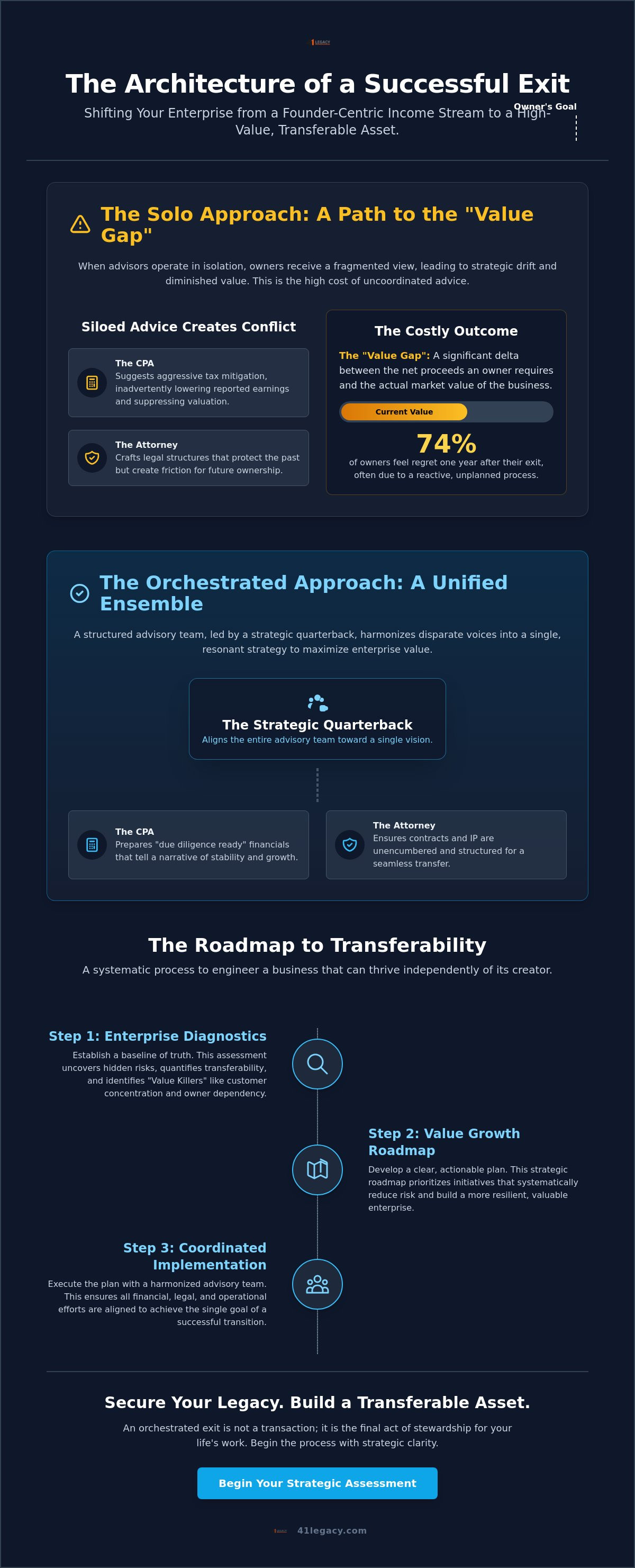
We often encounter the "Value Gap." This is the delta between the current enterprise value and the net proceeds required to sustain the founder's lifestyle after the transition. Industry research consistently reveals a stark disparity: while the vast majority of owners intend to transition their businesses within the next decade, fewer than one-third possess a documented strategy. This lack of preparation often leads to a painful realization during the final hour that the business isn't yet the transferable asset the owner imagined. This complexity highlights the vital role of advisors in exit planning. When advisors operate in isolation, the owner receives a fragmented view of reality that risks the integrity of the entire legacy.
The High Cost of Uncoordinated Advice
Traditional "siloed" advice often leads to strategic drift. A CPA might suggest aggressive tax mitigation strategies that inadvertently lower the reported earnings, which then suppresses the business's valuation multiple when it's time to transition. Simultaneously, an attorney might craft legal structures that protect the past but create friction for future ownership. Without a unified vision, these efforts become counterproductive. The emotional weight of an unplanned exit is equally significant. Research from PREScore indicates that 74% of owners feel regret one year after their exit, often because the transition was reactive rather than a masterpiece of design.
Transitioning from Income Stream to Transferable Asset
Cash flow is the lifeblood of today, but enterprise value is the foundation of tomorrow. Many owners fall into the trap of viewing their business solely as a personal income stream. To build a legacy, one must identify "Value Killers" such as undocumented processes, customer concentration, and the founder's over-dependence. At 41 Legacy, we utilize Enterprise Diagnostics to establish a baseline of truth. This assessment uncovers hidden risks and provides the clarity needed to engineer true transferability. It's the difference between a business that is merely "market-ready" and a founder who is "owner-ready," ensuring the essence of the work is preserved for the next generation.
The Advisory Ensemble: Defining Essential Roles in the Planning Process
Building a legacy is an act of collective stewardship. We view the advisory team as a sophisticated ensemble where each member contributes a specific frequency to the overall harmony of the transition. Understanding the roles of each key player is essential for any owner seeking to preserve the essence of their life's work while maximizing its value. This collaborative dynamic defines the role of advisors in exit planning, moving beyond simple transactional support to a state of active guardianship over the enterprise's future.
The Technical Specialists: CPA and Legal Counsel
The CPA serves as the guardian of fiscal integrity. Their objective is to transform raw financial data into a narrative of stability and growth. This involves preparing "due diligence ready" financials that can withstand the intense scrutiny of modern buyers who, in 2026, are applying stricter standards to operational maturity. Proactive tax planning is equally critical. With the federal estate tax exemption set to increase to approximately $15 million per individual on January 1, 2026, the CPA must ensure that your business structure is optimized for these new thresholds well in advance. The attorney acts as the architect of structural transferability. They ensure that intellectual property, employment agreements, and customer contracts are not just legally sound, but are unencumbered and ready for new ownership. This structural precision prevents the business from being anchored to the founder's personal signature.
The Financial and Personal Alignment
Wealth management serves as the vital bridge between the enterprise and the individual. It's the pillar that ensures the "post-exit" life is as rewarding as the one that preceded it. A wealth manager aligns personal financial goals with the timing of the business transition, ensuring that the net proceeds satisfy the owner's long-term needs. This process requires a meticulously coordinated balance sheet. It integrates personal investments with business equity to provide a comprehensive view of wealth. When these elements are out of sync, owners often face the "regret trap." This is a common phenomenon where the financial outcome of a sale fails to meet the emotional and lifestyle expectations of the founder.
The Strategic Advisor acts as the curator of this entire process. They don't just provide advice; they manage the Value Growth Roadmap that guides the technical specialists. This role ensures that the CPA's tax strategies and the attorney's legal frameworks serve the primary goal: building a transferable asset. To begin identifying the strengths and vulnerabilities in your current structure, a Strategic Advisory engagement can provide the clarity needed to align your team toward a singular vision of perfection.
The Strategic Quarterback: Aligning the Advisory Team for Perfection
The transition of a significant enterprise is a complex symphony. Without a conductor, even the most skilled musicians produce only noise. While the CPA and attorney provide essential technical notes, the role of advisors in exit planning reaches its highest expression when guided by a strategic quarterback. This lead advisor doesn't replace your existing specialists; instead, they ensure every professional is playing from the same sheet of music. By maintaining a high-level strategic view, often referred to as professional-room altitude, the quarterback prevents the strategic drift that occurs when technical experts operate in isolated silos.
A primary function of this role is to facilitate the Value Acceleration Methodology. This structured framework, often championed by a Certified Exit Planning Advisor (CEPA), focuses on three pillars: maximizing business value, ensuring personal financial readiness, and creating a life plan for the post-transition era. It's essential that these professionals collaborate on exit planning projects to eliminate friction between competing interests. For instance, the quarterback ensures that a tax strategy proposed by the CPA doesn't inadvertently complicate the legal transferability engineered by the attorney. They provide coordination without overstepping into the provision of specific legal or tax advice, preserving the integrity of each specialist's contribution.
The Master of Orchestration
Business owners are often tempted to act as their own project managers during an exit. However, the emotional and operational demands of running a company make this a perilous path. The quarterback manages the Monthly Implementation Support, bridging the communication gap between the owner's vision and the technical execution. They hold the team accountable to the strategic roadmap, ensuring that momentum is maintained and that granular details don't obscure the ultimate objective. This curatorial approach allows the founder to remain focused on the health of the business while the transition architecture is built with surgical precision.
Protecting the Vision and the Legacy
Every tactical decision made during the planning process must serve the long-term goal of transferability. It's easy for an advisory team to become hyper-focused on narrow goals, such as immediate tax minimization, at the expense of overall enterprise value. The quarterback acts as the guardian of the owner's legacy. They keep the ensemble focused on building a transferable asset that can thrive independently of the founder. By aligning every legal structure and financial report with the final exit goals, they ensure that the business is not just sold, but successfully transitioned as a masterpiece of enduring value.
From Assessment to Implementation: The Roadmap to Transferability
The journey from a founder-led company to a transferable asset follows a disciplined sequence. It begins with Enterprise Diagnostics, an exhaustive examination that reveals hidden operational risks often overlooked in standard financial audits. This is where the role of advisors in exit planning becomes truly practical, as they translate diagnostic data into a customized Value Growth Roadmap. This roadmap serves as the definitive blueprint for increasing enterprise value while systematically preparing the organization for a future without its creator.
Execution is where most plans falter. Implementation Support provides the necessary structure to ensure that the strategic objectives don't remain mere aspirations on a page. Through monthly reviews, the advisory team maintains a state of Continuous Alignment, adjusting the strategy as market conditions or internal milestones evolve. This ensures that every professional, from the CPA to the Strategic Advisor, remains focused on the same horizon. To begin this transformation, you can secure an Exit Readiness Assessment to establish your current baseline of transferability.
Reducing Owner Dependency
The Rainmaker Trap is a common affliction where the business's success is inextricably tied to the founder's personal relationships or technical expertise. If your presence is required for the business to function, you haven't built an asset; you've built a job. Engineering the business to thrive independently requires a deliberate shift in Strategic Capacity. This involves empowering a leadership team capable of executing the vision, thereby transforming the owner from an indispensable operator into a strategic steward. This process doesn't happen by accident; it requires the same meticulous attention to detail as the restoration of a fine instrument.
Engineering Transferability
Documentation is the preservation of a company's inner essence. Standard Operating Procedures (SOPs) are not mere clerical exercises; they are the mechanical drawings that allow a new owner to replicate your success. A business must be evaluated on two distinct fronts: its market attractiveness, which measures buyer demand, and its internal readiness, which measures the ease of transition. Transferability is the ultimate measure of a business's health, representing the degree to which an enterprise can sustain its performance without the intervention of its founder. When these elements are aligned, the business becomes a masterpiece ready for its next gallery.
Stewardship of Legacy: Preparing for a Successful Transition
Stewardship is a deliberate choice. It's the decision to treat your enterprise as a masterpiece to be preserved rather than a commodity to be liquidated. When you view your life's work through this lens, the entire transition process shifts from a transactional burden to a philosophical achievement. It's no longer about the departure; it's about the enduring resonance of what remains. The role of advisors in exit planning is to act as the dedicated curators of this vision, ensuring that the technical intricacies of the transition never diminish the essence of the legacy you've built.
True peace of mind doesn't come from a single document or a favorable valuation. It emerges from the confidence that a coordinated, professional team is managing every variable of your exit with surgical precision. By aligning your personal goals with the business's operational maturity, you ensure the enterprise is prepared for its next guardian. This structured approach protects your employees, your family, and the history you've authored over decades of dedication.
Building Your Value Growth Roadmap
Clarity is the first step toward a successful transition. We begin with project-based Enterprise Diagnostics to uncover the specific risks and opportunities within your current structure. These diagnostics provide the objective truth needed to move forward with confidence. From this baseline, we develop a customized Value Growth Roadmap, a strategic document that outlines the precise steps required to build a transferable asset. Whether you're positioning the business for an internal succession or an external transition, this roadmap serves as your definitive guide.
Strategy without execution is a hollow endeavor. This is why we emphasize the importance of monthly accountability. Through our Monthly Implementation Support, we ensure that the tactical goals of the roadmap are met with consistency. We work alongside your leadership team to increase strategic capacity, systematically reducing the business's reliance on your daily presence. This process doesn't just prepare you for an exit; it builds a healthier, more resilient company today.
The Path Forward with 41 Legacy
We believe every business has a story that deserves a respectful conclusion. As your strategic partner, 41 Legacy provides the high-level coordination required to harmonize your technical specialists. We don't just offer advice; we provide a structured framework for implementation that keeps your team focused on the ultimate measure of success: transferability. We invite you to step into the role of a steward, focusing on the long-term health and value of the enterprise you've created.
The journey toward a successful legacy begins with a single, decisive action. By securing an Exit Readiness Assessment, you gain an immediate understanding of your business's current standing and the steps required to reach your goals. Don't leave the future of your life's work to chance. Let's begin the process of engineering a transition that honors your past while securing your future, ensuring your masterpiece is ready for its next chapter.
Securing the Future of Your Masterpiece
Your business is a testament to years of vision and meticulous effort. It deserves a transition that reflects that same level of dedication. We've explored how shifting from a founder-centric model to a transferable asset requires a disciplined architecture and a unified advisory ensemble. By reducing owner dependency and engineering strategic capacity, you ensure that the essence of your work continues to resonate long after your departure.
Understanding the multifaceted role of advisors in exit planning ensures that your transition is a deliberate triumph rather than a reactive event. At 41 Legacy, our national strategic advisory expertise is led by a Certified Exit Planning Advisor (CEPA). We focus specifically on transferability engineering and owner-dependency reduction to help you build an enterprise that stands as a lasting masterpiece. Our process is designed for the owner who views their business as a legacy to be protected, not just a transaction to be closed.
The first step toward this strategic clarity is an objective evaluation of your current standing. Begin your journey with an Exit Readiness Assessment at 41 Legacy. It's time to prepare your enterprise for its next guardian with the precision and reverence it deserves. We look forward to helping you secure the future of your life's work.
Frequently Asked Questions
What is the primary role of an exit planning advisor?
The primary role is to act as a strategic architect who aligns the business's value growth with the owner's personal and financial objectives. They look beyond a single transaction to engineer long-term transferability. This involves coordinating various technical specialists to ensure the business can thrive independently of the founder, transforming it from a personal income stream into a high-value asset.
When is the best time to hire an exit planning team?
The ideal time to engage a team is three to five years before your desired transition date. This window allows for meaningful value growth and the implementation of owner-dependency reduction strategies. Starting early ensures that the "Value Gap" can be closed through deliberate engineering rather than reactive measures, allowing you to maximize the enterprise's worth before the transition begins.
How does an exit planning advisor differ from a business broker?
An advisor focuses on long-term value creation and organizational health, whereas a broker typically manages the final transaction. The advisor's work happens years before a sale, focusing on transferability engineering and strategic capacity. They prepare the business to be a high-value asset, while a broker's role is primarily to find a buyer for the current state of the company.
Why do I need a "Quarterback" if I already have a CPA and an attorney?
The "Quarterback" provides the strategic alignment that prevents technical specialists from working in silos. While a CPA manages tax and an attorney handles legal structures, a quarterback ensures these efforts don't conflict. The role of advisors in exit planning is most effective when a central coordinator maintains the professional-room altitude needed to protect the owner's ultimate vision and legacy.
Can an exit planning advisor help me reduce my daily involvement in the business?
Yes, reducing owner dependency is a core objective of the planning process. Advisors use Enterprise Diagnostics to identify vulnerabilities and help build the strategic capacity of your leadership team. By documenting the inner essence of the business through structured processes, they transform the company from a personal job into a transferable asset that operates flawlessly without your constant presence.
What is the difference between enterprise value and market value in exit planning?
Enterprise value represents the inherent worth of the business based on its systems, leadership, and growth potential, while market value is what a specific buyer pays at a given moment. Exit planning focuses on maximizing enterprise value by de-risking the company. This ensures it remains attractive regardless of fluctuating market conditions, providing a more stable and predictable foundation for your legacy.
Is an Exit Readiness Assessment necessary if I don’t plan to sell for five years?
It's essential because it establishes the baseline of truth for your multi-year strategy. An assessment uncovers hidden vulnerabilities that take time to remediate, such as customer concentration or undocumented processes. By understanding your readiness today, you can spend the next five years following a Value Growth Roadmap that systematically builds a masterpiece of transferability and resilience.
How does exit planning protect my legacy and my employees?
It protects your legacy by ensuring the business is structurally sound enough to survive a change in leadership. A well-orchestrated plan provides a clear roadmap for the next guardian, which reduces uncertainty for employees and customers. The role of advisors in exit planning includes preparing the enterprise for a seamless transition, preserving the culture and history you've spent your life building.
Disclaimer
This article is for educational and informational purposes only and does not provide legal, tax, investment, or business brokerage advice. 41 Legacy does not offer M&A brokerage services, legal document drafting, tax preparation, or investment advisory services. Business owners should consult licensed professionals in those disciplines before making decisions related to business transactions, legal matters, tax strategy, or financial planning. All examples are illustrative and may not apply to your specific situation.