
The Masterpiece of Autonomy: Reducing Owner Dependency Before Selling Your Business
If your business cannot survive a thirty-day absence of its architect, you haven't built an enduring asset; you've merely crafted a very demanding job. It's a heavy realization that often surfaces only when the prospect of an exit nears. We understand the quiet anxiety of feeling trapped by the very operations you birthed, fearing that the enterprise might crumble the moment you step away. This tension often leads to significant price-chipping during due diligence, as buyers discount the value of a company that relies too heavily on its founder. By focusing on reducing owner dependency before selling, you aren't just preparing for a transaction. You're engaging in a profound act of stewardship that validates the true essence of your work.
This guide serves as a strategic roadmap to transform your company into a self-sustaining masterpiece of autonomy. You'll learn how to utilize Enterprise Diagnostics and a Value Growth Roadmap to identify "Rainmaker" risks that threaten your enterprise value. We'll examine the technical precision required for transferability engineering, moving beyond daily management to create a legacy that thrives in your absence. By the end of this exploration, you'll have the clarity needed to command maximum value at the closing table while ensuring your company's history continues long after your departure.
Key Takeaways
- Understand the "Rainmaker" paradox and why being the primary driver of revenue can inadvertently devalue your enterprise in the eyes of a sophisticated buyer.
- Learn the technical process of reducing owner dependency before selling by transitioning from tribal knowledge to a documented Business Operating System.
- Discover how founder reliance directly influences purchase agreements, often leading to restrictive earn-out structures and increased post-sale obligations.
- Implement a phased diagnostic approach to identify operational risks and build the strategic capacity necessary for a successful, independent legacy.
- Explore the "Quarterback" philosophy for aligning your CPA, attorney, and wealth manager toward the singular goal of enterprise transferability.
The Rainmaker Trap: Why Owner Dependency Devalues Your Legacy
A business that mirrors its founder's every breath isn't an asset; it's a reflection. This is the core of owner dependency, where the enterprise essence is so deeply intertwined with your daily presence that the two become inseparable. While being the primary driver of growth feels like a badge of honor, it often creates a "Rainmaker" paradox. If you are the only one capable of closing the most significant contracts or maintaining key relationships, your company's success is tethered to your personal stamina. For a buyer, this isn't a masterpiece of engineering. It's a high-risk liability.
Sophisticated investors don't seek to buy a job; they look for a transferable engine of profit. When the founder is the sole source of institutional knowledge, the economic value of a business suffers a profound erosion. This creates a painful "Value Gap," the distance between what your company is worth today and what it could be worth if it functioned independently. Reducing owner dependency before selling is the only way to bridge this gap, transforming a personal obligation into a high-value, transferable asset that commands respect at the closing table.
The Psychology of the Indispensable Founder
The journey toward an exit requires a fundamental shift from operator to steward. Many founders struggle with the "I do it" phase, fearing that delegating authority will lead to a loss of quality or identity. However, true excellence is found in the "They do it" phase, where your vision is executed by a team that doesn't require your constant intervention. It's a move from ego-driven control to legacy-driven leadership. We believe a comprehensive Value Growth Roadmap must begin with this internal shift, replacing the fear of being unneeded with the pride of having created something that can thrive without you.
How Buyers Audit Your Presence
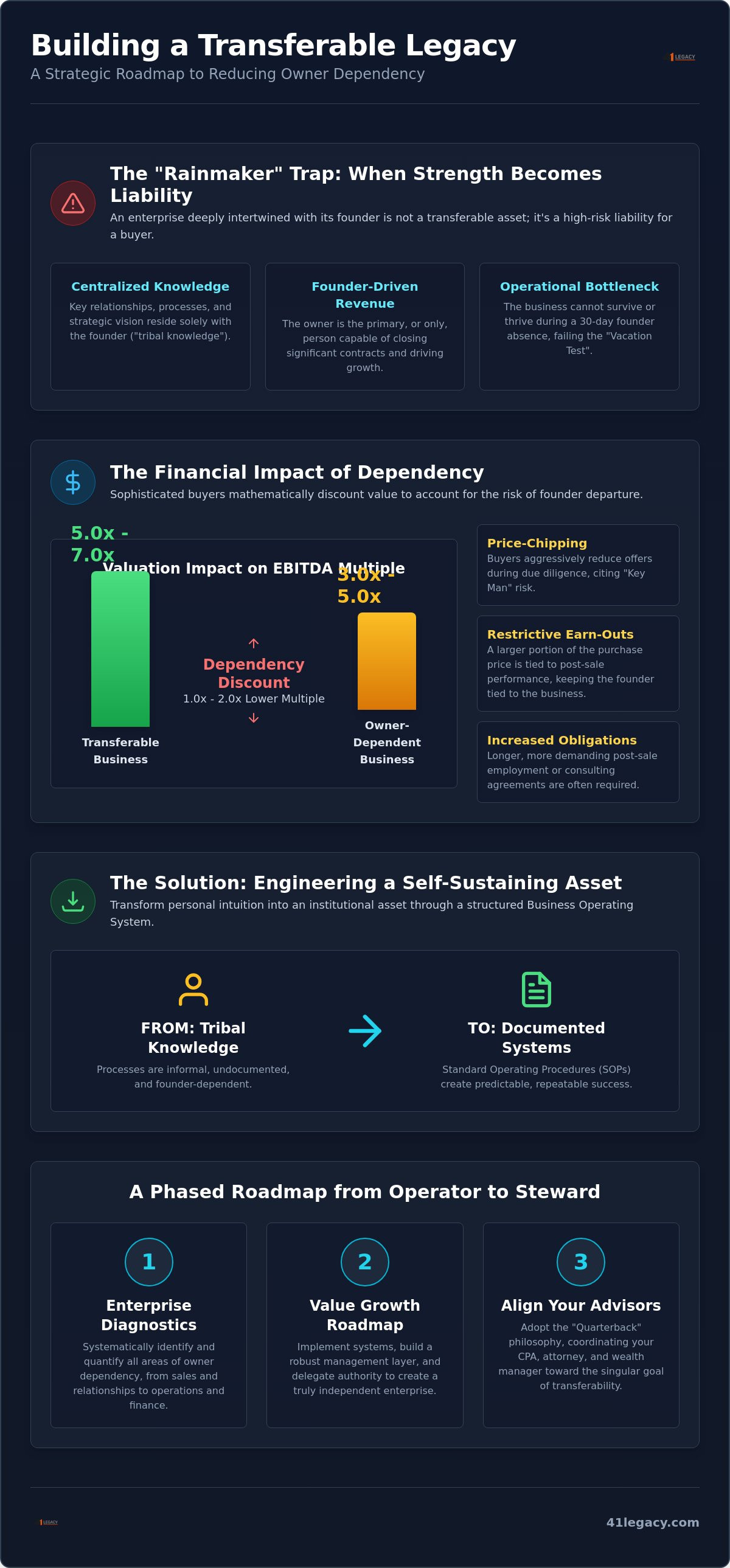
During due diligence, buyers perform what we call the "Vacation Test." They scrutinize your financial records to see if EBITDA remains stable or grows when you are off-grid. If performance dips during your absence, it signals a "Key Man" risk that can decimate your valuation. Research indicates that businesses with high owner dependency typically sell at a 1.0x to 2.0x lower EBITDA multiple compared to peers with strong, independent management teams. A buyer calculates the dependency discount by mathematically reducing the purchase price to account for the probability that earnings will evaporate once your personal influence is removed. Identifying these skeletons early is the first step in reducing owner dependency before selling, ensuring your hard work translates into a lasting financial reward.
Transferability Engineering: Building Systems That Outlast the Founder
True transferability is an engineering feat. It requires moving beyond the "tribal knowledge" locked within the founder's mind and codifying it into a formal Business Operating System. This transition isn't merely administrative; it's a philosophical shift. When you build systems that outlast your presence, you're not just documenting tasks. You're preserving the essence of your company’s excellence. Sophisticated buyers look for this mechanical precision. They want to see that the business's success is repeatable, predictable, and entirely independent of your daily intervention. Reducing owner dependency before selling is the process of turning an individual's intuition into an institutional asset.
The Architecture of Standard Operating Procedures (SOPs)
Standard Operating Procedures serve as the legal evidence of a company’s independent value. During a transition, these documents prove that the enterprise can function without the founder’s hands on the wheel. To truly mitigate the risk of owner dependence, these systems must document both the "how" and the "why" of your unique value proposition. This ensures the company’s standards remain uncompromised even as leadership evolves. Transferability engineering requires more than a dusty manual. It requires a culture where mid-level managers are empowered to own and update their own systems. Using Enterprise Diagnostics allows you to identify exactly where these operational bottlenecks exist before they become liabilities during a sale.
Decentralizing Authority and Decision-Making
Decentralizing authority is the final stage of building an autonomous masterpiece. It begins with a Strategic Capacity Evaluation to ensure your management team has the cognitive "room" to lead. If every significant decision still requires your final say, you haven't built a transferable asset. You've built a bottleneck. Implementing a leadership framework that functions without the founder is essential for increasing enterprise value. This involves intentional talent development, where you move from being the primary problem-solver to a mentor who fosters a culture of accountability. A business that makes its own decisions is a business that survives its creator. If you're ready to see where your business stands, consider starting with a Strategic Capacity Evaluation to map your path forward.
The Financial Narrative: How Dependency Impacts Your Purchase Agreement
The purchase agreement is the final audit of your journey as a steward. It's the moment when the abstract concept of enterprise value is distilled into binding legal prose. If you've successfully navigated the process of reducing owner dependency before selling, this document will reflect a clean, definitive transfer of power. However, if the business remains tethered to your personal involvement, the buyer will use the contract as a scalpel to hedge against the risk of your departure. A "turn-key" asset commands a higher percentage of cash at closing, while a founder-centric business often faces a fragmented payout structure designed to protect the buyer from the unknown.
In the high-stakes environment of 2026 M&A, buyers are increasingly meticulous about how they structure these obligations. They aren't just buying your past performance; they're auditing the probability of your company’s future success without you. When the enterprise essence is inseparable from the founder, the purchase agreement becomes a mechanism for risk distribution rather than a simple exchange of value. Proving the business can thrive independently is the only way to ensure your net proceeds aren't eroded by contractual contingencies.
Earn-outs and Holdbacks: The High Cost of Being Needed
Buyers utilize earn-outs to "buy" your continued presence and performance when they don't trust the company’s independent engine. These structures act as "Golden Handcuffs," forcing you to remain in an operational role to achieve the full purchase price. The strategic goal of any prepared owner should be to minimize these contingencies through prior preparation. By conducting a thorough Exit Readiness Assessment, you can identify these dependency triggers early. This allows you to negotiate from a position of strength, presenting a management team and systems that require no post-sale training wheels.
Reps, Warranties, and the Knowledge Qualifier
Representations and warranties are the promises you make about the health of the business, and they carry significant legal weight. If you're involved in every granular detail of the company, "Knowledge Qualifiers" become much harder to defend. A buyer will argue that as an indispensable owner, you should've known about every minor liability or operational flaw. Decentralized data and a strong management team reduce this post-closing indemnification risk. When others own the data and the decisions, your personal liability is tempered. Clean diagnostics and structured disclosure schedules prove that the company’s integrity is built into its architecture, not just your memory.
A Roadmap to Strategic Capacity: Transitioning from Operator to Steward
Transitioning from operator to steward is not a single event; it is a disciplined progression. At 41 Legacy, we view this evolution as the ultimate refinement of your business’s architecture. The journey begins with a Phase 1 Diagnostic, utilizing Enterprise Diagnostics to identify the "skeletons" in your operational closet. These are the hidden dependencies and "Rainmaker" risks that threaten your eventual exit. Following this, Phase 2 develops a bespoke Value Growth Roadmap, aligning your talent and systems with a clear exit objective. Finally, Phase 3 provides the Monthly Implementation Support required to ensure the asset is truly transferable. Reducing owner dependency before selling requires this structured rigor to move from theoretical value to realized wealth.
The 12-Month Autonomy Audit
A successful exit is proven, not promised. Reducing owner dependency before selling requires a commitment to a 12-month timeline to demonstrate that the company’s heart beats independently of its founder. During months one through four, the focus is on systematizing core revenue-generating processes. This ensures that the company’s success is institutionalized rather than personal. Months five through eight involve hiring or promoting the "Replacement Layer" of leadership, those individuals who will carry the legacy forward. The final four months are the most critical: the Founder-Free operating cycle. This is where you step back entirely to prove that EBITDA remains resilient without your daily touch.
Measuring Success: The Transferability Scorecard
Success in this endeavor is measured by a Transferability Scorecard. This tool tracks key metrics that signal readiness for a high-value exit, such as the decentralization of customer relationships and the depth of the management bench. It is vital that recurring revenue is tied to the system rather than the person; a buyer will not pay a premium for revenue that walks out the door with the seller. Our monthly advisory support maintains strict accountability for these goals, ensuring the business remains on its path to autonomy. This steady rhythm of improvement transforms the business from a personal obligation into a pristine, transferable asset. If you are ready to begin this transition, you can start your Value Growth Roadmap today to ensure your legacy is preserved and your value is maximized.
The 41 Legacy Approach: Coordinating Your Advisory Team for a Seamless Exit
The transition of a business is rarely a solitary act; it is a complex symphony that requires a singular, unified vision. At 41 Legacy, we embrace a "Quarterback" philosophy, acting as the strategic coordinator for your entire advisory team. While your CPA, attorney, and wealth manager possess immense technical skill within their respective silos, they often lack a shared roadmap for the ultimate objective: enterprise transferability. By reducing owner dependency before selling, we provide the technical foundation that allows these specialists to perform their roles with surgical precision. Our role is to ensure that every legal document, tax strategy, and financial plan is harmonized with the goal of building a legacy that survives its creator.
This coordinated approach bridges the gap between granular legal paperwork and high-level strategic growth. We move beyond the transactional, positioning the owner as a steward of an enduring entity rather than just a seller of a company. When the advisory team operates in unison, the business is no longer a collection of disconnected parts; it becomes a masterpiece of autonomy. This alignment is the final step in validating the work of a lifetime, ensuring that the essence of the enterprise remains intact long after the founder has departed the daily arena.
The Power of Coordinated Business Advisory
A strategic roadmap is the only way to prevent the "price chipping" that frequently occurs during due diligence. When your CPA and attorney are aligned with a pre-emptive diagnostic, they can address potential liabilities before a buyer ever discovers them. This proactive stance ensures that your personal financial goals are perfectly synchronized with the company’s actual market value. Coordinated advisory services provide the clarity needed to navigate complex negotiations without compromising the integrity of the asset. By maintaining this professional-room altitude, we help you avoid the reactive pitfalls that often devalue a business in its final hours.
The Final Validation of Transferability
The moment of exit should be a celebration of craftsmanship, not a series of compromises. The most favorable purchase agreements are won years before the sale, through the disciplined application of transferability engineering and owner-dependency reduction. When the final agreement reflects a business that thrives independently, it validates the founder's role as a true architect of value. This is the ultimate proof of a legacy: an organization that possesses its own heartbeat and a future that is not tethered to a single individual. We invite you to begin your journey toward a transferable asset with 41 Legacy, ensuring that your exit is as sophisticated and impactful as the business you have built.
From Individual Effort to Institutional Excellence
Transforming your company into a self-sustaining asset is the final, most profound act of leadership. By moving beyond the Rainmaker Trap and engineering systems that outlast your presence, you aren't just exiting; you're ensuring your work survives its creator. We've explored how reducing owner dependency before selling directly impacts your purchase agreement, protecting your net proceeds from aggressive earn-outs and price-chipping. True transferability is built on the technical precision of decentralized decision-making and a management team prepared to lead without a founder's final say.
Our CEPA-led team serves as your strategic "Quarterback," coordinating with your professional advisors to align every operational detail with your personal financial goals. We focus on building transferable enterprise value that commands respect in the market. This disciplined approach ensures that when you finally step away, you leave behind a masterpiece of autonomy rather than a personal obligation. You've spent years building your business. Now, it's time to ensure it can thrive without you.
Secure Your Legacy: Schedule an Exit Readiness Assessment
Frequently Asked Questions
How long does it take to reduce owner dependency before a sale?
Most successful transitions require a timeline of twelve to twenty-four months. This period allows for the thorough documentation of systems, the elevation of a leadership team, and at least one full operating cycle to prove the business functions without the founder. Rushing this evolution often leads to significant value leakage during the due diligence process.
Will my business value decrease if I step back from daily operations?
The opposite is true; your business value typically increases as you step away. While it's natural to feel that your personal touch drives success, a buyer views your constant presence as a high-risk liability. Proving that the company thrives in your absence transforms it into a transferable asset, which often commands a higher EBITDA multiple.
What is the "Vacation Test" in exit planning?
The Vacation Test is a practical diagnostic where the owner steps away from the business for several weeks without any operational contact. If the enterprise remains profitable and decisions are made effectively by the team, the company passes. It's a vital milestone in the process of reducing owner dependency before selling, providing proof of autonomy to potential buyers.
How does owner dependency affect the earn-out period in a sale?
High dependency usually results in longer and more restrictive earn-out structures. Buyers use these contractual mechanisms to force your continued involvement until they're confident the business won't crumble without you. Minimizing this reliance early in your exit journey allows you to negotiate for more cash at the closing table and a shorter post-sale obligation.
Why do buyers care about SOPs if they plan to change the systems anyway?
Standard Operating Procedures provide legal evidence that your company’s value is institutionalized rather than personal. Even if a buyer intends to integrate their own processes, well-documented SOPs prove that your staff is trained to follow structured systems. It signals a disciplined culture and a management team that's capable of executing a vision without founder intervention.
Can a small business ever be truly independent of its founder?
Independence is achievable for any business that successfully transitions from an operator-led model to a steward-led model. This requires building a "Replacement Layer" of leadership and decentralizing decision-making power. Small enterprises achieve this by focusing on Transferability Engineering and empowering mid-level managers to own specific outcomes rather than just following orders.
What is the role of a Certified Exit Planning Advisor (CEPA) in this process?
A CEPA acts as the strategic "Quarterback" for your entire advisory team, ensuring your CPA, attorney, and wealth manager work in harmony. They provide the roadmap for maximizing enterprise value and reducing operational risks. This coordinated approach ensures that your business improvements and personal financial goals are perfectly aligned for a successful exit.
How do I tell my customers that I am stepping back from the business?
Frame the transition as an intentional investment in the company’s future and its ability to serve them better. Introduce your leadership team as the primary points of contact long before an exit is announced. This shift builds their trust in the institution’s systems rather than your personal involvement, which preserves the company's goodwill and transferability.

Article by
Mike Laskowski
Mike Laskowski is a Business Value Growth Strategist who helps business owners uncover the truths that drive their performance, risk, and readiness. Blending forensic interviewing from a 26‑year federal career with Strategic Capacity analysis and CEPA methodology, he works upstream to reduce owner dependency, increase transferability, and strengthen enterprise value. Mike guides founders through clarity, operational evolution, and transition readiness so their companies become transferable, owner‑independent assets that endure beyond the founder.
Disclaimer
This article is for educational and informational purposes only and does not provide legal, tax, investment, or business brokerage advice. 41 Legacy does not offer M&A brokerage services, legal document drafting, tax preparation, or investment advisory services. Business owners should consult licensed professionals in those disciplines before making decisions related to business transactions, legal matters, tax strategy, or financial planning. All examples are illustrative and may not apply to your specific situation.