
The Master Architect’s Guide to the Key Drivers of Enterprise Value
The true measure of an enterprise is not found in the owner's ability to perform, but in the organization's ability to endure. While many founders view their personal brilliance as their greatest strength, sophisticated buyers often see it as a structural flaw. To secure a premium multiple, you must look beyond the bottom line and master the key drivers of enterprise value that define a truly transferable asset. This is the shift from being a master of a trade to becoming the architect of an enduring legacy.
You understand the exhaustion of the rainmaker trap and the quiet anxiety that your business might falter the moment you step away. It's a common frustration to realize that strong EBITDA alone doesn't guarantee a successful transition. This guide provides a clear framework to reduce owner dependency and strengthen the internal systems that external successors prioritize. You'll discover how to engineer strategic clarity and build a business that functions with the precision of a fine timepiece; ensuring your life's work remains vibrant and valuable long after your tenure concludes.
Key Takeaways
- Understand the distinction between a lifestyle practice and a transferable asset, focusing on the structural durability that sophisticated buyers demand.
- Learn why revenue quality and EBITDA precision are the foundational elements of a high-value financial narrative.
- Discover how to master the key drivers of enterprise value by systematically reducing owner dependency and empowering a next-generation management team.
- Identify how to establish brand moats and scalable growth prospects that ensure the business remains attractive to external successors.
- Gain a framework for using enterprise diagnostics to identify risks and coordinate your advisory team through a structured value growth roadmap.
The Essence of Enterprise Value: Beyond the Balance Sheet
A business is more than a vehicle for profit; it's a living entity that requires careful stewardship to reach its true potential. To the uninitiated, success is often measured by the height of the annual revenue or the prestige of the client list. However, a master architect understands that Enterprise value is the only metric that truly captures the durability and transferability of what you've built. It represents the strength of the foundation, not just the beauty of the facade. True value exists independently of the founder, surviving and thriving long after the original creator has moved on.
There's a profound distinction between a lifestyle business and a transferable asset. A lifestyle business serves the owner, providing income and status while requiring constant personal intervention. In contrast, a transferable asset serves the market, operating as a self-sustaining machine. A company generating eight figures in revenue can possess zero enterprise value if its success is tethered to the founder’s daily breath. Without structural integrity, that revenue is merely a temporary stream that dries up the moment the owner exits. As a steward, your role is to cultivate an essence that can be handed to another without losing its vitality.
The Philosophical Shift from Income to Value
Focusing solely on annual income is a short-term pursuit that often sacrifices the long-term health of the organization. This creates what we call the "Value Gap," which is the distance between what your business is worth today and what you need it to be worth to achieve your ultimate goals. Bridging this gap requires a mental pivot from managing cash flow to engineering an asset. Enterprise value is the price a sophisticated buyer pays for a future stream of de-risked cash flow. By prioritizing the key drivers of enterprise value, you ensure that every decision adds a permanent stone to the cathedral of your legacy rather than just filling the coffers for a single season.
Valuation Multiples: The Market’s Verdict on Risk
The market views risk as a discount on your hard-earned EBITDA. When a buyer evaluates your company, they aren't just looking at the numbers; they're looking for the cracks in the structure that might lead to failure. Qualitative levers, such as customer concentration or weak systems, act as a weight that contracts your valuation multiple. Conversely, strong internal controls and a clear market position expand that multiple. It's essential to begin determining enterprise value early in your journey. This diagnostic approach allows you to identify the specific key drivers of enterprise value that need reinforcement, ensuring you don't leave your exit to chance.
Financial Drivers: The Precision of Cash Flow and Revenue Quality
Financial statements are the ledger of a company's history, yet their true power lies in their ability to predict the future. While raw profit is a necessary component of survival, the precision of your cash flow determines the height of your multiple. High-quality EBITDA is one of the most critical key drivers of enterprise value, as it reflects a business that has been normalized for a new steward. This process often involves "add-backs," which are technical adjustments used to remove one-time expenses or owner-specific costs. These aren't mere accounting tricks; they're essential tools for revealing the true earnings power of the underlying asset.
Not all revenue is created equal. A hierarchy exists where recurring, contractual revenue sits at the summit, while one-time transactional sales reside at the base. Predictability reduces a buyer's anxiety, transforming a volatile practice into a stable institution. When revenue is "sticky," the enterprise gains a level of structural security that commands a premium. High profit margins further signal a strong competitive position, suggesting that the business possesses a "brand moat" that protects it from the erosive forces of the market.
Revenue Quality and Predictability
Identifying revenue streams that are both predictable and repeatable is central to Driving Company Value. Sophisticated successors look for businesses where the next year's income is already largely secured through subscriptions or long-term contracts. This stability must be paired with a diversified client base. Customer concentration risk is a significant devaluator; if a single client represents more than 10 or 15 percent of your revenue, the entire enterprise is vulnerable. True value is found in a broad foundation where no single loss can threaten the integrity of the whole. Utilizing robust financial forecasting helps prove that your growth is not an accident but a calculated result of your business design.
The Cleanliness of Financial Infrastructure
To move from a personal practice to a high-value asset, you must transition from "checkbook accounting" to institutional-grade reporting. This requires the adoption of GAAP-compliant statements or, at a minimum, reviewed financials from a reputable CPA. Clean data acts as the precision engineering of your growth. It allows you to reduce "owner perks" and present a professional, de-risked P&L that stands up to intense scrutiny. When your financial records are pristine, you eliminate the ambiguity that leads to "deal fatigue" and price re-negotiations. A transparent financial infrastructure is an invitation to a buyer, signaling that the business is managed with the discipline of a public corporation.
Structural Transferability: Severing the Tether of Owner Dependency
A business's soul shouldn't reside solely in the mind of its founder. While your vision sparked the enterprise, your daily presence shouldn't be the fuel that keeps it burning. Structural transferability is the art of engineering an organization that functions with mechanical precision in your absence. This is one of the most critical key drivers of business value, yet it's often the most neglected by visionary leaders. If you're the primary salesperson, the chief problem solver, and the sole keeper of client relationships, you've fallen into the "Rainmaker Trap." To a buyer, this doesn't look like a high-value asset; it looks like a liability waiting to happen.
Human capital is the bridge between a founder-led practice and a transferable institution. Building a "Next-Gen" management team isn't just about hiring; it's about curating a group of specialists who are empowered to lead. A buyer is looking for a leadership layer that's already proven its ability to navigate challenges without the founder's intervention. You can measure your progress through the "Vacation Test." If you can't step away for thirty days without the business slowing down, you haven't yet built an asset. You've built a complex machine that still requires your hand on the lever.
Owner Dependency Reduction
Delegating critical relationships and technical knowledge is a deliberate architectural choice. It requires a willingness to step back so the enterprise can step forward. A business that requires the owner’s presence is a job, while a business that thrives in their absence is an asset. At 41 Legacy, we focus on Owner Dependency Reduction to ensure the essence of your company isn't lost when you transition. This shift allows the founder to move from the center of the storm to the role of a strategic steward who guides the vision rather than managing the minutiae.
The Role of SOPs in Value Creation
Standard Operating Procedures (SOPs) are more than just manuals; they're the blueprints for your legacy. They turn "tribal knowledge"—the unwritten rules and intuition held by long-term employees—into institutional intellectual property. This documentation is a vital component among the key drivers of enterprise value because it reduces the perceived "key person risk" for any successor. When processes are documented, the business becomes repeatable and scalable. For a deeper look at how to implement these systems, explore our guide on what is sop in business to begin documenting your success with surgical precision.
The Strategic Narrative: Growth Prospects and Market Position
While financial metrics provide the foundation, the strategic narrative provides the soul. A successor isn't merely acquiring your past performance; they're investing in a future they can claim as their own. To achieve a premium multiple, you must demonstrate that the business possesses a "Brand Moat"—a protective barrier that makes your market position difficult to replicate. This narrative is one of the most compelling key drivers of enterprise value because it transforms a company from a commodity into a unique essence. It's the difference between selling a service and offering a proprietary solution that the market cannot easily replace.
Growth scalability is the ultimate proof of a well-engineered asset. You must demonstrate that the business can expand without a corresponding, exponential increase in overhead or owner intervention. Buyers look for "plug-and-play" engines where the systems are already refined and the market opportunity is vast. Proving this scalability requires a broad foundation of customer diversification. While we previously discussed the financial risk of concentration, the strategic narrative focuses on resilience. A diversified base proves the business survives market shifts, making it a stable vessel for a new steward's ambitions.
Barriers to Entry and Competitive Advantage
The strength of your enterprise is often measured by how hard it is for others to follow in your footsteps. Establishing barriers to entry—such as trademarks, patents, or exclusive vendor relationships—creates a sanctuary for your profit margins. This competitive advantage isn't just a technical detail; it's an expression of your company's unique identity. By positioning the business as a leader in a specific niche, you ensure that it remains a connoisseur's choice in a crowded marketplace. This exclusivity is what allows for the "curb appeal" that attracts sophisticated successors who value heritage and performance.
The Credible Growth Roadmap
A master architect doesn't just build for today; they provide the blueprints for tomorrow. Your strategic narrative should include a documented roadmap that identifies "low-hanging fruit" for the next owner. This might include untapped market segments, potential product extensions, or operational efficiencies that haven't yet been fully realized. Proving that there's a clear path to expansion makes the business an irresistible opportunity. For a deeper exploration of these strategies, examine our guide on how to increase enterprise value. To understand where your company stands today, we invite you to begin with a Strategic Capacity Evaluation to identify your most potent levers for growth.
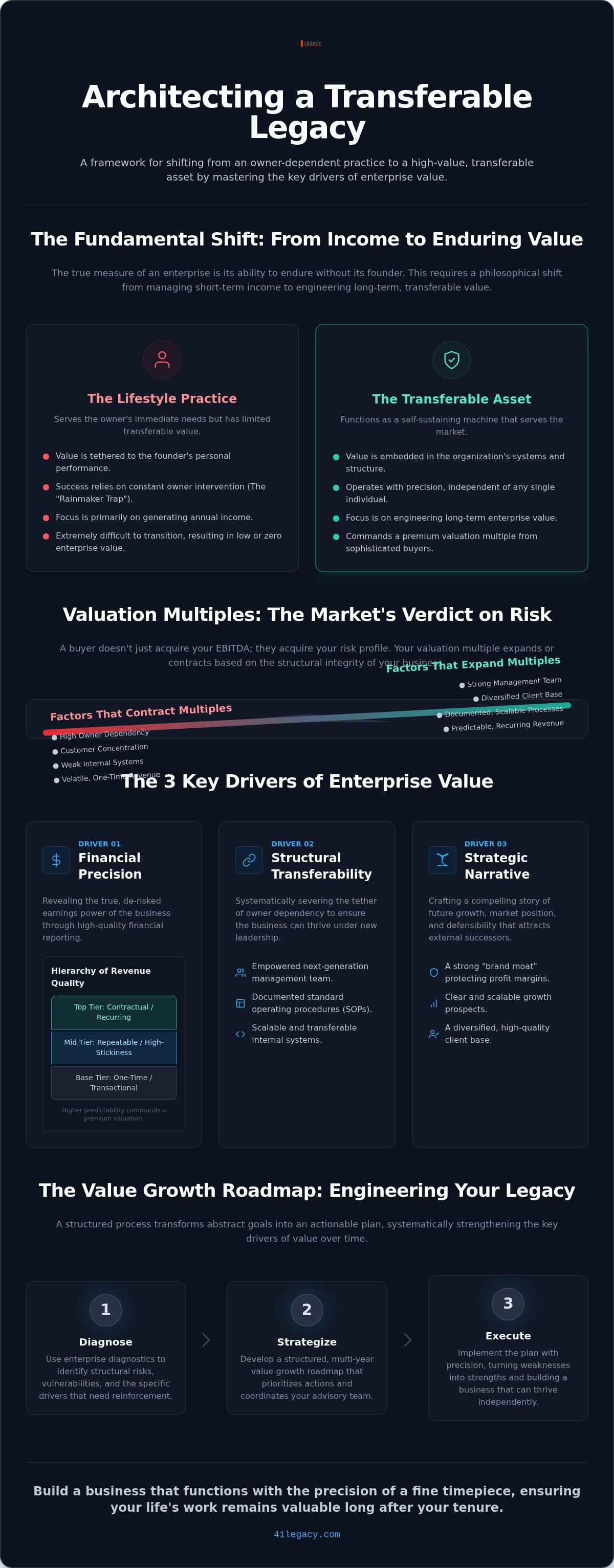
The Value Growth Roadmap: Engineering Your Transferable Legacy
The creation of a high-value, transferable asset is not a matter of chance; it's a disciplined exercise in precision engineering. While the preceding sections detailed the individual key drivers of enterprise value, the Value Growth Roadmap is the master plan that integrates these components into a harmonious whole. This process moves beyond the theoretical, transforming strategic clarity into a tangible, high-performance reality. It requires a commitment to excellence and a refusal to settle for a business that remains tethered to its founder.
A Certified Exit Planning Advisor (CEPA) serves as the architect of this transition, ensuring that every structural adjustment serves the dual purpose of increasing value and reducing risk. This isn't a solo endeavor but a coordinated movement toward a singular, uncompromising vision of perfection. By focusing on the long-term health of the enterprise, you transition from the daily grind of management to the dignified role of a legacy guardian. It's a journey that demands monthly accountability and a steadfast focus on the ultimate objective.
The Diagnostic Process
At 41 Legacy, we begin with a rigorous Enterprise Diagnostic to uncover the hidden "Value Gap," which is the distance between your current worth and the potential value of a fully optimized asset. This data-driven assessment allows us to identify the specific risks devaluing your company today. We prioritize the "Big Rocks," those critical levers that will have the most significant impact on your valuation multiple. Regular readiness assessments ensure that the trajectory remains true, allowing for the "precision engineering" of your growth. This disciplined approach ensures that your efforts are never wasted on minor repairs when the foundation requires reinforcement.
Coordinating the Advisory Team
A masterpiece requires many hands, but only one vision. Your technical specialists, including your CPA, attorney, and RIA, possess immense skill in their respective disciplines, yet they often operate in silos. 41 Legacy acts as the "quarterback" for this advisory team, coordinating their efforts toward the unified goal of enterprise value growth. We ensure that every tax strategy and legal document supports the ultimate transferability of the asset. This alignment prevents the friction that often occurs when technical expertise lacks strategic direction. Our mission is to provide the Strategic Advisory and monthly implementation support necessary to build a legacy that survives the founder and flourishes for generations to come.
Architecture for an Enduring Legacy
The transition from a personal practice to a high-value asset requires a profound shift in perspective. You've explored how mastering the key drivers of enterprise value involves more than just monitoring a balance sheet; it's about engineering structural durability. By prioritizing revenue quality and severing the tether of owner dependency, you ensure your company remains a vibrant, living entity long after your tenure. True transferability is the ultimate expression of a well-crafted business and the highest form of stewardship.
Our collective of specialists, led by Certified Exit Planning Advisor (CEPA) leadership, is dedicated to this pursuit of excellence. We utilize a structured Value Growth Roadmap methodology to identify latent risks and amplify your company's essence. Whether you're empowering a next-generation management team or documenting institutional knowledge, every step is a deliberate move toward a successful transition. You don't have to navigate this complex terrain alone. We invite you to Begin Your Journey with an Exit Readiness Assessment today. Together, we'll build a legacy that stands as a testament to your vision and craftsmanship. Your life's work deserves a foundation that endures.
Frequently Asked Questions
What is the difference between equity value and enterprise value?
Enterprise value represents the total value of business operations, including debt and equity, minus cash. Equity value is specifically the value attributable to owners after debt is settled. While equity value is what an owner receives, enterprise value measures overall operational strength. It's the foundational figure used when assessing the key drivers of enterprise value for any organization. This metric provides the market's verdict on the durability of the entire entity.
How does owner dependency specifically lower my business valuation?
Owner dependency creates what we call "key person risk," which sophisticated successors view as a significant structural flaw. If the owner is the primary driver of sales or technical execution, the business's survival is tied to a single individual. This uncertainty forces buyers to apply a higher risk discount, which significantly reduces the valuation multiple. Building a management team and documented systems ensures the asset remains valuable even after the founder's departure.
Can a company with declining revenue still have high enterprise value?
It's possible if the underlying structural integrity and profitability remain exceptionally strong. A business with declining revenue might command value if it possesses proprietary intellectual property, recurring contracts, or significant market barriers. However, most buyers prioritize growth. If the decline indicates a failing market position, value will erode regardless of historical performance. A company must eventually prove it can scale to maintain a premium multiple and attract sophisticated successors.
What are the most common "red flags" that devalue a business during due diligence?
Common devaluators include customer concentration, where a single client represents over 15% of revenue, and poor financial transparency. Incomplete documentation of internal processes or a lack of reviewed financial statements also triggers alarm. Buyers look for "owner-centric" relationships where key vendors deal only with the founder. These red flags suggest the business isn't a transferable asset but a personal practice with high operational risk that could fail after the original creator exits.
How long does it typically take to significantly increase enterprise value?
Substantial growth usually requires 24 to 36 months of deliberate engineering. While some operational efficiencies provide immediate results, mastering the key drivers of enterprise value like leadership depth and revenue quality takes time to prove. This duration allows for the implementation of a Value Growth Roadmap and provides the historical data needed to demonstrate that improvements are repeatable. It's a journey of precision that ensures the business thrives independently of its original founder.
Why is recurring revenue valued so much higher than project-based revenue?
Recurring revenue offers predictability and reduces the cost of future sales, which de-risks the investment for a successor. Project-based revenue requires the business to "start at zero" every month, creating volatile cash flows and higher stress. A buyer pays a premium for the certainty that income will continue without massive marketing reinvestment. This stability is a hallmark of a high-performance organization and a primary factor in securing a higher valuation multiple during a transition.
Do I need a formal valuation before starting a value growth roadmap?
You don't need a certified valuation to begin the process. 41 Legacy starts with an Enterprise Diagnostic and Exit Readiness Assessment to establish a baseline of market attractiveness and structural health. This identifies the "Value Gap" without the expense of a formal appraisal. The goal is to understand the strategic levers that drive future worth rather than just documenting today's price. We focus on building value today to ensure the business is always ready.
What is the role of a Certified Exit Planning Advisor (CEPA) in this process?
A CEPA acts as the master architect and "quarterback" for your entire advisory team. They coordinate the efforts of your CPA, attorney, and wealth advisor to ensure all technical decisions align with your legacy goals. By focusing on transferability and risk reduction, a CEPA ensures you're building an asset that can thrive independently. They provide the strategic guidance necessary to move from a lifestyle practice to a high-value enterprise with a clear, actionable roadmap.

Article by
Mike Laskowski
Mike Laskowski is a Business Value Growth Strategist who helps business owners uncover the truths that drive their performance, risk, and readiness. Blending forensic interviewing from a 26‑year federal career with Strategic Capacity analysis and CEPA methodology, he works upstream to reduce owner dependency, increase transferability, and strengthen enterprise value. Mike guides founders through clarity, operational evolution, and transition readiness so their companies become transferable, owner‑independent assets that endure beyond the founder.
Disclaimer
This article is for educational and informational purposes only and does not provide legal, tax, investment, or business brokerage advice. 41 Legacy does not offer M&A brokerage services, legal document drafting, tax preparation, or investment advisory services. Business owners should consult licensed professionals in those disciplines before making decisions related to business transactions, legal matters, tax strategy, or financial planning. All examples are illustrative and may not apply to your specific situation.