
Transferability & Owner Dependency
The Legacy of the Strategic Sale: Pros and Cons of Selling to a Strategic Buyer
What if the highest offer for your life's work is actually the greatest threat to its soul? You've spent decades meticulously crafting an enterprise that stands as a testament to your vision, and it's natural to feel a profound responsibility toward the culture that defines its essence. We understand that while the financial harvest is vital, the preservation of your legacy is what truly weighs on your mind. Balancing these priorities requires a deep understanding of the pros and cons of selling to a strategic buyer, as the wrong alignment can dismantle years of careful stewardship.
In this article, you'll discover how a strategic acquisition can maximize your enterprise value while navigating the complexities of preserving your company's core. We'll examine the strategic engineering required to bridge culture gaps and the diagnostics necessary to ensure your business continues to grow independently. By mastering these nuances, you can achieve a transition that is as professional as it is profitable, securing a future where your impact remains undiminished.
Key Takeaways
- Discover how to identify buyers who seek more than just financial returns, focusing on the symbiosis of market integration to elevate your enterprise value.
- Navigate the nuanced pros and cons of selling to a strategic buyer, balancing the potential for a significant financial premium against the delicate task of preserving your organizational culture.
- Master the art of transferability engineering to reduce owner dependency, turning your personal expertise into a structured asset that thrives independently of your presence.
- Understand the "Quarterback" model of strategic advisory and why distinguishing between tax preparation and transferability is vital for a professional transition.
- Learn to protect your professional legacy by identifying the specific risks to brand identity that occur when a smaller essence is absorbed into a larger corporate structure.
The Essence of the Strategic Buyer: A Pursuit of Symbiosis
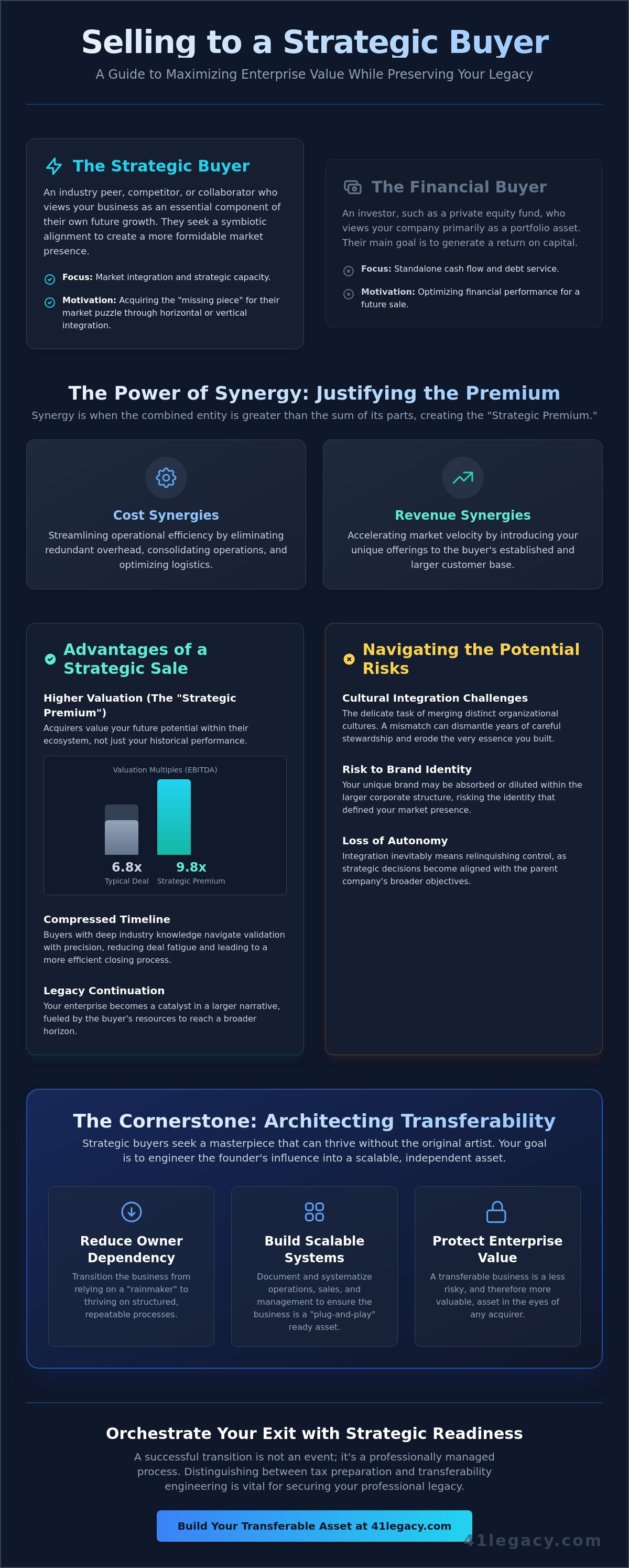
A strategic buyer is not merely an investor seeking a return on capital. They are often a peer, a competitor, or a collaborator within your industry who views your business as an essential limb of their own future growth. Unlike a financial acquirer, who prioritizes cash flow and debt service, the strategic buyer seeks a symbiotic alignment. They are looking for the "missing piece" that completes their market puzzle. This distinction is the foundation for understanding the pros and cons of selling to a strategic buyer. While a financial fund might view your company as a portfolio entry, a strategic partner sees it as a vital organ that will beat in rhythm with their existing operations.
These entities usually operate through horizontal integration, where they acquire a competitor to expand their footprint, or vertical integration, where they secure a place in their own supply chain. Their motivation is driven by the belief that your enterprise, when grafted onto theirs, creates a more formidable market presence. They don't just value your current earnings; they value the strategic capacity you've built. For the steward of a legacy, this means your company's story doesn't end at the exit; it becomes a catalyst for a much larger narrative.
The Anatomy of Synergy
Synergy is the mathematical realization that the whole is greater than the sum of its parts. In the context of Mergers and acquisitions, these synergies manifest in two distinct forms. Cost synergies allow the combined entity to eliminate redundant overhead, streamlining the mechanical efficiency of the business. This might involve consolidating back-office operations or optimizing logistics to reduce waste. Revenue synergies occur when your unique offerings are introduced to the buyer's established customer base, creating a surge in market velocity. These synergies represent the "strategic premium" that often allows these buyers to offer valuations that exceed those of purely financial bidders. It's a calculation based on future potential rather than just historical performance.
The Strategic Buyer Playbook
Strategic buyers are connoisseurs of precision. They look for assets that possess a rare degree of transferability. They evaluate your enterprise through a lens of "plug-and-play" readiness. This means they are searching for organizations where the founder's influence has been successfully engineered into scalable systems. If the business is too dependent on the "rainmaker," its value diminishes in their eyes. They seek a masterpiece that can be displayed in a new gallery without the original artist standing beside it. Successful acquisitions often preserve the original brand's essence while fueling it with the buyer's superior resources. The goal is to ensure the business thrives independently, honoring the stewardship of the founder while embracing a broader horizon.
The Advantages of the Strategic Path: Elevating Enterprise Value
A strategic partner often justifies a valuation that a purely financial investor cannot match. This "Strategic Premium" arises because the buyer isn't just looking at your standalone cash flow. They're calculating the combined power of your assets within their larger machine. When weighing the pros and cons of selling to a strategic buyer, the potential for a significant financial harvest is frequently the primary driver. In the current 2026 market, while typical deals might see multiples around 6.8x EBITDA, premium strategic acquisitions are commanding multiples as high as 9.8x. This gap represents the value of your brand's essence when placed in the hands of a buyer with the infrastructure to scale it instantly.
The timeline of a strategic sale can also be remarkably compressed. Because these buyers already speak your industry's language, they move through the validation process with technical precision. They don't need a year to understand your market; they're already living in it. This familiarity allows them to leverage their existing infrastructure to verify your company's value quickly. For the owner, this means a more efficient path to the closing table and a reduced risk of deal fatigue. It's a professional transition that respects the time you've invested in building your enterprise.
Maximizing the Financial Harvest
Strategic buyers prioritize your company's trajectory over its history. While a traditional advisor might focus on the precision of past ledgers, a strategic acquirer is focused on the untapped capacity of your market position. A strategic buyer buys your future, not your past. This shift in perspective allows you to bridge the "Value Gap," securing a price that reflects the years of stewardship you've invested. Achieving this premium requires a high degree of strategic readiness, ensuring the business is a polished asset ready for immediate integration. When the enterprise is engineered for transferability, it commands a higher price because the buyer sees a path to immediate revenue synergies.
Stability for the Enterprise
Beyond the ledger, a strategic sale offers a permanent sanctuary for your company's mission. These buyers provide access to vast resources, including global distribution channels, deep capital reserves, and specialized talent pools that a standalone business could never cultivate. For your key employees, this transition isn't an end but an expansion. They gain the opportunity to grow within a larger ecosystem, supported by an established industry leader. This stability provides the peace of mind that your legacy will be preserved and protected long after your departure. It allows for a cleaner break, as the buyer's existing infrastructure often reduces the need for an extended founder transition period, allowing you to move into your next chapter with confidence.
The Weight of Integration: Navigating the Risks of a Strategic Sale
The acquisition of a masterpiece involves more than a simple change in ownership; it requires a delicate integration into a new collection. While the financial rewards are compelling, the pros and cons of selling to a strategic buyer include significant risks that can tarnish a legacy if not managed with precision. The most profound of these is the potential for a culture clash. When two distinct corporate essences are forced to harmonize, the resulting friction can dismantle the very systems that made the enterprise valuable. For the owner, this represents a loss of identity as their name and life's work are absorbed into a larger, often more sterile, corporate structure.
Post-merger integration friction is the silent killer of enterprise value. It occurs when the buyer's operational pace or decision-making style conflicts with your established norms. This friction impacts the remaining team's morale and productivity, potentially devaluing the asset the buyer just purchased. Understanding the pros and cons of selling to a strategic buyer means recognizing that the highest offer may come with the highest integration risk. A successful transition requires more than a signature; it demands a strategic alignment of vision and values long before the transaction begins.
The Human Element of the Transition
Protecting the inner essence of the company during a takeover is a philosophical challenge. Employees who have thrived under your stewardship may feel a deep sense of anxiety regarding their future roles. This uncertainty often leads to talent flight, where key members of your team seek stability elsewhere. Managing this transition requires a meticulous approach to communication and a clear understanding of how the buyer intends to treat your staff. Seeing your life’s work under new management is rarely easy. It demands a level of detachment that many founders find difficult to achieve without prior preparation and a commitment to the business's independent health.
Operational and Confidentiality Risks
The due diligence process introduces a specific competitor risk that cannot be ignored. Because strategic buyers are often active participants in your market, you are essentially opening your books to a rival. The danger of revealing trade secrets or proprietary processes is real. If the deal fails to close, you may have inadvertently provided a competitor with a roadmap to your success. Maintaining strict confidentiality until the definitive agreement is signed is essential. Poor transferability engineering can exacerbate these risks, leading to deal fatigue or price chips where the buyer attempts to reduce the offer based on perceived integration hurdles that were not addressed pre-sale.
Architecting Transferability: Preparing the Enterprise for its Next Chapter
A masterpiece is only truly transferable if it can be appreciated and maintained without the artist’s constant touch. For many business owners, the greatest obstacle to a successful exit is the "Rainmaker Trap," a condition where the enterprise’s vitality is inextricably linked to the founder’s daily presence. When analyzing the pros and cons of selling to a strategic buyer, this dependency stands as a primary devaluator. A strategic acquirer is searching for a self-sustaining system, not a job that requires your perpetual oversight. To command the premium valuations discussed previously, you must transition from being the primary creator to the architect of a transferable asset.
Documenting the "Art" of your business involves translating decades of craftsmanship into scalable, documented SOPs. This process ensures that the technical precision of your operations is preserved even after you've stepped away. By building a management team that can thrive independently, you reduce the risk for the buyer and increase the attractiveness of the acquisition. This engineering of transferability is the most effective way to mitigate the integration risks that often plague strategic sales. It transforms your company from a founder-led entity into a professional organization ready for its next chapter.
The Diagnostic Phase
Before presenting your business to the market, you must view it through the uncompromising lens of a sophisticated buyer. The diagnostic process serves as a curatorial review of the company’s health, revealing whether the internal mechanics are as polished as the outward brand appearance. Utilizing Enterprise Diagnostics allows us to identify and mitigate "Red Flags" long before they reach the diligence table. These diagnostics uncover value leaks and operational weaknesses that could lead to price chips or deal failure. By addressing these issues early, you ensure the enterprise is presented in its most pristine state, ready for a seamless transition of stewardship.
The Value Growth Roadmap
Strategic clarity is achieved through a disciplined Value Growth Roadmap that prioritizes transferable value over mere top-line revenue. While many owners focus on growth for growth’s sake, we focus on the health and transferability of that growth. This involves implementing monthly implementation support to ensure the business stays on its strategic path. Clean reporting and robust financial forecasting are not just administrative tasks; they are the evidence of a well-governed enterprise. When you focus on these pillars, you aren't just preparing for a sale; you're building a more resilient, valuable business that can thrive under any ownership structure. If you are ready to see how your business measures up, we invite you to begin with an Exit Readiness Assessment to gain immediate clarity on your current position.
Orchestrating the Exit: The Role of Strategic Readiness
The final orchestration of a transition is a moment of profound significance, representing the culmination of years of meticulous stewardship. To ensure this moment is handled with the reverence it deserves, we utilize a "Quarterback" model. This approach coordinates the specialized skills of CPAs, attorneys, and strategic advisors into a single, harmonious effort. When evaluating the pros and cons of selling to a strategic buyer, having a unified front prevents the fragmentation of your vision. It ensures that the technical precision of the legal documents matches the strategic intent of the transfer, protecting the essence of what you've built.
It's vital to recognize that your CPA, while a master of tax history, is not an exit planner. Their expertise is rooted in compliance and the accurate reporting of past events. In contrast, exit planning is an engineering feat focused on transferability and the enhancement of future value. Aligning every decision toward the ultimate goal of a successful transfer requires a different lens. You aren't just closing a ledger; you're ensuring the enterprise remains a living entity capable of thriving long after your departure. This shift from owner to steward is the hallmark of a professional transition.
The Coordinated Advisory Team
A Certified Exit Planning Advisor (CEPA) acts as the conductor of this professional ensemble, harmonizing legal, tax, and strategic goals into perfect alignment. Our role at 41 Legacy is to maintain the "professional-room altitude" throughout this process. We ensure that high-level strategic clarity isn't lost in the granular complexities of the transaction. By providing a structured framework for communication, we help your existing advisors work with surgical precision toward a common objective. This collaborative environment reduces risk and ensures that the final harvest of your work is both financially and emotionally rewarding.
Securing the Future
The final signature carries an immense emotional weight, signaling the transition of history from one guardian to the next. A well-prepared business owner exits with a sense of confidence and reverence, knowing they've built a transferable asset that stands on its own merits. This is the ultimate realization of stewardship: the creation of a masterpiece that can be admired and maintained in a new gallery without the original artist's touch. Understanding the pros and cons of selling to a strategic buyer is the first step in this journey, but the final step is the legacy you leave behind. If you're ready to define that legacy, begin your journey toward exit readiness today.
Securing Your Place in History
The transition of a business is a definitive act of stewardship that requires both technical precision and a deep respect for what has been built. You've seen how balancing the pros and cons of selling to a strategic buyer involves weighing a significant financial premium against the delicate task of cultural preservation. Success in this arena isn't accidental. It is the result of deliberate transferability engineering and a commitment to reducing owner dependency long before the final signature is required.
At 41 Legacy, we provide the national strategic advisory expertise needed to transform your enterprise into a polished, transferable asset. Led by a Certified Exit Planning Advisor (CEPA), our team specializes in increasing enterprise value while ensuring your mission continues to thrive independently. Don't leave your legacy to chance when you can architect your exit with a Value Growth Roadmap. Your work deserves a transition that is as professional as the business itself. We're here to help you move forward with clarity and confidence.
Frequently Asked Questions
What is the difference between a strategic buyer and a financial buyer?
A strategic buyer is an operating company seeking market synergy, while a financial buyer is typically an investment firm focused on standalone returns. Strategic acquirers look for how your enterprise fits into their existing machine to create cost or revenue advantages. Financial buyers generally prioritize cash flow and debt service capacity. Understanding the pros and cons of selling to a strategic buyer starts with recognizing that their valuation is based on your combined future potential.
Why do strategic buyers often pay a higher premium for a business?
Strategic buyers pay a premium because they can realize value that a standalone owner cannot access. They calculate the "strategic premium" based on cost eliminations and revenue expansion through their existing distribution channels. In 2026, premium strategic deals often command multiples near 9.8x EBITDA, significantly higher than the 6.8x average for typical financial transactions. They're paying for the accelerated growth your asset provides to their established ecosystem.
What are the biggest risks when selling to a direct competitor?
Selling to a competitor carries the risk of exposing sensitive trade secrets and proprietary processes to a rival. If the transaction fails to close, your competitor may leave the diligence table with a detailed map of your customer list and operational advantages. There is also the threat of talent flight if key staff feel their roles are redundant within the competitor's structure. These risks require meticulous confidentiality and phased information disclosure.
How does owner dependency impact my ability to sell to a strategic buyer?
High owner dependency significantly devalues your company in the eyes of a strategic acquirer. They're looking for a "plug-and-play" asset that functions with mechanical precision without the founder’s daily intervention. If the business relies on your personal relationships or technical skill, the buyer sees a high-risk transition. Reducing this dependency through transferability engineering is essential to securing a clean, professional exit and maximizing your financial harvest.
How long does the strategic sale process typically take?
A strategic sale often moves faster than a financial one, typically taking six to nine months from initial engagement to closing. Because the buyer already understands the industry, they can complete technical due diligence with greater speed. However, the complexity of post-merger integration planning can extend the pre-closing period. When weighing the pros and cons of selling to a strategic buyer, a well-prepared business with a high degree of strategic readiness is more likely to stay on the shorter end of this timeline.
Should I tell my employees I am talking to a strategic buyer?
Confidentiality is paramount, so you generally shouldn't inform employees until a definitive agreement is highly certain. Premature disclosure can trigger anxiety and talent flight, which devalues the enterprise during the most sensitive phase of negotiation. Instead, focus on building a management team that is prepared for growth. Once the deal is secure, communicate the transition with a narrative of expansion and new opportunities for their professional development.
What is an Exit Readiness Assessment and why do I need one?
An Exit Readiness Assessment is a professional diagnostic used to identify value leaks and operational weaknesses before you go to market. It provides a clear view of your business through a buyer's lens, highlighting areas where transferability can be strengthened. You need one to ensure you aren't leaving value on the table or walking into diligence with hidden red flags. It’s the foundational step in architecting a successful legacy.
How do I protect my trade secrets during due diligence with a strategic buyer?
Protecting trade secrets requires a disciplined, phased approach to due diligence. You should utilize a secure virtual data room and only release highly sensitive information after a buyer has demonstrated serious intent and financial capacity. In some cases, a "clean room" approach is used, where only third-party advisors view the most critical data. This ensures you maintain the essence of your competitive advantage until the transfer is legally finalized.
Disclaimer
This article is for educational and informational purposes only and does not provide legal, tax, investment, or business brokerage advice. 41 Legacy does not offer M&A brokerage services, legal document drafting, tax preparation, or investment advisory services. Business owners should consult licensed professionals in those disciplines before making decisions related to business transactions, legal matters, tax strategy, or financial planning. All examples are illustrative and may not apply to your specific situation.