
Transferability & Owner Dependency
The Key Drivers of Enterprise Value: Building a Transferable Legacy
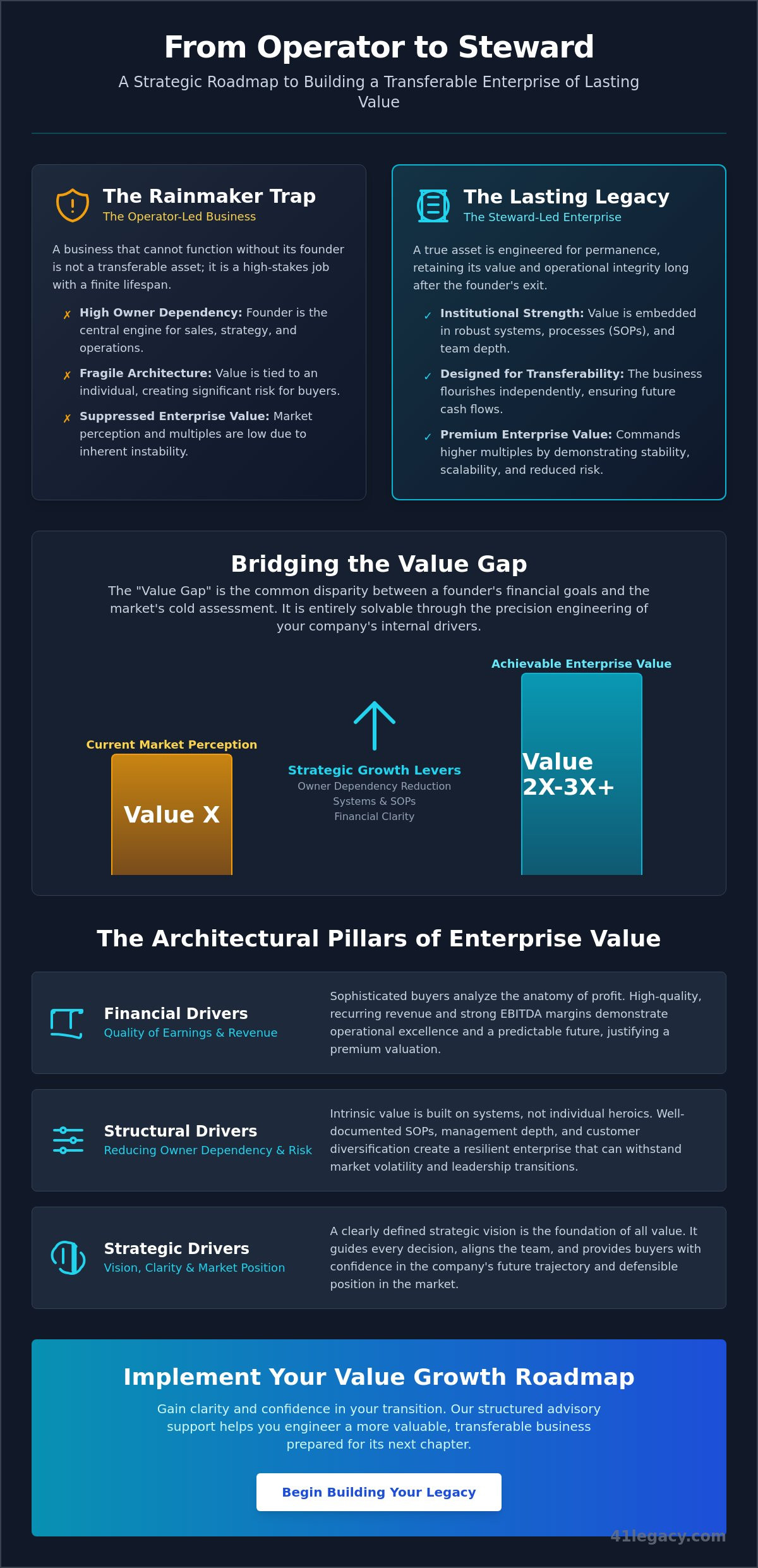
A business that cannot breathe without its founder isn't an asset; it's a job with an expiration date. While many owners take pride in being the central engine of their firm, this "Rainmaker Trap" creates a fragile architecture that sophisticated buyers view with skepticism. In an era where deal values reached $1.6 trillion in 2025, the market increasingly favors companies designed for permanence over those built on individual heroics. Understanding the key drivers of enterprise value is the first step toward evolving from an operator into a steward of a lasting legacy.
We recognize the weight of the "Value Gap" that often exists between a founder's financial goals and the cold reality of market perception. It's a common frustration, yet it's entirely solvable through meticulous engineering of your internal systems. This article reveals the strategic levers that transform a profitable business into a high-value, transferable asset that thrives independently of your daily presence. We'll provide a clear roadmap for increasing your enterprise value while reducing personal stress through better delegation and robust SOPs, ensuring your business commands the premium multiple it deserves.
Key Takeaways
- Move from operator to steward by understanding that true enterprise value is measured by a company’s ability to flourish independently of its founder.
- Analyze the financial metrics that matter most, including the quality of earnings and the specific key drivers of enterprise value that command premium market multiples.
- Address the "Rainmaker Trap" by implementing structural engineering and SOPs that transform individual expertise into institutional excellence.
- Identify the "Value Gap" within your organization and learn the strategic steps necessary to align your current operations with your long-term legacy goals.
- Gain clarity on how a Value Growth Roadmap and structured advisory support can streamline your transition and reduce the risks associated with owner dependency.
Defining Enterprise Value: Beyond the Financial Formula
Enterprise value is often reduced to a cold calculation on a balance sheet. While the technical definition of Enterprise Value accounts for equity, debt, and cash, this formula only captures a snapshot in time. It doesn't account for the soul of the organization or its ability to endure. For the sophisticated owner, value isn't just about what the business earned yesterday. It's about what it can reliably produce tomorrow without the founder's direct intervention.
We view the key drivers of enterprise value as the architectural pillars that support a lasting legacy. A business that generates significant revenue but relies entirely on the founder’s personal relationships or specialized knowledge is a lifestyle business. It’s a high-paying job, not a transferable asset. True value emerges when we shift our focus from historical revenue to future transferability. Buyers don't buy the past; they buy the certainty of future cash flows and the systems that guarantee them.
This transformation begins with strategic clarity. It's the foundation upon which all other levers are built. Without a clear vision of what the business is and where it's going, every other improvement is merely cosmetic. We use Enterprise Diagnostics to uncover the hidden risks that devalue an organization, allowing owners to move from being a central cog to a dedicated steward of a self-sustaining entity. This shift in perspective is what separates those who simply run a company from those who build a legacy.
The Concept of the Transferable Asset
A business should function as a living, self-sustaining organism. When a founder is the primary source of sales, strategy, and problem-solving, the business lacks independent life. Stewardship requires building a structure where the team and systems carry the weight of the vision. A transferable asset is a business that retains its core essence and operational integrity long after the founder has stepped away from the helm. This level of engineering ensures that the value you've built isn't tied to your physical presence, but is instead woven into the very fabric of the company.
Intrinsic vs. Extrinsic Drivers
External market forces, such as interest rates or industry shifts, are extrinsic factors that we cannot control. However, the most significant key drivers of enterprise value are intrinsic. These are the internal mechanics of your operation: your management depth, your systems, and your customer diversification. By focusing on precision within these internal processes, you create a fortress that protects the business from market volatility. We help owners master these internal levers through Transferability Engineering, ensuring the enterprise remains resilient regardless of the economic climate. It's this dedication to internal excellence that commands a premium multiple during a transition.
Financial Drivers: The Quality of Earnings and Revenue
Financial metrics are the empirical evidence of a steward’s precision. While revenue provides the scale, it's the quality of earnings that truly defines the 7 Key Drivers of Enterprise Value. A business with ten million dollars in revenue might be worth less than one with five million if the latter possesses superior predictability and efficiency. Buyers aren't just looking at the bottom line; they're dissecting the anatomy of that profit to see if it's healthy, sustainable, and capable of surviving a transition.
Sophisticated advisors and acquirers look for clarity in the numbers. Clean, professional financial reporting acts as a bridge of trust between the current steward and the future owner. When accounting is handled with surgical precision, it reduces the perceived risk for an acquirer, signaling that the enterprise is managed with a devotion to excellence. This transparency allows for a more accurate assessment of the internal mechanics, ensuring that the value you've built is recognized and respected during a Strategic Capacity Evaluation.
EBITDA and Operational Excellence
EBITDA margins serve as a vital marker of how well the business machine is tuned. A higher margin doesn't just mean more profit; it signals that the organization is run with extreme operational efficiency and discipline. It shows that the company can generate significant cash flow without excessive waste or friction. This level of performance is highly attractive to buyers who value a refined engine over one that requires constant, expensive repairs. Professional financial reporting ensures these margins are defensible and grounded in reality, further insulating the business from valuation skepticism.
The Power of Recurring Revenue
Revenue is the lifeblood of the enterprise, but not all income is created equal. Subscription or contract-based models command higher multiples because they provide a narrative of future certainty. Transactional models require the business to "win" every sale anew, whereas recurring streams prove that the market values the ongoing essence of the service. Diversifying the customer base is equally critical to eliminate single-point-of-failure risks that can devalue a firm. Any single customer accounting for more than 15% of annual revenue creates a structural vulnerability that leads to a significant valuation discount. By spreading revenue across a broader client base, you protect the legacy from the sudden departure of a single entity.
Financial forecasting serves as a final tool for demonstrating future potential. It moves the conversation from what has been to what can be, providing a data-driven projection of the company's trajectory. When these forecasts are rooted in historical accuracy and operational stability, they become a powerful testament to the business’s resilience. This forward-looking approach ensures that the key drivers of enterprise value are not just present, but are actively accelerating toward a successful future transition.
Structural Drivers: Reducing Owner Dependency and Risk
Structural integrity is the invisible architecture that allows a business to stand long after its architect has departed. While financial metrics provide the scale, the internal strength of an organization determines its ultimate resilience. Among the most critical key drivers of enterprise value is the deliberate reduction of owner dependency. A business that relies on the founder as its primary engine is inherently limited; it possesses a ceiling that no amount of revenue can pierce. True transferability requires a shift from individual brilliance to institutional excellence.
We believe that a business should be built like a masterpiece, where every component functions in harmony without constant manual adjustment. When the founder is the sole repository of strategy and relationships, the enterprise is fragile. Buyers look for a structure that can maintain its momentum under new stewardship. This requires a transition from the founder as the central cog to a team of dedicated specialists who execute the vision with precision. Establishing this depth is a fundamental step in our process of Transferability Engineering.
Escaping the Rainmaker Trap
The Rainmaker Trap is a common affliction where the founder remains the company’s most effective salesperson and primary decision-maker. While this may drive growth, it devalues the firm in the eyes of a future owner. They seek a management team that can operate independently. We help owners navigate this transition through Owner Dependency Reduction, moving the founder toward the role of a strategic steward. This involves a Strategic Capacity Evaluation of the existing leadership, identifying those capable of carrying the legacy forward. It’s a psychological and operational shift that transforms the business into a self-governing entity.
The Role of Documented Systems
Documented systems are the blueprints of the enterprise. They ensure that the quality and precision of your work remain consistent, regardless of who is performing the task. Understanding what is sop in business is fundamental to creating a transferable asset. These systems act as a knowledge vault, protecting the company’s historical excellence and operational secrets. By codifying every critical process, you create a business that is not just a collection of people, but a sophisticated machine. This documentation reduces perceived risk, proving to a buyer that the essence of the work is preserved within the system itself.
Risk mitigation through compliance and management depth completes this structural fortress. When a business can demonstrate a deep bench of talent and a clean regulatory history, it moves into a rare category of excellence. These structural key drivers of enterprise value ensure that the organization is not just profitable today, but prepared for the complexities of tomorrow. By building these foundations, you ensure your legacy is protected and your business commands the premium it deserves.
Strategic Drivers: Identifying and Closing the Value Gap
The Value Gap is a quiet architect of frustration for many founders. It represents the distance between the current market reality of your firm and the financial figure required to fund your next chapter. In a market where deal values reached $1.6 trillion across more than 10,000 transactions in 2025, the competition for premium assets is fierce. Closing this gap requires a refusal to accept average market performance. Instead, we focus on the key drivers of enterprise value that elevate a brand from a commodity to a premium asset. It's about building a business that doesn't just survive the market, but leads it.
Strategic clarity allows a steward to look past daily operations and see the enterprise as a whole. While previous sections focused on the internal mechanics of profit and structure, strategic drivers focus on the company's trajectory. This involves identifying hidden value killers that might not appear on a standard P&L statement but can significantly devalue a firm during a transition. By addressing these gaps now, you ensure that the essence of what you've built is preserved and properly valued by the next generation of ownership.
Quantifying the Value Gap
Calculating this gap is the first step toward a successful transition. It requires an honest assessment of current worth versus your ultimate exit goal. With the 21% federal corporate tax rate now permanent under the One Big Beautiful Bill Act, founders have a more stable foundation for long-term risk modeling and financial planning. We utilize a Value Growth Roadmap to prioritize the most impactful improvements, ensuring every effort moves the needle. Regular enterprise diagnostics allow you to track this progress with precision. This data-driven approach ensures that your stewardship is focused on growth that matters, turning a theoretical future into a tangible, measurable reality.
Market Attractiveness and Scalability
A truly valuable enterprise must prove it can grow without a proportional increase in costs. This is the essence of scalability. Buyers look for a business positioned as a leader in a curated niche, where the Unique Selling Proposition is unmistakable. When you demonstrate a clear path to future growth for a successor, you remove the uncertainty that often devalues a firm. Positioning your brand as an authority in its space attracts buyers who value heritage and performance over mere volume. It involves creating an essence that is both rare and highly sought after.
Identifying these hidden levers is the only way to ensure your business commands the multiple it deserves. By mastering the key drivers of enterprise value, you move beyond the limitations of the present and begin building for a future that thrives without you. To begin uncovering the specific obstacles standing between your current worth and your legacy goals, we invite you to schedule an Exit Readiness Assessment.
The Path Forward: Implementing Your Value Growth Roadmap
Implementing a vision requires more than a simple list of goals; it demands the disciplined execution of the key drivers of enterprise value. While many owners understand the theory of value growth, the transition from operator to steward often falters during the implementation phase. A roadmap is only as effective as the hands that guide its progress. We provide the structure and accountability necessary to ensure that your strategic objectives aren't lost in the noise of daily operations.
Most business owners possess a trusted inner circle of professionals, yet these advisors often operate in silos. Your CPA focuses on the 21% flat corporate tax rate, while your attorney prioritizes risk mitigation. Given the landscape shifted by the One Big Beautiful Bill Act (OBBBA), where the federal estate tax exemption has risen to $15 million, the need for coordinated planning has never been more urgent. We serve as the "quarterback" for this team, aligning every professional voice toward a singular vision of transferability and legacy. This coordinated approach ensures that every tactical decision supports the long-term health of the enterprise.
Coordinating the Professional Advisory Team
A standard CPA or attorney is a master of their specific discipline, but they aren't necessarily specialists in exit readiness. A successful transition requires a Certified Exit Planning Advisor (CEPA) to orchestrate the various moving parts of the Value Growth Roadmap. We bridge the gap between these experts, ensuring that legal structures, tax planning, and operational improvements work in harmony. By acting as the central point of coordination, we help owners avoid the fragmented advice that often leads to a "Value Gap" at the moment of exit.
The Discipline of Monthly Implementation
Excellence is not a singular act, but a habit of meticulous stewardship. Moving from theoretical strategy to granular technical excellence requires consistent effort and accountability. Our Monthly Implementation Support provides the steady rhythm needed to transform your business into a transferable asset. We focus on the details that others overlook, from refining SOPs to strengthening management depth. This disciplined approach ensures that the improvements we've identified are woven into the very fabric of the company, creating a legacy that thrives for the next generation.
Building a transferable business is a philosophical endeavor as much as a technical one. It’s a commitment to preserving the essence of what you’ve built while preparing it for a future that exists beyond your physical presence. By mastering the key drivers of enterprise value through structured Strategic Advisory, you elevate your role from founder to guardian. Your business becomes more than a source of income; it becomes a lasting contribution to your family, your employees, and your community.
Securing the Future of Your Enterprise
True stewardship means acknowledging that your business is a living entity with a story that extends far beyond your tenure. By mastering the key drivers of enterprise value, you transform a successful operation into a resilient, transferable asset. We've explored how operational efficiency, documented systems, and a reduction in owner dependency create the structural integrity required to command a premium multiple. This transition from founder to steward is a meticulous process that requires both technical precision and a commitment to long-term excellence.
Our structured advisory model, led by a Certified Exit Planning Advisor (CEPA), acts as the essential "quarterback" for your professional team. We don't just focus on transactions; we focus on the engineering of a lasting impact. It's about aligning your advisors toward a singular vision of clarity and growth. To understand how your organization currently measures against these standards, you should begin your journey with an Exit Readiness Assessment. You've spent years building your business; now it's time to ensure it thrives for the next generation.
Frequently Asked Questions
What is the difference between equity value and enterprise value?
Enterprise value represents the total economic worth of the business entity, encompassing its entire capital structure. It's calculated by adding equity value and total debt, then subtracting cash and cash equivalents. While equity value reflects the portion of the company owned by shareholders, enterprise value provides a more comprehensive view of the cost to acquire the entire operation. It's the standard metric used by sophisticated buyers to assess the total price of the business machine.
How can I reduce owner dependency if I am the face of the company?
Reducing dependency requires a deliberate shift from a personal brand to an institutional one. You must begin by elevating a second-in-command and documenting the specific decision-making frameworks that define your unique approach. By transferring key client relationships to a capable leadership team and utilizing Transferability Engineering, you ensure the business retains its essence without your daily presence. This process transforms you from the central engine into a strategic steward of the legacy.
What is a 'good' EBITDA multiple for my industry?
A "good" multiple is relative and depends heavily on how well you manage the key drivers of enterprise value compared to your peers. While industry averages provide a baseline, companies with recurring revenue and low owner dependency consistently command multiples at the top of their sector's range. Buyers pay a premium for predictability and scalability. Focusing on qualitative improvements often moves a business from an average multiple to an elite one, regardless of the industry standard.
Why do I need an Exit Readiness Assessment if I'm not planning to sell soon?
Exit readiness is synonymous with business health and operational excellence. Conducting an assessment early allows you to identify "value killers" and structural risks while you still have the strategic runway to correct them. It provides a baseline for your Value Growth Roadmap, ensuring that every hour you spend in the business is actually increasing its worth. Building a business that is ready to sell at any time gives you the ultimate freedom to choose when you actually depart.
How do Standard Operating Procedures (SOPs) impact my business valuation?
SOPs act as the blueprints that prove your business is a self-sustaining organism rather than a collection of individual efforts. Buyers view documented systems as a form of insurance against operational failure after the founder exits. When processes are codified, the risk of a transition is significantly lowered, which directly correlates to a higher valuation multiple. They represent the difference between a business that relies on tribal knowledge and one that possesses institutional intelligence.
Can a business be too profitable to sell?
A business is never too profitable, but it can be too risky if that profit is tied to a single point of failure. If extreme profitability is the result of a founder's personal genius or a single massive contract, buyers will see it as a high-risk personal income stream. To make high profits attractive to an acquirer, they must be backed by a management team and systems that can replicate those results. Transferability is the lens through which all profit is viewed during a transition.
What are the most common 'value killers' in a mid-market company?
The most frequent obstacles to a high-value exit include customer concentration over 15%, high owner dependency, and technical debt in internal systems. These factors create a "Value Gap" that can derail a transition or lead to heavy discounts during due diligence. Inconsistent financial reporting also serves as a major red flag, as it suggests a lack of operational discipline. Addressing these hidden risks through Enterprise Diagnostics is essential for protecting the legacy you've built.
How long does it typically take to significantly increase enterprise value?
Significant growth in the key drivers of enterprise value typically requires a horizon of 18 to 36 months of disciplined implementation. This window allows for the stabilization of new management structures and the documentation of at least two years of clean, professional financial performance. It's a time-intensive process of craftsmanship that cannot be rushed. Consistent effort over this period ensures that the value growth is real, sustainable, and ready to be tested by the market.
Disclaimer
This article is for educational and informational purposes only and does not provide legal, tax, investment, or business brokerage advice. 41 Legacy does not offer M&A brokerage services, legal document drafting, tax preparation, or investment advisory services. Business owners should consult licensed professionals in those disciplines before making decisions related to business transactions, legal matters, tax strategy, or financial planning. All examples are illustrative and may not apply to your specific situation.