
The Key Drivers of Enterprise Value: Building a Transferable Asset for the Future
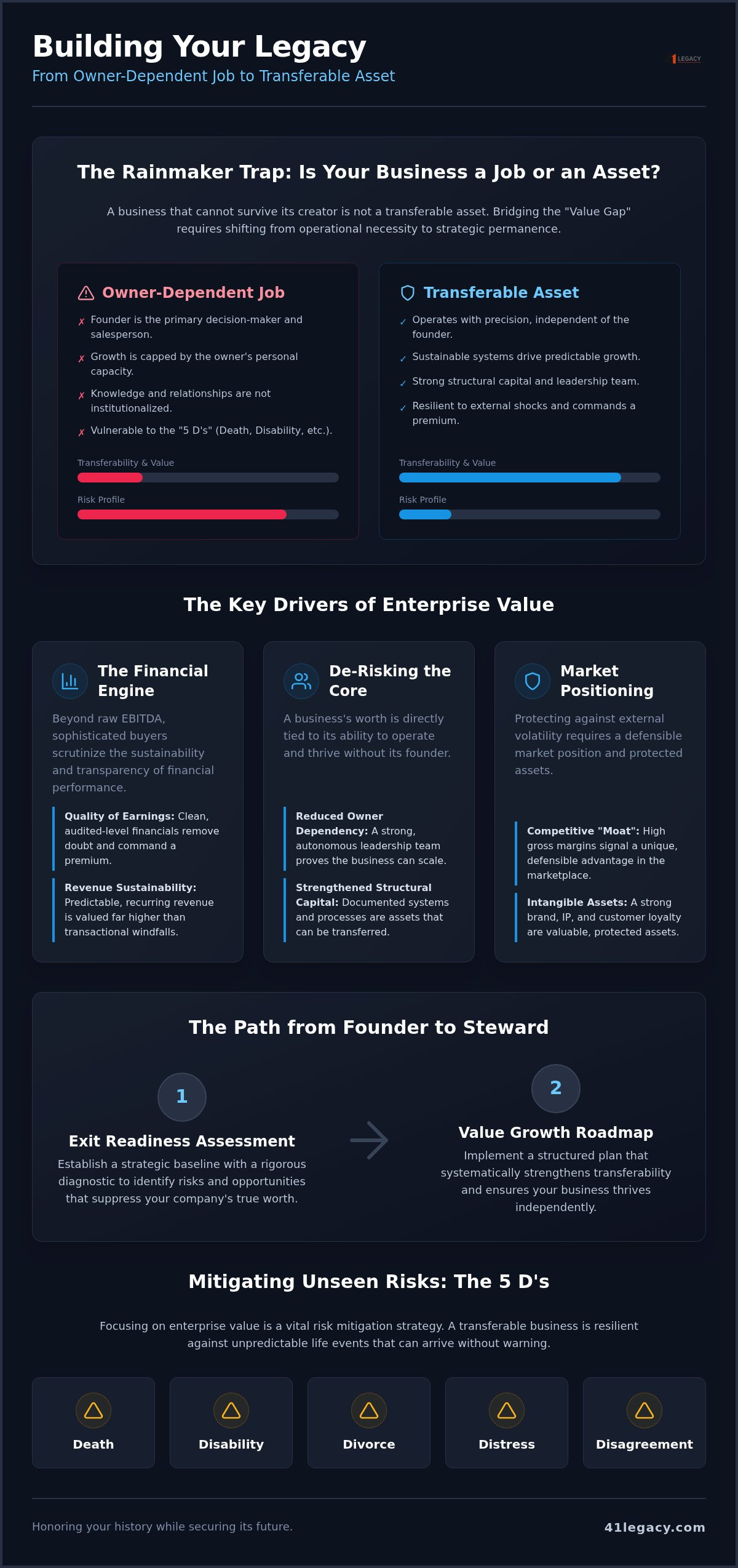
A business that cannot survive the absence of its creator is not an asset; it's a job with an expensive overhead. You've likely felt the persistent pull of the "Rainmaker Trap," where the preservation of your life's work depends entirely on your daily presence. While your revenue may be impressive, the market's appraisal of your legacy depends on the key drivers of enterprise value that exist outside of your personal shadow. We understand the profound sense of stewardship you feel toward what you've built, and we recognize that true excellence requires a shift from operational necessity to strategic permanence.
You deserve to see the essence of your company distilled into a form that's both durable and distinct. We'll show you how to move beyond the uncertainty of market value by focusing on transferability engineering and owner dependency reduction. This article provides a clear framework for identifying your "Value Gap" and implementing the structured precision needed to command a higher multiple. By the end, you'll understand how to cultivate a firm that thrives as a self-sustaining entity, honoring your history while securing its future.
Key Takeaways
- Bridge the "Value Gap" by redefining your company as a transferable asset rather than a source of personal income.
- Strengthen the key drivers of enterprise value by prioritizing the quality of earnings and rigorous financial transparency.
- Cultivate the structural capital needed to eliminate owner dependency and command a premium multiple during a transition.
- Use an Exit Readiness Assessment to establish a strategic baseline for identifying risks that suppress your company's true worth.
- Transition from founder to steward by implementing a Value Growth Roadmap that ensures your business thrives independently.
Beyond the Balance Sheet: Redefining Enterprise Value as a Transferable Asset
Enterprise value is the ultimate measure of a company's health and its potential for a lasting impact. In the technical sense, enterprise value represents the total economic worth of the business, encompassing both equity and debt while accounting for cash reserves. For the dedicated founder, however, it's far more than a financial figure. It's the tangible manifestation of their vision and sacrifice. True excellence in business ownership requires a shift in perspective, moving from viewing the company as a source of personal income to treating it as a distinct, transferable asset.
Many owners suffer from a "Value Gap," which is the difference between their current valuation and the capital required to secure their future. Bridging this chasm requires a deep understanding of the key drivers of enterprise value. If a business cannot function without its creator, its market appeal is severely limited. Transferability is the litmus test of true worth. Sophisticated buyers don't seek a job; they seek an engine of growth that operates with surgical precision, regardless of who sits in the founder's chair.
The Philosophical Shift: From Operator to Steward
We view a business as a living entity with its own story to tell and a progression that should outlast any single individual. When a founder remains the primary decision-maker and salesperson, they inadvertently create a valuation ceiling. The business's growth is throttled by the owner's personal capacity. To unlock higher levels of worth, one must adopt a professional-room altitude. This transition from operator to steward involves detaching the company's identity from your own. It's an act of preservation, ensuring the essence of the organization remains intact even as the leadership changes.
Why Enterprise Value Matters Years Before an Exit
Focusing on value growth isn't just about a future transaction; it's a vital risk mitigation strategy. Life is unpredictable, and the "5 D's" (death, disability, divorce, distress, and disagreement) can arrive without warning. A business built on strong key drivers of enterprise value is resilient against these external shocks. At 41 Legacy, we believe that optimizing for transferability today improves your daily quality of life and operational efficiency. It allows you to build a legacy that honors the past while remaining aggressively prepared for the future. By treating the business as a masterpiece in progress, you ensure that its value is captured, protected, and eventually passed on with dignity.
The Financial Engine: Quality of Earnings and Revenue Sustainability
The financial performance of a business is the pulse of its legacy, a rhythmic confirmation of its health and vitality. While EBITDA serves as the standard baseline for valuation, it's merely the starting point for a deeper conversation about worth. Sophisticated investors look past the raw numbers to examine the "Quality of Earnings." This process involves a forensic level of scrutiny to ensure that profits are not just present, but are sustainable and accurately documented. Clean, audited-level financial statements command a premium because they remove the friction of doubt, allowing the true excellence of the enterprise to shine through without the haze of disorganized accounting.
Revenue sustainability is perhaps the most influential of the key drivers of enterprise value. There is a profound difference between transactional revenue and recurring revenue. A business that must "kill what it eats" every month carries an inherent risk that depresses its multiple. Conversely, predictable, contractually recurring revenue acts as a promise of future performance. We often see owners celebrate a "windfall year," yet a single spike in profit is less valuable to a buyer than a steady, upward trajectory of disciplined growth. To understand how your current financial health translates into market worth, conducting enterprise diagnostics is a vital step in the stewardship of your asset.
Margins and Competitive Advantage
Superior gross margins are the hallmark of a business with a formidable "moat." When a company can maintain high margins relative to its peers, it signals to the market that it possesses a unique competitive advantage or a specialized niche that cannot be easily replicated. This operational efficiency directly inflates the enterprise multiple. During this evaluation, we focus on "normalized earnings," which serve as the true reflection of a company's profit potential by stripping away non-recurring expenses or personal owner-related costs. This precision ensures the business is appraised based on its actual mechanical strength rather than temporary anomalies.
Revenue Concentration and Diversity
A business that relies on a handful of clients is a fragile entity. The "80/20 rule," where a significant portion of revenue is tied to a small percentage of the customer base, creates a "concentration risk" that can terrify potential successors. Protecting the inner essence of the company requires a deliberate strategy of customer diversification. By spreading revenue across a broader mix of industries and clients, you insulate the enterprise from market shifts and individual client departures. This balance ensures the company remains a resilient, transferable asset that can withstand the tests of time and external volatility.
De-risking the Core: Reducing Owner Dependency and Strengthening Structural Capital
A business tethered to its founder is a business in peril. We often encounter founders caught in the "Rainmaker Trap," a state where every critical sale and strategic decision flows through a single point of failure. While being the primary driver of growth may feel like a position of strength, it's actually a significant liability that investors will penalize. True owner dependency reduction is one of the most potent key drivers of enterprise value because it proves the business can thrive without the architect's daily oversight. When the founder is the business, there's no asset to transfer; there's only a job to be filled.
To move beyond this ceiling, a company must invest in its structural capital. This is the invisible architecture of the firm, comprising the systems, processes, and intellectual property that remain when the lights go out at night. By implementing a Value Growth Roadmap, you begin the deliberate process of transitioning responsibilities from your personal desk to a resilient leadership team. This shift directly translates to a lower discount rate in professional valuations, as it replaces the uncertainty of a single individual with the reliability of a self-sustaining system.
The Power of Documented SOPs
Documented Standard Operating Procedures (SOPs) are the codified wisdom of your organization. They represent a transition from tribal knowledge to institutional memory, ensuring that every task is performed with the same rhythmic consistency regardless of who executes it. Buyers pay a premium for "turnkey" operations because they are purchasing certainty. This focus on process precision reflects the meticulous nature of high-end business craftsmanship, where every detail is polished to ensure the company functions as a masterpiece of efficiency rather than a collection of ad-hoc responses.
Building Human Capital and Leadership Depth
A leadership team isn't just a collection of subordinates; it's the strategic engine of the firm. Cultivating human capital requires a commitment to talent development that goes beyond basic training. We utilize a Strategic Capacity Evaluation to determine if your second-tier management possesses the skills and authority to execute your long-term vision. This depth of leadership ensures that the company's "inner essence" is preserved through transitions. When a buyer sees a team capable of autonomous growth, they see a durable asset worth a higher multiple, not a fragile entity that will crumble the moment the founder departs.
Market Positioning and Intangible Assets: Protecting Against External Volatility
Enterprise value isn't built in a vacuum. It exists within a market that is often volatile and unforgiving. While the financial engine and internal systems provide the foundation, your market positioning acts as the protective casing for the asset. Brand equity and intellectual property are the intangible key drivers of enterprise value that transform a simple business into a sought-after institution. A company's reputation and culture aren't just HR metrics; they're the marketable essence that tells a story of permanence and reliability to potential successors. This narrative of excellence is what separates a mere service provider from a guardian of a specific industry legacy.
Identifying hidden risks within your market environment requires a cold, objective gaze. We utilize Enterprise Diagnostics to peel back the layers of external perception and find where the business might be vulnerable to shifting industry trends. This diagnostic approach ensures that the stewardship of your legacy is based on rigorous data rather than optimistic assumptions. To begin this process of discovery and fortify your market standing, we invite you to utilize our Enterprise Diagnostics to secure your company's future value.
Strategic Positioning and Market Share
The distinction between a commodity player and a specialized leader is the difference between surviving and thriving. We advocate for being a "big fish in a small pond," where your specific expertise grants you significant pricing power. Specialized niches are naturally insulated from the price wars of the broader market. This refusal to settle for average performance becomes a brand identifier in itself. When you occupy a unique space with surgical precision, your valuation multiple reflects the rarity and desirability of what you've built.
Technology and Intellectual Property
Proprietary technology and unique service methodologies create a barrier to entry that competitors find impossible to scale. Modern tech stacks and refined systems don't just improve efficiency; they increase the speed at which a transferable asset can grow. We view these as the structural safeguards of your curatorial expertise. Protecting these assets through legal and structural frameworks ensures that the inner essence of your work remains exclusive. By codifying your unique approach, you turn abstract talent into a vibrant, scalable asset that commands respect and a premium multiple.
From Theory to Implementation: Building Your Value Growth Roadmap
The transition from a profitable company to a high-value, transferable asset is not an accidental occurrence. It is the result of a deliberate distillation process. To begin this journey, an Exit Readiness Assessment is essential to establish a baseline that replaces speculation with strategic certainty. By identifying the key drivers of enterprise value at the outset, we can move with a shared sense of purpose. This assessment serves as the foundation for all subsequent value-building activities, ensuring that every hour of effort contributes to the long-term health and durability of the firm.
The complexity of this endeavor requires a harmonious coordination of expertise. We serve as the "Quarterback" for your professional advisory team, aligning the technical precision of your CPA, the legal rigor of your attorney, and the strategic vision of your RIA toward a singular objective. This collaborative approach ensures that the work remains cohesive and the stewardship of your legacy is never fragmented. Implementation is where theory meets reality. Through monthly accountability and structured support, the strategic roadmap becomes a living document that guides the company toward its highest potential worth.
The 41 Legacy Process: Diagnostics to Implementation
Our methodology begins with Enterprise Diagnostics, an intensive review that exposes the "Value Gap" and identifies the specific risks suppressing your company's multiple. This data is then transformed into a customized Value Growth Roadmap, a strategic blueprint designed to enhance transferability and reduce owner dependency. We don't believe in static reports that gather dust. Our Monthly Strategic Advisory serves as the guardian of your long-term vision, providing the consistent cadence needed to execute Transferability Engineering with surgical precision. Learn more about our structured advisory process at 41 Legacy to see how we bridge the gap between current operations and a lasting legacy.
Actionable Steps for the Next 90 Days
Transforming an enterprise requires immediate, focused action. The next three months are a critical period for establishing the momentum necessary for long-term growth. We recommend focusing on the following foundational steps:
- Conduct an owner dependency audit: Identify the specific decisions and sales processes that still require your personal intervention to function.
- Review financial statements for clarity: Work with your team to identify "add-back" opportunities and ensure your reporting reflects the true earning power of the business.
- Schedule a professional diagnostic: Establish a baseline valuation to identify the "Value Gap" and determine the most effective key drivers of enterprise value for your specific industry.
These initial steps move you away from the daily operational burden and toward the role of a strategic steward. By treating the business as a masterpiece in progress, you ensure that the essence of your life's work is preserved, protected, and prepared for a successful future transition.
Cultivating a Legacy of Strategic Permanence
The transformation of your business from a personal endeavor into a self-sustaining masterpiece is the ultimate act of leadership. It requires a meticulous focus on transferability, where tribal knowledge is distilled into institutional memory and revenue is fortified against market shifts. By addressing owner dependency and financial transparency today, you create an asset that possesses its own inherent vitality, independent of your daily presence. Focusing on the key drivers of enterprise value ensures that your life's work is both protected and prepared for its next chapter.
Success in this transition demands more than a document; it requires a disciplined orchestration of expertise. Led by Certified Exit Planning Advisor (CEPA) leadership, our team utilizes a proven Value Growth Roadmap methodology to identify and bridge your "Value Gap." We serve as the strategic quarterback for your professional advisory team, ensuring that every legal, financial, and operational detail is aligned with your long-term vision. You've built something remarkable. Now, it's time to ensure it endures. Secure your legacy with an Exit Readiness Assessment from 41 Legacy and begin the journey toward building a truly durable asset.
The future of your masterpiece is waiting to be secured.
Frequently Asked Questions
What is the difference between Equity Value and Enterprise Value?
Enterprise Value (EV) represents the total economic worth of the company, including both debt and equity. It's often described as the "takeover price" required to acquire the entire entity. Equity Value is simply the portion of the company owned by shareholders. For stewards of a legacy, focusing on EV is critical. It reflects the true operational health and market attractiveness of the business, regardless of its current capital structure.
How can I reduce owner dependency if I am the face of the business?
Reducing owner dependency requires a deliberate shift from being the "Rainmaker" to becoming the "Architect" of the system. You must document Standard Operating Procedures and empower a leadership team to handle daily decisions. A business that can thrive for 30 days without your input is a more durable asset. This transition is one of the most significant key drivers of enterprise value as it ensures the company's essence survives your departure.
What is a "Value Gap" and why does it matter?
The Value Gap is the difference between your business's current worth and the capital you need to fund your next chapter. Identifying this gap through Enterprise Diagnostics is essential because it dictates the intensity of your growth strategies. Without knowing this figure, you might be building toward a financial goal that won't actually support your desired legacy. Knowing the gap allows for a more precise and purposeful implementation of your Value Growth Roadmap.
Do I need an exit plan if I don't plan on selling for 10 years?
Yes, because exit planning is essentially sophisticated business planning with an eye toward strategic permanence. A business that is "ready to sell" is better managed, more profitable, and less stressful to own today. Starting a decade early allows you to maximize your multiple. It also ensures you're prepared for the "unforeseen 5 D's," such as disability or distress, that can force an unplanned transition.
Why should I hire a "Quarterback" advisor instead of just using my CPA?
A "Quarterback" advisor, such as a Certified Exit Planning Advisor (CEPA), coordinates your entire professional team to ensure all financial and legal decisions align with your ultimate goal. While CPAs and attorneys provide vital technical expertise, they often work in silos. We integrate these perspectives to maximize the key drivers of enterprise value. This ensures that tax planning, legal structures, and strategic growth move in perfect harmony toward a successful future transition.
How do recurring revenue models impact my business's valuation?
Recurring revenue models provide buyers with predictable future cash flow, which significantly reduces their perceived risk. Transactional businesses are often seen as more fragile because they must "start at zero" every month. Shifting even a portion of your business to a subscription or contract-based model can dramatically increase your EBITDA multiple. It proves the business has a reliable, self-sustaining pulse that doesn't depend on constant new sales effort.

Article by
Mike Laskowski
Mike Laskowski is a Business Value Growth Strategist who helps business owners uncover the truths that drive their performance, risk, and readiness. Blending forensic interviewing from a 26‑year federal career with Strategic Capacity analysis and CEPA methodology, he works upstream to reduce owner dependency, increase transferability, and strengthen enterprise value. Mike guides founders through clarity, operational evolution, and transition readiness so their companies become transferable, owner‑independent assets that endure beyond the founder.
Disclaimer
This article is for educational and informational purposes only and does not provide legal, tax, investment, or business brokerage advice. 41 Legacy does not offer M&A brokerage services, legal document drafting, tax preparation, or investment advisory services. Business owners should consult licensed professionals in those disciplines before making decisions related to business transactions, legal matters, tax strategy, or financial planning. All examples are illustrative and may not apply to your specific situation.