
The Key Drivers of Enterprise Value: Building a Transferable Asset for the Future
The true worth of a masterpiece isn't found in the artist's signature, but in the work's ability to captivate an audience long after the brush is set down. In the sophisticated world of strategic transitions, enterprise value functions much the same way. Many founders eventually discover they've built a "Rainmaker Trap" where their personal involvement is the only thing keeping the gears turning. Mastering the key drivers of enterprise value requires a shift in perspective, moving from the role of a daily operator to a steward of a lasting legacy. It's about engineering a business that possesses its own internal rhythm and clinical precision, independent of any single individual.
You've likely spent decades perfecting your craft, yet you might still face uncertainty regarding the actual market value of your life's work. We recognize the profound dedication required to reach this level of excellence; we're here to help you protect it. This article outlines the critical factors that transform a profitable company into a high-value, transferable asset that thrives independently of its founder. You'll discover a clear framework for reducing operational dependency and securing a higher multiple in a market that increasingly prices risk based on leadership depth. This ensures your business remains a vibrant testament to your vision long into the future.
Key Takeaways
- Understand the "Value Gap" and how redefining your business as a transferable asset is the first step toward true stewardship of your legacy.
- Learn why high-quality earnings and transparent financial statements create a baseline of trust that commands a premium valuation multiple.
- Identify the key drivers of enterprise value that allow a company to function with surgical precision without the daily involvement of its founder.
- Discover how protecting intangible assets like brand equity and intellectual property serves as a vital shield against external market volatility.
- Establish a strategic baseline through an Exit Readiness Assessment to coordinate your advisory team toward a singular, high-value transition goal.
Beyond the Balance Sheet: Redefining Enterprise Value as a Transferable Asset
In the quiet halls of high-end business strategy, we view a company not merely as a source of income, but as a masterpiece in progress. At its core, Enterprise value represents the total economic worth of a business, encompassing both its equity and its debt. It's the definitive measure of what an organization has achieved and what it promises for the future. However, for many founders, a silent "Value Gap" often exists. This is the distance between the current market valuation of the firm and the financial capital the owner requires to fund their next chapter with dignity and security.
Closing this gap requires a focus on the key drivers of enterprise value. We must look past the immediate gratification of annual profits and examine the structural integrity of the organization. The ultimate litmus test for any company is its transferability. A business that cannot function without its creator isn't a true asset; it's a high-pressure job. To attract sophisticated buyers who value long-term stability, we must transition from a lifestyle business model to a transferable asset that stands on its own merits.
The Philosophical Shift: From Operator to Steward
Viewing a business as a living entity requires a profound shift in mindset. You're no longer just the operator; you're the steward of a legacy. When a business relies on the founder's daily presence for sales or decision-making, it hits a valuation ceiling that no amount of revenue can break. Achieving a professional-room altitude means rising above the tactical noise to focus on strategic growth. This elevation allows the business to develop its own story, rhythm, and progression. It ensures the entity survives and thrives far beyond your personal tenure.
Why Enterprise Value Matters Years Before an Exit
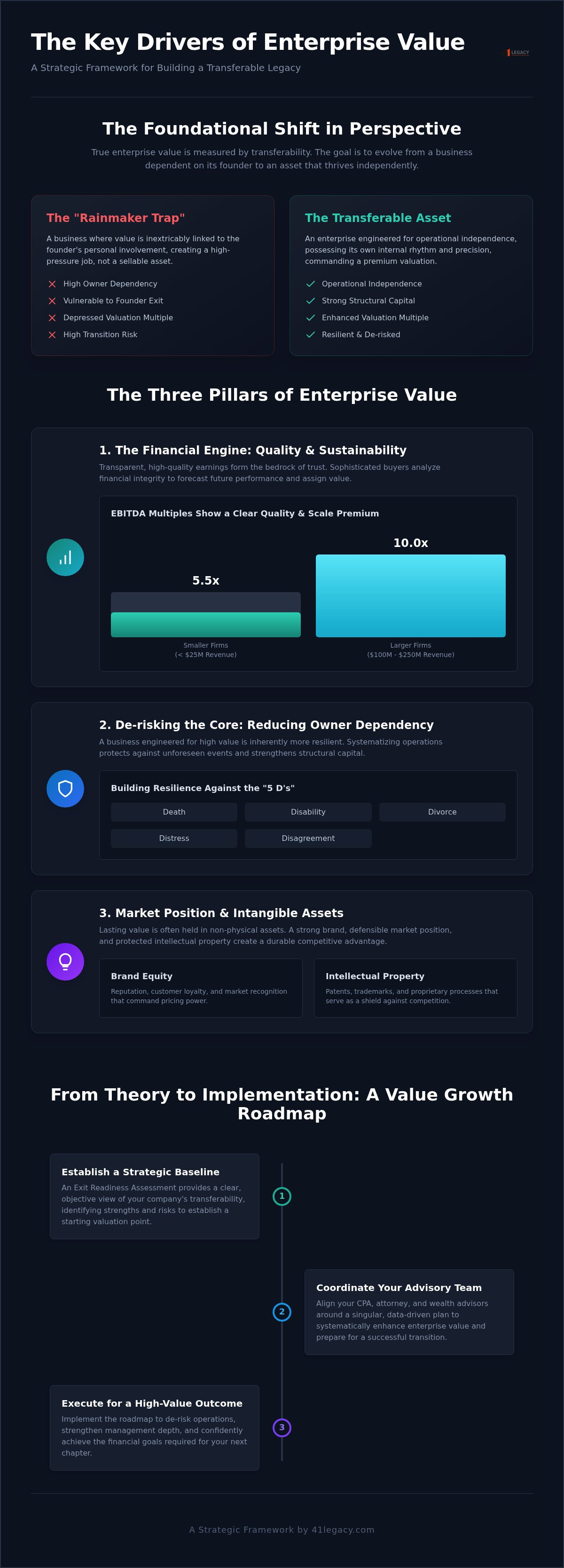
Building value isn't a task reserved for the twilight of a career. It's a vital risk mitigation strategy. Life is unpredictable, and the "5 D's"—death, disability, divorce, distress, and disagreement—can strike without warning. A business engineered for high enterprise value is inherently more resilient. By focusing on these drivers today, you improve current operational efficiency and your own quality of life. You aren't just preparing for a transition; you're polishing a gem. This meticulous approach preserves the essence of the company, ensuring your impact remains visible for future generations.
The Financial Engine: Quality of Earnings and Revenue Sustainability
Financial integrity is the silent heartbeat of a transferable asset. While top-line revenue often captures the imagination, sophisticated investors look deeper, seeking the precision of a finely tuned engine. The standard baseline for this evaluation is EBITDA, or Earnings Before Interest, Taxes, Depreciation, and Amortization. It serves as a universal language, stripping away the variables of capital structure and tax jurisdictions to reveal the raw operational strength of the enterprise. In 2025, average EBITDA multiples for private-equity-sponsored transactions showed a clear size premium, ranging from 5.5x for smaller firms to 10.0x for those in the $100M to $250M range. This disparity highlights that scale alone isn't the goal; rather, it's the quality and predictability of those earnings that command the highest respect.
True value is found in the "Quality of Earnings." Clean, audited-level financial statements act as a testament to your meticulous stewardship. When financials are transparent and rigorously documented, they remove the friction of uncertainty that often devalues a company during due diligence. This clarity allows for the calculation of normalized earnings, which represent the true profit potential of the business by removing one-time windfalls or non-recurring expenses. Establishing this baseline is one of the key drivers of enterprise value, as it provides a reliable forecast for future performance. Identifying where your current financials stand is the purpose of our Enterprise Diagnostics, ensuring your records reflect the excellence of your work.
Margins and Competitive Advantage
Superior gross margins are more than just numbers; they're evidence of a competitive moat. When a business maintains margins significantly above the industry average, it signals a unique market position or an intellectual property that competitors cannot easily replicate. This operational efficiency directly elevates the enterprise multiple. It tells the story of a company that doesn't just compete on price but leads through innovation and precision. Normalized earnings reflect this potential, showing buyers the sustainable profit the business can generate under new ownership.
Revenue Concentration and Diversity
A balanced revenue mix protects the inner essence of your company from the volatility of the market. The 80/20 rule, where a small handful of clients represent the majority of revenue, creates a fragility that sophisticated buyers find unappealing. Diversifying your customer base is an act of risk mitigation that strengthens the foundation of the business. By ensuring no single client holds the power to disrupt your stability, you build a resilient entity capable of enduring through shifting economic cycles. This diversity is among the essential key drivers of enterprise value that turn a profitable firm into a secure investment.
De-risking the Core: Reducing Owner Dependency and Strengthening Structural Capital
A business that cannot survive its creator is a liability, not a legacy. Many founders inadvertently fall into "The Rainmaker Trap," where they remain the primary architect of every sale and the sole arbiter of every major decision. While this central role feels essential during the early years of growth, it eventually becomes a profound risk. Sophisticated investors don't just buy cash flow; they buy the certainty that those flows will continue after the founder departs. Reducing this dependency is one of the most significant key drivers of enterprise value, as it directly lowers the discount rate applied by buyers who are wary of "key man" risk.
Building this independence requires an investment in Structural Capital. This term refers to the internal systems, proprietary processes, and documented knowledge that allow a company to function with surgical precision. When a business is structured this way, it possesses its own institutional memory. We utilize a Value Growth Roadmap to guide owners through this transition, systematically moving responsibilities from the founder to the organization itself. This shift ensures the "inner essence" of the company is protected and transferable.
The Power of Documented SOPs
Buyers pay a substantial premium for "turnkey" operations. Standard Operating Procedures (SOPs) are the blueprints of your business's craftsmanship. They transform tribal knowledge, which exists only in the minds of a few, into a permanent asset. This meticulous documentation ensures that quality remains consistent regardless of who is performing the task. In the world of high-value transitions, process precision is a signal of a mature, well-governed enterprise that is ready for its next chapter. It's the difference between a chaotic workshop and a master's studio.
Building Human Capital and Leadership Depth
A transferable asset requires a second-tier management team capable of executing the strategic vision. Legacy isn't built in isolation; it's carried forward by people. Developing this leadership depth is essential for long-term enterprise health. We often conduct a Strategic Capacity Evaluation to identify the potential within your existing workforce. By fostering talent and delegating authority, you create a resilient structure that thrives on collective expertise. This depth of leadership provides the stability that investors crave, ensuring the company's progression remains steady long after the transition is complete.
Market Positioning and Intangible Assets: Protecting Against External Volatility
The marketplace is a shifting landscape, yet a truly valuable enterprise remains anchored by its strategic positioning. While financial metrics provide the foundation, the marketable essence of a company is often found in its intangible assets. These include your brand equity, intellectual property, and the unique culture that defines your organization's character. In a climate where buyers increasingly scrutinize the link between delivery capacity and cash conversion, these intangible drivers serve as vital key drivers of enterprise value. They act as a sophisticated shield, protecting the core of your business from the turbulence of external economic cycles.
Sophisticated investors are drawn to businesses that possess a clear "attractiveness" within their industry. This isn't merely about popularity; it's about the clinical precision with which a company solves a specific problem. To understand how your business sits within this competitive ecosystem, we utilize Enterprise Diagnostics to identify hidden risks and untapped opportunities in your market environment. This diagnostic process ensures your positioning is intentional and your legacy is secure against unforeseen volatility.
Strategic Positioning and Market Share
There is a profound difference between being a commodity player in a crowded field and being a "big fish in a small pond." We advocate for the latter. Specialized niches allow for significant pricing power because your expertise cannot be easily replaced. This refusal to settle for average market performance becomes a brand identifier in itself. When you dominate a specific segment, your valuation multiple rises, reflecting the rarity and desirability of the asset you've curated. It's an act of strategic artistry that commands respect from the highest levels of the M&A community.
Technology and Intellectual Property
Proprietary technology and unique service methodologies create a formidable barrier to entry for competitors. These aren't just tools; they are the structural safeguards of your curatorial expertise. By integrating modern tech stacks and "IS Services," you increase the speed and scalability of your operations. This digital transformation ensures that your transferable asset can grow without a proportional increase in manual labor. Protecting these innovations through legal and structural frameworks is essential. It transforms your daily processes into a permanent, defensible piece of intellectual property that lives on long after the founder's tenure.
To begin uncovering the hidden value within your market position, we invite you to schedule your Enterprise Diagnostics today.
From Theory to Implementation: Building Your Value Growth Roadmap
Transforming a business into a transferable asset is a deliberate act of stewardship. It requires moving beyond the abstract and into the rigorous application of strategy. The journey begins with a comprehensive Exit Readiness Assessment. This diagnostic doesn't merely provide a score; it establishes the baseline for all future value-building activities by identifying exactly where the "Value Gap" resides. Without this clarity, efforts to improve the key drivers of enterprise value risk being fragmented and ineffective. Precision is the hallmark of a master artisan, and it's equally vital in the engineering of a company's future.
Strategic growth is a coordinated effort. Most business owners maintain relationships with CPAs, attorneys, and RIAs, yet these professionals often operate in isolation. We serve as the "Quarterback" for this advisory team, ensuring every technical detail aligns with your ultimate vision. This collaborative approach ensures that tax strategies, legal structures, and wealth management goals are all moving toward a single, high-value transition. It's about maintaining a professional-room altitude where every move is intentional and every outcome is engineered for success. We remove the burden of coordination from the owner, allowing you to focus on the high-level stewardship of your legacy.
Transferability Engineering is the final stage of this process. It's the meticulous work of ensuring that the systems and leadership depth we've discussed are fully integrated into the company's daily rhythm. Through Monthly Implementation Support, we provide the accountability needed to turn a strategic roadmap into a living reality. This ensures that when the time comes for a transition, the business is not just a collection of assets, but a thriving, independent entity. It's a masterpiece ready for its next curator.
The 41 Legacy Process: Diagnostics to Implementation
Our approach moves from high-level Enterprise Diagnostics to a customized Value Growth Roadmap. This isn't a static document; it's a dynamic guide for your company's evolution. As the guardians of your long-term legacy, our Monthly Strategic Advisory ensures that the essence of your work is preserved while its marketability is enhanced. Learn more about our structured advisory process at 41 Legacy to see how we bridge the gap between where you are and where you intend to be.
Actionable Steps for the Next 90 Days
The progression toward a high-value exit starts with small, precise movements. Over the next quarter, we recommend focusing on these foundational steps to establish momentum:
- Conduct a preliminary owner dependency audit to identify which decisions still require your personal signature and which can be delegated.
- Review your financial statements with a focus on "add-back" opportunities to reveal the true normalized earnings of the firm.
- Schedule a professional diagnostic to identify the key drivers of enterprise value that require immediate attention to strengthen your market position.
Engineering a Legacy of Permanent Value
Building a transferable asset is the ultimate act of business stewardship. We've explored how clean financials and the reduction of owner dependency create the structural integrity necessary for a high-value transition. By focusing on strategic positioning and protecting your intangible assets, you ensure the company's essence remains resilient against market fluctuations. Mastering these key drivers of enterprise value is what separates a lifestyle business from a legacy that thrives for generations. It's a meticulous process that requires both technical precision and a clear, long-term vision.
Under the leadership of a Certified Exit Planning Advisor (CEPA), we provide the strategic coordination needed to align your CPAs, attorneys, and RIAs toward a singular goal. Our proven Value Growth Roadmap methodology serves as the blueprint for this transformation, ensuring no detail is left to chance. We serve as the quarterback for your professional team, removing the burden of implementation from your shoulders. We invite you to take the first step in identifying your "Value Gap" and polishing your life's work into its finest form. Secure your legacy with an Exit Readiness Assessment from 41 Legacy. Your business is a masterpiece; it's time to ensure its story continues with strength and clarity.
Frequently Asked Questions
What is the difference between Equity Value and Enterprise Value?
Enterprise Value (EV) represents the total economic worth of the company, encompassing both its debt and equity. While Equity Value only reflects the portion owned by shareholders, EV is the definitive measure of operational health. It's often described as the "takeover price" of the entity. For a steward of a legacy, focusing on EV is essential because it captures the true market attractiveness of the business regardless of its capital structure.
How can I reduce owner dependency if I am the face of the business?
Reducing dependency on the founder requires a deliberate evolution from being the "Rainmaker" to becoming the "Architect" of the organization. You must document standard operating procedures and empower a leadership team to handle daily decisions. A business that thrives for 30 days without your input is a more resilient, transferable asset. This shift is one of the key drivers of enterprise value, as it removes the risk associated with a single individual.
What is a "Value Gap" and why does it matter?
The Value Gap is the difference between your company's current market valuation and the financial capital you need to fund your next chapter. Identifying this through Enterprise Diagnostics is a vital first step in your strategic progression. Without understanding this gap, you might build toward a goal that fails to support your desired lifestyle. It provides the necessary clarity to ensure your life's work results in a secure and dignified transition.
Do I need an exit plan if I don't plan on selling for 10 years?
Yes, beginning your exit strategy ten years in advance is simply sound business planning. A company that's ready for a transition at any moment is inherently better managed and more profitable today. This long-term horizon allows you to maximize your valuation multiple while protecting the entity against the "unforeseen 5 D's." Being prepared ensures that your impact is preserved, regardless of when you choose to step away from the daily operations.
Why should I hire a "Quarterback" advisor instead of just using my CPA?
A "Quarterback" advisor, such as a Certified Exit Planning Advisor (CEPA), ensures that all your professional specialists are moving toward a singular vision. While CPAs and attorneys offer technical excellence, they often work in isolation from one another. We coordinate these experts to align financial, legal, and strategic decisions. This holistic approach is one of the key drivers of enterprise value, turning fragmented advice into a unified roadmap for growth.
How do recurring revenue models impact my business's valuation?
Recurring revenue models significantly enhance valuation because they provide buyers with the certainty of predictable future cash flow. Transactional businesses carry higher risk because they must effectively start over at the beginning of every month. Shifting even a small portion of your revenue to a subscription or contract-based model can dramatically increase your EBITDA multiple. It transforms a series of sales into a steady, reliable pulse that defines a high-value asset.

Article by
Mike Laskowski
Mike Laskowski is a Business Value Growth Strategist who helps business owners uncover the truths that drive their performance, risk, and readiness. Blending forensic interviewing from a 26‑year federal career with Strategic Capacity analysis and CEPA methodology, he works upstream to reduce owner dependency, increase transferability, and strengthen enterprise value. Mike guides founders through clarity, operational evolution, and transition readiness so their companies become transferable, owner‑independent assets that endure beyond the founder.
Disclaimer
This article is for educational and informational purposes only and does not provide legal, tax, investment, or business brokerage advice. 41 Legacy does not offer M&A brokerage services, legal document drafting, tax preparation, or investment advisory services. Business owners should consult licensed professionals in those disciplines before making decisions related to business transactions, legal matters, tax strategy, or financial planning. All examples are illustrative and may not apply to your specific situation.