
The Key Components of a Business Exit Plan: A Blueprint for Transferable Legacy
Imagine dedicating decades to crafting a masterpiece only to realize the structure cannot stand if you step away. While a significant majority of business owners anticipate exiting their ventures within the next decade, surprisingly few have a comprehensive, written transition plan in place. You've likely felt the quiet weight of this uncertainty, searching for the key components of a business exit plan that can bridge the Value Gap. You might fear your daily involvement is the only pillar holding the entity together, or worry that your professional advisors lack a unified architectural vision.
Your business is a living legacy. It requires the precision of a master artisan to survive beyond your tenure. This article transforms a static exit strategy into a dynamic roadmap that maximizes enterprise value and secures your life's work. We'll examine how to reduce owner-dependency and engineer transferability into the very essence of your company. You'll gain a clear, actionable blueprint to ensure your business remains a high-value asset that thrives long after your stewardship ends.
Key Takeaways
- Shift from viewing an exit plan as a one-time document to embracing it as a living architectural blueprint for long-term enterprise health.
- Identify the key components of a business exit plan that engineer transferability through financial precision and documented operational harmony.
- Master the transition from operator to guardian by reducing owner dependency, ensuring the business thrives independently of your daily involvement.
- Utilize enterprise diagnostics to uncover your Value Gap and implement a structured roadmap that prioritizes growth and risk reduction.
- Learn the importance of the "quarterback" role in orchestrating unaligned professional advisors to protect the integrity of your life’s work.
The Architecture of a Strategic Business Exit Plan
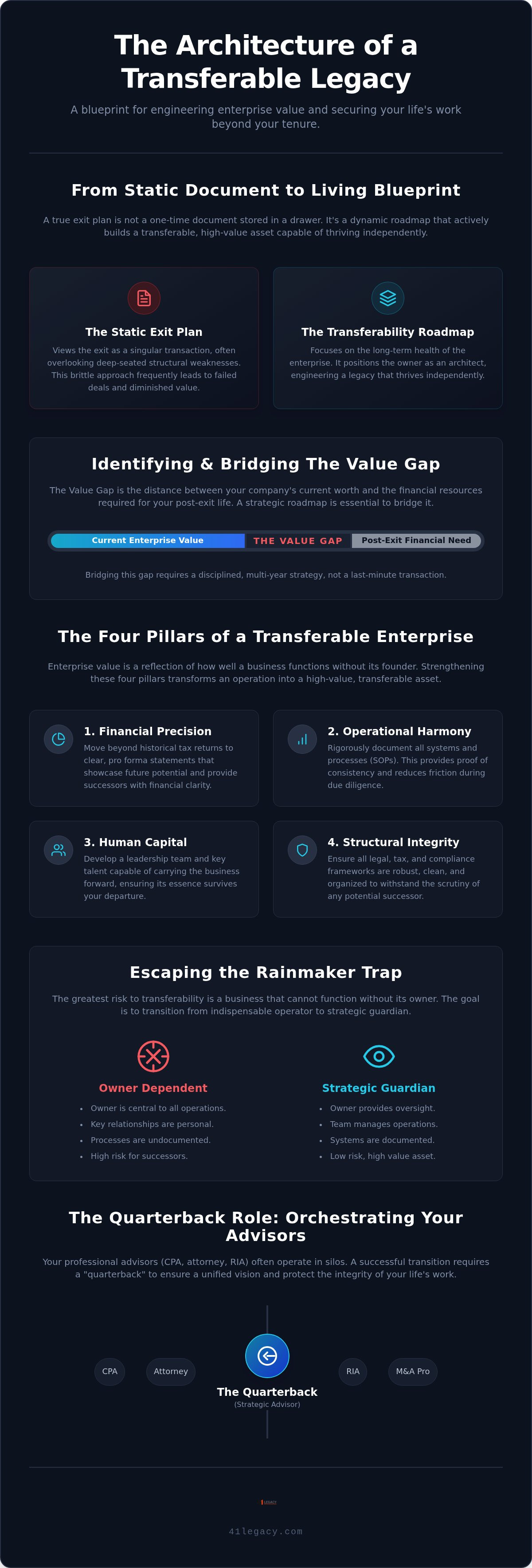
A strategic business exit plan is far more than a contingency; it is a declaration of intent. Many owners mistakenly view their exit as a terminal event, a singular transaction handled by brokers. We choose to see it as the architectural preservation of an essence. A static document, resting in a drawer, cannot account for the shifting tides of the market or the evolving health of an enterprise. It's a brittle approach that often fails when tested by reality. Instead, the key components of a business exit plan must form a living strategy that prioritizes the creation of a transferable asset over the mere mechanics of a sale.
This distinction is vital. A sale plan focuses on the exit itself, often ignoring the underlying structural weaknesses that lead to failed transactions. A transferability roadmap focuses on the health of the entity. It positions you, the owner, as the master architect of your company’s future. You aren't just preparing to leave; you are engineering a legacy that can thrive independently of your daily presence. This shift in perspective moves you from the role of a weary operator to that of a strategic steward.
Contextualizing the Exit: Why Templates Often Fail
Generic templates are the ghosts of someone else's success. They overlook the unique inner essence and specific operational rhythms that make your company distinct. When you focus on the deal before establishing readiness, you risk the integrity of the entire transition. A template should never be a final answer. It should serve as a diagnostic tool, revealing where the structure is weak and where it requires reinforcement. True readiness demands a bespoke approach that respects the history of the work while preparing it for a new steward.
The Essential Components of Strategic Clarity
Strategic clarity begins with identifying the Value Gap. This is the distance between the current worth of your enterprise and the financial requirements of your post-exit life. Bridging this gap is not a hurried task. It requires a timeline that respects the time-intensive nature of high-end craftsmanship. Another of the key components of a business exit plan is the definition of the Transferable Asset. This is a business that possesses its own momentum, clear financial precision, and operational harmony. At 41 Legacy, we provide the structured advisory support needed to transform these conceptual goals into a tangible, high-value reality.
Engineering Enterprise Value: The Four Pillars of Transferability
Enterprise value isn't a static number found on a balance sheet; it's a reflection of how well a business functions without its creator. To achieve a successful transition, one must look at the four pillars of transferability with the eye of a master artisan. Financial precision is the first pillar. It requires moving past the historical narrative of tax returns toward the clarity of pro forma statements. This allows a successor to see the future potential of the enterprise through a lens of extreme precision. Operational harmony follows, relying on the rigorous documentation of systems to ensure the work remains consistent. Human capital represents the soul of the transition, requiring you to develop talent that ensures the business survives your departure. Finally, structural integrity ensures your legal and tax frameworks are robust. These are the key components of a business exit plan that transform a chaotic operation into a polished, transferable asset.
Building these pillars takes time and a refusal to settle for less than perfection. When these elements are unaligned, the business remains tethered to the founder, creating a risk that many successors are unwilling to accept. By focusing on enterprise diagnostics early, you can identify which pillars require reinforcement. This isn't a transactional exercise; it's a philosophical endeavor to preserve the essence of what you've built. Strengthening these areas ensures that the enterprise stands as a testament to your dedication, capable of thriving long after you've stepped away.
Operational Excellence through Documentation
Standard Operating Procedures are not mere administrative burdens. They serve as the definitive blueprint for a transferable legacy. When a potential successor investigates your work, they seek evidence of consistency and technical excellence. Organized SOPs reduce friction during the due diligence process, providing the confidence that the inner essence of the company is captured in its processes. This level of organization signals that the business is a self-sustaining entity, ready for its next chapter without the constant intervention of its founder.
Financial Readiness and Enterprise Diagnostics
Precision in valuation is the cornerstone of a successful transition. Determining Enterprise Value early in the process allows you to identify the specific Value Drivers that a generic template would overlook. Through our Enterprise Diagnostics, we help you uncover the hidden strengths and vulnerabilities within your financial structure. Understanding these key components of a business exit plan allows you to move from a place of uncertainty to one of absolute confidence. This alignment ensures that your ultimate exit meets your retirement needs while protecting the legacy you've meticulously crafted.
The Rainmaker Trap: Reducing Owner Dependency
The most dangerous asset in any enterprise is a founder who remains the primary driver of its success. While your technical excellence and vision built the foundation, your daily involvement now represents the greatest threat to its future. If you are the company’s most prolific salesperson or its sole problem-solver, the business is essentially a personal practice rather than a transferable asset. A buyer doesn't want to buy you; they want to buy the machine you built. A successor seeks a machine that functions with clinical precision, not a performance that ends when the lead actor leaves the stage. Transitioning from an operator to a strategic steward is a psychological evolution. It requires a profound shift in perspective, moving away from being the "Rainmaker" toward becoming the "Guardian" of a self-sustaining entity.
This evolution is central to Transferability Engineering. It involves removing the founder from the center of the operational web to ensure the inner essence of the company remains intact. When we evaluate the key components of a business exit plan, the reduction of owner-dependency emerges as the most critical driver of a successful transition. Without this, the enterprise faces a significant discount in the eyes of potential successors. A firm led by systems and a robust team will always command a higher valuation than one led by a singular personality.
Identifying Owner Dependency in Your Current Model
Recognizing the signs of a Rainmaker bottleneck is an essential diagnostic step. If every major client relationship, technical decision, or strategic pivot requires your personal approval, you've created a structural vulnerability. This dependency creates a Value Gap because a successor cannot replicate your personal history or intuition. System-led firms operate with a harmony that persists regardless of who holds the title of CEO. By auditing your daily tasks, you can identify where your presence is a constraint rather than a catalyst for growth.
Empowering the Next Generation of Leadership
Talent development is not merely a human resources function; it's a core value-growth strategy. You must cultivate a culture of accountability where leadership is distributed and the company’s standards are upheld by a team of specialists. This ensures that the technical excellence you established becomes part of the firm's DNA. Learning how to increase enterprise value requires investing in a leadership tier capable of independent governance. Investing in these human capital structures is among the vital key components of a business exit plan for those who value heritage as much as performance. This preparation ensures that when you finally step away, the legacy you’ve meticulously crafted remains a living, breathing entity.
Executing the Roadmap: From Diagnostic to Implementation
The transition from a theoretical vision to a tangible, transferable asset requires a disciplined execution of the roadmap. It begins with a comprehensive Enterprise Diagnostic, a process that strips away the surface level to reveal the inner essence of the firm's health. Once the vulnerabilities in the foundation are identified, we prioritize activities that specifically close the Value Gap. It's not a chaotic rush; it is a deliberate sequence of improvements designed to protect your life's work. By establishing a Monthly Implementation Support rhythm, we ensure that these key components of a business exit plan are not merely discussed but meticulously integrated into the company’s DNA. This level of rigor ensures that the key components of a business exit plan remain at the forefront of every operational decision.
Execution also demands the seamless coordination of your professional advisory team. We work alongside your CPA and attorney to ensure that every structural detail is polished to a high sheen. Finally, we continuously monitor the enterprise value, protecting it against market volatility or internal drift. This structured approach moves the business toward a state of readiness that standard due diligence checklists simply cannot provide. It transforms a collection of ideas into a resilient, high-performance entity ready for its next chapter.
The Power of Monthly Implementation Support
Most strategies fail because they lack a heartbeat. Without structured accountability, even the most elegant roadmap will sit on a shelf, gathering dust. Our Monthly Implementation Support provides the steady rhythm necessary to turn strategic vision into granular technical excellence. It transforms the owner from a visionary into a steward of a living legacy. This ensures that every milestone is met with extreme precision, maintaining the momentum required for a successful transition. We don't just plan for the future; we build it through consistent, intentional action.
Bridging the Gap Between Plan and Reality
Diagnostics move the conversation from the theoretical to the practical. Through Strategic Capacity Evaluation, we determine if the business has the structural strength to support future growth under new leadership. This process establishes a cadence of growth that appeals directly to sophisticated buyers who value heritage as much as performance. If you are ready to begin this meticulous journey, explore our Value Growth Roadmap to see how we bridge the gap between today’s worth and tomorrow’s potential. This is the path to ensuring your business thrives long after your stewardship ends.
The Quarterback Role: Orchestrating Your Advisory Team
A sophisticated transition is never a solo performance. It requires a professional-room altitude where technical precision meets a singular, unified vision. Often, business owners find themselves caught in the middle of unaligned advice from their CPA, attorney, and wealth advisor. Each specialist possesses immense skill, yet they often operate in silos, unaware of how their specific technical decisions impact the broader architecture of the enterprise. One of the most critical key components of a business exit plan is the deliberate orchestration of these voices. Without a central figure to harmonize these disciplines, the integrity of your legacy can be compromised by fragmented strategy.
We act as the strategic quarterback, ensuring that every professional in the room is moving toward the same goal: transferability. This coordination allows the owner to remain the steward of the vision while we handle the intricacies of alignment. By facilitating communication between your legal and financial experts, we ensure that tax strategies support the eventual transition and that legal frameworks protect the enterprise value we've worked to grow. This collective, first-person perspective ensures that nothing is left to chance, and every detail is polished to a high sheen.
The Certified Exit Planning Advisor (CEPA) Advantage
The presence of a Certified Exit Planning Advisor: Architect of Your Business Legacy provides a significant advantage in navigating the Value Acceleration process. A CEPA doesn't replace your existing advisors; they empower them. By providing a structured framework for readiness, the CEPA ensures that technical experts are focused on value-growth activities rather than just compliance. This coordinated approach significantly reduces the owner’s emotional burden, replacing the chaos of unaligned advice with the calm confidence of a master artisan's plan. It ensures the key components of a business exit plan are addressed with clinical precision.
Protecting Your Life’s Work through Collaborative Precision
The danger of uncoordinated advice is most acute in the final stages of a transition. If legal goals aren't in perfect harmony with tax and strategic objectives, the resulting friction can erode the very value you've spent decades building. We believe that legacy preservation should be woven into every technical decision, ensuring that the essence of your company survives the transfer. This level of collaborative precision is what separates a standard exit from a truly successful legacy. If you're ready to secure your future, Begin Your Exit Readiness Assessment with 41 Legacy today and experience the difference of an orchestrated approach.
Securing the Future of Your Life's Work
Your business is more than a series of transactions. It's a testament to your technical excellence and vision. Transforming this entity into a transferable asset requires a meticulous focus on reducing owner dependency and harmonizing your professional advisory team. By addressing the key components of a business exit plan with the precision of a master artisan, you ensure the inner essence of your company survives the transition. You've built a masterpiece; now it's time to ensure it can stand alone.
Our team, led by a Certified Exit Planning Advisor (CEPA), provides the strategic quarterback coordination needed to align your CPA, attorney, and wealth advisor toward a singular goal: maximizing enterprise value. We don't just plan for an exit. We engineer a legacy that thrives independently of its founder. This architectural approach replaces uncertainty with clarity, allowing you to step away with the confidence that your work is protected.
Secure Your Business Legacy with an Exit Readiness Assessment
Take the first step toward protecting your life’s work today. Your role as a steward is to build something that lasts. We're here to ensure that structure stands firm for the next generation.
Frequently Asked Questions
What is the difference between an exit strategy and an exit plan?
An exit strategy represents the conceptual vision of your eventual departure, whereas a business exit plan is the detailed architectural blueprint required for execution. One defines the desired destination; the other engineers the technical path. At 41 Legacy, we focus on the key components of a business exit plan to ensure the enterprise functions as a self-sustaining asset. Without a structured plan, the strategy remains a mere aspiration, vulnerable to market shifts and operational decay.
When is the best time to start using a business exit plan template?
Proactive planning should begin years before a transition is imminent. While many owners wait until they are ready to leave, the most effective time to implement the key components of a business exit plan is three to five years in advance. This window allows for the meticulous refinement of operations and the closing of the Value Gap. Early preparation transforms the business from a personal practice into a transferable masterpiece that commands a premium valuation.
How does owner dependency affect the valuation of my business?
Owner dependency acts as a heavy anchor on enterprise value, often resulting in a substantial discount during a transition. If the company’s technical excellence and relationships reside solely within the founder, a successor views the acquisition as high-risk. Reducing this dependency is a vital part of transferability engineering. A system-led firm, where processes are documented and leadership is distributed, consistently achieves higher valuation multiples than those trapped in the Rainmaker model.
What is a Value Gap and how do I calculate it?
The Value Gap is the clinical difference between your current enterprise value and the net amount required to fund your post-exit lifestyle. To calculate it, you must first undergo a formal assessment of your company's worth, accounting for taxes and transaction costs. Subtracting this figure from your financial requirements reveals the gap. Identifying this distance early allows us to prioritize value-growth activities that bridge the divide through disciplined, strategic action and advisory support.
Do I need a Certified Exit Planning Advisor (CEPA) if I already have a CPA?
A CEPA serves a distinct and vital role that complements your CPA’s expertise. While your CPA provides essential technical precision regarding tax compliance and historical reporting, a CEPA acts as the strategic quarterback for the entire transition. We coordinate your professional team to ensure every decision aligns with the goal of exit readiness. This collaborative approach ensures that legacy preservation is woven into the technical frameworks established by your accountant and attorney.
How long does it typically take to prepare a business for a successful transfer?
Preparing an enterprise for a successful transfer is a time-intensive endeavor that typically requires 18 to 36 months of focused effort. This period allows for the implementation of standard operating procedures, leadership development, and financial cleanup. While a transaction can happen quickly, engineering true transferability requires a steady, unhurried rhythm. This timeline ensures that the business’s inner essence is protected and its value is maximized before the stewardship of the company officially changes hands.
Can a template help me if I plan to transition the business to a family member?
Internal transitions to family members require the same level of strategic rigor as an external sale. A structured roadmap ensures that the successor inherits a healthy, self-sustaining entity rather than a burden. Preparation protects family harmony by establishing clear expectations and financial boundaries. Even in a legacy transfer, the business must be treated as a transferable asset to ensure it thrives under the stewardship of the next generation and maintains its historical impact.
What are the most common risks that devalue a business during an exit?
Several critical risks can erode the value of your life’s work during an exit. The most prominent include high owner dependency, customer concentration, and a lack of documented operational harmony. Additionally, unaligned professional advisors can create structural friction that complicates the transition. By utilizing enterprise diagnostics, we identify these vulnerabilities early. This allows us to implement a Value Growth Roadmap that mitigates risk, protects your legacy, and secures the enterprise’s long-term health.

Article by
Mike Laskowski
Mike Laskowski is a Business Value Growth Strategist who helps business owners uncover the truths that drive their performance, risk, and readiness. Blending forensic interviewing from a 26‑year federal career with Strategic Capacity analysis and CEPA methodology, he works upstream to reduce owner dependency, increase transferability, and strengthen enterprise value. Mike guides founders through clarity, operational evolution, and transition readiness so their companies become transferable, owner‑independent assets that endure beyond the founder.
Disclaimer
This article is for educational and informational purposes only and does not provide legal, tax, investment, or business brokerage advice. 41 Legacy does not offer M&A brokerage services, legal document drafting, tax preparation, or investment advisory services. Business owners should consult licensed professionals in those disciplines before making decisions related to business transactions, legal matters, tax strategy, or financial planning. All examples are illustrative and may not apply to your specific situation.

