
Transferability & Owner Dependency
The Invisible Architecture: Understanding Intellectual Property Value for Small Business
The true soul of an enterprise doesn't reside in its physical inventory or the machinery on its floor. It lives within the invisible architecture of documented wisdom and proprietary methodology. Many founders fear their business is too dependent on their personal knowledge to ever survive a transition. Recognizing the intellectual property value for small business is the first step toward transforming a demanding daily operation into a durable, transferable legacy. Precision is the guardian of value. It's about capturing the essence of your craft so it can be passed to the next steward without the risk of dilution.
You likely feel the weight of being the sole engine of your company's success, fearing the business couldn't survive your absence. We promise to show you how to transform that personal expertise into a durable asset that thrives independently of your daily involvement. We'll explore how to identify your hidden assets, document the essence of your operations, and bridge the value gap to ensure a successful, high-value exit.
Key Takeaways
- Recognize your proprietary processes as an intellectual moat, the invisible architecture that separates a premium firm from a mere commodity.
- Escape the Rainmaker Trap by distilling personal expertise into institutional knowledge, ensuring the enterprise remains vital without its founder.
- Uncover the true intellectual property value for small business through precise documentation that captures the essence of your unique craftsmanship.
- Utilize an Enterprise Diagnostic to reveal hidden assets and integrate them into a strategic Value Growth Roadmap for long-term health.
- Position yourself as a steward of a transferable legacy by engineering a business that commands respect and premium value in any market.
The Invisible Architecture: Defining Intellectual Property Value for Small Business
A business is far more than a collection of physical assets or a list of active contracts. It's a living entity, a vessel for a specific vision and a set of refined practices. For the sophisticated owner, the true intellectual property value for small business resides in the "intellectual moat" that separates a premium firm from a replaceable commodity. This moat is the invisible architecture of your success. It consists of the methods, insights, and standards that ensure every client experience mirrors your original intent. When these elements remain uncodified, they are mere shadows. Once documented, they transform into a durable, transferable asset that commands a premium from those who value excellence over luck.
Stewardship requires a profound shift in perspective. You aren't just running an operation; you're curating a legacy. This legacy must be capable of outliving its founder to be truly valuable. Buyers and successors are not looking to purchase your personal genius. They are looking for a system that functions with surgical precision. Intellectual property serves as the bridge between your daily efforts and a lasting impact. It's the codified essence of the business that allows it to thrive independently of any single individual. By protecting this essence, you ensure the company's story continues long after your direct involvement ends.
Beyond the Patent: The Broad Spectrum of Small Business IP
Many owners ignore their most valuable assets because they don't fit into the traditional category of a utility patent. In the world of small business, IP is found in proprietary methods, curated customer lists, and the weight of a brand's reputation. Trade secrets are often the most potent yet under-protected assets in a firm's portfolio. These are the internal rhythms and "secret sauces" that competitors cannot easily replicate. We must distinguish between personal goodwill, which is the value tied to the founder's personality, and enterprise goodwill. Enterprise goodwill is built on IP. It's the difference between a business that relies on a "rainmaker" and one that operates as a high-performance, transferable asset.
Why IP Value is the Compass for Exit Readiness
Clarity regarding your IP is the ultimate tool for reducing risk. When a successor can see exactly how the business generates its results, their confidence grows. This clarity is essential for closing the "Value Gap," which represents the distance between your current enterprise value and your ultimate financial destination. Identifying and protecting these assets is a core part of a strategic Value Growth Roadmap. To put it simply, IP value is the financial expression of a company's unique competitive advantage. By focusing on this invisible architecture, you prepare the business for a transition that honors its history while securing its future.
The Four Pillars of Intellectual Assets: Protecting the Essence of the Enterprise
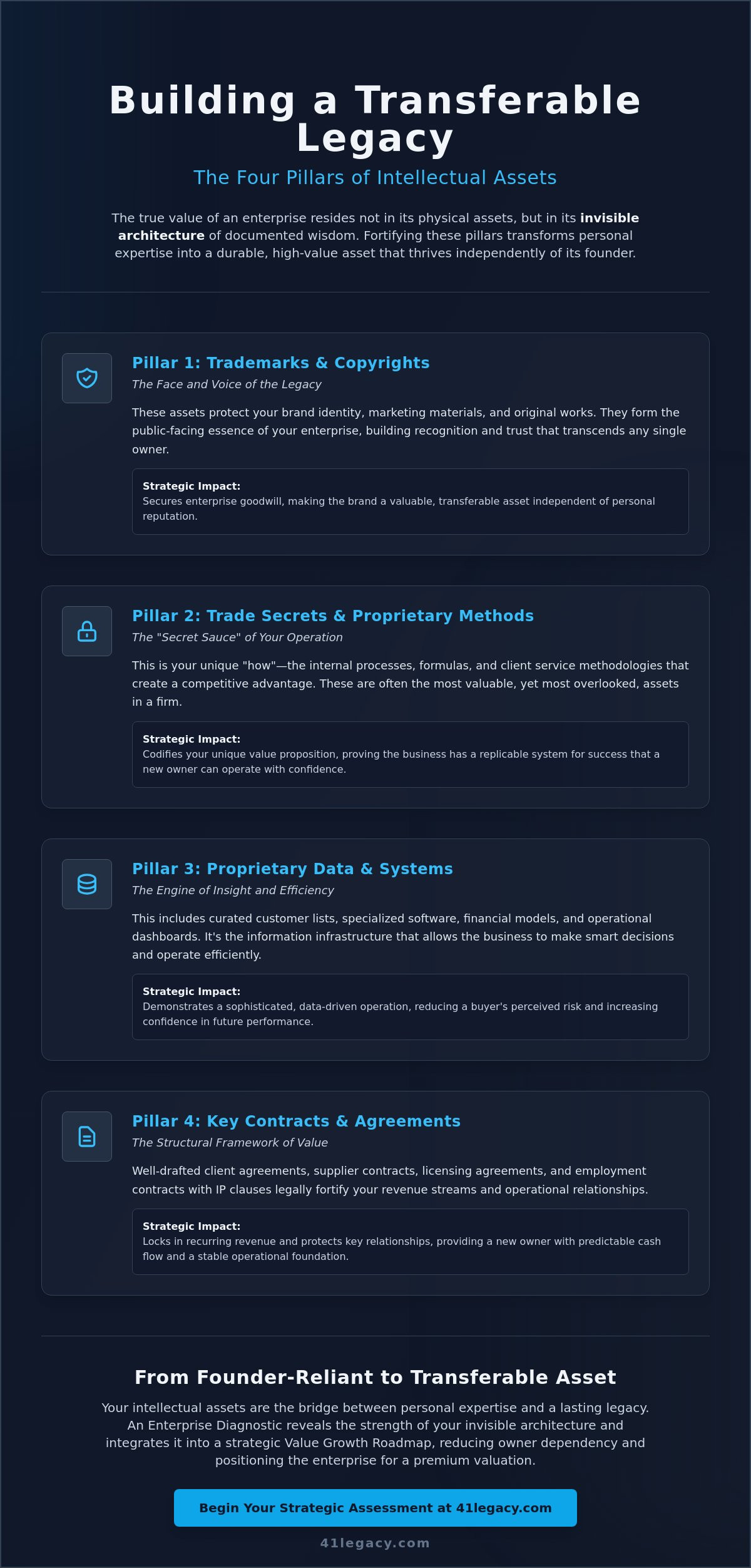
Every masterpiece requires a foundation of unwavering structural integrity. In the architecture of a premium firm, this foundation is built upon four distinct pillars that act as guardians of your historical and future performance. These pillars are not merely legal checkboxes; they are the sentinels of your craft. When an acquirer examines an enterprise, they seek the assurance that the "essence" of the business is both protected and transferable. Precision in documentation is the hallmark of a sophisticated, exit-ready firm. It signals that you have moved beyond the chaotic energy of a founder-led shop and into the disciplined stewardship of an enduring asset. By fortifying these pillars, you effectively reduce the strategic risk that often devalues smaller companies during a transition.
Ensuring these structures are sound requires more than a standard legal filing. It requires a "quarterback" who can align legal specialists with your broader financial and legacy goals. Without this strategic oversight, you risk holding a collection of disparate documents that fail to support a high-value exit. To understand where your current protections stand, a professional Enterprise Diagnostic can reveal the hidden vulnerabilities in your invisible architecture.
Trademarks and Copyrights: The Face and Voice of the Legacy
Brand identity is the marketplace's memory of your excellence. Trademarks secure this identity, creating a competitive moat that prevents the dilution of your hard-earned reputation. Meanwhile, copyrights protect the voice of the legacy, covering everything from proprietary training manuals to bespoke software and marketing materials. These assets are vital for Transferability Engineering. They ensure the intellectual property value for small business is legally detached from the founder's personhood and firmly anchored to the enterprise itself. This legal separation is what allows a brand to maintain its weight and authority long after the original artisan has departed the workshop.
Patents and Trade Secrets: The Engine of Innovation
While patents offer public protection for unique inventions, they can sometimes be a costly distraction for smaller firms. Often, the true engine of innovation lies in trade secrets. These are the proprietary workflows, formulas, and "inner workings" that define your unique approach to building value and growth for small businesses. By codifying these secrets, you transform them from "founder's intuition" into "institutional knowledge." This transition is essential for reducing owner-dependency. It makes your most complex processes teachable and repeatable. When the intellectual property value for small business is properly engineered into the company's DNA, the business becomes a self-sustaining engine of value that no longer requires the founder's constant calibration.
Engineering Transferability: How IP Reduces Owner Dependency
The most precarious position for a founder is the "Rainmaker Trap." This occurs when the enterprise's success is tethered solely to the owner's personal intuition and daily intervention. If the "secret sauce" exists only in your mind, it cannot be sold, gifted, or transitioned; it simply evaporates when you depart. True stewardship requires a deliberate shift from Foundational Knowledge, which is held by individuals, to Institutional Knowledge, which is owned by the firm. When you codify your unique methods into documented Standard Operating Procedures (SOPs), those procedures become a potent form of IP. They provide the predictability that sophisticated acquirers crave. They don't just pay for your past performance. They pay for the certainty that those results will continue under new leadership.
Determining the actual intellectual property value for small business requires an honest look at where your wisdom lives. If your wisdom is trapped in your head, it's a liability. If it's engineered into the business's DNA, it's an asset. This transition is a core component of Transferability Engineering. By distilling your personal expertise into repeatable systems, you transform the business from a high-paying job into a durable legacy that commands a premium valuation multiple.
The Owner Dependency Audit
A rigorous audit is the first step in identifying if your intellectual value is trapped in your daily activities. Ask yourself: could a successor maintain your standards of excellence using only the documentation currently on file? Moving from a Master Artisan to a Steward of a Transferable Asset requires a profound psychological shift. You must value the system as much as the output. Reducing this dependency is the most direct path to increasing your enterprise value. It removes the "key person risk" that often causes potential transitions to fail during the final stages of evaluation.
Codifying the 'Secret Sauce'
Capturing the "how" of your business doesn't mean stripping away its artisanal quality. It means defining the standards that make that quality possible. This is where human talent meets technical engineering. You are creating a blueprint of your excellence so it can be replicated with surgical precision by others. Understanding Intellectual Property For Small Businesses involves recognizing that your workflows are your most valuable inventions. A business is only a transferable asset when its success is a result of its systems, not its owner. By protecting these workflows as trade secrets, you ensure the intellectual property value for small business remains high, regardless of who sits in the founder's chair.
The Diagnostic Approach: Auditing Your Intellectual Moat for Exit Readiness
Every enduring legacy begins with a moment of rigorous self-reflection. To truly understand the intellectual property value for small business, one must look beyond the balance sheet and into the very machinery of the operation. An Enterprise Diagnostic serves as the foundational inquiry into the health of your invisible architecture. It's a precise examination designed to uncover the hidden gems of proprietary wisdom that often go unnoticed in the heat of daily commerce. This diagnostic process doesn't merely list what you own; it evaluates the strength of your "intellectual moat." By identifying where your proprietary systems are vulnerable, you can begin the vital work of fortifying the business for its eventual transition.
Once these assets are identified, a Value Growth Roadmap provides the necessary sequence for prioritizing their protection. Not all IP is created equal. Some assets are essential for current stability, while others are the primary drivers of future growth. A Strategic Capacity Evaluation determines if your current intellectual assets can withstand the pressures of scaling. If a proprietary process works for ten clients but breaks at a hundred, its value is significantly diminished. True stewardship requires ensuring that the essence of your business is robust enough to flourish under new leadership and increased demand.
Stewardship is a rhythm, not a destination. An audit shouldn't be viewed as a one-time event performed only when an exit is imminent. Instead, it's a consistent practice of refinement and protection. By maintaining this rhythm, you ensure the business is always in a state of high readiness, capable of commanding a premium valuation at any moment. To begin this process of discovery, we invite you to explore our Enterprise Diagnostics to see how your invisible architecture compares to industry standards of excellence.
Identifying the 'Value Gap' in Your Intangibles
Missing or unprotected IP creates a silent discount on your company's potential valuation. This is the "Value Gap," the distance between what your business is worth today and what it could be worth if its intellectual assets were fully codified. There is a profound difference between Market Attractiveness, which draws interest, and Internal Exit Readiness, which allows a deal to close. A diagnostic highlights exactly which intellectual assets require immediate "quarterbacking" by specialists. Whether it's a trademark that needs filing or a trade secret that needs documenting, addressing these gaps is essential for removing the friction that can stall a successful transition.
The Implementation Support Rhythm
Building a transferable asset requires more than just a plan; it requires execution. Monthly Implementation Support is the bridge that moves IP from the "idea" phase into the "asset" phase. During these sessions, the growth of your IP value is tracked as a key performance indicator of your overall exit readiness. A strategic advisor ensures the roadmap is executed with surgical precision, preventing the common drift that occurs when owners get pulled back into daily operations. This disciplined approach ensures that every proprietary method is documented, every brand asset is secured, and every system is engineered for a seamless transfer of power.
The Quarterback Perspective: Integrating IP into Your Value Growth Roadmap
The culmination of a lifetime's work deserves more than a fragmented approach to its preservation. While your CPA ensures fiscal compliance and your attorney guards against litigation, neither is naturally positioned to engineer the intellectual property value for small business into a cohesive growth strategy. 41 Legacy serves as the "Quarterback" of this process. We ensure that every legal protection and financial structure is aligned with the ultimate goal of enterprise value. Without this central coordination, a business owner often finds themselves with a collection of expert opinions that never quite form a unified roadmap. True value is found at the intersection of tax planning, legal defense, and operational engineering. It requires a singular vision to harmonize these disciplines.
Building a legacy requires a master artisan's eye for detail and a strategist's foresight. It's about creating a harmony where every asset, visible or invisible, contributes to the strength of the whole. This is the essence of stewardship. You aren't just managing a company; you're cultivating an entity that will maintain its integrity long after your direct influence ends. By integrating your intellectual assets into a comprehensive Value Growth Roadmap, you transform your daily labor into a durable monument of your professional excellence.
Aligning the Advisory Team
The "Quarterback" prevents the silo effect that often plagues professional transitions. When advisors work in isolation, they inadvertently work at cross-purposes. For example, a legal protection might be robust but structured in a way that creates an unnecessary tax liability during a future transfer. We ensure that your legal IP protections serve the singular mission of exit readiness. Coordinated advisory means that when a proprietary process is documented, it's done with the input of those who understand its impact on the final valuation. This level of precision ensures that the invisible architecture we've discussed is both structurally sound and financially optimized for the long term.
Securing Your Legacy with 41 Legacy
Preparation is the highest form of respect for your craft. Starting an Exit Readiness Assessment years before a planned transition provides the runway needed to address the value gaps that exist in most firms. It's a structured process that ensures your life's work is built to thrive independently, preserving the essence of what you've created. By engaging in this deliberate engineering, you move from a state of uncertainty to a position of quiet confidence. Your business becomes a transferable asset that reflects your uncompromising standards. We invite you to explore our Strategic Advisory services to begin engineering your company's transferability. Your legacy is the story of your excellence; let's ensure it's told with the precision it deserves.
Cultivating a Transferable Masterpiece
The evolution of a founder-led enterprise into a high-value masterpiece requires the eye of a master artisan and the discipline of a strategist. By documenting your proprietary methods and securing your brand's voice, you transform personal expertise into a transferable asset. This process doesn't just protect what you've built; it ensures the soul of your company remains intact for the next generation of leadership. Recognizing and engineering the intellectual property value for small business is the most direct path to closing the value gap and achieving a premium exit.
Our team, led by Certified Exit Planning Advisor (CEPA) expertise, utilizes a proprietary Enterprise Diagnostics process to uncover the hidden strength of your intellectual moat. We provide the structured implementation of a Value Growth Roadmap with surgical precision to ensure your legacy is both durable and independent. Secure your legacy and begin your Exit Readiness Assessment today. Your life's work deserves a transition that reflects its true worth and honors the impact you've made.
Frequently Asked Questions
What is the true value of intellectual property for a small business?
The true intellectual property value for small business is the premium an acquirer pays for a predictable, self-sustaining system that generates results without the founder's presence. It represents the intellectual moat that protects your margins from competition. By codifying your unique methods, you transform intangible wisdom into a tangible asset that can be valued and transferred with the same precision as physical machinery.
How do I know if my business is too dependent on me as the owner?
Your business is likely owner-dependent if operations decelerate or quality diminishes the moment you step away from daily management. A simple diagnostic is the "vacation test," where you measure the enterprise's ability to thrive during a month-long absence. If your personal intuition is the only engine for decision-making, your enterprise lacks the institutional knowledge required for a high-value transition.
Can standard operating procedures (SOPs) be considered intellectual property?
Documented standard operating procedures function as a critical form of intellectual property known as trade secrets. These SOPs capture the "secret sauce" of your operations, making your artisanal standards repeatable and teachable to others. Codifying these workflows is a central pillar of Transferability Engineering, as it ensures the essence of the business is anchored in the organization rather than a single individual.
What is the difference between personal goodwill and enterprise value?
Personal goodwill is the value tied to your individual reputation and relationships, while enterprise value is built on systems, brand, and proprietary assets. Personal goodwill often vanishes when a founder leaves, creating a significant risk for successors. High intellectual property value for small business is achieved by shifting that value into the enterprise, ensuring the legacy remains durable and commands a premium valuation multiple.
How does an Exit Readiness Assessment help with IP valuation?
An Exit Readiness Assessment identifies the "Value Gap" by uncovering hidden intellectual assets that have not yet been codified or protected. This diagnostic process evaluates your current intellectual moat and determines how much of your success is repeatable. By quantifying these intangibles, we can prioritize the steps needed to strengthen your enterprise value before you enter the market.
When should a small business owner start thinking about exit planning?
A business owner should ideally begin the exit planning process three to five years before their anticipated transition. This timeframe allows for the deliberate implementation of a Value Growth Roadmap and the reduction of owner dependency. Starting early ensures you have the capacity to engineer the business into a high-performance asset that commands a premium valuation when the time comes to step away.
Why do I need a 'Quarterback' if I already have an attorney and a CPA?
A strategic Quarterback ensures that your specialized advisors, such as CPAs and attorneys, work in harmony toward a singular vision of enterprise value. While specialists excel in their specific domains, they often work in silos that can lead to conflicting strategies. We provide the coordination necessary to ensure that legal protections and tax planning align perfectly with your long-term legacy goals.
What are the most common risks that devalue a small business's intellectual property?
The most common risks include the failure to document proprietary workflows and the lack of clear ownership agreements with employees or contractors. When the essence of your work is shared without protection, your intellectual moat is compromised. Regular Enterprise Diagnostics help identify these vulnerabilities, allowing you to fortify your assets and prevent the dilution of your company's unique competitive advantage.
Disclaimer
This article is for educational and informational purposes only and does not provide legal, tax, investment, or business brokerage advice. 41 Legacy does not offer M&A brokerage services, legal document drafting, tax preparation, or investment advisory services. Business owners should consult licensed professionals in those disciplines before making decisions related to business transactions, legal matters, tax strategy, or financial planning. All examples are illustrative and may not apply to your specific situation.