
Transferability & Owner Dependency
The Guardian’s Fatigue: Recognizing Business Owner Burnout Symptoms and Preserving Your Legacy
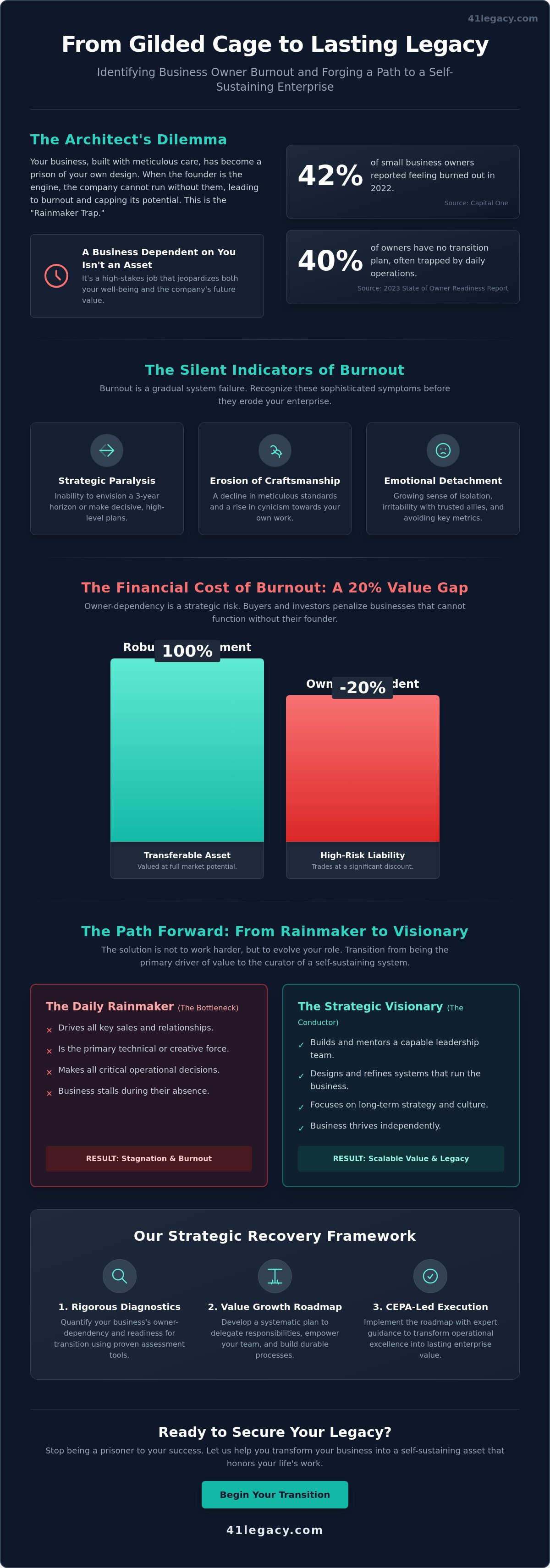
A business that cannot survive a single week without your direct intervention isn't a legacy; it's a gilded cage. You've spent years meticulously crafting your company with the precision of a master artisan, yet the very engine you built now demands every ounce of your remaining vitality. Recognizing business owner burnout symptoms isn't a sign of weakness. It's a critical diagnostic step for any steward who values the long term health of their enterprise. According to the 2023 State of Owner Readiness Report, 40% of owners have no transition plan, often because they're too buried in daily operations to look beyond the next quarter.
We believe your company should be a source of pride, not a personal burden. This article will help you identify the sophisticated indicators of exhaustion while providing a clear roadmap to transform your role from a daily Rainmaker into a Strategic Visionary. You'll learn how to increase enterprise value by reducing owner-dependency, ensuring your business remains a flourishing, transferable asset. We'll explore the specific steps required to transition from being the primary driver to becoming the curator of a self sustaining legacy that thrives independently of your daily presence.
Key Takeaways
- Recognize the subtle indicators of strategic paralysis and the erosion of craftsmanship that define business owner burnout symptoms in high-level stewardship.
- Analyze the "Value Gap" created by owner dependency and learn to distinguish between a business that acts as a personal burden and one that exists as a transferable asset.
- Implement a strategic recovery framework that utilizes rigorous diagnostics to quantify your business’s readiness for an eventual, graceful transition.
- Learn how to systematically reduce founder reliance through a Value Growth Roadmap, ensuring the soul of the enterprise thrives independently of its creator.
- Discover the CEPA-led methodology for preserving your legacy by transforming operational excellence into a durable and valuable corporate history.
The Weight of Stewardship: Redefining Business Owner Burnout
True stewardship requires a level of devotion that often borders on the sacrificial. For the business owner, the enterprise isn't merely a source of income; it's a living testament to their craftsmanship and vision. When the mechanical harmony of this asset begins to falter, the impact is felt first by its creator. While Occupational burnout is often discussed in general corporate terms, for the founder, it represents a deeper, more structural crisis. Traditional stress management techniques, such as vacations or mindfulness, often fail because they don't address the underlying architecture of owner-dependency.
Burnout is a signal. It indicates that the business has evolved beyond the capacity of a single individual to sustain its momentum. Common business owner burnout symptoms manifest as a persistent sense of isolation and the realization that the firm cannot breathe without the owner's constant intervention. This isn't just working hard; it's the weight of an uncompromising burden where every decision, from the aesthetic to the technical, rests on one set of shoulders. When the leader becomes the bottleneck, the very passion that built the company begins to erode its foundation.
The Philosophical Toll of the Rainmaker Trap
The Rainmaker Trap occurs when the owner remains the primary driver of value. This creates an invisible ceiling for the enterprise. According to a 2022 survey by Capital One, 42% of small business owners reported feeling burned out, a figure that highlights the emotional weight of carrying the professional futures of an entire team. The most successful owners are often the most susceptible. Their dedication to excellence makes them reluctant to delegate, yet this very devotion limits the enterprise's ability to scale or endure beyond their tenure. It's a paradox where the creator becomes the greatest risk to the creation.
Burnout as a Strategic Risk to Enterprise Value
An exhausted leader is a liability. In the eyes of a sophisticated advisor or potential buyer, a business that relies solely on owner vitality lacks "Market Attractiveness." If the owner is the soul of the machine, the machine stops when the owner departs. Preserving the soul of the business requires the owner to step back, ensuring the legacy thrives independently. A 2023 industry report suggests that owner-dependent firms trade at multiples 20% lower than those with robust, independent management structures. Strategic clarity demands building a transferable asset that doesn't rely on the founder's daily presence. To preserve the legacy, one must first ensure the business can survive the steward.
The Silent Indicators: Essential Business Owner Burnout Symptoms
Burnout doesn't arrive with a sudden crash. It's a gradual mechanical failure, a slow loss of compression in the engine that drives your enterprise. For the owner who views their company as a masterpiece, the first business owner burnout symptoms are often subtle shifts in perspective. You might find yourself in a state of strategic paralysis, unable to envision a three-year horizon or make high-level decisions with your usual precision. This isn't a lack of skill; it's a depletion of the creative reserves required to lead.
The erosion of craftsmanship often follows. You might notice a decline in the meticulous standards you once championed, or perhaps a relentless cynicism begins to take hold. New opportunities, once seen as avenues for evolution, start to feel like heavy burdens. This mental weight is often supported by research on entrepreneurial burnout which highlights how chronic stress disrupts cognitive function. You experience a fog that obscures your leadership, coupled with a growing sense of isolation. You feel that no one, even your closest advisory team, truly understands the stakes of the legacy you carry.
Behavioral Shifts in the Executive Suite
The executive suite reflects the owner's internal state. You may find yourself becoming increasingly irritable with long-term employees or trusted partners who were once your greatest allies. There's a tendency to avoid key financial metrics or strategic planning sessions, shifting the business from a mode of proactive growth to one of reactive survival. Instead of sculpting the future, you're merely reacting to the present. This shift often results in a 15% to 20% drop in operational efficiency as decision-making cycles lengthen.
The Impact on Organizational Culture
Owner fatigue isn't contained; it trickles down. When the foundational energy that defines your brand begins to dim, talent development and retention suffer. Your team looks to you for the spark of innovation, but when you're exhausted, you become a bottleneck. The company's soul, its unique heritage, starts to feel like just another job to your staff. Recognizing these business owner burnout symptoms early is the first step in restoring the vitality of your asset. To begin the process of stabilizing your leadership, consider a strategic diagnostic to identify where the pressure points are most acute.
The Architect’s Dilemma: Why Owner Dependency Fuels Burnout
The business owner often acts as the sole architect of their enterprise. Every decision, no matter how granular, flows through their hands. While this creates a masterpiece of individual effort, it also creates a structural failure for long-term longevity. When a business relies solely on its founder, a significant Value Gap emerges. This gap represents the difference between the business's current worth and its potential value if it functioned as a standalone entity. Professional buyers and successors seek transferable assets, not individual brilliance. If your presence is the only thing keeping the gears turning, you haven't built a company; you've created a demanding job you happen to own.
This dependency is a primary driver of business owner burnout symptoms. The weight of being the central hub in a hub-and-spoke model means every spoke threatens to break when the center falters. Without meticulous, documented Standard Operating Procedures (SOPs), the owner remains trapped in a cycle of firefighting. They're forced to solve the same problems repeatedly because the knowledge lives in their head rather than in the organization's DNA. This creates a psychological barrier to delegation. Founders often view their work as a bespoke art form that others can't possibly replicate, which leads to exhaustion and a stagnated legacy. Recognizing these business owner burnout symptoms early is the first step toward reclaiming your role as a visionary instead of a technician.
The High Cost of Being Irreplaceable
A business that can't operate without its founder is objectively worth less in the open market. The Exit Planning Institute’s 2023 State of Owner Readiness Report indicates that roughly 80% of an owner’s wealth is locked within their business. If that business is founder-dependent, a buyer will likely discount the purchase price by 20% to 50% to account for the risk of your departure. True stewardship involves building an entity that can thrive in your absence. The indispensable founder is a myth that ultimately destroys enterprise value and personal freedom.
Bridging the Gap Between Art and Engineering
Preserving your legacy requires transforming intuitive brilliance into repeatable, scalable systems. This is the essential shift from art to engineering. It involves using Enterprise Diagnostics to identify exactly where dependency risks lie within your operations. Professionalizing your advisory team is an act of self-preservation, not just a business strategy. It allows you to delegate bespoke tasks to a new generation of leaders who are trained to uphold your standards. By documenting your craftsmanship, you ensure the soul of the business survives your eventual transition, turning a fragile entity into a lasting, transferable asset.
From Exhaustion to Evolution: A Strategic Recovery Framework
Recovery is not a retreat; it's a meticulous restoration of purpose. To move beyond the heavy weight of business owner burnout symptoms, we apply a five phase architecture designed to transform a personality dependent company into a transferable masterpiece. This process mirrors the restoration of a vintage engine, where every component must be calibrated to function without constant manual intervention. A 2023 study by the Exit Planning Institute revealed that 78% of business owners lack a formal transition plan, a deficiency that often fuels the chronic stress of the guardian. Our framework replaces this uncertainty with the precision of a bespoke engineering plan.
- Phase 1: Exit Readiness Assessment. We begin with a diagnostic deep dive to quantify the current state of the business, identifying the structural weaknesses that drain your energy.
- Phase 2: Value Growth Roadmap. This phase focuses on the systematic reduction of owner dependency, ensuring the enterprise can breathe and function on its own.
- Phase 3: The Quarterback Advisory Team. We curate a specialized team to handle the tactical implementation, allowing you to step away from the daily friction.
- Phase 4: Visionary Reclamation. You return to the role of the master craftsman, focusing exclusively on high value activities that ignite your passion rather than exhausting your spirit.
- Phase 5: Legacy Transfer Timeline. We establish a clear, unhurried schedule for the eventual transfer of the asset, ensuring the soul of the business remains intact.
The Power of the Value Growth Roadmap
Clarity is the ultimate antidote to the psychological fog of business owner burnout symptoms. A structured roadmap provides the mental space necessary to view your business as a separate entity rather than an extension of your own identity. We prioritize value drivers that offer the most immediate relief, such as documented systems and decentralized decision making. It's the difference between being trapped inside the machine and standing back to admire its performance. Seeing a tangible path toward a successful exit provides a profound sense of relief that no temporary vacation can replicate.
The Role of Monthly Implementation Support
Consistency is the hallmark of true craftsmanship. Accountability prevents the start-stop cycle that often plagues recovery efforts. A strategic advisor acts as the guardian of your time, ensuring that the momentum of evolution continues even when your energy fluctuates. We build a rhythm of progress that doesn't require your constant oversight; it's a self sustaining process of improvement. This monthly cadence ensures that the transition from operator to steward is both graceful and permanent.
Securing the Future: How 41 Legacy Restores the Visionary
At 41 Legacy, we believe a business is more than a series of transactions; it's a living testament to a founder's dedication. Our philosophy centers on preserving the soul of the enterprise while meticulously building it into a transferable asset. We recognize that business owner burnout symptoms often signal that the company has become too dependent on its creator. To address this, we utilize a CEPA-led approach to identify and close the Value Gap. This process ensures the business's actual value aligns with the financial requirements of your next chapter.
We act as the strategic quarterback for your professional inner circle. By coordinating with your CPA, attorney, and financial advisors, we ensure every technical detail aligns with your overarching vision. This collaborative effort removes the weight of coordination from your shoulders, allowing you to focus on high-level stewardship rather than daily fires. Our commitment to planning honors your life’s work by ensuring it can survive, and thrive, beyond your direct involvement. We prioritize strategic clarity to reduce the risks associated with owner-dependency.
Beyond Restoration: The Evolution of Your Business
True evolution requires a shift in identity. We guide you through the transition from the Master Craftsman, who is essential to every operation, to the Curatorial Expert, who oversees a self-sustaining masterpiece. This change provides the peace of mind that comes from knowing your legacy is protected against unforeseen circumstances. View your current burnout not as a failure, but as the catalyst for your company’s greatest era. By distancing your personal identity from the daily mechanics, you allow the business to reach its full potential as an independent entity.
Take the First Step Toward Exit Readiness
Our diagnostic process is a bespoke service designed for high-value firms that demand excellence. We don't offer generic templates or surface-level advice. Instead, we provide an uncompromising strategic advisory that examines the structural integrity of your business. We focus on transferability and risk reduction to ensure your transition is executed with precision. Your life's work deserves a plan that is as refined as the brand you've built. It's time to move toward a future where the business thrives because of the systems you've established, not just the hours you put in. Begin your evolution with an Exit Readiness Assessment to secure your future today.
Beyond Stewardship: Engineering a Transferable Legacy
Identifying business owner burnout symptoms is a vital diagnostic for the health of your enterprise. When stewardship feels like a heavy burden, it often indicates the business is overly dependent on your personal intervention. A true legacy isn't built through perpetual exhaustion; it's found in the creation of a firm that operates with mechanical precision even in your absence. Shifting your focus toward transferability reduces operational risk and elevates the enterprise value of your life's work.
At 41 Legacy, we apply a meticulous approach to business evolution. Led by a Certified Exit Planning Advisor (CEPA), our team uses the proven Value Growth Roadmap methodology to transform owner-dependent firms into transferable assets. We specialize in restoring the visionary's clarity by removing the friction of daily operations. You've poured your soul into this company; it's time to ensure it survives as a lasting masterpiece of industry. Your dedication deserves a transition that's as polished as the business you've built.
Preserve your legacy and reclaim your vision; Schedule your Exit Readiness Assessment today.
The future of your business is a story still being written, and it's time to prepare for its most significant chapter.
Frequently Asked Questions
How do I distinguish between standard executive stress and true business owner burnout?
Standard stress is a temporary reaction to specific challenges, while true business owner burnout symptoms manifest as a persistent, bone-deep exhaustion that compromises your vision. According to the Maslach Burnout Inventory, burnout is defined by emotional exhaustion, depersonalization, and a diminished sense of personal accomplishment. If you find yourself viewing your business as a burden rather than a masterpiece, you've moved beyond stress into a state of chronic depletion that threatens your legacy.
Can my business actually increase in value if I spend less time in the daily operations?
A business increases in value significantly when it functions independently of its founder. Investors and buyers prioritize transferability; they often pay a premium for enterprises where the owner has successfully stepped away from daily operations. By reducing owner-dependency, you transform a job into a scalable asset. Data from the Exit Planning Institute suggests that ready businesses with documented systems consistently achieve valuation multiples 25% to 50% higher than those tethered to the owner's constant presence.
What is the "Value Gap," and how does it contribute to my feelings of exhaustion?
The Value Gap is the difference between your business's current worth and the amount required to fund your future aspirations. This gap creates exhaustion because it forces you to work harder to bridge a financial chasm that poor structure created. When 80% or more of your wealth is trapped in an illiquid asset, the pressure to maintain operations becomes a heavy weight. Closing this gap through strategic value growth relieves the psychological burden of uncertainty.
How does a Certified Exit Planning Advisor (CEPA) help with owner burnout?
A Certified Exit Planning Advisor acts as a master strategist who aligns your business, personal, and financial goals into a singular vision. They identify business owner burnout symptoms early by assessing the friction within your current operating model. By implementing the Value Acceleration Methodology, a CEPA helps you build a transferable legacy. This structured approach ensures the business thrives while you reclaim your time and mental clarity.
Why is documenting SOPs considered a "cure" for burnout symptoms?
Documenting Standard Operating Procedures is a meticulous process that transfers the soul of your craftsmanship into a repeatable system. It's a cure for burnout because it eliminates the need for you to make every minor decision. When processes are codified, your team can execute with precision without your direct supervision. This structural harmony reduces the daily friction that leads to mental fatigue and operational stagnation.
If I am already burnt out, is it too late to start a Value Growth Roadmap?
It's never too late to begin a Value Growth Roadmap, as the framework is designed to restore order to chaotic environments. Even if you feel depleted, starting this journey provides a clear path out of the daily grind. The roadmap identifies the most critical value drivers to fix first, providing immediate relief to the organization. Implementing these strategic changes can revitalize both the owner and the enterprise within 90 to 180 days.
How do I explain my need to step back to my employees without causing alarm?
Frame your transition as an evolution of the company's legacy rather than a retreat. Explain that you're focusing on high-level strategy to ensure the firm's longevity for the next 20 years. By empowering your team to take on more responsibility, you're investing in their professional growth and the business's stability. This approach fosters a culture of stewardship where every employee feels like a guardian of the brand's future.
What is the role of a "Quarterback" in a business owner’s advisory team?
The Quarterback is the lead advisor who coordinates your entire team of professionals, including CPAs, attorneys, and wealth managers. They ensure every specialist is working in harmony toward your ultimate goal of legacy preservation. This role is vital for a burnt-out owner because it removes the burden of managing multiple complex workstreams. Your Quarterback maintains the strategic rhythm; this allows you to focus on the artistry of your craft instead of administrative friction.
Disclaimer
This article is for educational and informational purposes only and does not provide legal, tax, investment, or business brokerage advice. 41 Legacy does not offer M&A brokerage services, legal document drafting, tax preparation, or investment advisory services. Business owners should consult licensed professionals in those disciplines before making decisions related to business transactions, legal matters, tax strategy, or financial planning. All examples are illustrative and may not apply to your specific situation.