
The Guardian’s Diagnostic: Navigating Value Gap Analysis for Business Legacy
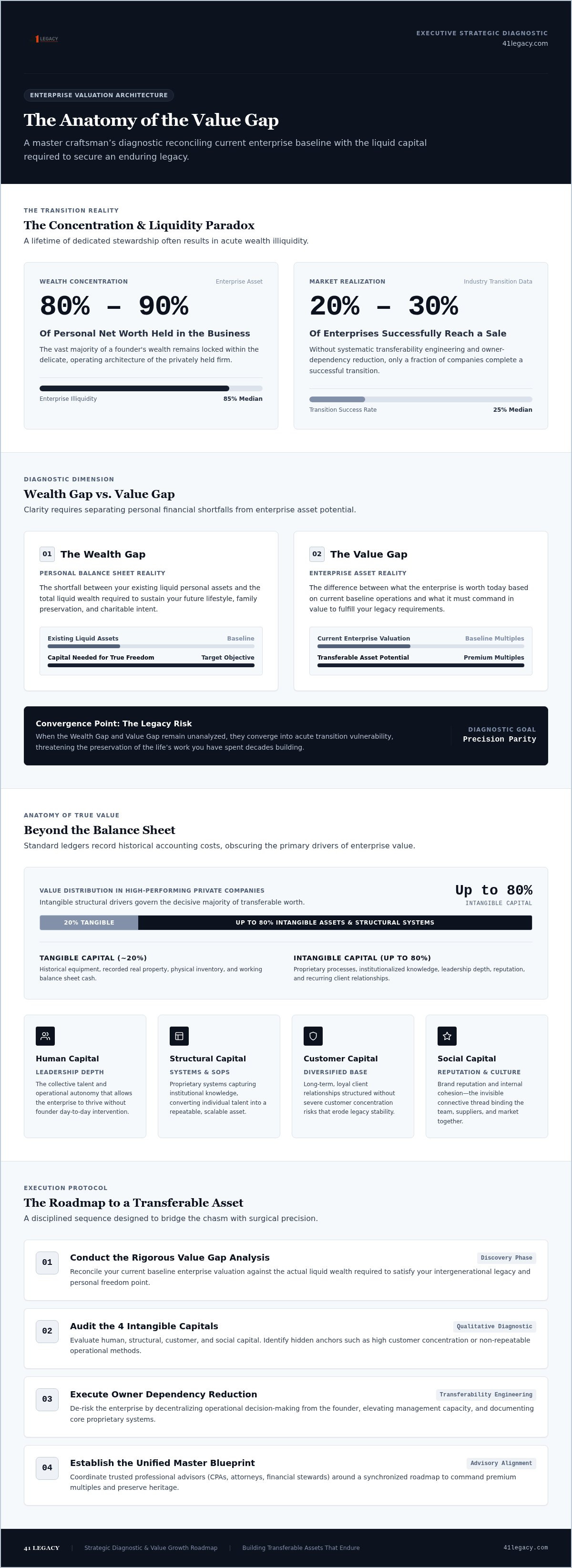
Between 80% and 90% of your personal net worth is likely held within the delicate architecture of your business. It's a staggering concentration of wealth that represents a lifetime of stewardship, yet industry data reveals that only 20% to 30% of such enterprises successfully reach a sale. This tension creates a profound sense of uncertainty for the owner who values their heritage as much as their performance. At the heart of this challenge lies the need for a rigorous value gap analysis, a strategic diagnostic that measures the distance between your current enterprise value and the financial requirements of your future legacy.
You've built something of true essence, and it's natural to feel a protective instinct over its transition. We understand the weight of ensuring your life's work isn't left to chance or uncoordinated advice. This guide provides a clear roadmap to bridge that chasm, focusing on transferability engineering and the reduction of owner dependency. By the end of this exploration, you'll possess a sophisticated understanding of how to protect your essence, increase your enterprise's marketability, and secure the freedom point necessary to fund your intergenerational impact with absolute precision.
Key Takeaways
- Perform a meticulous value gap analysis to reconcile your current enterprise baseline with the liquid wealth required to fund your enduring legacy.
- Identify the intangible drivers that comprise up to 80% of enterprise value, moving beyond tangible assets to protect your business’s inner essence.
- Implement owner dependency reduction to transform a founder-reliant company into a transferable asset capable of commanding premium multiples.
- Establish a strategic roadmap that acts as a master blueprint, coordinating your professional advisors to ensure your life’s work is fully protected.
Understanding the Value Gap: The Chasm Between Current Reality and Future Legacy
Your business is more than a sequence of transactions; it's a living narrative of your dedication and a testament to your vision. For many owners, a profound realization arrives when they discover that the current worth of their enterprise doesn't yet align with the financial requirements of their intended legacy. This discrepancy is what we call the value gap. A meticulous value gap analysis isn't a mere accounting exercise. It's a master craftsman's diagnostic designed to reveal whether your life's work is a fragile dependent of your presence or a transferable asset capable of enduring through time.
Standard balance sheets often obscure the truth. They record historical costs but fail to articulate future economic earning power or the strength of your internal systems. While a formal business valuation methodology provides the necessary structural foundation, it's the diagnostic layer above these numbers that captures the business's inner essence. We treat this process with the same reverence a curator brings to a private collection, ensuring that every intangible nuance is accounted for and every risk is identified with surgical precision.
The Distinction Between Wealth and Value Gaps
The path to true freedom requires clarity across two distinct dimensions. Your wealth gap represents the personal financial shortfall between your existing liquid assets and the total capital needed to fund your future lifestyle and charitable intent. Conversely, the value gap identifies the unrealized potential residing within the company itself. It's the difference between what the business is worth today and what it must be worth to satisfy your long-term goals. When these gaps remain unaddressed, they converge to create a legacy risk, threatening the very preservation of the impact you've spent decades building.
Why a Diagnostic is a Guardian's Duty
Ignoring these gaps until the moment of transition is a precarious gamble. A proactive diagnostic serves as a protective measure, acting as a guardian for the organization's heritage. By identifying structural weaknesses early, we protect the stability of your employees and the continuity of your brand. It's about securing a future where the transition isn't a point of friction, but a seamless progression of your vision. We believe that true stewards don't wait for the sunset to plan for the light; they engineer resilience into the very fabric of their enterprise today to ensure their essence survives the transition.
The Anatomy of Enterprise Value: Beyond the Balance Sheet
The true weight of an enterprise rarely rests on its ledger. While traditional accounting focuses on the tangible, up to 80% of enterprise value in high-performing private companies is actually governed by intangible capital. Understanding this distribution is essential for a meaningful value gap analysis. We don't view a business as a mere collection of equipment and cash; it's a complex, living organism. To ensure your legacy endures, we must look beyond the balance sheet to the structural and human elements that define its inner essence.
A transferable asset is built upon four pillars of intangible capital. Each requires surgical precision to evaluate and refine:
- Human Capital: This is the depth of your leadership. It's the collective talent that ensures the business thrives without your daily intervention.
- Structural Capital: These are the proprietary systems and SOPs that capture your institutional knowledge, turning individual expertise into a repeatable process.
- Customer Capital: We look for a diverse, loyal client base. High customer concentration is a risk that erodes the foundation of your legacy.
- Social Capital: This represents the brand's reputation and internal culture. It's the invisible thread that binds your team and market together.
Market Attractiveness vs. Owner Readiness
Profitability alone doesn't guarantee a successful transition. A company can generate significant EBITDA and still remain unmarketable if it lacks strategic capacity. Buyers are often wary of the primary causes of a valuation gap, which frequently stem from a lack of owner readiness. A comprehensive value gap analysis reveals these hidden anchors, allowing us to address them before they compromise your transition. If the business is essentially a personal job for the owner, its value is tethered to a single life. By focusing on risk reduction and transferability engineering, we expand the valuation multiple and ensure the business can stand alone. This meticulous attention to detail is what allows us to act as a guardian for your life's work. You can explore our specific methodology for determining enterprise value to see how we quantify these intangible elements. For those ready to begin this journey, our strategic advisory services provide the roadmap necessary to bridge the chasm.
Analyzing the Drivers: Intangible vs. Tangible Assets
While tangible assets like precision machinery or liquid reserves provide a physical foundation, they rarely dictate the ultimate market multiple. A profound value gap analysis often reveals that true economic resilience is woven into the intangible fabric of the organization. To understand enterprise value beyond the balance sheet, one must appreciate the distinction between the objects a company owns and the essence it possesses. Tangible assets are static; intangible drivers are the living energy that propels the enterprise forward without the founder’s constant touch.
The most significant anchor on enterprise value is often the founder’s own excellence. This 'Rainmaker Trap' occurs when the business’s success is inextricably linked to the owner’s unique skills or relationships. While impressive, this dependency creates a fragile asset. If the essence of the work cannot be transferred, the work itself loses its marketability. We approach this challenge through transferability engineering, a meticulous process of decoupling the business’s performance from the founder’s daily participation. It's the transition from being the primary artisan to becoming the curator of a self-sustaining masterpiece.
Identifying Value Detractors
A rigorous diagnostic uncovers the hidden risks that suppress your company's worth. These detractors are often invisible to the untrained eye but glaring to a sophisticated buyer. We focus on identifying the following vulnerabilities:
- High customer concentration, where a single relationship holds the power to destabilize the entire firm.
- A lack of documented systems, leaving institutional knowledge vulnerable to the passage of time.
- Heavy reliance on the founder for critical operations, which signals a lack of leadership depth.
The Multiplier Effect of Risk Reduction
Closing the chasm identified in your value gap analysis often begins with the surgical removal of risk. When we eliminate operational uncertainties, we don't just add value; we multiply it. Clean financial records and pro forma accuracy provide the clarity a connoisseur requires to appreciate the true worth of the asset. Furthermore, systemization acts as the blueprint for this endurance. You can explore our insights on What is an SOP in Business? to understand how documented processes serve as the foundation for a transferable legacy. By refining these internal structures, we ensure the business remains a living, breathing entity that thrives long after the creator has stepped away.
The Enterprise Diagnostic: A Meticulous Process of Discovery
Discovery is a deliberate act of stewardship. We don't merely look at numbers; we observe the soul of the organization. This diagnostic process is conducted with what we call professional-room altitude, a perspective that rises above the daily tactical noise to see the enterprise in its entirety. As your Certified Exit Planning Advisor (CEPA), we act as the lead architect or 'quarterback' for your ensemble of professional advisors. We harmonize the technical precision of your CPAs and the legal foresight of your attorneys, ensuring that every specialist is working toward a singular, uncompromising vision of perfection.
A rigorous value gap analysis serves as the catalyst for this transformation. It's the moment where the abstract becomes concrete, allowing us to measure the distance between your current reality and your ultimate legacy. This isn't a transactional event but a philosophical endeavor to protect the essence of what you've created. By coordinating these disparate professional voices, we ensure that your life’s work is handled with the reverence it deserves, moving beyond simple accounting into the realm of heritage preservation.
Step 1: The Initial Enterprise Diagnostic
The first movement in our process is the Initial Enterprise Diagnostic. This phase is dedicated to uncovering the current market value of your business and contrasting it with its true potential value. We look for 'Red Flags', those structural flaws or operational dependencies that could halt a transfer of ownership before it even begins. This assessment provides the essential data needed for a thorough diagnostic, identifying exactly where the business is most vulnerable. It's a baseline of truth from which all future growth is measured.
Step 2: Building the Value Growth Roadmap
Once the diagnostic is complete, we translate our findings into a Value Growth Roadmap. This isn't a generic checklist. It's a bespoke strategy that prioritizes actions offering the highest return on enterprise value. We focus heavily on owner dependency reduction, setting clear milestones that transform the business into a self-sustaining asset. For those seeking specific tactical maneuvers to strengthen their position, our guide on how to increase enterprise value offers deeper insights into this transformative work.
The transition from diagnostic discovery to monthly implementation support marks the moment where vision becomes reality. We don't leave you with a document; we remain by your side to ensure every strategic objective is met with surgical precision. To begin your own journey of discovery and secure the future of your life's work, we invite you to explore our enterprise diagnostic services today. We're here to act as the guardian of your business's history, ensuring its story continues long after you've stepped away.
Bridging the Gap: Your Roadmap to a Transferable Asset
Bridging the chasm between current operations and your future legacy requires more than intent. It demands the application of transferability engineering to a sophisticated mechanical standard, ensuring every component of the enterprise functions with surgical precision. The Value Growth Roadmap serves as the definitive guide to closing the distance revealed in your initial value gap analysis. We don't view this as a mere checklist of tasks. Instead, it's a master blueprint that ensures your life's work is refined into a masterpiece of endurance. By adopting the 'Quarterback' model, we harmonize the efforts of your entire advisory ensemble, ensuring that legal, tax, and financial strategies move in perfect synchronization toward your ultimate freedom point.
You've spent decades as the primary artisan of your firm. Now, the transition to steward requires a different kind of focus. We act as the guardian of this transition, providing the strategic clarity needed to move from a founder-reliant model to a self-sustaining asset. This process is unhurried and thoughtful, reflecting the time-intensive nature of high-end craftsmanship. Every adjustment made to the organization’s structure is designed to preserve its inner essence while expanding its marketability to the highest possible level.
The Role of Monthly Implementation Support
Accountability is the vital force that transforms a strategic vision into a tangible reality. Through Monthly Implementation Support, we provide the steady, unhurried rhythm required to maintain momentum and ensure the strategic essence of the business remains uncompromised. We coordinate the specific, technical contributions of your CPAs, Attorneys, and Financial Advisors, acting as the lead architect for the overarching vision. This collaborative approach prevents the fragmentation of advice and ensures that every tactical move serves the primary goal of enhancing enterprise value. It's a process of constant refinement, where technical precision meets persistence to protect your heritage.
The Ultimate Goal: A Business That Thrives Without You
The pinnacle of entrepreneurial achievement is the creation of a business that thrives entirely independent of its founder. A truly transferable asset is a self-sustaining entity, a legacy that possesses its own internal gravity and momentum. Reaching this state provides a profound sense of peace, knowing that your life's work is secure and that your impact will endure through the passage of time. It's the transition from being the engine of the enterprise to becoming its honored steward. To secure this future, we invite you to begin your Enterprise Diagnostic journey at 41 Legacy. Let us help you bridge the value gap analysis findings and engineer a legacy that stands as a testament to your vision.
Securing the Future of Your Life's Work
The preservation of your business’s essence is a noble pursuit that requires both artistic vision and surgical precision. Through a rigorous value gap analysis, you've identified the chasm between your current enterprise worth and the financial requirements of your future legacy. We've explored how transferability engineering and the reduction of owner dependency transform a founder-reliant company into a self-sustaining asset. This transition isn't merely a financial exit; it's the final act of stewardship for a masterpiece you've spent a lifetime building.
Our team, led by a Certified Exit Planning Advisor (CEPA), is exclusively focused on building transferable enterprise assets that stand the test of time. We use a proven Value Growth Roadmap methodology to coordinate your professional ensemble, acting as the guardian of your business's history. You don't have to navigate this complex transition alone. We invite you to Secure Your Legacy with a Comprehensive Exit Readiness Assessment. Your dedication has created something extraordinary, and we're here to ensure its story continues with the same excellence that defined its creation.
Frequently Asked Questions
What is the difference between a business valuation and a value gap analysis?
A business valuation is a retrospective snapshot of what your enterprise is worth today based on historical performance. In contrast, a value gap analysis is a forward-looking diagnostic that measures the distance between that current baseline and the liquid wealth required to fund your future legacy. It identifies the unrealized potential within your firm, providing a strategic roadmap to bridge the chasm between reality and your ultimate financial goals.
How do I know if my business is too dependent on me to be transferable?
If your physical absence for thirty days would result in a decline in revenue or operational chaos, your enterprise is likely founder-reliant. High owner dependency is signaled when you are the primary conduit for sales or the sole arbiter of critical decisions. A transferable asset must possess its own internal gravity, functioning with surgical precision whether the creator is present or not to ensure the legacy endures.
Why doesn't my CPA or Attorney perform a value gap analysis?
While these professionals are essential specialists, their focus is often retrospective or defensive. CPAs handle tax compliance and historical reporting; attorneys mitigate legal risk and draft documents. They rarely possess the specific framework required for transferability engineering. This diagnostic is a holistic endeavor that requires a Certified Exit Planning Advisor to harmonize these disparate disciplines toward a single, uncompromising vision of growth and protection.
Can a value gap be closed if I plan to exit in less than two years?
Two years is a compressed timeline, but significant progress can still be achieved through intensive implementation support. While three to five years is the ideal duration for a masterpiece of transition, focusing on owner dependency reduction and clean financial records can yield immediate results. We prioritize the highest ROI actions to expand the valuation multiple as quickly as possible, ensuring your business's inner essence is protected.
What is the 'Rainmaker Trap' in value gap analysis?
The Rainmaker Trap occurs when the founder remains the primary driver of revenue and commercial relationships. While your individual excellence built the firm, it now acts as a liability for a potential buyer. If the company’s success is tethered to your unique charisma, it isn't a transferable asset. True value growth requires shifting this living energy into the systems and team you’ve curated with such meticulous care.
How does reducing owner dependency actually increase the sale price?
Buyers pay a premium for certainty and resilience. When you reduce owner dependency, you lower the company-specific risk, which directly expands the valuation multiple. A business that operates via documented SOPs and a capable leadership team is viewed as a self-sustaining organism rather than a fragile dependent. This transferability engineering ensures the buyer isn't just purchasing a job, but a reliable stream of future cash flows.
What are the four capitals of intangible value?
The four capitals represent the invisible architecture of your enterprise: Human, Structural, Customer, and Social Capital. Human capital is the talent you’ve gathered; structural capital is the systemization of your institutional knowledge. Customer capital involves the diversity and loyalty of your client base, while social capital is the brand’s culture and market reputation. Together, these intangible elements dictate up to 80% of a private company’s ultimate market value.
What is the role of a Strategic Advisory Quarterback in exit planning?
A Quarterback acts as the lead architect for your entire advisory ensemble. In exit planning, this role ensures your CPA, attorney, and financial advisor aren't operating in isolation. We provide the strategic clarity needed to align every professional decision with the goal of building a transferable asset. This coordination prevents fragmented advice and ensures your life’s work is handled with the sophisticated passion and technical precision it deserves.

Article by
Mike Laskowski
Mike Laskowski is a Business Value Growth Strategist who helps business owners uncover the truths that drive their performance, risk, and readiness. Blending forensic interviewing from a 26‑year federal career with Strategic Capacity analysis and CEPA methodology, he works upstream to reduce owner dependency, increase transferability, and strengthen enterprise value. Mike guides founders through clarity, operational evolution, and transition readiness so their companies become transferable, owner‑independent assets that endure beyond the founder.
Disclaimer
This article is for educational and informational purposes only and does not provide legal, tax, investment, or business brokerage advice. 41 Legacy does not offer M&A brokerage services, legal document drafting, tax preparation, or investment advisory services. Business owners should consult licensed professionals in those disciplines before making decisions related to business transactions, legal matters, tax strategy, or financial planning. All examples are illustrative and may not apply to your specific situation.