
The Guardian’s Audit: Deciphering Common Deal Killers in Due Diligence
What if the very success that built your legacy is the precise weight that causes it to fracture under the scrutiny of a sophisticated buyer? It's a sobering thought for any steward who has spent decades refining an enterprise, only to face the silent anxiety that a single undisclosed liability might unravel years of meticulous craftsmanship. We understand that your business is more than a set of financial statements; it's a living history. You've likely felt the weight of uncertainty regarding whether your asset can truly thrive without your daily presence.
In this exploration, you'll master the art of identifying and mitigating the hidden risks and common deal killers in due diligence that threaten the transferability of your life's work. With global deal values projected to reach $4 trillion in 2026, the demand for precision has never been higher. We provide a clear framework to reduce owner dependency and establish the strategic clarity required to protect your enterprise value. By the end of this audit, you'll possess the confidence to ensure your transition is not just a transaction, but a successful preservation of your essence.
Key Takeaways
- Shift your perspective from an active operator to a steward of a transferable asset that thrives independently of your daily presence.
- Uncover the common deal killers in due diligence, focusing on the "Rainmaker Trap" where founder-centric success creates a significant risk for potential buyers.
- Strengthen your financial integrity by ensuring every add-back and performance metric is supported by clean, professional, and substantiated data.
- Utilize an Exit Readiness Assessment as a proactive diagnostic to identify hidden structural vulnerabilities before they threaten your enterprise value.
- Learn to coordinate your CPA, attorney, and advisors through a structured framework that prioritizes long-term legacy over simple transaction readiness.
The Gravity of Due Diligence: Protecting the Essence of the Enterprise
The transition from business operator to steward of a lasting legacy is a profound evolution of purpose. It requires a shift in perspective, moving from the daily mechanics of production to the careful preservation of an enterprise's essence. In this context, the Due diligence process serves as more than a mere investigation; it's the ultimate verification of a company’s transferable soul. It's the moment when the history you've built meets the cold, surgical gaze of the future.
Buyers don't simply seek a profitable balance sheet. They seek a living entity capable of thriving long after its creator has departed. When red flags emerge, sophisticated buyers don't view them as isolated errors. Instead, they see the audible echoes of underlying structural instability. This is why identifying common deal killers in due diligence early is essential for any owner who values the integrity of their exit. There's a sharp, often painful distinction between a business that generates income and a truly transferable asset that commands a premium multiple.
The Buyer’s Lens: Risk vs. Performance
A buyer’s obsession with risk isn't an indictment of your past achievements. It's a calculated assessment of future cash flows. While you see decades of dedication, the buyer sees a series of probabilities. High performance without structural support creates a "Value Gap," where the perceived risk of your departure devalues the enterprise. The emotional weight of a deal-killer can be devastating for an owner, yet it's often the result of a failure to engineer the business for independence. We focus on bridging this gap through meticulous strategic capacity evaluation, ensuring the enterprise's performance is decoupled from the owner's individual effort.
Due Diligence as a Philosophical Audit
View the scrutiny of a transaction as a meticulous examination of craftsmanship. Just as a curator examines the provenance of a masterpiece, a buyer examines the corporate history and technical precision of your documentation. Transparency is the hallmark of a sophisticated enterprise. It signals that the organization operates on a level where compromise doesn't exist. By addressing common deal killers in due diligence through proactive diagnostics, you demonstrate that your business isn't a collection of habits, but a disciplined, high-value asset. This level of preparation reflects a deep respect for the subject matter and ensures the essence of your work is preserved for the next generation of leadership.
The Shadow of the Founder: Why Owner Dependency is the Ultimate Warning
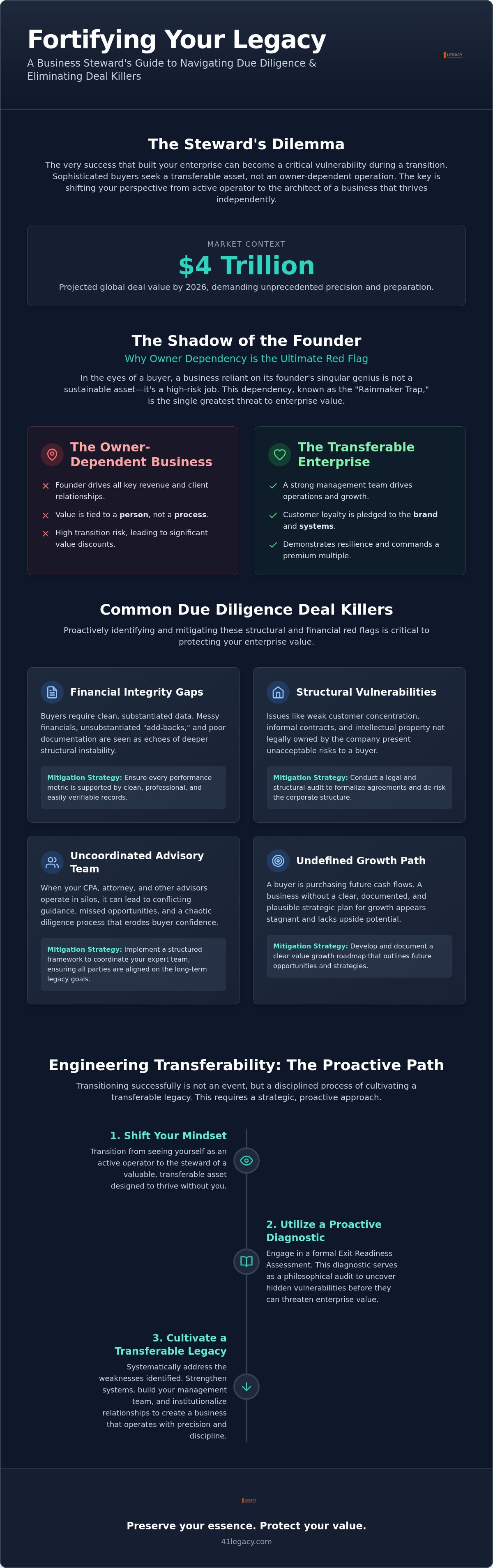
The founder’s brilliance often casts a long shadow over the very enterprise they seek to preserve. While individual talent is the catalyst for initial growth, it frequently becomes a structural anchor during a transition. In the eyes of a sophisticated acquirer, a business that relies on the singular genius of its creator is not an asset; it's a job. This reliance is one of the most common deal killers in due diligence because it signals that the value vanishes the moment the owner exits the building. The business must be more than a mirror reflecting your personal effort.
The "Rainmaker Trap" is perhaps the most visible manifestation of this dependency. If you are the primary driver of revenue, the architect of every key partnership, and the face of every major account, the buyer sees immense fragility. They aren't purchasing your past successes. They're purchasing the certainty of future performance. When that performance is tethered to a person rather than a process, the enterprise value suffers a significant discount. A buyer requires a furnace that sustains its own heat, not a flame that requires constant tending by its creator.
The Transferability of Relationships
A buyer’s audit meticulously examines whether customer loyalty is pledged to the brand or the individual founder. If key suppliers and marquee clients only answer to you, the transition risk becomes unacceptable. Owner Dependency is the single greatest threat to enterprise value. To build a lasting legacy, one must engineer a shift where technical operations and sales functions are institutionalized. This ensures that the essence of the service remains intact even as the hands at the helm change. Conducting a Strategic Capacity Evaluation can reveal whether these vital connections are truly transferable or merely personal.
The Management Gap
A robust organizational chart is the hallmark of a high-value enterprise. Buyers look for a leadership team that executes strategy independently, moving beyond the role of "helpers" who merely wait for instruction. There's a profound difference between a staff that assists you and a leadership team that operates the entity. The latter provides the strategic capacity necessary to sustain growth through time.
Bridging the management gap requires a deliberate commitment to institutionalizing your wisdom. It's the difference between a business that survives its founder and one that thrives because of the systems the founder left behind. Identifying these common deal killers in due diligence early allows you to transition from an indispensable operator to a visionary steward, ensuring your impact resonates long after the final signature is dry.
Beyond the Balance Sheet: Structural and Financial Red Flags
Financial records serve as the meticulous biography of an enterprise, documenting its history with either surgical precision or alarming ambiguity. For the sophisticated steward, these documents are a testament to the discipline of the organization. However, inaccurate or unaudited statements represent one of the most common deal killers in due diligence. Buyers view technical gaps in reporting as a symptom of a deeper structural failure, suggesting that the essence of the business is not properly captured or controlled. When the numbers lack professional rigor, the buyer’s trust evaporates, often leading to a precipitous decline in valuation.
The danger of "add-backs" is particularly acute during this phase of scrutiny. While normalizing earnings is a standard practice, add-backs that cannot be substantiated by clean, rigorous data are viewed as fiction rather than fact. This lack of substantiation often mirrors the absence of documented Standard Operating Procedures (SOPs). Without a library of SOPs, the financial results of the company appear accidental rather than engineered. A buyer isn't looking for a lucky streak. They're looking for a repeatable, scalable system where every outcome is the result of a deliberate process.
Financial Irregularities and the Value Gap
Pro Forma statements must reflect a realistic future, not merely a hopeful projection. When these statements are inflated, they create a significant Value Gap that sophisticated advisors will identify almost immediately. Commingling personal and business expenses in the ledger is another frequent deterrent. It signals a lack of internal governance and professional discipline that makes a buyer question the integrity of the entire operation. Unexplained liabilities or unresolved debt further cloud the corporate history, suggesting that the business hasn't yet reached the "professional-room altitude" required for a premium exit.
The Fragility of Revenue
A lack of recurring revenue is often viewed as a high-risk gamble. If the enterprise must reinvent its sales pipeline every month, its future is inherently unstable. This fragility is compounded by high customer concentration. If a single client represents more than 10% to 15% of your revenue, you don't own a company; you own a contract that a buyer may not be able to renew. These common deal killers in due diligence are often accompanied by "ownership ghosts"-unrecorded transfers of equity or pending litigation that haunt the corporate records. Addressing these structural red flags requires a proactive diagnostic approach, ensuring that the machine you've built is as polished as the products it creates.
Engineering Transferability: A Proactive Diagnostic for Business Stewards
The audit of an enterprise is not merely a discovery of truth; it's a verification of it. For the sophisticated business steward, the preparation for a transition begins long before a letter of intent is signed. It requires a transition from reactive management to proactive engineering. By treating the preparation phase as a philosophical endeavor, you neutralize the common deal killers in due diligence before they ever reach a buyer’s desk. This level of foresight ensures that the essence of what you have built is preserved with the same meticulous care used in its creation.
The catalyst for this transformation is a comprehensive Exit Readiness Assessment. This diagnostic serves as the antidote to red flags, providing a clear vision of the enterprise's current state. From this foundation, we develop a Value Growth Roadmap, a structured path designed to systematically eliminate structural vulnerabilities. Through Transferability Engineering, we polish the business into a high-sheen asset, ensuring that every gear and piston in the organizational machine operates with technical precision and independent sovereignty.
The Self-Diagnostic Process
A disciplined approach to readiness involves a three-step evaluation of the enterprise's internal health. This process provides the strategic clarity necessary to bridge the gap between current performance and future potential.
- Step 1: Assessing the Value Gap. We identify the discrepancy between the current worth of the enterprise and your ultimate financial goals, ensuring the roadmap is aligned with your legacy requirements.
- Step 2: Auditing SOPs. Standard Operating Procedures are examined for clarity, precision, and ease of adoption, transforming tribal knowledge into institutional capital.
- Step 3: Evaluating Strategic Capacity. We assess the leadership team’s ability to execute complex strategies without founder intervention, verifying that the business can thrive in your absence.
Reducing Risk through Documentation
Documentation is the provenance of your business masterpiece. Every contract, IP assignment, and corporate record must be polished to perfection. A clean Virtual Data Room (VDR), established years before a potential sale, signals to buyers that the organization operates with a rare level of discipline. It transforms the due diligence phase from an interrogation into a confirmation of excellence. Proactive diagnostics prevent the erosion of trust that often leads to 11th-hour price renegotiations, protecting the enterprise value you have spent a lifetime building. We invite you to begin this process by initiating an Enterprise Diagnostic to secure the future of your legacy.
The Path to Exit Readiness: Cultivating a Transferable Legacy
The journey toward a successful transition is rarely a solitary endeavor. It requires the presence of a "Quarterback" to harmonize the efforts of your CPA, attorney, and RIA. While these professionals are masters of their respective domains, they often operate in isolation, lacking the unified vision required to neutralize the common deal killers in due diligence that we have explored. Our philosophy transcends the transactional nature of exit planning. We view our work as Legacy Building, the deliberate act of ensuring that the essence of your enterprise is not merely sold but successfully transferred to the next generation of leadership.
In a global market where deal values are projected to reach $4 trillion in 2026, the margin for error is non-existent. A fragmented advisory team is a liability that a sophisticated buyer will exploit. By aligning your professional team under a single, cohesive strategy, we ensure that every decision strengthens the enterprise’s transferability. This transition from business operator to visionary steward is the final act of craftsmanship in your career, requiring the same dedication to perfection that built the company originally.
The Coordinated Advisory Team
Your CPA is a master of tax precision and compliance. Your attorney is a guardian of legal protection. However, these specialists are often transactional by nature; they protect value, but they do not necessarily engineer it for growth. A Certified Exit Planning Advisor (CEPA) orchestrates the transition, providing the strategic oversight needed to identify common deal killers in due diligence before they manifest as failed transactions. We ensure that your professional decisions are not made in a vacuum, but are instead aligned toward the singular goal of total transferability and maximum enterprise value.
Your Value Growth Roadmap
Execution is the bridge between a vision of legacy and the reality of a successful transition. Through our Strategic Advisory services, we provide the monthly implementation support necessary to move your enterprise from a state of potential to a state of total exit readiness. This process is not a hurried sprint toward a closing date. It is a steady, unhurried refinement of every organizational detail, from owner-dependency reduction to the institutionalization of tribal knowledge.
There is a profound peace of mind that comes from knowing your enterprise is a masterpiece of engineering, capable of thriving independently of your daily intervention. When the business is prepared with this level of technical and aesthetic precision, the transition becomes a celebration of your impact rather than a source of anxiety. We invite you to secure the future of your life's work. Begin your journey with an Exit Readiness Assessment and ensure your legacy is preserved for generations to come.
Securing the Future of Your Enterprise Masterpiece
The evolution from an active operator to a visionary steward is the final act of professional craftsmanship. Throughout this audit, we've explored how identifying the common deal killers in due diligence early is the only way to protect the essence of what you've built. By decoupling the enterprise from your personal effort and refining your structural governance, you ensure the business thrives long after the transition. It's about moving beyond mere profitability and toward the creation of a truly transferable asset that commands respect in the marketplace.
Under the guidance of our Certified Exit Planning Advisor (CEPA) leadership, we utilize a sophisticated Enterprise Diagnostics process to illuminate the path forward. Our focus remains steadfast on long-term transferability and value growth, helping you bridge the Value Gap with precision and grace. You've spent years building your history; now is the time to ensure its permanence. Secure your legacy with an Exit Readiness Assessment from 41 Legacy. Your life's work deserves a future that's as polished and intentional as the effort you put into its creation.
Frequently Asked Questions
What is the most common red flag that kills a business sale?
Owner dependency is widely regarded by sophisticated buyers as the most significant deterrent to a successful transaction. When the enterprise's success is tied to the founder's personal effort rather than institutional systems, the risk of failure post-transition becomes unacceptable. This structural vulnerability is among the most common deal killers in due diligence because it suggests the asset's value will vanish the moment the creator exits the building.
How does owner dependency affect the valuation of my company?
Owner dependency acts as a direct discount on your enterprise multiple, often leading to a significant Value Gap. Buyers pay for the certainty of future cash flows, and if those flows are tethered to your unique skills or personal relationships, the buyer will offset that risk with a lower valuation. Reducing this dependency through our Value Growth Roadmap is essential for anyone seeking a premium exit that reflects the true essence of their legacy.
Can I fix financial red flags after due diligence has already started?
Attempting to rectify financial irregularities once formal scrutiny has begun is extremely difficult and often erodes the buyer's trust. While you can provide clarifying data, the presence of unexplained liabilities or commingled expenses during the audit suggests a lack of internal discipline and governance. It's far more effective to conduct an Enterprise Diagnostic months or even years before engaging a buyer to ensure your corporate history is polished and precise.
What is an Exit Readiness Assessment and why is it different from a valuation?
An Exit Readiness Assessment is a comprehensive audit of your company's transferability and structural health, whereas a valuation merely provides a numerical estimate of worth. The assessment identifies hidden risks and provides a framework to mitigate them before they become common deal killers in due diligence. It serves as a proactive diagnostic that prepares the enterprise to thrive independently of the founder, ensuring the asset is truly ready for transition.
How much customer concentration is considered a red flag by buyers?
Most sophisticated buyers view a single customer representing more than 10% to 15% of total revenue as a significant structural risk. High customer concentration creates a fragile revenue stream that is highly susceptible to disruption if that relationship falters during the change in ownership. Buyers will often protect themselves against this fragility through aggressive earn-out structures or substantial discounts on the final purchase price.
Why do buyers care about Standard Operating Procedures (SOPs) during diligence?
Buyers prioritize Standard Operating Procedures because they represent the institutionalized wisdom and repeatability of the organization. Documented SOPs prove that your business results are the product of a deliberate, scalable system rather than individual heroics or accidental luck. A lack of these procedures indicates the business lacks the strategic capacity to function without its creator, which is a primary concern during any rigorous audit.
What role does a CEPA play in identifying red flags before a sale?
A Certified Exit Planning Advisor (CEPA) acts as the quarterback for your professional team, coordinating the efforts of your CPA, attorney, and other advisors. The CEPA identifies structural vulnerabilities early, allowing you to address them through a disciplined Value Growth Roadmap. This proactive oversight ensures that every aspect of the enterprise is engineered for total transferability, protecting the integrity of your legacy long before a buyer enters the room.
Is a lack of recurring revenue always a deal-killer?
A lack of recurring revenue isn't always a deal-killer, but it significantly increases the risk profile and typically results in a lower valuation multiple. Buyers prefer predictable, contractually obligated income over transactional revenue that must be re-earned every month through constant effort. Enhancing your revenue quality through Transferability Engineering is a critical component of preparing your enterprise to be viewed as a high-value, sustainable masterpiece.

Article by
Mike Laskowski
Mike Laskowski is a Business Value Growth Strategist who helps business owners uncover the truths that drive their performance, risk, and readiness. Blending forensic interviewing from a 26‑year federal career with Strategic Capacity analysis and CEPA methodology, he works upstream to reduce owner dependency, increase transferability, and strengthen enterprise value. Mike guides founders through clarity, operational evolution, and transition readiness so their companies become transferable, owner‑independent assets that endure beyond the founder.
Disclaimer
This article is for educational and informational purposes only and does not provide legal, tax, investment, or business brokerage advice. 41 Legacy does not offer M&A brokerage services, legal document drafting, tax preparation, or investment advisory services. Business owners should consult licensed professionals in those disciplines before making decisions related to business transactions, legal matters, tax strategy, or financial planning. All examples are illustrative and may not apply to your specific situation.