
The Emotional Side of Selling Your Business: Navigating the Transition of a Lifetime
A legacy is not sold; it is entrusted. For a dedicated founder, a business is far more than a collection of assets; it is a living chronicle of your life's work, an extension of your identity that's been meticulously crafted over decades. You've spent years ensuring every gear turns with precision, yet the thought of stepping away often brings an unexpected weight. It's natural to feel a sense of guilt toward your team or a quiet fear that your purpose might vanish once the keys are handed over. Understanding the emotional side of selling your business is often more challenging than the technical transfer itself.
By reframing the exit as an act of stewardship, you can transform your enterprise into a transferable asset that thrives long after your daily presence fades. We'll explore how to resolve the psychological friction of due diligence, reduce owner dependency, and architect a strategic roadmap for your next chapter. This approach serves as a quarterback for your transition, reducing your mental load while ensuring your legacy is defined by peace and clarity rather than uncertainty.
Key Takeaways
- Address the identity paradox by viewing your business as a living entity that must eventually flourish independently of your daily presence.
- Bridge the value gap by engineering transferability, which turns owner dependency into a source of long-term enterprise strength.
- Master the emotional side of selling your business by utilizing Enterprise Diagnostics to gain objective clarity and peace of mind during the transition.
- Learn how a coordinated advisory team serves as a strategic quarterback to protect your vision and reduce the mental load of a transition.
- Prepare for your third act by shifting the narrative from a final exit to the intentional evolution of your life’s work.
The Identity Paradox: Navigating the Emotional Weight of Your Life’s Work
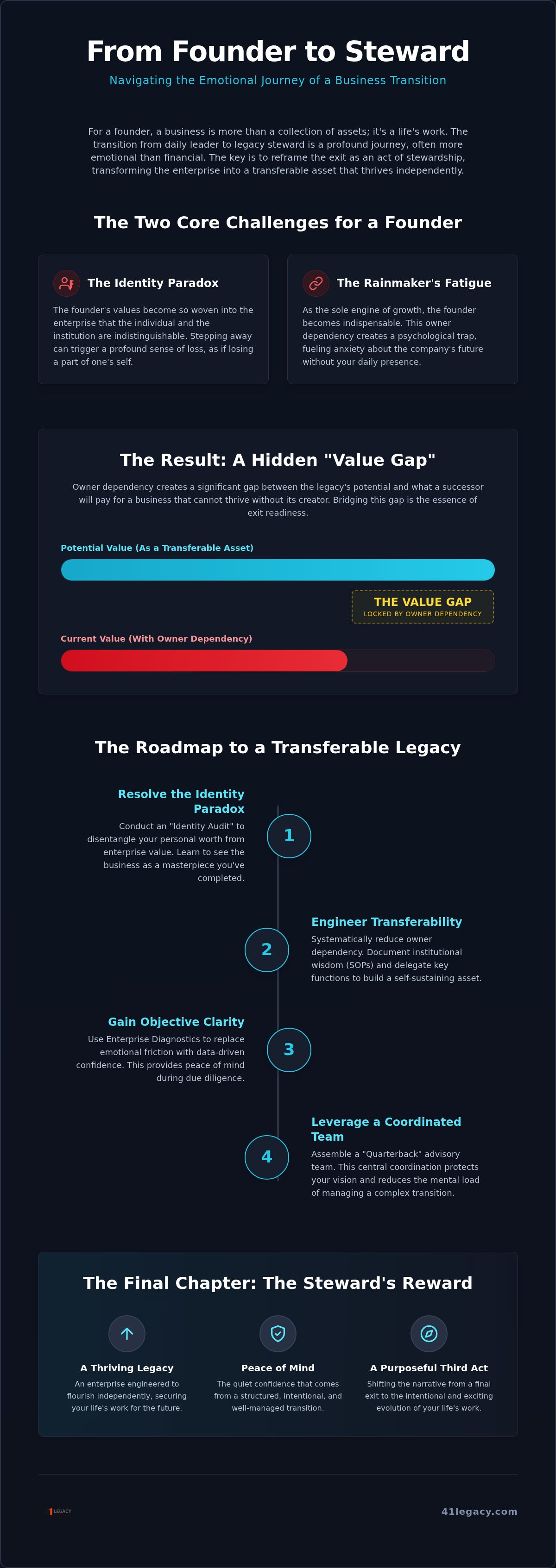
The creation of a business is an act of high artistry. Over decades of labor, the founder’s values, voice, and vision become woven into the very fabric of the enterprise. This fusion creates what we define as the Identity Paradox, a state where the individual and the institution become indistinguishable. For those leading a Closely held corporation, the business isn't just a financial asset; it's a living entity with its own history and heartbeat. Acknowledging the emotional side of selling your business requires a profound reverence for this history. It's not a mere transaction, but a transition of a legacy that demands a sophisticated level of care and precision.
This process often mirrors a grief cycle. Owners may move through denial about their readiness, anger at the complexities of the transition, and a deep bargaining phase as they try to preserve every minute detail of their influence. Recognizing these stages is the first step toward moving from owner-dependency to a state of strategic clarity. True stewardship involves preparing the business to flourish even when the founder's hand is no longer on the wheel. It's about ensuring the essence of the work remains intact while the structure evolves.
The Founder’s Identity Crisis
For years, your title has provided a specific social currency. You've been "The Answer" for employees, family members, and the community. Stepping away means moving from the center of the storm to the role of an observer, which can trigger a profound sense of loss. To mitigate this, we recommend performing an Identity Audit. This exercise helps you disentangle your personal worth from the enterprise value. It allows you to see the business as a masterpiece you've completed, rather than a mirror you must constantly stand before to feel seen. By focusing on transferability, you protect both the business's future and your own sense of self.
The Fear of the Unknown
Anxiety often stems from the vacuum created by a sudden exit. Without a clear "Third Act," the silence following a transition can feel deafening. We view this evolution as an expansion of your impact rather than a hard ending. By utilizing strategic advisory support to build a Value Growth Roadmap, you ensure the business thrives without your constant intervention. Exit Readiness is the bridge between current anxiety and future purpose. It provides the peace of mind that your life's work is secure, allowing you to step into your next chapter with the same confidence that built your company.
The Rainmaker’s Fatigue: How Owner Dependency Fuels Pre-Sale Anxiety
The relentless demand to be the primary engine of growth is a weight few understand. In many instances, particularly within the legal definition of a closely held corporation, the founder acts as the sole "Rainmaker." While this role is born of passion and grit, it eventually becomes a psychological trap. You become indispensable. This indispensability is the hidden driver of pre-sale anxiety; it's difficult to envision a future for the enterprise without your constant pulse at its center. This owner-dependency creates a significant "Value Gap." This represents the distance between the legacy's potential and what a successor is willing to pay for a business that cannot breathe without its creator.
Confronting the emotional side of selling your business requires you to address this fatigue head-on. Transferability Engineering offers a sophisticated path out of this exhaustion. It transforms the enterprise from a personal burden into a masterpiece of independent operation. By focusing on owner-dependency reduction, you aren't just increasing enterprise value. You're reclaiming your mental freedom and ensuring the essence of your work is preserved through a more resilient structure.
Breaking the Chains of Daily Operations
A business that requires your presence to function is not yet a transferable asset; it is an elaborate trap of your own making. The solution lies in the meticulous documentation of your institutional wisdom. We often ask: What is an SOP in Business? It's the blueprint that allows your team to execute with your level of precision. To start, identify the top three tasks that currently require your unique touch. Create a roadmap to delegate these functions immediately. This isn't just about operational efficiency. It's about building a legacy that is designed to survive your absence.
The Mental Load of the Single Point of Failure
There's a quiet, heavy burden in knowing the business might falter if you're absent for a week, let alone a year. This realization fuels the darker emotional side of selling your business. Through Strategic Capacity Evaluation, we identify these hidden risks. We look for the points where the architecture of the enterprise relies too heavily on one pillar. A truly transferable asset provides you with immediate emotional freedom. It allows you to see that your creation is strong enough to stand on its own. If you're ready to begin this transition, an Exit Readiness Assessment can provide the clarity you need to move forward with confidence.
Beyond the Valuation: The Emotional ROI of Exit Readiness
Precision in the architecture of your business does more than attract a successor; it preserves the sanity of the creator. While the financial ledger captures the tangible worth of your labor, the true return on investment in preparation is found in your psychological well-being. A business that's technically ready for transition is a business that allows its owner to sleep. The emotional side of selling your business is often dominated by a quiet "fear of exposure" during the due diligence process. When every process is documented and every risk is mitigated, that fear is replaced by the quiet confidence of a master who knows their work can withstand the most rigorous scrutiny.
We view an Exit Readiness Assessment as a vital diagnostic for peace of mind. It's the first step in moving from the chaos of owner-dependency to the clarity of a transferable asset. By identifying gaps before they become liabilities, you reclaim control over the narrative of your departure. This proactive stance transforms the transition from a stressful transaction into a deliberate act of stewardship.
Closing the Value Gap for Peace of Mind
Anxiety often lives in the space between assumption and reality. We define the "Value Gap" as the distance between the current enterprise valuation and the capital required to fund your next chapter with dignity. Uncertainty about this number fuels the "Fear of the Unknown," keeping many founders trapped in a cycle of "just one more year." By determining enterprise value early, you replace vague hope with strategic clarity. Knowing your "number" acts as a psychological anchor, allowing you to focus on growth with a specific destination in mind. This clarity is the foundation of a stress-free transition.
Readiness vs. Non-Readiness: An Emotional Comparison
The contrast between a prepared owner and an unprepared one is stark. The reactive seller often feels defensive and anxious, viewing every inquiry during due diligence as a personal critique of their life's work. In contrast, the Strategic Steward remains calm and authoritative. Because they've utilized Enterprise Diagnostics, they already know where the strengths and vulnerabilities lie. They aren't reacting to the process; they're leading it.
Owner Dependency Reduction is the primary lever here. When the business no longer relies on your daily intervention to thrive, the emotional weight of "leaving" vanishes. You aren't abandoning a team; you're handing over a high-performance machine that's built to last. This shift in perspective is what allows a founder to move from the president's office to their "Third Act" with a sense of completion rather than loss.
The Quarterback Model: Reducing Isolation Through a Coordinated Advisory Team
The weight of a transition is often magnified by the fragmentation of the professional room. While your CPA focuses on tax mitigation and your attorney manages legal risk, these experts frequently operate in isolation. This "Advisory Silo" places the owner in the exhausting role of mediator. You're forced to reconcile conflicting guidance while simultaneously managing the emotional side of selling your business. It's a recipe for decision fatigue that can stall even the most successful transition.
True stewardship requires a more refined architecture. The Quarterback model introduces a Certified Exit Planning Advisor as the central coordinator of your transition team. This role functions as the guardian of your vision, ensuring that technical precision serves the higher purpose of your legacy. By centralizing the narrative, we remove the owner from the crossfire of competing professional opinions. This structure transforms the advisory process from a source of stress into a source of strategic clarity.
Aligning the Professional Room
Our approach to Strategic Advisory doesn't replace your trusted team; it harmonizes their efforts. We coordinate with your existing CPAs and attorneys to ensure every professional is rowing toward the same legacy goal. This alignment is critical for maintaining the enterprise's value and your own peace of mind. To test the current state of your professional room, ask your advisors a simple question: "How does your current strategy specifically increase the transferability of this asset?" If the responses are uncoordinated, it's a sign that your vision is at risk of being lost in the technical details.
Eliminating the Isolation of Command
Leadership is inherently solitary, but the period preceding an exit can feel like total isolation. You often can't discuss the intricacies of a potential transition with employees or family members for fear of creating premature anxiety. This silence creates a vacuum where the emotional side of selling your business can become overwhelming. Our Monthly Implementation Support provides the partnership and accountability owners need during this sensitive time. We serve as a curatorial board for your business's next chapter, offering a steady hand and a clear roadmap. You don't have to carry the burden of the "Third Act" alone.
If you're ready to replace the isolation of command with a coordinated team of specialists, explore our Strategic Advisory and implementation support.
Crafting the Final Chapter: From Business Owner to Legacy Steward
The final strokes of a masterpiece require the most steady hand. As you approach the conclusion of your active tenure, it's vital to shift the narrative from one of "exiting" to one of "evolving." This is the moment where your role matures from a daily operator into a legacy steward. Navigating the emotional side of selling your business is ultimately an architectural challenge; you're designing the bridge to your "Third Act." This next chapter is where your accumulated time, talent, and treasure are redeployed into endeavors that reflect your deepest values. By viewing the enterprise as a transferable asset, you ensure that your life’s work becomes a permanent fixture in the landscape of your industry rather than a temporary monument to your own effort.
A sophisticated Exit Planning for Business Owners strategy serves as the blueprint for this evolution. It allows you to move beyond the technicalities of the ledger and focus on the preservation of the company’s essence. When the business is prepared to flourish independently, it ceases to be a burden and becomes your greatest masterpiece.
Redefining Purpose Through Stewardship
Stewardship is the highest form of leadership. It's the recognition that you've built something larger than yourself, an entity that deserves a future beyond your own involvement. As a steward, your primary objective is to prepare the organization for its next guardian. This involves a commitment to legacy preservation, ensuring that the core values and culture you've meticulously cultivated survive the transition. To provide clarity during this process, we recommend writing a "Letter of Intent for Legacy." This document should articulate the non-negotiable principles that must be protected, serving as a guiding light for future leadership. It transforms your departure from a loss into a graceful passing of the torch.
The Peace of a Transferable Asset
There is a profound, quiet peace that comes with knowing a task is truly finished. Utilizing Value Growth Roadmaps provides the structural integrity needed to reach this sense of completion. When the diagnostics show that the enterprise no longer relies on your daily presence, the emotional weight of "leaving" evaporates. You've given the organization the greatest gift a founder can provide: the ability to thrive without them. This independence is the ultimate proof of your success as an architect of value. To secure your own peace of mind and begin this final chapter with confidence, we invite you to start your journey with an Enterprise Diagnostic. Secure the legacy you've worked a lifetime to build.
Securing the Masterpiece: Your Path to a Purposeful Transition
Transitioning from a daily operator to a legacy steward is the ultimate act of leadership. It requires disentangling your identity from the enterprise and engineering a structure that flourishes in your absence. By addressing the emotional side of selling your business through strategic readiness, you replace the anxiety of the unknown with the peace of a completed work. You've spent decades building this entity; it deserves a transition as meticulously crafted as its foundation.
Our team, led by Certified Exit Planning Advisors, acts as the strategic quarterback for your professional room. We align your CPAs and attorneys under a singular, cohesive vision. Through a structured Value Growth Roadmap, we focus on owner-dependency reduction to ensure your business remains a vibrant, transferable asset. This disciplined approach provides the clarity you need to step confidently into your third act. You don't have to carry the weight of this transition alone.
Begin Your Exit Readiness Assessment with 41 Legacy and ensure your life’s work continues to thrive.
Frequently Asked Questions
Is it normal to feel depressed after selling my business?
It's entirely natural to experience a period of mourning after the transition. The identity paradox we've discussed often leads to a profound sense of loss once the daily rhythm of leadership ceases. Many founders find that their social currency was tied to their title, creating an emotional vacuum. Preparing for a "Third Act" with the same precision used to build the company is essential to navigating this shift and finding a new sense of purpose.
How can I tell my employees I’m planning an exit without causing panic?
Transparency should be balanced with strategic timing. We recommend framing the transition as an evolution of the legacy rather than a departure. By demonstrating that you've engineered a business that thrives independently, you provide your team with a sense of security. Communicating your commitment to finding a successor who respects the established culture ensures that employees see themselves as part of the entity's continued story rather than victims of a transaction.
What is the biggest emotional mistake owners make during a sale?
The most significant error is failing to define a life beyond the president’s office. Without a clear vision for your talent and treasure, the emotional side of selling your business becomes a source of paralysis. Owners often sabotage the process during due diligence because they subconsciously fear the upcoming vacuum of purpose. A documented Value Growth Roadmap provides the technical and psychological structure needed to complete the masterpiece and step away with dignity.
How do I know if I’m emotionally ready to step away from my company?
Emotional readiness is often signaled by a shift in perspective from operator to steward. You're ready when you no longer view the enterprise as a reflection of your personal worth, but as a transferable asset you've successfully curated. If the thought of the business flourishing without your daily intervention brings a sense of pride rather than a feeling of being replaced, you've achieved the strategic clarity necessary for a graceful evolution.
Does an exit readiness assessment help with the stress of selling?
Diagnostic clarity is the most effective antidote to transition anxiety. An Exit Readiness Assessment identifies the specific operational gaps that fuel the "fear of exposure" during due diligence. By addressing these vulnerabilities early, you move from a reactive state to one of calm authority. This technical preparation directly impacts the emotional side of selling your business, providing the confidence that your legacy is secure and your masterpiece is truly finished.
What should I do if my spouse and I have different views on exiting the business?
Differing visions between partners require a coordinated advisory approach to find a shared legacy goal. We often see one spouse ready for the "Third Act" while the other remains tied to the identity of the business. Utilizing strategic advisory support allows both parties to articulate their personal and financial objectives in a professional setting. This process harmonizes the emotional weight of the transition, ensuring the final chapter of the business supports the future of the family.
How can I protect my company's culture after I leave?
Protection of culture requires the technical precision of Transferability Engineering. You must encode the company's core values into the very architecture of the enterprise through meticulous documentation and SOPs. When the essence of the work is woven into the daily operations, it becomes independent of the founder. This ensures that the next guardian of the legacy inherits a living entity with a clearly defined heartbeat that can survive the transition of leadership.
Why is a Certified Exit Planning Advisor (CEPA) different from a business broker?
A CEPA functions as a strategic quarterback rather than a transactional agent. While others might focus on the mechanics of a sale, a CEPA prioritizes the long-term health and transferability of the enterprise. We use Enterprise Diagnostics and Value Growth Roadmaps to bridge the gap between current operations and a lasting legacy. Our focus is on reducing owner dependency and strengthening the asset, ensuring the founder achieves both financial success and emotional peace of mind.

Article by
Mike Laskowski
Mike Laskowski is a Business Value Growth Strategist who helps business owners uncover the truths that drive their performance, risk, and readiness. Blending forensic interviewing from a 26‑year federal career with Strategic Capacity analysis and CEPA methodology, he works upstream to reduce owner dependency, increase transferability, and strengthen enterprise value. Mike guides founders through clarity, operational evolution, and transition readiness so their companies become transferable, owner‑independent assets that endure beyond the founder.
Disclaimer
This article is for educational and informational purposes only and does not provide legal, tax, investment, or business brokerage advice. 41 Legacy does not offer M&A brokerage services, legal document drafting, tax preparation, or investment advisory services. Business owners should consult licensed professionals in those disciplines before making decisions related to business transactions, legal matters, tax strategy, or financial planning. All examples are illustrative and may not apply to your specific situation.