
The Definitive Selling a Business Checklist: Engineering Your Transferable Legacy
A business is not merely a source of income; it's a living vessel for your life's work, yet most owners inadvertently build a gilded cage rather than a transferable masterpiece. You've likely spent decades refining your craft and building a reputation, only to realize that the firm's value remains inextricably tied to your daily presence. It's a heavy realization to face the Value Gap, that silent thief of enterprise value. Implementing a structured business exit readiness checklist is the first step in evolving from an operator to a steward of a lasting legacy.
We understand the meticulous nature of what you've built. This article promises to reveal the essential stages of exit readiness, moving beyond the noise of transactional brokerage to the precision of value growth. You'll gain a clear roadmap to reduce owner dependency and harmonize your advisory team. We'll examine how enterprise diagnostics and strategic capacity evaluations serve as the blueprints for your transition, ensuring your company remains a high-value asset that flourishes in 2026 and beyond.
Key Takeaways
- Shift your perspective from a one-time transaction to a state of constant preparedness; this ensures your firm remains a transferable asset rather than a founder-dependent lifestyle business.
- Employ a structured business exit readiness checklist to identify and engineer the internal pillars that drive enterprise value and eliminate the risks of owner dependency.
- Use Enterprise Diagnostics to bridge the Value Gap by aligning your financial and structural records with the rigorous standards of a sophisticated buyer.
- Establish a strategic quarterback for your advisory team to ensure that your CPA, attorney, and professional advisors are working in harmony toward your long-term legacy goals.
- Move beyond static planning by implementing a Monthly Strategic Advisory model that transforms strategic clarity into measurable and sustained value growth.
Beyond the Transaction: Why Exit Readiness is Your True Selling Checklist
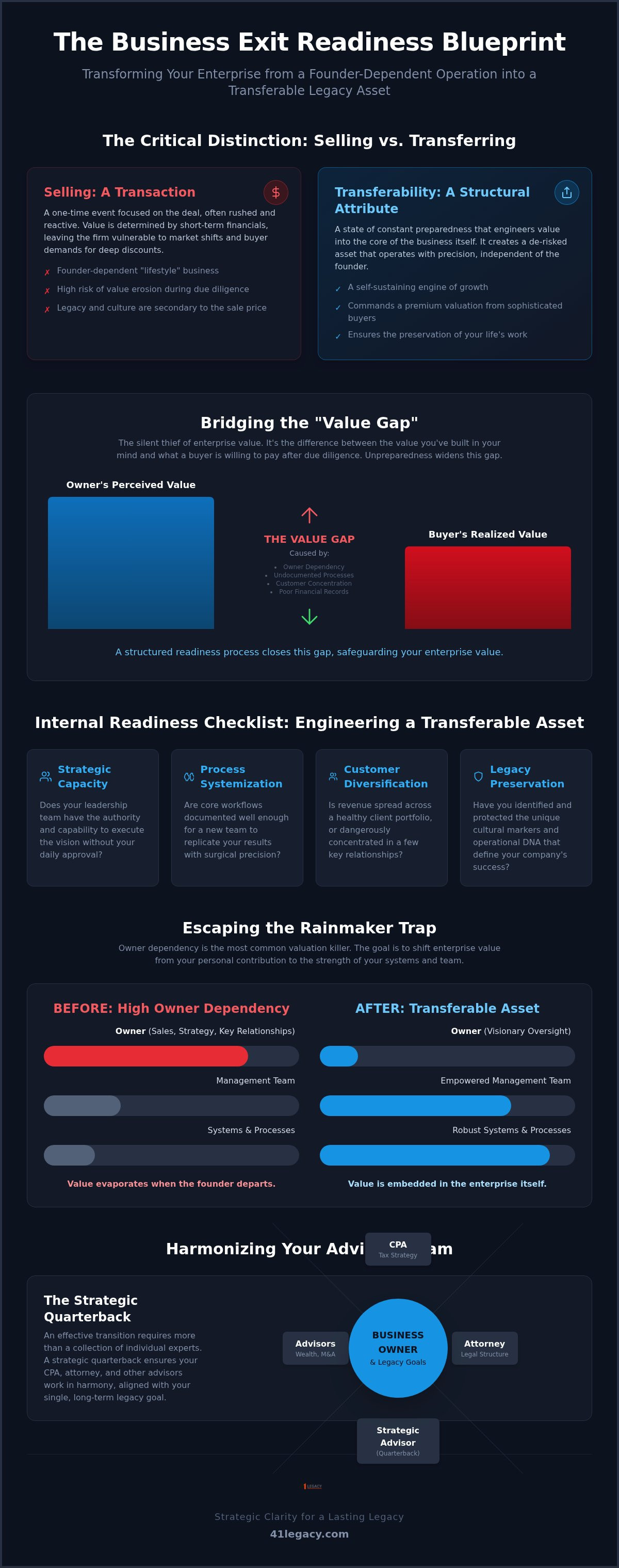
For the visionary founder, the enterprise is more than a series of ledger entries; it's a living testament to a career of dedication. Yet, many approach the eventual transition as a simple transaction to be handled by a broker. This is a mistake. True exit readiness is a state of constant, structural preparedness that transforms a company from a founder-dependent operation into a transferable asset built for longevity. A comprehensive business exit readiness checklist shouldn't begin with a sales pitch. It must begin with foundational engineering. You're not just selling a company; you're acting as the steward of a lasting legacy that must thrive independently of your daily presence.
The Distinction Between Selling and Transferring
A sale is a transaction, a fleeting moment where ownership changes hands. Transferability, however, is a structural attribute of the enterprise itself. While many focus on the deal, a Certified Exit Planning Advisor acts as a strategic architect, ensuring the firm's internal systems are polished to a high sheen. Sophisticated buyers seek the essence of a company, looking for sustainable operations and a culture that remains intact long after the original owner departs. They aren't looking for a job; they're looking for an engine of growth that operates with surgical precision.
The Financial Cost of Unpreparedness
The absence of a clear exit strategy often results in what we call the Value Gap. When an owner is forced to exit due to health or market shifts, the lack of readiness allows buyers to demand significant discounts during due diligence. In 2026, determining enterprise value requires more than just looking at the bottom line. It requires proving that the business is a de-risked asset. Without a robust business exit readiness checklist, you risk leaving the preservation of your essence to chance. Preparation is the only way to ensure the value you've created isn't eroded by the friction of a hasty transition.
The Internal Readiness Checklist: Engineering a Transferable Asset
To build a legacy that survives the founder, one must view the enterprise through the lens of a master artisan. It's not enough to be profitable; the business must be beautiful in its autonomy. Engineering a transferable asset requires a shift from doing to designing. A business exit readiness checklist isn't a mere list of documents; it's a diagnostic of your company's soul and its ability to breathe on its own. We call this Transferability Engineering. It's the meticulous process of ensuring the essence of your work remains even when your hands leave the wheel.
Operational maturity is the hallmark of a premium firm. It's the difference between a business that requires your constant attention and one that functions with surgical precision. To achieve this, you must audit your internal pillars with an uncompromising eye for detail. Consider the following elements as essential components of your structural readiness:
- Strategic Capacity: Does your leadership team have the authority to execute the vision without your daily approval?
- Process Systemization: Are your core workflows documented well enough for a stranger to replicate your results?
- Customer Diversification: Is your revenue spread across a healthy portfolio, or is it concentrated in a few precarious relationships?
- Legacy Preservation: Have you identified the unique cultural markers that define your company's success?
Reducing Owner Dependency: The Rainmaker Trap
The most common valuation killer is owner dependency. If you're the primary rainmaker, you've built a lifestyle, not an asset. High-value buyers aren't looking to replace you; they're looking for a self-sustaining engine. When a founder is the sole driver of sales or technical expertise, the firm's value evaporates the moment they depart. To command a premium valuation, you must demonstrate that the business thrives because of your systems, not because of your personality. Our Transferability Engineering approach focuses on elevating tier-two leadership, ensuring that critical decision-making is distributed throughout the organization.
The Blueprint of Success: Documented SOPs
Documented SOPs in business are the blueprints of success. They provide the new steward with the exact mechanical specifications of your success. Without these records, your business is a collection of tribal knowledge, which is a significant risk for any successor. A robust business exit readiness checklist prioritizes the systemization of mission-critical processes. By codifying your methods, you reduce perceived risk and prove that your excellence is repeatable. This level of documentation acts as the manual for the next generation, allowing them to maintain the high sheen of the legacy you've meticulously polished over the years.
The Financial and Structural Audit: Bridging the Value Gap
Precision in the financial realm is the foundation upon which all enterprise value rests. For the dedicated owner, the balance sheet is more than a record of past performance; it's a structural blueprint that proves the integrity of the work. Bridging the Value Gap requires a shift from accounting for tax mitigation to accounting for enterprise value. While minimizing tax liability is a common operational goal, it often obscures the true strength of the firm. A sophisticated buyer seeks transparent, robust earnings that can be replicated under new stewardship, making "clean" financials and pro forma statements essential for establishing confidence.
The business exit readiness checklist must prioritize the creation of a Value Growth Roadmap. This living document serves as the strategic pulse of your transition, moving beyond static records to active value enhancement. By utilizing Enterprise Diagnostics, we uncover the hidden friction points that prevent your firm from reaching its full valuation potential. This process transforms your financial data into a narrative of excellence, ensuring that every dollar of revenue is backed by a de-risked, sustainable system.
Enterprise Diagnostics and Strategic Valuation
Understanding the difference between current market value and potential transferable value is the first step in increasing enterprise value. Enterprise Diagnostics allow us to view the firm through the critical eye of a successor, identifying financial red flags before they derail a transition. Sophisticated buyers scrutinize several key areas during their evaluation:
- Earnings Quality: Are profits derived from sustainable operations or one-time anomalies?
- Add-back Clarity: Are owner-related expenses clearly identified and easily separated from core operations?
- Revenue Consistency: Does the firm demonstrate a predictable, recurring revenue model?
- Financial Transparency: Are the records maintained with surgical precision, meeting the highest professional standards?
Identifying and Mitigating Structural Risks
A firm's inner essence must be protected from external vulnerabilities. Structural risks, such as high customer concentration or a reliance on a single supplier, act as invisible cracks in the foundation of your legacy. A Strategic Capacity Evaluation is necessary to prove that the company possesses the infrastructure to support future growth without the founder's intervention. By proactively mitigating these risks, you ensure that your business exit readiness checklist addresses the longevity of the asset. This level of preparation signals to the market that you have engineered a masterpiece capable of flourishing across generations, preserving the impact of your life's work.
The Strategic Alignment Checklist: Your Coordinated Advisory Team
A masterpiece is rarely the work of a solitary hand; it's the result of a symphony of specialists working in perfect harmony. In the pursuit of a transferable legacy, your advisory team represents the different disciplines of the craft. However, without a central point of coordination, these experts often operate in silos. A CPA might focus on tax mitigation, while an attorney prioritizes risk avoidance, and a wealth manager looks toward the post-exit horizon. This lack of alignment creates friction, often leading to a fragmented business exit readiness checklist that fails to capture the true essence of the enterprise.
We believe every transition requires a strategic lead, a "Quarterback," to ensure that all professional efforts converge on a singular vision of value growth. Without this conductor, the owner is often left to mediate between conflicting professional opinions, which wastes precious time and erodes strategic clarity. Coordinating these specialists isn't just about efficiency; it's about the preservation of the company's historical significance and future potential. Siloed advice is a common pitfall that devalues the firm by creating uncoordinated strategies that sophisticated buyers will quickly identify during due diligence.
The Coordinated Advisory Team Model
The architecture of a successful exit relies on a specific assembly of artisans. Each role is vital, yet their individual contributions must be woven into a cohesive strategy. At 41 Legacy, we coordinate these specialists to protect the integrity of your life's work. The essential roles for your team include:
- Certified Exit Planning Advisor (CEPA): The strategic architect who oversees the entire readiness process and ensures the Value Growth Roadmap is executed.
- CPA: The guardian of financial records who ensures tax efficiency is balanced with enterprise value.
- Attorney: The expert who secures the legal foundation, ensuring contracts and structures are transferable.
- Wealth Manager: The specialist who aligns the owner's personal financial needs with the business's performance.
- M&A Specialist: The professional who provides insight into market demand and buyer expectations.
Effective advisor alignment requires deliberate structure. Ensure your team holds regular alignment meetings where the primary goal is the growth of enterprise value, not just the completion of transactional tasks. To begin this orchestration, you can engage our strategic advisory services to act as your central point of coordination.
The Role of the Exit Readiness Assessment
The foundation of this collaborative effort is a shared "source of truth." An Exit Readiness Assessment provides the diagnostic data needed for every advisor to work from the same blueprint. It moves the conversation beyond theory and into the realm of technical precision. Understanding exit planning for business owners as a holistic discipline ensures that no aspect of the company's health is ignored. This initial diagnostic phase is a critical step in your business exit readiness checklist, requiring a thorough review of:
- Operational maturity and owner dependency levels.
- Financial transparency and the clarity of earnings.
- Strategic capacity of the existing leadership team.
- Personal and financial goal alignment for the founder.
When your team shares a common map, the path to a transferable legacy becomes clear and certain.
Navigating the Roadmap: Implementing Your Exit Readiness Strategy
A static document is a ghost of an intention. To truly transform your enterprise, you must move beyond the initial business exit readiness checklist and enter the phase of active stewardship. Implementation is where the master artisan's skill is most visible. It's a rhythmic process that balances high-level legacy vision with granular technical execution. Through Monthly Implementation Support, strategic clarity becomes operational reality. This disciplined approach ensures that your Value Growth Roadmap isn't just a plan, but a living engine of enterprise value that moves with surgical precision.
The pursuit of perfection in transferability is a long-term endeavor. It's a competitive advantage that de-risks the asset and secures its future in a way that transactional brokers cannot replicate. By maintaining momentum, you ensure that the Value Gap doesn't just narrow; it closes entirely. This is the essence of Transferability Engineering. It's the commitment to building something that possesses its own heartbeat, independent of your daily intervention.
The Value Growth Roadmap in Action
Execution requires prioritization. Not every task on your business exit readiness checklist carries the same weight. You must identify the levers that have the most direct impact on enterprise value and address them with extreme precision. Our Monthly Strategic Advisory model provides the accountability necessary to keep the transition on track, ensuring that progress never stagnates. Consider these monthly milestones to maintain the sheen of your firm's operational health:
- Reviewing Strategic Capacity Evaluation metrics to ensure leadership autonomy.
- Auditing newly documented SOPs for clarity and replicability by successors.
- Assessing the reduction of owner dependency in critical sales and operational cycles.
- Synchronizing with your coordinated advisory team to verify financial transparency and earnings quality.
Securing the Legacy
As the steward of your company's history, the final decision to transition is a philosophical one. You've built something that possesses a life of its own, a narrative of excellence that deserves to continue. Before engaging transactional specialists, you must face the "Go/No-Go" criteria with total confidence. Is the business a truly transferable asset? Does it possess the structural integrity to flourish across time? When the engineering is sound, the transition becomes a natural progression rather than a disruptive event.
Your life's work deserves a guardian's care. To begin the process of engineering your transferable legacy and protecting the essence of your firm, we invite you to embark on an Exit Readiness Assessment. This is the definitive first step in securing the value of what you've built and ensuring it thrives for generations to come.
Securing Your Enduring Legacy
Building a company is a profound act of creation, yet the true measure of its success lies in its ability to thrive without its founder. Transitioning from a lifestyle operation to a transferable asset requires more than a simple transaction. It demands the meticulous application of a business exit readiness checklist that prioritizes structural integrity and owner independence. By bridging the Value Gap through comprehensive Enterprise Diagnostics and a structured Value Growth Roadmap, you ensure that the essence of your life's work remains untarnished by the friction of transition.
Our team of specialists, led by Certified Exit Planning Advisor expertise, acts as the strategic quarterback to harmonize your professional advisors and protect your enterprise value. You've spent decades polishing your masterpiece; don't leave its future to chance. We invite you to Begin Your Exit Readiness Assessment with 41 Legacy and take the first step toward a certain future. Your legacy is a living entity, and with the right engineering, its impact will resonate long into 2026 and beyond. The path to a graceful transition is clear, and we're here to help you navigate it with confidence.
Frequently Asked Questions
What is the difference between a business broker and an exit planning advisor?
A business broker focuses on the transaction itself, while an exit planning advisor acts as a strategic architect who prepares the firm long before an offer arrives. Brokers typically enter the process when you're ready to go to market. In contrast, an advisor uses a business exit readiness checklist to engineer transferability and reduce owner dependency. This ensures that when you do engage a broker, your company is a de-risked, high-value asset that commands a premium.
How long does the exit readiness process typically take in 2026?
In 2026, the timeline for comprehensive exit readiness typically spans 12 to 36 months, depending on the current structural maturity of the enterprise. This duration allows for the meticulous implementation of a Value Growth Roadmap and the systemization of core processes. While an Exit Readiness Assessment can be completed relatively quickly, the actual engineering of a transferable legacy is a deliberate, time-intensive endeavor that requires consistent monthly implementation to bridge the Value Gap effectively.
What is the "Value Gap" and how do I calculate it for my business?
The Value Gap is the disparity between your firm's current market value and the net proceeds required to fund your future aspirations. You calculate this by subtracting your current enterprise value and existing personal wealth from your ultimate financial goal. We use Enterprise Diagnostics to uncover this gap with surgical precision. Identifying this number is a foundational step in any business exit readiness checklist, as it establishes the target for all subsequent value growth initiatives.
Why is owner dependency considered a primary risk by sophisticated business buyers?
Sophisticated buyers view owner dependency as a fundamental structural flaw because it signals that the firm's success is tied to a person rather than a system. If the founder is the primary driver of sales or technical expertise, the business cannot function independently. This "Rainmaker Trap" creates significant risk for a successor. Reducing this dependency is the core of Transferability Engineering, transforming the company into a self-sustaining engine that thrives under new stewardship.
Can I successfully sell my business if I do not have documented SOPs?
You can certainly attempt to sell without documented SOPs, but you'll likely face a significant buyer discount during due diligence. Without clear blueprints, a buyer perceives your excellence as tribal knowledge that might disappear when you depart. Documented systems act as the manual for the next owner, proving that your results are repeatable and sustainable. They are the essential mechanical specifications that transform a collection of tasks into a high-value, transferable asset.
How does an Exit Readiness Assessment differ from a standard business valuation?
A standard business valuation provides a snapshot of what your company is worth today based on historical data. An Exit Readiness Assessment, however, is a forward-looking diagnostic that evaluates the structural qualities of the firm. It measures transferability, identifies owner dependency risks, and evaluates strategic capacity. While a valuation tells you the price, the assessment tells you why that price exists and provides the roadmap to increase it before you exit.
What specific roles should be included in a coordinated advisory team?
A coordinated advisory team requires a diverse assembly of specialists working toward a singular vision. This team typically includes a Certified Exit Planning Advisor (CEPA) serving as the quarterback, a CPA, a specialized attorney, a wealth manager, and an M&A specialist. Each artisan brings technical precision to their specific discipline. Without a strategic lead to align these roles, the advice often becomes siloed, which can inadvertently devalue the enterprise and create friction during the transition.
How does transferability engineering impact the final sale price of a company?
Transferability engineering directly impacts the final sale price by de-risking the asset and making it more attractive to high-quality buyers. When a business is systemized and independent of its founder, it often commands a higher valuation multiple. Buyers are willing to pay a premium for a firm that offers predictable earnings and operational maturity. This process ensures your legacy isn't just sold, but successfully transferred as a masterpiece of functional engineering.

Article by
Mike Laskowski
Mike Laskowski is a Business Value Growth Strategist who helps business owners uncover the truths that drive their performance, risk, and readiness. Blending forensic interviewing from a 26‑year federal career with Strategic Capacity analysis and CEPA methodology, he works upstream to reduce owner dependency, increase transferability, and strengthen enterprise value. Mike guides founders through clarity, operational evolution, and transition readiness so their companies become transferable, owner‑independent assets that endure beyond the founder.
Disclaimer
This article is for educational and informational purposes only and does not provide legal, tax, investment, or business brokerage advice. 41 Legacy does not offer M&A brokerage services, legal document drafting, tax preparation, or investment advisory services. Business owners should consult licensed professionals in those disciplines before making decisions related to business transactions, legal matters, tax strategy, or financial planning. All examples are illustrative and may not apply to your specific situation.