
The Business Value Gap Analysis: Bridging the Chasm Between Current Worth and Future Legacy
Roughly 80% of a typical business owner's net worth is locked within their company, yet only an estimated 20% to 30% of businesses that go to market ever reach a successful closing. This sobering reality often stems from a fundamental disconnect between an owner's perceived worth and the market's assessment of a company's independent health. A rigorous business value gap analysis reveals the structural deficiencies that often remain hidden beneath daily operations. You've spent years as the steward of your enterprise, but if the business cannot breathe without your constant oversight, you're likely facing a chasm between your current value and your future needs.
This article provides the clarity needed to bridge that chasm and secure your lifelong legacy. We'll guide you through the process of quantifying your wealth gap and identifying the specific risks that suppress your enterprise value. You'll discover a structured roadmap designed to reduce owner dependency and engineer true transferability. This journey isn't just about preparing for a transaction; it's about honoring the essence of what you've built by ensuring it thrives long after you've stepped away. By the end of this guide, you'll have the framework to transform your business from a personal job into a valuable, transferable asset.
Key Takeaways
- Distinguish between your personal financial requirements and the market's assessment of your company to define the exact scope of your strategic chasm.
- Conduct a business value gap analysis to expose the structural vulnerabilities that often remain hidden within even the most successful operations.
- Identify how "invisible risks," such as excessive owner dependency, create significant valuation discounts that compromise your future security.
- Learn the diagnostic steps required to align your enterprise performance with the specific wealth targets necessary to fund your lifelong legacy.
- Transition from passive observation to active refinement by implementing a Value Growth Roadmap designed to engineer a more transferable and valuable asset.
What is a Business Value Gap Analysis? Defining the Strategic Chasm
The business you've cultivated is more than a ledger of transactions; it's a testament to your vision and dedication. Yet, many owners find themselves standing at the edge of a silent precipice when they contemplate their departure. What is a Business Value Gap Analysis? At its core, it's the process of identifying the discrepancy between what your company is currently worth and the capital required to fund your desired future. This isn't merely a financial calculation. It's a fundamental assessment of the enterprise's ability to survive and thrive without its founder.
The Wealth Gap vs. The Value Gap
Understanding the distinction between these two concepts is essential for any steward of a legacy. The Wealth Gap represents the difference between your current net worth and the specific amount you need to maintain your lifestyle after you exit. Given that roughly 80% of a typical business owner's net worth is tied up in their company, according to industry research, this number is often substantial. Conversely, the Value Gap is the distance between your business's current market value and its potential value if it were optimized for transferability.
These numbers rarely align by chance. To quantify this chasm, we must evaluate three critical factors:
- The Personal Target: The precise capital required to secure your post-exit life.
- The Current Baseline: What a sophisticated buyer would pay for your current operations.
- The Potential Peak: The value achievable by eliminating risks and maximizing efficiency.
The Philosophical Shift: From Income to Enterprise Value
True mastery requires looking beyond the monthly Profit and Loss statement. While high revenue might suggest health, it can often mask deep structural weaknesses that a business value gap analysis will quickly expose. A business that relies entirely on the founder's daily presence isn't an asset; it's a high-paying job. To bridge the chasm, you must view your company as a masterpiece of engineering designed for independence.
Utilizing enterprise diagnostics allows us to look into the inner essence of the organization, uncovering the hidden risks that suppress its worth. We're moving from managing a source of income to refining a transferable asset. This shift in perspective ensures that the business remains a living entity, capable of telling its story long after the original author has moved on. We don't just look at what the business does. We look at what it's worth without you.
The Three Pillars of the Value Gap: Wealth, Value, and Transferability
A sophisticated business value gap analysis is not a singular data point. It is a structural examination of three interlocking pillars that support the weight of your future. While many owners view their company through the narrow lens of annual revenue, a master artisan understands that true worth is built upon the harmony of personal financial security, strategic market value, and operational independence. These pillars interact to create a comprehensive exit readiness assessment, providing the clarity required to protect what you have built.
The Wealth Pillar: Securing the Family Legacy
The Wealth Pillar focuses on the alignment between your business asset and your personal financial destiny. This is often the primary driver of owner anxiety. Many founders operate under a "guessed" exit number, assuming the eventual sale will naturally cover their post-exit needs. This lack of precision is dangerous. We work to coordinate with your wealth managers to verify the "Wealth Gap" number, ensuring the business value is sufficient to fund your lifelong legacy. Bridging this divide requires Closing the Chasm: Implementing the Value Growth Roadmap, a process that transforms the business from a personal extension into an institutional asset.
The Value Pillar: Maximizing the Multiple
The Value Pillar examines the "Multiple" your business commands in the market. Two companies with identical earnings can have vastly different valuations based on their strategic growth potential. A business that demonstrates consistent growth and a diversified client base will always outshine one that has plateaued. By focusing on strategic capacity, we help you refine the inner essence of your company to attract the highest possible market premium.
The Transferability Pillar: Reducing Owner Dependency
This is the qualitative heart of the business value gap analysis. A business that relies on the owner as the primary "Rainmaker" is a business with a significant value discount. Transferability engineering is the art of building a company that outlasts its creator. Implementing owner dependency reduction ensures that your technical precision and artistic vision are embedded into the organization itself. This is achieved through the meticulous creation of SOPs, which serve as the blueprint for a transferable legacy.
Refining these pillars is the work of a lifetime. Initiating a structured Enterprise Diagnostics process is the first step toward ensuring your business can thrive independently of your daily presence.
Identifying the Invisible Risks: Why Your Valuation Might Be a Mirage
A business owner often views their company through the lens of history and hard work, seeing a valuation that reflects decades of effort. However, a sophisticated buyer sees something different. They look for the "Invisible Risks" that act as structural fractures in your enterprise. These fractures create a significant discount, often leading to a valuation that feels like a mirage when the time comes to transition. A thorough business value gap analysis is designed to illuminate these shadows, moving beyond simple cash flow to evaluate the actual health and resilience of the organization.
Two of the most common detractors are customer concentration and key-man risk. If 20% of your revenue comes from a single client, your business is fragile. If the loss of one key employee or the owner's absence halts operations, the value drops precipitously. This is why a certified exit planning advisor scrutinizes the details an owner might overlook. We categorize these findings into Value Drivers, which enhance the multiple, and Value Detractors, which erode it. Identifying these factors early is the difference between a successful legacy and a failed transition.
The Hidden Weight of Owner Dependency
We must evaluate your "Strategic Capacity." This is the organization's ability to scale and function without your direct intervention. We often use the "Vacation Test" as a diagnostic tool. If you can't step away for 30 days without the business suffering, you haven't built a transferable asset yet. You've built a cage. We prefer to view the business as a living entity that requires its own immune system. This system consists of robust processes and a leadership team capable of protecting the company's essence in your absence. Without this independence, the business value gap analysis will always reveal a shortfall in true market worth.
Market Attractiveness vs. Internal Readiness
It's a common mistake to assume a thriving market will compensate for internal disarray. A great market cannot save a poorly structured business. There is a profound difference between a business being "saleable" and it being "transferable." A saleable business might find a buyer, but a transferable business ensures the legacy continues and the owner receives full value. By determining enterprise value through the lens of internal readiness, we benchmark where you stand today versus where you must be to secure your future. This precision ensures that when you choose to step away, the foundation remains unshakable.
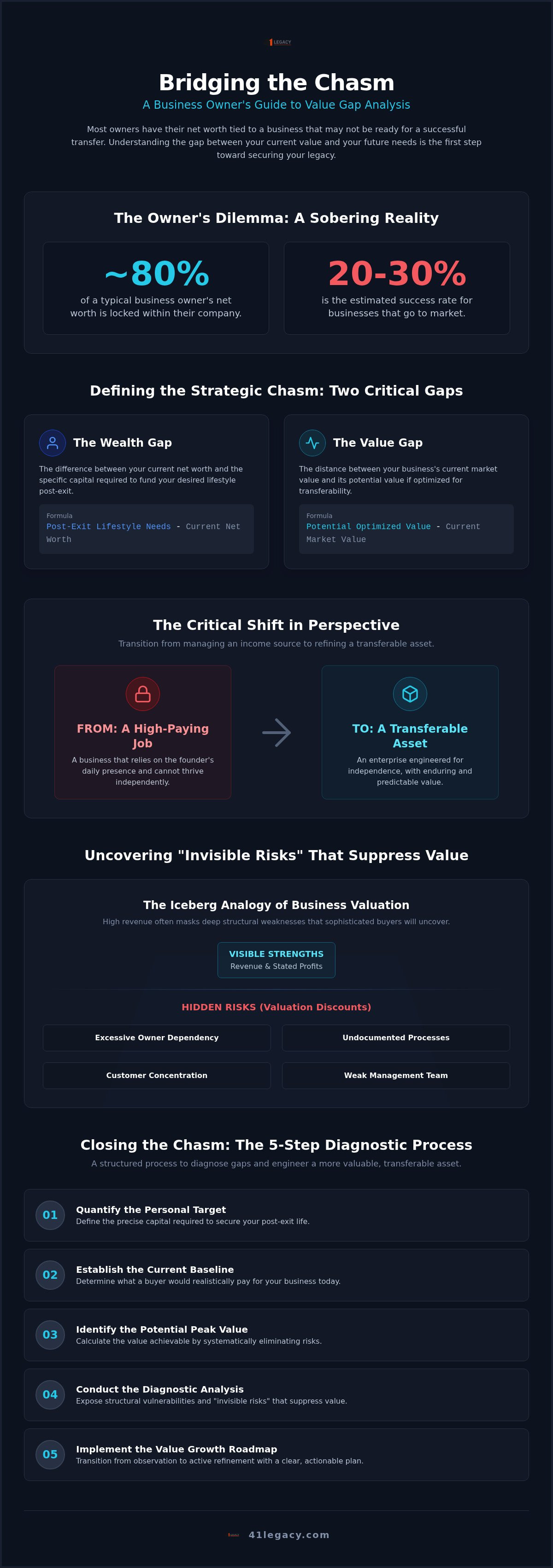
The 5-Step Diagnostic Process to Quantify Your Gap
Quantifying the chasm between your current operations and your future legacy requires a disciplined, rhythmic approach. A professional business value gap analysis is not a simple calculation; it's a diagnostic journey that examines the inner essence of your enterprise. This process transforms abstract goals into a concrete, actionable roadmap for value growth. To ensure the preservation of your essence, we follow a structured sequence designed for technical precision and strategic depth.
- Step 1: Enterprise Diagnostics. We establish a rigorous baseline, assessing the current health and market position of the company.
- Step 2: Financial Alignment. We coordinate with your CPAs to verify the Wealth Gap, ensuring your personal financial needs are clearly defined.
- Step 3: Root Cause Identification. We pinpoint the specific structural fractures, such as a lack of SOPs or excessive owner dependency, that suppress your value.
- Step 4: Strategic Roadmap Development. We design the path toward Transferability Engineering, focusing on building an asset that thrives independently.
- Step 5: Monthly Implementation. We guide the unhurried, rhythmic progress of a master artisan, ensuring every refinement is polished to a high sheen.
Step 1 & 2: The Baseline Assessment
You cannot close a gap that hasn't been measured with surgical precision. During the diagnostic phase, we act as a Guardian of History, meticulously gathering data to establish your current baseline. This isn't about overwhelming you with spreadsheets; it's about distilling the complexity of your life's work into clear, manageable metrics. By aligning with your financial specialists, we ensure that the business value gap analysis reflects the reality of your balance sheet. This coordination prevents the "mirage" valuation and provides the honesty required for true transformation.
The "Quarterback" Advantage in Closing the Gap
Most owners have a team of talented specialists, yet these advisors often operate in silos. A CPA focuses on tax mitigation; an attorney focuses on legal protection. Without a central lead, their individual efforts can accidentally widen the value gap by prioritizing short-term savings over long-term transferability. We serve as the "quarterback," aligning your professional advisory team toward a singular, uncompromising vision of perfection. This structured support ensures that every tax strategy and legal document strengthens the enterprise's independent health. To begin your own diagnostic journey, explore how our Enterprise Diagnostics can provide the clarity you need to secure your future.
Closing the Chasm: Implementing the Value Growth Roadmap
The transition from the diagnostic phase to active Value Growth is where the conceptual becomes tangible. This is the stage where the findings of your business value gap analysis are forged into a resilient structure. Identifying the chasm is merely the beginning; closing it requires a disciplined commitment to refinement. Our strategic advisory ensures the roadmap is followed with the same meticulous attention a curator gives to a private collection. It isn't enough to witness the fractures. We must heal them through deliberate, rhythmic action that respects the history of the enterprise.
At the heart of this process lies Owner Dependency Reduction. This is the primary lever for growth, shifting the weight of the business from your personal involvement to a self-sustaining organizational system. We view your company as a legacy to be protected, not just a transaction to be closed. This philosophy ensures that every improvement adds to the inner essence of the firm, making it more attractive to successors and more secure for your family's future.
The Roadmap to Transferability
We begin the implementation by prioritizing the "low-hanging fruit"—those immediate refinements that offer the most significant impact on enterprise value with the least amount of friction. This creates early momentum and provides the clarity needed for more complex engineering. The role of monthly implementation support is vital here. It provides the steady, unhurried rhythm required to maintain focus amidst the noise of daily operations. By systematically removing yourself from the critical path of every decision, you build a business that thrives independently of the founder. This independence is the hallmark of a truly transferable asset.
The Final Goal: A Successful Legacy Transfer
Success in this journey is defined by more than a final valuation. It's the profound peace of mind that comes from knowing the value gap has been closed and your lifelong legacy is secure. When a business is properly prepared, the transition is a natural progression rather than a disruptive event. You've spent years as the steward of this enterprise; finishing well is the ultimate act of craftsmanship. To begin the process of securing your future and honoring your work, we invite you to Start your Enterprise Diagnostic with 41 Legacy. We stand ready to help you bridge the chasm and protect the essence of what you've built.
Securing Your Masterpiece for the Progression of Time
Your business is a living testament to your dedication, but its ultimate value depends on its ability to thrive beyond your presence. A meticulous business value gap analysis provides the clarity needed to identify where your current structure fails to meet your future legacy goals. By addressing invisible risks and engineering true transferability, you move from being a daily operator to a steward of a lasting asset. This isn't a transactional event; it's the final act of a master artisan ensuring their work survives the progression of time.
Our approach, led by Certified Exit Planning Advisor (CEPA) expertise, utilizes comprehensive Enterprise Diagnostics to illuminate the path forward. We act as your strategic quarterback, coordinating your professional advisors to ensure every legal and financial decision serves the health of your enterprise. This structured advisory model protects the essence of what you've built while securing your post-exit life with surgical precision.
Begin Your Journey to Exit Readiness with 41 Legacy
The legacy you've built deserves to be preserved with the same uncompromising vision you used to create it. We're here to ensure your transition is as polished as the work itself.
Frequently Asked Questions
What is the difference between a business valuation and a value gap analysis?
A valuation is a static snapshot of what the business is worth today, whereas a business value gap analysis is a strategic comparison between that current worth and the wealth required to fund your future legacy. While a valuation provides a number, the gap analysis reveals the structural deficiencies and risks that prevent you from reaching your target. It's the difference between knowing where you stand and knowing how far you must travel.
How long does it typically take to close a significant business value gap?
Closing a substantial gap is a rhythmic process that typically requires a multi-year period of focused implementation. This timeline allows for the deep structural refinements needed to engineer true transferability and reduce owner dependency. It isn't a transactional event but a period of intentional stewardship. The duration depends on the complexity of the enterprise's current fractures and the owner's commitment to following the strategic roadmap.
Can a business be profitable but still have a large value gap?
Yes, profitability can often mask significant value detractors that a business value gap analysis will expose. A company may generate high annual income but remain worthless to a sophisticated buyer if it relies entirely on the founder's daily presence. If the profit is dependent on personal relationships or specialized knowledge held only by you, the enterprise lacks the transferability required to command a high market multiple.
Why do most business owners fail to close the value gap before they exit?
Most owners fail because they confuse income with enterprise value and wait too long to begin the diagnostic process. Roughly 70% of owners are in the early stages of planning or have no plan at all, leading to valuations that dissolve during due diligence. Without a strategic lead to coordinate their professional advisory team, owners often focus on daily operations rather than building a transferable asset that can thrive independently.
What role does a CPA play in a business value gap analysis?
Your CPA provides the critical financial data required to verify the Wealth Gap, ensuring your post-exit capital needs are grounded in reality. While they focus on historical performance and tax mitigation, we coordinate their work within the larger strategic framework. This ensures that financial decisions don't accidentally widen the gap by ignoring enterprise-level risks. The CPA is a vital specialist, while we act as the quarterback for the entire advisory team.
How does reducing owner dependency directly impact the value gap?
Reducing owner dependency is the most powerful lever for closing the gap because it transforms the business into a self-sustaining entity. When you remove yourself from the critical path of operations, you eliminate the single greatest risk in the eyes of a buyer. This shift increases the multiple your business commands, directly raising the enterprise value by proving the company's essence can survive and grow long after you've stepped away.
Is a value gap analysis necessary if I plan to pass the business to my children?
It's essential because internal transitions require the same structural health as an external sale. If you pass a business that is too dependent on you, you're transferring a burden rather than a legacy. A gap analysis ensures the company is financially stable and operationally independent enough to support the next generation. It protects both the family's wealth and the essence of the enterprise you've spent your life building.
What is the first step in conducting an enterprise diagnostic?
The first step is the assessment of your current baseline through a structured diagnostic process. This involves gathering data on the company's internal readiness and market attractiveness without overwhelming the owner. We act as a guardian of history during this phase, identifying the structural fractures and invisible risks that currently suppress your value. This foundational clarity allows us to design a Value Growth Roadmap that honors your work while preparing for the future.

Article by
Mike Laskowski
Mike Laskowski is a Business Value Growth Strategist who helps business owners uncover the truths that drive their performance, risk, and readiness. Blending forensic interviewing from a 26‑year federal career with Strategic Capacity analysis and CEPA methodology, he works upstream to reduce owner dependency, increase transferability, and strengthen enterprise value. Mike guides founders through clarity, operational evolution, and transition readiness so their companies become transferable, owner‑independent assets that endure beyond the founder.
Disclaimer
This article is for educational and informational purposes only and does not provide legal, tax, investment, or business brokerage advice. 41 Legacy does not offer M&A brokerage services, legal document drafting, tax preparation, or investment advisory services. Business owners should consult licensed professionals in those disciplines before making decisions related to business transactions, legal matters, tax strategy, or financial planning. All examples are illustrative and may not apply to your specific situation.