
The Business Value Gap Analysis: Bridging the Chasm Between Current Worth and Future Legacy
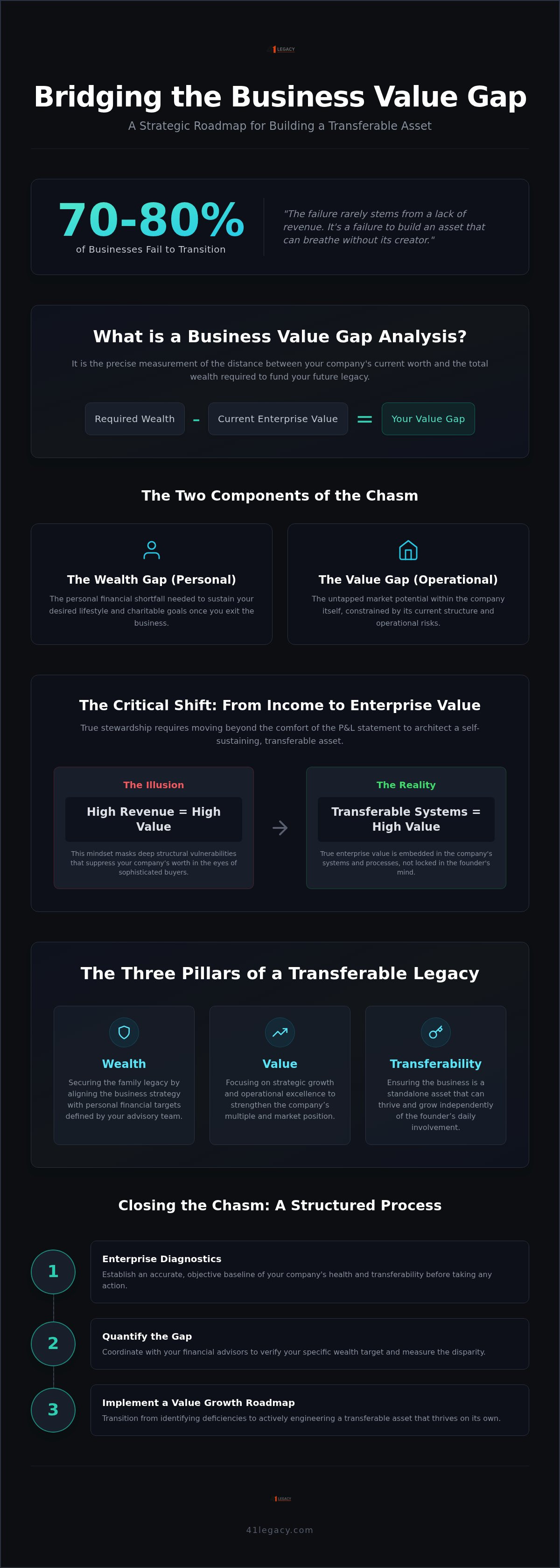
Only 20 to 30 percent of small businesses listed for sale actually transition successfully, leaving a staggering majority of founders adrift. This failure rarely stems from a lack of revenue. Instead, it's often a failure to build an asset that can breathe without its creator. You've poured your life into this enterprise, yet there's often a silent, widening chasm between what the market will pay and what your future legacy requires. Performing a rigorous business value gap analysis is the first step in honoring your history by securing your financial future.
It's natural to feel that your business is inseparable from your identity, but true stewardship means preparing it to thrive independently. We understand the weight of ensuring your life's work provides the wealth necessary for your next chapter. This article will show you how to quantify your current standing and identify the structural risks that suppress your company's worth. We'll provide a clear roadmap to reduce owner dependency and engineer a transferable asset, giving you the confidence to transition on your own terms when the time is right.
Key Takeaways
- Quantify the disparity between your current enterprise value and the financial requirements of your future legacy through a structured business value gap analysis.
- Distinguish between the personal Wealth Gap and the operational Value Gap to understand how market potential aligns with your unique financial goals.
- Identify "invisible risks," such as owner dependency and customer concentration, that act as silent anchors on your company’s valuation in the eyes of sophisticated buyers.
- Utilize Enterprise Diagnostics to establish an accurate baseline of your company's health before coordinating with financial advisors to verify your specific wealth target.
- Implement a Value Growth Roadmap to transition from identifying deficiencies to actively engineering a transferable asset that thrives independently of your daily involvement.
What is a Business Value Gap Analysis? Defining the Strategic Chasm
A business is more than a ledger of transactions; it's a living testament to a founder's vision and a repository of years of dedication. Yet, for many, a silent deficiency exists between their current reality and their ultimate aspirations. A business value gap analysis serves as the precise instrument we use to measure this distance. It's the difference between the current enterprise value and the total wealth required to fund your life after you've stepped away from the helm. This isn't merely a financial calculation. It's a fundamental assessment of whether your life's work can endure without your constant presence. We approach this as guardians of your legacy, ensuring that the essence of what you've built is preserved through a successful transition.
The Wealth Gap vs. The Value Gap
The Wealth Gap represents the personal financial shortfall. It's the capital you lack to sustain your desired lifestyle and charitable goals once the business paycheck stops. This number is deeply personal, rooted in your vision for the future. In contrast, the Value Gap measures the untapped potential within the company itself. It asks what the market would pay for your current structure versus what it could pay if the business were perfectly optimized for transferability. These figures rarely align by chance. Most owners find their wealth goals are tethered to a business that, while profitable, lacks the structural integrity to command a premium. A foundational Gap analysis reveals that high revenue doesn't always translate to high value. Without intentional planning, the chasm between what you have and what you need remains unbridgeable.
The Philosophical Shift: From Income to Enterprise Value
True stewardship requires moving beyond the surface-level comfort of the P&L statement. Many owners mistake healthy cash flow for a healthy asset. This is a dangerous illusion. High revenue often masks deep structural vulnerabilities, such as extreme owner dependency or customer concentration. We view the business as a transferable asset rather than just a source of personal income. This requires a profound philosophical shift. You must stop seeing yourself as the primary engine and start seeing yourself as the architect of a self-sustaining system. To uncover these hidden fissures, we utilize enterprise diagnostics. This process moves past the numbers to examine the "essence" of the organization. It identifies whether the value is locked in the founder's mind or embedded in the company's systems. Only when the value is transferable does the gap begin to close. By performing a business value gap analysis, you transition from a simple operator to a master builder of enterprise value.
The Three Pillars of the Value Gap: Wealth, Value, and Transferability
A comprehensive business value gap analysis rests upon three distinct yet interwoven pillars. If one is neglected, the entire structure of your legacy is at risk. We view these pillars through the lens of a master artisan, where precision in one area enhances the beauty and strength of the whole. The Wealth Pillar ensures your family's future is secure. The Value Pillar focuses on the strategic growth that drives your company's multiple. Finally, the Transferability Pillar ensures the business can exist as a standalone entity, independent of your daily touch. These three pillars form the core of a thorough exit readiness assessment.
The Wealth Pillar: Securing the Family Legacy
Many founders operate under a cloud of anxiety because they've only "guessed" their exit number. This lack of clarity is the primary driver of owner stress. We act as a coordinator for your personal team of advisors, ensuring your business strategy aligns with the targets set by your wealth managers. While we don't provide investment advice, we ensure the business value you're building is capable of meeting those specific personal requirements. This alignment is a critical component of any guide to gap analysis, as it grounds abstract business numbers in real-world personal security. If you're ready to see where your pillars stand, consider beginning with our Enterprise Diagnostics to reveal your current baseline.
The Value Pillar is about more than revenue; it's about the quality of that revenue. Sophisticated buyers look for strategic growth that suggests future scalability. By focusing on high-margin offerings and sustainable market positioning, you maximize the "multiple" applied to your earnings. This isn't just about making the business bigger. It's about making it more valuable in the eyes of those who value excellence and long-term stability.
The Transferability Pillar: Reducing Owner Dependency
The most common risk found in a business value gap analysis is the "Rainmaker Trap." This occurs when the founder is the sole driver of sales, culture, and strategy. If the business cannot breathe without you, it's a job, not an asset. Implementing owner dependency reduction is essential to closing the gap. We guide you in the creation of robust SOPs, which serve as the blueprint for a company that thrives on its own. By addressing these factors with surgical precision, you transform your company into a masterpiece of transferability that outlasts your daily involvement.
Identifying the Invisible Risks: Why Your Valuation Might Be a Mirage
A valuation on paper is often a fragile portrait, captured in a moment of stillness that may not reflect the turbulence of reality. For the business owner, what appears to be a robust figure can quickly dissolve into a mirage when subjected to the scrutiny of a sophisticated buyer. These professionals don't just look at the current yield; they search for "Value Detractors" that act as structural anchors. A business value gap analysis is designed to illuminate these invisible risks before they derail a transition. We find that while owners often focus on "Value Drivers" like revenue growth, buyers are more concerned with customer concentration and key-man risk. If a single client represents a large portion of your income, the foundation is not solid; it is precarious.
To bridge this divide, a certified exit planning advisor acts as a curatorial expert, identifying the flaws that an owner’s pride might overlook. This diagnostic rigor is essential to drive strategic change within the organization. By quantifying these risks, we move from subjective optimism to technical precision, ensuring the enterprise's essence is protected from market volatility. A thorough business value gap analysis provides the technical clarity needed to transform a mirage into a tangible, transferable asset.
The Hidden Weight of Owner Dependency
Strategic capacity is the measure of whether your company can scale, or even survive, without your constant intervention. We often utilize the "Vacation Test" as a visceral diagnostic tool. If the business falters during a three-week absence, it lacks its own "immune system." We view the company as a living entity that must possess the internal strength to heal and grow independently of its founder. Reducing this dependency is the most effective way to close the gap identified in your analysis. It's about moving from being the engine of the business to being its architect.
Market Attractiveness vs. Internal Readiness
There's a vital distinction between a business that is saleable and one that is truly transferable. A thriving market may make a business saleable, but only internal readiness makes it transferable at a premium multiple. A great market cannot save a company with hollowed-out systems or a lack of middle management. We use the process of determining enterprise value to benchmark your readiness against industry standards. This ensures that when you choose to step away, you're handing over a masterpiece of engineering, not a burden that will crumble under new stewardship.
The 5-Step Diagnostic Process to Quantify Your Gap
Quantifying the distance between your company's current standing and your ultimate legacy is a technical endeavor that demands a structured approach. A business value gap analysis is not a mere estimate; it's an exacting diagnostic process that moves through five distinct phases. We begin with Enterprise Diagnostics to assess the baseline, followed by Financial Alignment to verify your "Wealth Gap" with your financial team. We then identify the root causes of value suppression, such as a lack of documented systems or excessive owner dependency. From there, we develop a strategic roadmap for Transferability Engineering and engage in Monthly Implementation. This steady, rhythmic progress mirrors the work of a master artisan refining a masterpiece until it's ready for its next steward.
Step 1 & 2: The Baseline Assessment
You can't close a gap that hasn't been measured with surgical precision. During the diagnostic phase, we act as a Guardian of History. We approach your data with reverence, understanding that every number represents years of dedication and sacrifice. Our process is designed to gather essential insights without overwhelming you, ensuring we establish a baseline that's both accurate and respectful of the work you've already completed. By coordinating with your CPA to verify the "Wealth Gap" number, we ensure that your business strategy is grounded in the reality of your personal financial needs.
The "Quarterback" Advantage in Closing the Gap
A common failure in transition planning is the lack of coordination between professional advisors. CPAs, attorneys, and wealth managers often work in silos, focusing on their specific technical disciplines without a shared vision. We serve as the "quarterback" for your existing team, ensuring their collective expertise aligns with your long term goals. Without this strategic lead, a tax decision or a legal document might accidentally widen the value gap by hindering the company's transferability. We ensure every professional is moving in harmony, protecting the enterprise's health while preparing it for a successful future transition.
If you're ready to move beyond guesswork and begin this diagnostic journey, our Enterprise Diagnostics provide the clarity needed to establish your baseline and start engineering your legacy.
Closing the Chasm: Implementing the Value Growth Roadmap
The diagnostic phase is complete. Every structural deficiency and hidden risk has been cataloged with the technical precision of a master artisan. Transitioning from the clinical observations of a business value gap analysis to the active implementation of a growth strategy requires a shift in perspective from observer to architect. Closing the chasm requires more than intent; it demands the steady hand of strategic advisory to ensure the roadmap is followed to its conclusion. We view the business not as a transaction to be closed, but as a legacy to be protected, ensuring that the essence of what you've built remains intact through the transition.
Owner dependency reduction serves as the primary lever in this transformative stage. By systematically decoupling your personal identity from the company's operational engine, you increase the enterprise's strategic capacity. This isn't merely about efficiency. It's about building a living entity capable of self-sustenance. As you implement these changes, you're no longer just managing a source of income; you're refining a transferable asset that commands respect in a competitive market.
The Roadmap to Transferability
Success begins with prioritizing the "low-hanging fruit," those immediate structural improvements that yield the highest impact on value. This might involve formalizing key contracts or diversifying a concentrated customer base. Maintaining momentum in these efforts is often the greatest challenge for a busy founder. Our monthly implementation support provides the unhurried, rhythmic progress necessary to keep the project on track. The goal is to build a business that thrives independently of the founder, allowing the organization to breathe and grow based on its own internal strength rather than your daily exertion.
The Final Goal: A Successful Legacy Transfer
Defining success goes far beyond the final purchase price. True success is the peace of mind that comes from knowing the value gap is closed and your family's future is secure. It's the quiet confidence of a steward who has prepared their masterpiece for its next chapter. When the structural risks are mitigated and the wealth targets are met, the transition becomes a celebration of achievement rather than a source of anxiety. You've honored your history by building something that lasts. If you're ready to begin this journey of preservation and growth, start your Enterprise Diagnostic with 41 Legacy today and discover the path to a lasting legacy.
Securing the Future of Your Lifelong Masterpiece
Your business is a testament to your vision, but its ultimate value depends on its ability to exist apart from you. By conducting a rigorous business value gap analysis, you move from the uncertainty of guesswork to the technical precision of a master builder. You've learned that identifying invisible risks and reducing owner dependency are the vital levers that transform a profitable company into a transferable asset. This process isn't just about an eventual transition; it's about the stewardship of your history and the preservation of your essence.
Our Certified Exit Planning Advisor (CEPA) led process ensures your strategy is grounded in expert diagnostic rigor. We serve as the strategic quarterback for your advisory team, utilizing comprehensive Enterprise Diagnostics to ensure every professional decision aligns with your long-term wealth goals. You've built something remarkable. Now is the time to ensure it endures. Begin Your Journey to Exit Readiness with 41 Legacy. Your legacy deserves a foundation as strong as the vision that created it.
Frequently Asked Questions
What is the difference between a business valuation and a value gap analysis?
A valuation provides a technical snapshot of current worth, while a business value gap analysis identifies the distance between that worth and the founder's ultimate wealth requirements. A standard valuation is retrospective, focusing on past performance. The gap analysis is a strategic, forward-looking diagnostic tool. It uncovers structural deficiencies and invisible risks that prevent the business from reaching its full potential as a transferable asset for future stewards.
How long does it typically take to close a significant business value gap?
Closing a substantial gap usually requires eighteen to thirty-six months of intentional work. This duration allows for the unhurried refinement of systems and the reduction of owner dependency. It isn't a quick fix but a rhythmic process of engineering transferability. The timeline depends on the complexity of the invisible risks identified during the diagnostic phase and the owner's commitment to implementing a Value Growth Roadmap.
Can a business be profitable but still have a large value gap?
Yes, profitability often masks a significant value gap if the company's success is entirely dependent on the founder. A business generating high cash flow can still be unsellable if it lacks documented systems or middle management. Buyers discount the value of profitable firms that present high key-man risk. In these cases, the gap exists because the income isn't transferable to a new steward without the current owner's presence.
Why do most business owners fail to close the value gap before they exit?
Most owners fail because they lack strategic clarity and wait too long to begin the diagnostic process. Many founders are consumed by daily operations, leaving little room for the long-term engineering of enterprise value. Without a structured roadmap, they remain in the Rainmaker Trap, where their personal involvement is the primary value driver. This lack of preparation leads to failed transitions or significant discounts during the sale process.
What role does a CPA play in a business value gap analysis?
A CPA provides the essential financial data needed to verify the Wealth Gap number. They ensure that the financial baseline is accurate and help coordinate the owner's personal tax considerations with the business's growth strategy. We act as a quarterback for the owner's advisory team, ensuring the CPA's technical precision aligns with the broader strategic goals of increasing transferability and reducing operational risk factors.
How does reducing owner dependency directly impact the value gap?
Reducing owner dependency increases the company's multiple by proving the business can thrive as a standalone entity. When a founder is no longer the sole engine of sales and strategy, the risk for a new owner drops significantly. This shift transforms a job into a transferable asset. By empowering a management team and formalizing systems, you close the gap between current worth and the premium value sophisticated buyers pay for stability.
Is a value gap analysis necessary if I plan to pass the business to my children?
It's essential for internal transitions to ensure the next generation inherits a healthy, sustainable asset rather than a burden. A business value gap analysis identifies whether the company can support your retirement needs while remaining viable for your heirs. Without this diagnostic rigor, you risk passing on an enterprise that is too dependent on your unique skills, potentially jeopardizing both your legacy and your children's future success.
What is the first step in conducting an enterprise diagnostic?
The first step is a comprehensive baseline assessment of the company's internal health and strategic capacity. We examine the essence of the organization beyond the balance sheet to identify structural weaknesses and invisible risks. This phase requires a deep dive into your systems, management structure, and customer concentration. Establishing this clear starting point allows us to create a precise Value Growth Roadmap tailored to your specific legacy goals.

Article by
Mike Laskowski
Mike Laskowski is a Business Value Growth Strategist who helps business owners uncover the truths that drive their performance, risk, and readiness. Blending forensic interviewing from a 26‑year federal career with Strategic Capacity analysis and CEPA methodology, he works upstream to reduce owner dependency, increase transferability, and strengthen enterprise value. Mike guides founders through clarity, operational evolution, and transition readiness so their companies become transferable, owner‑independent assets that endure beyond the founder.
Disclaimer
This article is for educational and informational purposes only and does not provide legal, tax, investment, or business brokerage advice. 41 Legacy does not offer M&A brokerage services, legal document drafting, tax preparation, or investment advisory services. Business owners should consult licensed professionals in those disciplines before making decisions related to business transactions, legal matters, tax strategy, or financial planning. All examples are illustrative and may not apply to your specific situation.