The Bar Your Buyer Sets
The Bar Your Buyer Sets
And the two ways to clear it
Before you read
Most owners who want a more valuable business reach for the same answer: grow. More revenue, more customers, more trucks. Sometimes that is right. Often it is not, because a buyer does not pay for growth on its own. A buyer pays for earnings, discounted by how risky those earnings look. Risk is what a buyer actually evaluates, and growth that adds risk can leave a business worth less than when it started.
This article introduces the 41 Legacy Buyer's Bar Method, a way to choose between the two levers every owner really has: grow, or take risk out. It stands on two traditions, and both deserve credit.
The math comes from corporate finance and private equity. The principle that growth creates value only when the next dollar earns more than the return investors require is the backbone of McKinsey's work on valuation and of how private equity firms decide where capital goes. The discipline of working one bottleneck at a time comes from Eliyahu Goldratt's Theory of Constraints.
The behavior comes from Growth Drive. Growth Drive's Clarity platform assesses how a business actually operates across 24 Growth-Driving Objectives, from leadership and processes to customer base and brand, and measures the result as Strategic Capacity, with a dollar value on what each gap is costing the owner. That is what makes risk measurable instead of a gut feeling, and it is the other half of this method.
Traditional valuation tells you what a business earns and what a buyer will demand for it. Clarity tells you why a buyer will demand it, and what would change their mind. The Buyer's Bar Method puts the two side by side so an owner can see the best path forward in dollars.
The question behind the question
Picture a service business with an 80% gross margin that still breaks even. The fixed costs eat everything. On paper it is worth almost nothing, and the standard advice is predictable: stop growing, fix your returns first.
That advice is often exactly backwards.
The trucks, the office, the crew lead and the software are already paid for. The next customer does not need any of them. Most of what that customer pays drops straight to profit. For this business, growth is not the risk. Growth is the cheapest way to build value it has.
The standard advice looks at what the business has earned on average, across every dollar ever put into it. The better question is what the next dollar will earn, and whether that is more than a buyer would demand. Those two can point in opposite directions, and when they do, the usual answer is the wrong one.
The bar your buyer sets
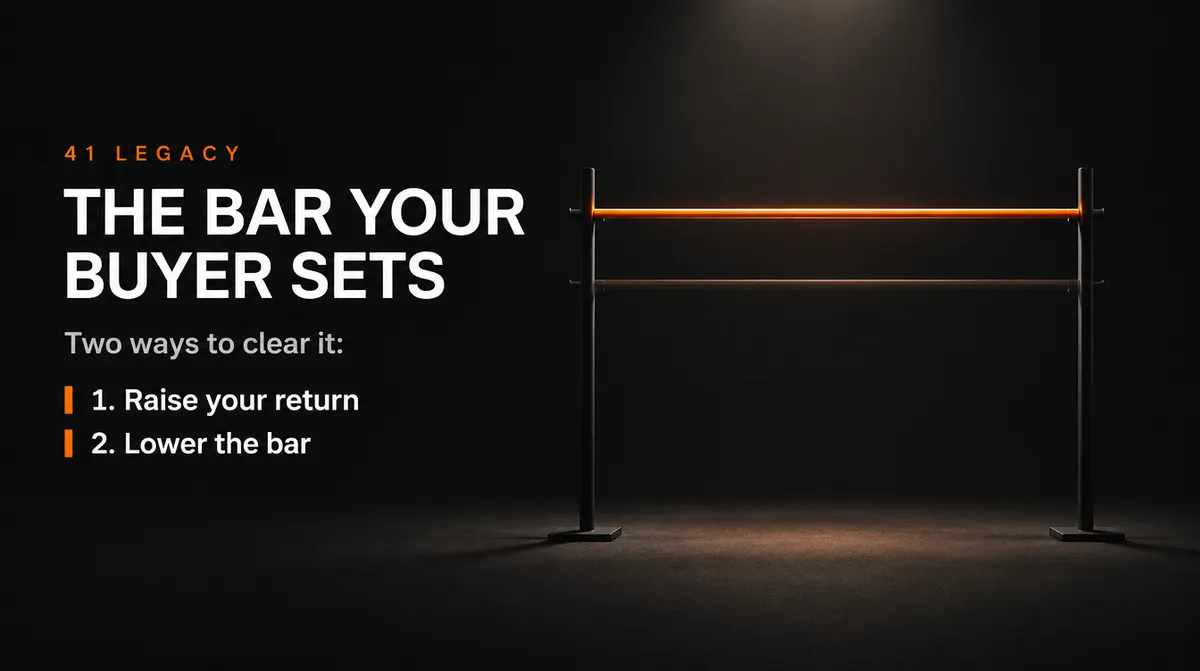
Every buyer looks at your business and asks one question: what return do I need to make this worth the risk? A clean, owner-independent business with steady customers clears a low bar. A business that runs through its owner, with one big customer and loose books, has to clear a high one. The higher the bar, the less a buyer will pay for the same profit.
We call that number the Buyer's Bar. It is the standard your business is measured against, whether you plan to sell next year or never.
There are only two ways to clear a bar:
Raise your return.Grow, when the next dollar you invest earns more than the bar.
Lower the bar.Take risk out, so a buyer demands less and pays more for the profit you already have.
Most owners only think about the first. The second is often faster and cheaper, and it makes the first one safer. The real question is never "should we grow?" It is "which of these two moves creates more value right now?"
Three ideas that change the answer
1. Judge the next dollar, not the average one.Your history is the average of every decision you have ever made. Your next move is a new decision. A business with empty capacity can earn far more on its next dollar than its history suggests. A business in a saturated market can earn far less, even if its history looks great. We look at both, side by side, against the same bar. When they disagree, that is where the conventional answer goes wrong.
2. Speed has a price.Getting bigger makes a business less risky: fewer eggs in one customer's basket, a bigger pool of buyers. Growing too fast makes it riskier: the owner gets stretched, quality slips, cash gets tight, new hires are not ready. So there is a right pace for every business, and it depends on how the business actually runs, not just its numbers. Strong systems and a real management team let you grow faster without raising the bar.
3. One thing at a time. At any moment, one constraint is holding the business back. Sometimes it is a deal-breaker a buyer would walk away from, like one customer at half of revenue or books nobody can verify. Sometimes it is the one thing that caps how fast you can grow, like an owner who closes every sale. Fixing anything else first spends money without moving value.
What it looks like in practice
It is a rhythm, not a one-time verdict.Lower the bar until clearing it is easy. Grow at the pace the business can carry. Re-check, because growth itself moves the bar. Then repeat.
We pair two kinds of evidence. The math comes from your financials: what the business earns today, and what the next dollar would earn. The behavior comes from Growth Drive's Clarity assessment, which scores how the business actually operates across its 24 Growth-Driving Objectives and puts a value on what each gap is costing you. Clarity is what turns "the business depends too much on me" from a feeling into a number a buyer would recognize. Math and behavior, priced together.
What you get is not a grade. It is a decision with dollar figures attached: what growing is worth, what de-risking is worth, which to do first, and how fast to go. Every number comes with a range, because the point is to make better decisions, not to pretend the future is certain.
Questions worth asking about your own business:
If I put one more dollar into growth, what would it actually earn?
Is that more or less than what a buyer would demand from a business like mine?
What is the one thing a buyer would worry about most, and what would fixing it be worth?
How fast can we grow before something breaks?
For advisors and centers of influence
If you advise owners as a CPA, attorney, wealth advisor, banker or broker, you have seen both mistakes: the owner who pours money into growth that dilutes value, and the owner who sits still when growth was the cheapest path to a better exit. The Buyer's Bar Method gives you and your client a shared language for that decision, grounded in the same return-on-new-capital logic used in corporate finance and applied to the price a real buyer would pay for this business, with Growth Drive's Clarity supplying the behavioral evidence most valuation work leaves out.
It is built to sit alongside your work, not replace it. It does not value a business for a transaction or give tax or legal advice. It tells an owner which lever to pull next and what it is worth.
The bottom line
Your business is always being measured against a bar, whether or not you plan to sell. You can clear it by earning more on the next dollar, or by lowering it. Knowing which one to do first, and how fast, is worth more than either one done at the wrong time.
Mike Laskowski is Strategic and Architectural Partner at 41 Legacy, where he helps owners build businesses that are worth more and depend on them less. The Buyer's Bar Method is a methodology of 41 Legacy. Clarity, Strategic Capacity and the Growth-Driving Objectives are part of Growth Drive's platform.

