The Art of Transferability: Reducing Owner Dependency to Build a Lasting Legacy
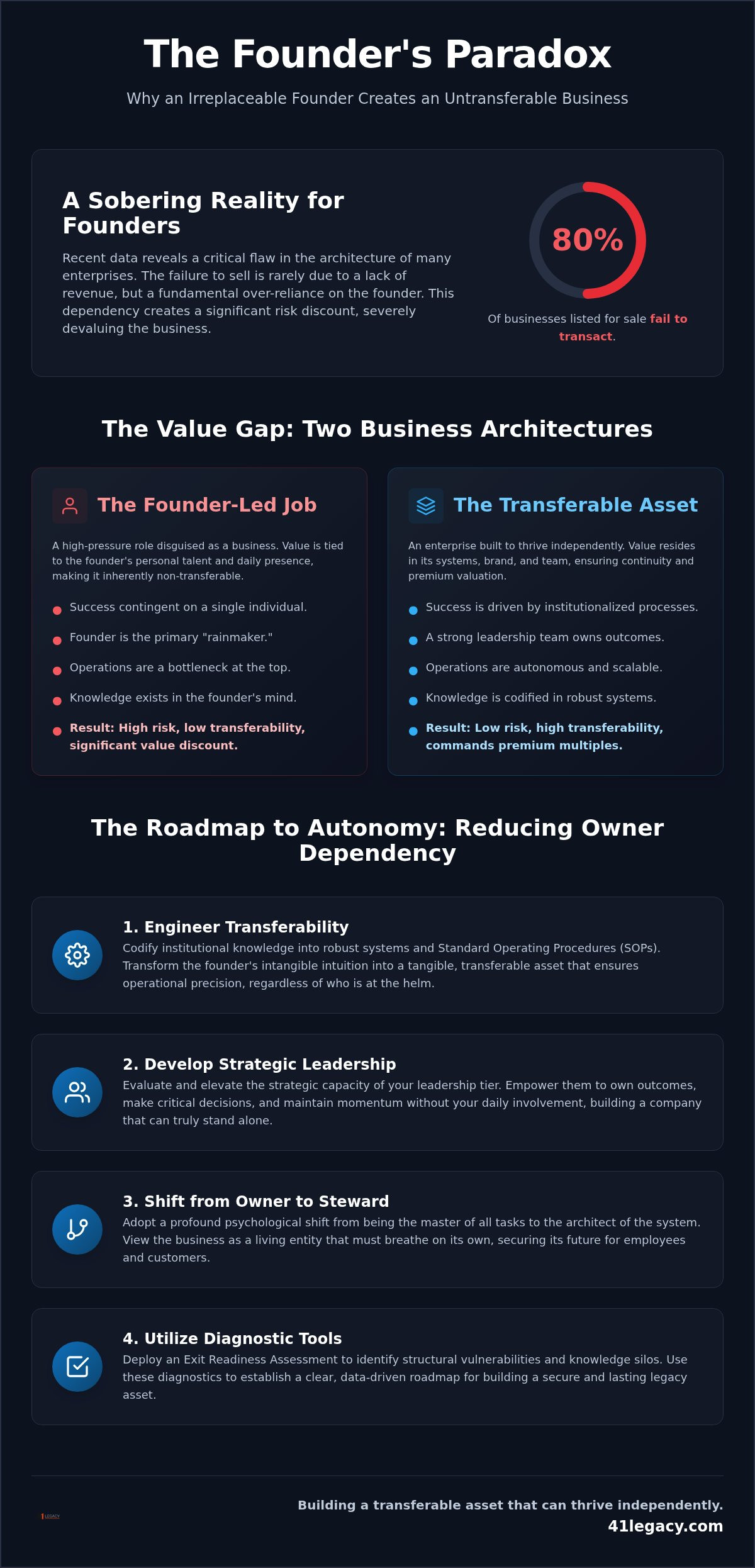
Recent data from 2026 reveals a sobering reality for the modern founder: nearly 80% of businesses listed for sale fail to ever reach a transaction. This failure rarely stems from a lack of revenue. Instead, it points to a fundamental flaw in the architecture of the enterprise itself. When a business relies entirely on the founder's personal relationships and daily intuition, it remains a high-pressure job rather than a transferable asset. True mastery in leadership requires a deliberate shift toward reducing owner dependency, ensuring the soul of the organization is preserved within its systems rather than its personalities.
You likely recognize the weight of being the sole engine of your company's progress. It's a burden that leads to operational bottlenecks and a persistent sense of burnout. This article will show you how to transform your business into a high-value enterprise that qualifies as a legacy asset. We'll examine the strategic clarity needed to engineer transferability, moving from a founder-led model to a structured organization that commands premium multiples and offers you the freedom you've earned.
Key Takeaways
- Understand why an irreplaceable founder creates a risk discount, devaluing the enterprise by making success contingent on a single individual.
- Learn to codify institutional knowledge into robust systems that act as the organization's DNA, ensuring the essence of the work survives the transition.
- Discover the methodology for reducing owner dependency to bridge the Value Gap and transform a founder-led job into a high-value transferable asset.
- Evaluate the strategic capacity of your leadership tier to ensure they are prepared to own outcomes and maintain momentum without your daily involvement.
- Utilize an Exit Readiness Assessment as a diagnostic tool to identify structural vulnerabilities and establish a roadmap for a secure, lasting legacy.
The Paradox of the Irreplaceable Founder: Why Your Presence Devalues the Asset
The founder's greatest triumph often becomes their most significant liability. In the early stages of an enterprise, your singular vision and tireless energy are the primary drivers of success. However, as the organization matures, the very qualities that sparked growth can become the anchors that prevent a successful transition. This is the paradox of the irreplaceable founder: the more the business relies on your daily presence, the less it is worth to a successor. A business that cannot function without its creator is not an asset; it is a high-pressure job with significant overhead.
Sophisticated investors distinguish sharply between a personal practice and a transferable enterprise asset. If you are the primary "rainmaker" responsible for the majority of sales and client relationships, you haven't yet built a company that can stand alone. When you depart, the revenue likely departs with you. This reliance on personal goodwill is a testament to your individual talent, but it is inherently non-transferable. True value is found in enterprise goodwill, which consists of the institutionalized trust and repeatable systems that remain when you are no longer in the room.
The Invisible Ceiling of Founder-Led Growth
The technical skills required to build a business to its first million dollars are rarely the same strategic skills needed to scale to ten million and beyond. At a certain threshold, the founder becomes an operational bottleneck. Every decision, from minor expenditures to strategic pivots, requires your personal approval. This creates a state of fragility that buyers find deeply unattractive. Moving toward reducing owner dependency is not merely an operational choice; it is a fundamental requirement for unlocking the next stage of growth. By removing yourself as the sole point of failure, you increase the business's resilience and its appeal to those who value stability over individual heroics.
The Legacy Perspective: From Owner to Steward
True mastery in business ownership is measured by the organization’s performance in your absence. This requires a profound psychological shift from being the master of all tasks to becoming the architect of systems. You must begin to view the business as a living entity that must eventually breathe on its own. This perspective honors your moral obligation to the employees and customers who rely on the brand's continuity long after your tenure ends. Effective Succession planning is the ultimate expression of this stewardship. By codifying your expertise into repeatable processes, you transform the business into a legacy asset. At 41 Legacy, we believe that reducing owner dependency is the most critical step in preserving the essence of what you have built for the generations to follow.
Engineering Transferability: Building Systems That Outlast the Individual
Transferability is the measure of an enterprise’s ability to function with surgical precision in the absence of its founder. It is the ultimate expression of business health. While many view systematization as a pre-sale chore, we see it as the fundamental architecture of a lasting legacy. To engineer transferability is to weave the founder’s wisdom into the very fabric of the organization, ensuring that the essence of the craft remains even when the craftsman steps away. It is the transition from a person-centric model to a process-centric asset.
At the heart of this endeavor lie Standard Operating Procedures, which serve as the DNA of the enterprise. These are not mere binders gathering dust; they are living blueprints that codify every vital movement of the business. By reducing owner dependency through these rigorous frameworks, you transform intangible intuition into a tangible, transferable asset. This process moves beyond simple documentation into the realm of Transferability Engineering, where every workflow is designed for continuity and resilience, regardless of who holds the reins.
The Architecture of Autonomous Operations
True autonomy begins with the identification of mission-critical tasks that currently exist only within the founder’s mind. These "knowledge silos" represent significant risk to any successor. Through a structured process of Enterprise Diagnostics, we pinpoint these single points of failure and redistribute that intelligence across the team. This creates a culture of accountability where systems manage the process. When the team owns outcomes rather than just tasks, the business achieves a state of strategic capacity that allows it to thrive independently of your daily involvement.
Technology as a Force Multiplier
Sophisticated technology acts as the nervous system of a transferable enterprise. By implementing integrated platforms that offer real-time data, you eliminate the "knowledge tax", which is the wasted time and energy spent retrieving information that should be readily available. A scalable tech stack is not just a tool for efficiency; it's a high-value feature that attracts sophisticated successors by demonstrating operational maturity. Establishing a Value Growth Roadmap ensures that your technological investments directly support the goal of reducing owner dependency while maximizing the long-term health of the enterprise.
Quantifying the Cost of Dependency: The Enterprise Value Perspective
Enterprise value is never a static figure; it is a dynamic reflection of perceived risk. For the founder, the business represents a lifetime of craftsmanship, yet a sophisticated buyer views the same entity through the lens of continuity. When a business is tethered to its creator, it carries a heavy burden of key person risk. This risk manifests as a direct reduction in the EBITDA multiple, often slashing the potential sale price by half or more. The pursuit of reducing owner dependency is, therefore, the most effective way to protect the equity you've spent decades building.
A profitable business can still be unsellable if its success is non-transferable. Buyers aren't just looking for past performance; they're purchasing future cash flows. If those cash flows are contingent on your personal relationships or unique technical expertise, the asset is considered fragile. To maximize value, you must move beyond the role of the operator and become the architect of a self-sustaining engine. This shift ensures that the enterprise’s worth is anchored in its systems rather than your individual presence.
The Mathematics of Risk and Reward
Consider two companies with identical revenues. The first operates through a decentralized leadership tier and robust systems, while the second requires the founder’s approval for every strategic pivot. The system-driven enterprise commands a premium multiple because its future cash flows are predictable and transferable. In contrast, the owner-driven company faces a risk discount that reflects the uncertainty of its survival post-transition. Customer concentration and owner dependency often act as twin anchors, dragging down valuation regardless of current profitability. The Value Gap is the financial manifestation of operational risk, representing the difference between what your business is worth today and what it could be worth if it functioned independently of your daily presence.
The Exit Readiness Assessment: A Financial Reality Check
Waiting until you're ready to transition is a strategic error that often leads to a failed transaction. By the time you reach the negotiating table, your structural dependencies are already baked into the buyer's offer. Utilizing a proactive Exit Readiness Assessment allows you to identify these vulnerabilities with surgical precision. This diagnostic process serves as a reality check, revealing the Value Gap before it becomes a permanent loss. At 41 Legacy, we use these insights to create a roadmap for reducing owner dependency, ensuring that when the time comes to step away, you're transferring a high-performance asset rather than a fragile liability. True stewardship means preparing the business to thrive long after the founder’s signature is no longer required on the checks.
The Roadmap to Autonomy: Strategic Capacity and Team Alignment
The architecture of a transferable asset is incomplete without a leadership tier capable of sustaining its momentum. While systems provide the blueprints, your team serves as the vital essence that executes the vision. Evaluating strategic capacity is the deliberate process of determining if your internal talent possesses the bandwidth and sophistication to lead in your absence. True autonomy requires a transition from command and control management to strategic stewardship. This shift is essential for reducing owner dependency, as it ensures the enterprise can navigate complexities without the founder’s constant intervention.
Mastery in ownership means building a business that thrives on your vision but survives without your presence. It's the difference between a collection of employees and a cohesive unit of specialists. When the team is aligned with the enterprise's core philosophy, the business becomes a self-governing entity. This alignment is the ultimate safeguard for your legacy, protecting the impact you've made on your industry and community.
Empowering the Next Generation of Leadership
Developing a leadership tier means cultivating individuals who own outcomes rather than just tasks. You must identify internal talent early, ensuring they are incentivized to remain with the organization through and after a transition. This involves creating a trajectory that aligns their personal growth with the enterprise’s long-term health. By empowering them to make high-level decisions, you fill the Value Gap with human capital. This transforms a fragile, founder-centric operation into a resilient organization that commands respect from sophisticated successors.
The Coordinated Advisory Approach
A successful transition is rarely the result of a single advisor’s efforts. It requires the synchronized expertise of your CPA, attorney, and wealth manager. Without a central point of coordination, these professionals often operate in silos, providing advice that may conflict with your ultimate exit goals. We utilize a "quarterback" model to align these various disciplines toward a singular objective: maximizing transferable enterprise value. This ensures that legal structures, tax strategies, and financial plans work in harmony rather than at cross-purposes.
To overcome the "operational gravity" that pulls founders back into daily minutiae, monthly implementation support is vital. It provides the structured accountability needed to maintain focus on high-level strategic goals while the business continues its daily cycles. By consistently reinforcing the systems and leadership behaviors established during the diagnostic phase, you solidify the foundation of your legacy. If you're ready to evaluate your team's readiness and begin the transition toward autonomy, we invite you to explore our Strategic Capacity Evaluation to map your path forward.
Securing Your Legacy: The Exit Readiness Assessment as a Diagnostic Tool
The final stage of ownership is not merely an exit; it is a transformation. It is the moment the founder evolves into the chairman, shifting from the frantic pace of the operator to the calm, strategic oversight of a steward. This evolution is only possible through reducing owner dependency to the point where the business possesses its own pulse and purpose. An Exit Readiness Assessment serves as the ultimate stress test for this transition, exposing the structural weaknesses that could compromise your legacy before they become insurmountable.
Enterprise Diagnostics offer a surgical look at the organization's health. We don't merely look at the balance sheet. Instead, we examine the intricate workflows and leadership dynamics that define the business's daily life. This process maps a path to freedom, ensuring that the essence of your life's work is preserved within a resilient, transferable structure. Meticulous planning is the only way to protect the impact you've built, turning a lifetime of effort into a masterpiece that endures.
Your Value Growth Roadmap
A structured assessment provides more than just data; it delivers strategic clarity. By identifying the Value Gap and the specific operational risks holding the enterprise back, we create a bespoke Value Growth Roadmap. This document serves as an authoritative guide, outlining the precise steps needed to strengthen transferability and reduce risk. It replaces the anxiety of uncertainty with a calm, methodical approach to business building. Taking this first step ensures that your enterprise is viewed as a high-performance asset rather than a founder-dependent liability.
A Call to Stewardship
Building a business that no longer requires your presence is the greatest gift you can leave to your employees, your customers, and your family. It represents the rare intersection of technical precision and artistic vision. When you engineer a company to thrive independently, you've achieved the highest level of mastery. You're no longer just a service provider. You're a guardian of a legacy. Reducing owner dependency is the final brushstroke on the canvas of your career. We invite you to begin your journey toward enterprise transferability with 41 Legacy. Together, we can ensure your life’s work remains a vibrant, living entity for generations to come.
The Architect’s Final Stroke: From Operator to Steward
Engineering a business that thrives in your absence is the ultimate expression of professional mastery. It requires a transition from the daily friction of operations to the strategic clarity of stewardship. By reducing owner dependency, you transform a fragile, founder-led organization into a resilient enterprise asset that commands respect and premium value. This process ensures the essence of your life's work is preserved through rigorous systems and a leadership tier prepared to own outcomes.
The path toward this autonomy begins with a deliberate assessment of your current structural health. Our Certified Exit Planning Advisor (CEPA) leadership provides the proprietary Enterprise Diagnostics and Value Growth Roadmaps necessary to navigate this complex transition. We serve as the quarterback for your legal and financial team, ensuring every professional insight aligns with the singular goal of maximizing transferable value. It's time to move beyond the operational bottleneck and claim the freedom you've earned.
Secure your legacy and build a transferable asset with 41 Legacy. Your business is more than a job; it's a masterpiece waiting to be completed.
Frequently Asked Questions
What is owner dependency and why does it matter for my business valuation?
Owner dependency refers to the structural reliance of an enterprise on the founder’s personal relationships, technical skill, or daily decision-making. It is a critical valuation metric because it represents significant key-person risk to any potential successor. When a business cannot breathe on its own, buyers apply a sharp risk discount to the EBITDA multiple. This effectively lowers the final price to account for the inherent uncertainty of the transition.
How can I tell if my business is too dependent on me?
The most effective diagnostic is the "vacation test," which measures if the business can sustain its momentum during your total absence. If your phone rings with operational questions or if strategic progress halts when you step away, the dependency is dangerously high. You should also look for "knowledge silos" where vital information exists only in your mind rather than in a shared, accessible system.
What are the first steps to reducing owner dependency?
The journey begins with an Exit Readiness Assessment to pinpoint exactly where your presence is most critical. Once these bottlenecks are identified, you must begin the process of reducing owner dependency by codifying your intuition into repeatable Standard Operating Procedures. This allows your team to own outcomes rather than just tasks, moving the business from a founder-led model toward a system-driven, transferable asset.
Can a business be sold if the owner is still heavily involved in sales?
While a sale remains possible, it often involves a significantly lower valuation or a restrictive multi-year earn-out period. Buyers are purchasing future cash flows, and if you are the primary rainmaker, those cash flows are considered fragile. Transferring sales authority to a competent leadership tier is essential for proving that the company’s success is institutional rather than personal. This shift is vital for securing a premium price.
How long does it typically take to reduce owner dependency significantly?
Engineering true operational autonomy typically requires a commitment of twelve to twenty-four months of focused effort. This duration allows for the meticulous documentation of workflows and the cultivation of a leadership tier that can lead without your daily intervention. It's a time-intensive process of craftsmanship that transforms a high-pressure job into a lasting legacy asset. Rushing this transition often leaves structural vulnerabilities that sophisticated buyers will detect.
What is the role of a Certified Exit Planning Advisor (CEPA) in this process?
A CEPA serves as the strategic coordinator for your legal, tax, and financial professionals, ensuring all advice aligns with your ultimate goals. They utilize Enterprise Diagnostics to uncover the Value Gap and create a Value Growth Roadmap tailored to your specific vision. By acting as a quarterback, they ensure that every tactical move made by your advisors serves the overarching objective of building a transferable enterprise.
Does documenting SOPs really increase the value of my company?
Documented systems serve as the DNA of a high-value company, providing a successor with a clear blueprint for continued success. SOPs eliminate the "knowledge tax" and ensure that precision is maintained across the organization without your direct oversight. This operational maturity signals to buyers that the business is a stable, scalable engine. Such stability naturally commands a premium multiple in the competitive marketplace.
What happens if I try to sell a business that is owner-dependent?
Attempting to transition a dependent business often leads to a failed transaction, as nearly 80% of businesses listed for sale fail to close. If a deal does proceed, the founder often loses significant leverage, resulting in price reductions or unfavorable terms. Reducing owner dependency is the only way to ensure your life’s work is recognized as a high-value asset capable of thriving long after you step away.
Article by
Mike Laskowski
Mike Laskowski is a Business Value Growth Strategist who helps business owners uncover the truths that drive their performance, risk, and readiness. Blending forensic interviewing from a 26‑year federal career with Strategic Capacity analysis and CEPA methodology, he works upstream to reduce owner dependency, increase transferability, and strengthen enterprise value. Mike guides founders through clarity, operational evolution, and transition readiness so their companies become transferable, owner‑independent assets that endure beyond the founder.
Disclaimer
This article is for educational and informational purposes only and does not provide legal, tax, investment, or business brokerage advice. 41 Legacy does not offer M&A brokerage services, legal document drafting, tax preparation, or investment advisory services. Business owners should consult licensed professionals in those disciplines before making decisions related to business transactions, legal matters, tax strategy, or financial planning. All examples are illustrative and may not apply to your specific situation.