
The Art of Transferability: Reducing Owner Dependency Before Sale
The most valuable business is not a testament to its founder's presence, but a monument to their absence. For many entrepreneurs, the realization that they've become the bottleneck of their own creation is both a point of pride and a source of profound exhaustion. You've built a legacy with meticulous care, yet the fear remains that the enterprise might falter the moment you step away. Reducing owner dependency before sale is not merely a tactical necessity; it's the final act of stewardship that transforms a personal practice into a lasting institution.
We understand the weight of this transition and the uncertainty that comes with delegating high level decisions. You deserve a business that operates with the rhythmic precision of a fine timepiece, commanding a premium valuation because it no longer requires your constant intervention. This article provides the strategic framework to engineer true transferability and ensure your company thrives independently of its creator. We'll explore how structured diagnostics and a clear value growth roadmap can secure your freedom while preserving the essence of what you've built.
Key Takeaways
- Recognize how owner dependency serves as a structural risk that signals fragility to sophisticated buyers and erodes your ultimate enterprise value.
- Identify the invisible threads of founder reliance through a rigorous Enterprise Diagnostics process that evaluates your company's culture and decision-making autonomy.
- Implement a strategic framework for reducing owner dependency before sale by evolving your daily role from a lead operator to a visionary steward.
- Develop a structured Value Growth Roadmap that coordinates your professional advisors and engineers a business capable of thriving independently.
- Position your enterprise as a high-value, transferable asset that preserves your legacy while providing the freedom to exit on your own terms.
The Silent Devaluation: Why Owner Dependency Erodes Enterprise Value
The true worth of an enterprise is found in its ability to endure beyond the presence of its creator. When a business relies solely on the brilliance of its founder, it possesses a hidden fragility that sophisticated buyers recognize instantly. This structural risk often results in a silent devaluation. The business appears successful on the surface, but its internal architecture is hollow. By prioritizing the task of reducing owner dependency before sale, you transform a fragile practice into a robust enterprise that commands respect in the marketplace.
Many founders fall into the "Rainmaker Trap." Their unique talent, while responsible for initial growth, eventually becomes the ceiling. The business cannot outgrow the founder's personal capacity; it's limited by the hours in their day and the depth of their focus. In this state, the organization remains a lifestyle business, providing an income but lacking the structural integrity of a transferable asset. To secure a successful exit, you must bridge the Value Gap. This is the chasm between what the business is worth today and the valuation required to meet your ultimate goals.
The Buyer’s Perspective on Founder Reliance
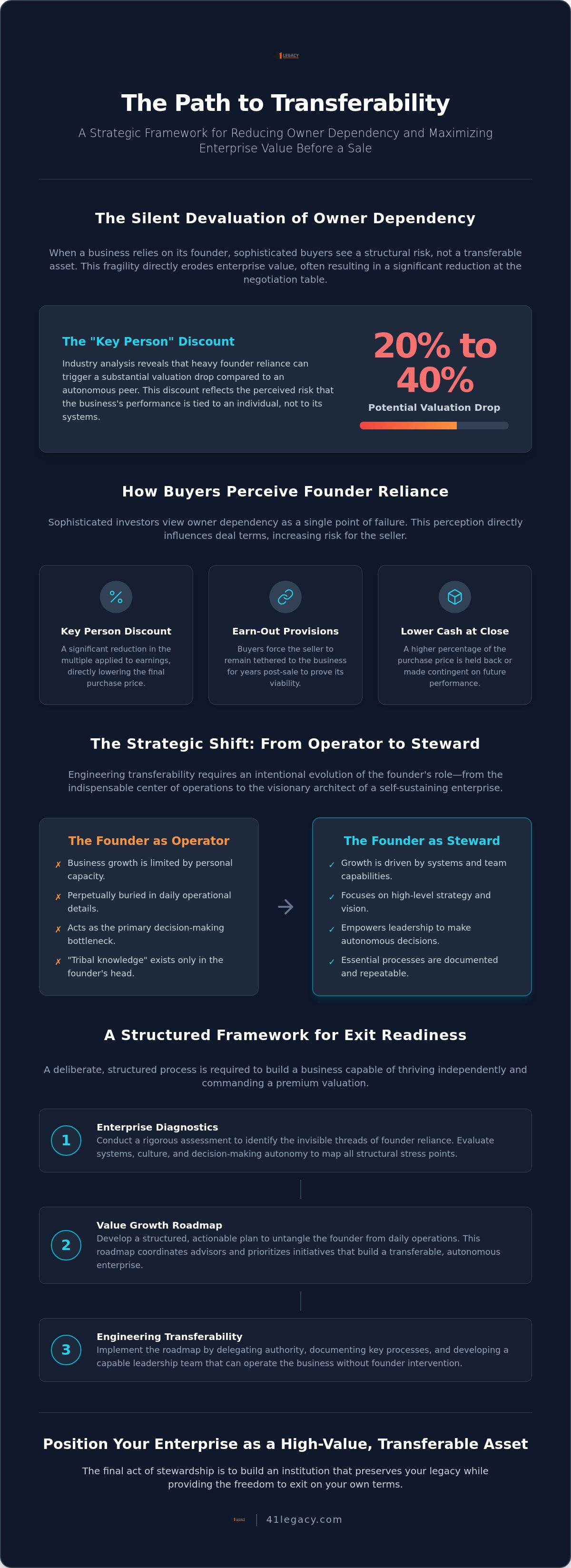
Sophisticated investors view owner dependency as a single point of failure. If the founder is the primary source of revenue or technical expertise, the acquisition carries extreme risk. Industry professionals report that this dependency can drop a valuation by 20% to 40% compared to an autonomous peer. This perception directly influences deal terms in several ways:
- The Key Person Discount: A significant reduction in the multiple applied to earnings.
- Earn-Out Provisions: Buyers force the seller to remain tethered to the business for years to prove its viability.
- Lower Cash at Close: A higher percentage of the purchase price is held back or contingent on future performance.
Effective succession planning mitigates these concerns by demonstrating that leadership and operational excellence are distributed across a capable team. At 41 Legacy, we believe that reducing owner dependency before sale is the most effective way to protect your equity and ensure a clean transition.
The Emotional Toll of Being Indispensable
Being indispensable is exhausting. It strips the founder of their strategic capacity, leaving them perpetually buried in the granular details of daily operations. There's often a lingering anxiety that the business will crumble without their constant touch. We invite you to reframe this. Delegation is not a surrender of control; it's an act of deep reverence for the company’s legacy. By empowering others, you ensure the entity you've spent years cultivating can stand on its own, preserving its essence for the next generation of leadership.
The Diagnostic Lens: Identifying the Invisible Threads of Founder Reliance
To transform a personal practice into a masterpiece of enterprise value, one must first perceive the intricate web of reliance that binds the founder to the daily operations. You cannot repair a structure if you haven't meticulously mapped its stress points. This is where Enterprise Diagnostics becomes an indispensable instrument. It functions as a high-resolution scan, revealing the structural dependencies that often remain hidden beneath a veneer of profitability. This rigorous assessment is the foundation for reducing owner dependency before sale, ensuring that the enterprise's value is rooted in its systems rather than its creator.
Sophisticated buyers aren't merely looking at the bottom line; they're searching for "Value Drivers." These are the autonomous mechanisms that generate profit without the founder's direct labor. Diagnostics help us distinguish between the obvious dependencies, such as the founder's role in primary sales, and the more insidious ones, like a culture of indecision that halts without the owner's nod. By identifying these invisible threads, we can begin to untangle the founder's identity from the business's performance.
Operational and Technical Dependencies
The "Tribal Knowledge" trap is a common ailment in mature businesses. When essential processes live only in the founder’s head, the business is essentially a collection of memories rather than a scalable asset. We must analyze decision-making bottlenecks. If every $1,000 expense requires your personal approval, you've created a ceiling for growth. Assessing the maturity of Standard Operating Procedures (SOPs) across all departments is vital. A business without documented precision is merely a hobby that pays well.
Sales and Relationship Concentration
Relationship concentration represents a significant risk to transferability. If you are the sole "Face of the Company," your departure creates a vacuum that no buyer wants to fill. Measuring revenue concentration is a cold necessity. What percentage of your sales is tethered to your personal network? True reducing owner dependency before sale requires the deliberate transfer of "social capital" to a broader leadership team. This ensures that the trust built over decades resides within the brand, not just the individual.
Creating a Viable Succession Plan begins with this uncompromising clarity. By undergoing professional Enterprise Diagnostics, you begin the sacred work of detaching your identity from the asset's performance, ultimately revealing a business that can stand entirely on its own.
Engineering Transferability: The Strategic Shift from Operator to Steward
Engineering transferability is the deliberate act of detaching the enterprise's heartbeat from your own. It represents a rigorous discipline where the business is refined into a standalone asset, capable of generating predictable results without your direct intervention. This process requires a fundamental reorientation of your identity. You must transition from the "Lead Artisan," whose hands are on every project, to the "Strategic Architect," who designs the systems that govern the work. This evolution is the cornerstone of reducing owner dependency before sale, transforming a high-performing job into a high-value institution.
Professionalizing the business is not a mere aesthetic choice; it's a structural requirement for any successful transition. Whether you're preparing for an internal succession or an external sale, a buyer is purchasing the future cash flows of the business, not your personal talent. At 41 Legacy, we guide this transition with surgical precision. We help you build the infrastructure that ensures your legacy survives your departure, positioning you as a steward of an enduring asset rather than a prisoner of its daily needs.
Systematization Beyond Documentation
True transferability goes deeper than a collection of simple checklists. It requires integrated systems that enforce accountability and provide real-time oversight. We utilize technology and sophisticated information services to automate functions that previously required owner-level supervision. This creates a culture where "the system is the boss," ensuring that quality and performance remain consistent regardless of who is in the room. When the architecture of the business handles the complexity, the founder is finally free to focus on the horizon.
Empowering the Next Generation of Leadership
A business is only as transferable as its management layer. We focus on identifying and developing "Strategic Capacity" within your team, moving them from tactical execution to high-level decision-making. The ultimate proof of this evolution is the "Vacation Test." If the business can thrive during your thirty-day absence, you've successfully engineered a transferable asset. By aligning management incentives with long-term enterprise value growth, we ensure that your team is as invested in the company's future as you are. This alignment is vital for reducing owner dependency before sale and securing a premium valuation.
The Value Growth Roadmap: A Structured Transition to Autonomy
A roadmap is more than a plan; it's a declaration of intent. It transforms the granular findings of our diagnostics into a rhythmic sequence of architectural improvements. This journey is not a frantic sprint of activity. It is a marathon of precision. Reducing owner dependency before sale requires steady, deliberate progress that honors the complexity of the enterprise while systematically removing the founder from the critical path.
We operate under a "Quarterback" model of advisory to ensure this transition remains cohesive. Most sophisticated owners already possess a circle of trusted CPAs, attorneys, and wealth managers. However, these professionals often work in isolation. We act as the conductor, aligning their specialized knowledge with your ultimate exit goals. Our monthly implementation support provides the necessary structural oversight to ensure the roadmap is executed with fidelity, preventing the gravity of daily operations from stalling your progress.
Phase 1: Protecting the Core
The initial movement focuses on insulation. We eliminate immediate "Key Person" risks through a combination of rigorous documentation and strategic insurance. It's vital that all intellectual property is secured as an enterprise asset rather than a personal one. We also begin addressing talent gaps, ensuring that the specialized knowledge previously held by the owner is distributed across a capable leadership layer.
Phase 2: Building Scalable Infrastructure
In this phase, we install the systems that allow the business to speak for itself. Financial forecasting and reporting must reach a level of maturity where they don't require "owner translation" for a buyer to understand them. We develop a repeatable sales process that relies on a proven methodology rather than the founder's personal network. This strengthens the balance sheet and reflects an organization that is truly autonomous.
Phase 3: Testing and Refining
The final phase is a period of validation. We execute "simulated exits" where the owner steps away for increasing intervals to stress-test the new systems. Feedback from the team during these absences is used to refine SOPs to a high sheen. This culminates in a finalized Exit Readiness Assessment, confirming that the business is a high-value asset ready for transition. To begin your journey toward a self-sustaining enterprise, we invite you to explore our Strategic Advisory services today.
Securing the Legacy: 41 Legacy’s Framework for Exit Readiness
A business is far more than a source of income; it's a living narrative of your dedication and expertise. As a founder, your ultimate responsibility is to act as a steward, ensuring that this narrative continues long after your personal tenure concludes. The transition from an owner-centric operation to a self-sustaining enterprise is the most significant transformation you'll ever lead. At 41 Legacy, we serve as the guardians of this evolution, ensuring that every structural detail is polished and every risk is mitigated. By reducing owner dependency before sale, you aren't just increasing a multiple; you're honoring the essence of what you've built.
The journey we've explored, from the initial diagnostic scan to the execution of a Value Growth Roadmap, is designed to move you toward a state of true enterprise freedom. We've seen how identifying invisible threads of reliance and engineering robust, autonomous systems can transform a fragile practice into a high-value, transferable asset. Our Strategic Advisory services provide the steady hand and technical precision required to navigate this complex terrain, positioning your business as a masterpiece of operational excellence.
The CEPA Advantage
Working with a Certified Exit Planning Advisor (CEPA) like Chris Giammarco provides a distinct strategic advantage. The CEPA framework is designed to integrate your business, personal, and financial goals into a singular, cohesive vision. This isn't a fragmented approach where advisors work in silos. Instead, it offers the peace of mind that comes from a coordinated, professional team working toward a common objective. We ensure that your exit is not a moment of crisis, but a planned and graceful transition that maximizes the value of your life's work.
Your Invitation to Strategic Clarity
The "Rainmaker Trap" is a heavy burden, but it doesn't have to be your permanent reality. True enterprise freedom is possible when you commit to the discipline of transferability. We invite you to step back and view your business through the eyes of a sophisticated buyer. This begins with a comprehensive Enterprise Diagnostic, an uncompromising look at the invisible threads that may still bind the company to your daily presence. You've spent years building your legacy. Now, it's time to ensure it has the strength to stand alone. Begin your journey toward a transferable legacy with 41 Legacy today.
Your Evolution from Founder to Strategic Architect
The journey toward transferability is the ultimate act of leadership. It requires a fundamental shift in perspective, where you view your enterprise not as a job to be performed, but as a masterpiece to be refined. By utilizing our comprehensive Enterprise Diagnostics framework, you gain the clarity needed to identify and address the structural risks that hinder growth. This disciplined process of reducing owner dependency before sale transforms your company into a high-value, autonomous entity that commands a premium in any market.
Led by Chris Giammarco, a Certified Exit Planning Advisor (CEPA), 41 Legacy provides the sophisticated guidance required for this transition. Our proven "Quarterback" model ensures your legal and financial advisors are perfectly aligned with your vision. You've spent a lifetime building your business; now is the time to ensure it can flourish without you. Secure your legacy and grow your enterprise value with a Value Growth Roadmap. We invite you to embrace the freedom that comes with a truly transferable asset.
Frequently Asked Questions
What is the "Value Gap" in exit planning?
The Value Gap is the difference between the current worth of your enterprise and the financial resources required to fund your desired lifestyle after the transition. It represents a structural shortfall that must be bridged through deliberate value growth and risk mitigation. By identifying this gap early, we can align your operational improvements with your ultimate financial aspirations, ensuring your exit meets your needs.
How long does it take to reduce owner dependency before a sale?
True structural transformation typically requires a horizon of twelve to thirty-six months. This duration allows for the meticulous documentation of processes and the seasoning of a new leadership layer. Reducing owner dependency before sale is a thoughtful endeavor that cannot be rushed; it requires time for the systems to prove their reliability during your absence.
Can I sell my business if I am still the main salesperson?
You can certainly sell, but you'll likely face a significant "Key Person" discount and extensive earn-out requirements. Sophisticated buyers view owner-led sales as a high-risk vulnerability. Transitioning those relationships to a capable team before the sale ensures that the enterprise's revenue engine remains intact after your departure, protecting your final valuation at the closing table.
What is the role of a "Quarterback" in an exit advisory team?
A Quarterback is the lead advisor who orchestrates the specialized efforts of your CPA, attorney, and wealth manager to ensure a cohesive transition. Without this central coordination, professional advice is often fragmented and contradictory. We provide this leadership to ensure every technical and legal detail serves your overarching legacy and long-term enterprise health.
Does reducing owner dependency mean I have to fire myself?
Evolution is not the same as termination. Reducing dependency means shifting your role from a tactical operator to a strategic steward or architect. You don't fire yourself; you liberate yourself to focus on high-level vision and growth. The goal is to create a business that functions as a high-performing asset rather than a demanding job.
What is an Exit Readiness Assessment?
An Exit Readiness Assessment is a rigorous diagnostic that evaluates your company's health from the uncompromising perspective of a sophisticated buyer. It identifies the operational, financial, and structural risks that could hinder a successful transition. This assessment provides the clarity needed to prioritize the improvements that will most significantly impact your enterprise's market attractiveness.
How do SOPs directly increase the selling price of a company?
Standard Operating Procedures (SOPs) increase a company's price by converting "tribal knowledge" into a transferable enterprise asset. When results are predictable and independent of the founder's personal intervention, the buyer's risk is significantly lowered. This reliability and consistency often lead to a higher EBITDA multiple, as the earnings are perceived as more durable and scalable.
Is owner dependency different for family-owned businesses?
Family-owned businesses often face unique dependency challenges rooted in emotional history and informal roles. The threads of reliance are frequently deeper and more personal than in non-family enterprises. Successfully reducing owner dependency before sale in a family context requires a sophisticated approach that honors the family's heritage while professionalizing the internal architecture to stand on its own.

Article by
Mike Laskowski
Mike Laskowski is a Business Value Growth Strategist who helps business owners uncover the truths that drive their performance, risk, and readiness. Blending forensic interviewing from a 26‑year federal career with Strategic Capacity analysis and CEPA methodology, he works upstream to reduce owner dependency, increase transferability, and strengthen enterprise value. Mike guides founders through clarity, operational evolution, and transition readiness so their companies become transferable, owner‑independent assets that endure beyond the founder.
Disclaimer
This article is for educational and informational purposes only and does not provide legal, tax, investment, or business brokerage advice. 41 Legacy does not offer M&A brokerage services, legal document drafting, tax preparation, or investment advisory services. Business owners should consult licensed professionals in those disciplines before making decisions related to business transactions, legal matters, tax strategy, or financial planning. All examples are illustrative and may not apply to your specific situation.